

TL;DR
Adding steam to a detailing menu means incorporating steam cleaning into the services and packages your shop offers customers, or using it behind the scenes to work faster and cut chemical costs. Professional detailing steamers use dry vapor at 260°F–320°F, leaving surfaces nearly moisture-free. The ROI case is strong: 20–40% labor time savings, near-zero chemical costs per job, and $50–150 in add-on revenue per vehicle. This guide defines every term you’ll encounter when evaluating steam equipment, structuring service tiers, and pricing steam services profitably.
Is Adding Steam to a Detailing Menu Worth It?
Yes. For most detailing businesses, adding steam cleaning is profitable because it increases average ticket value while reducing labor and chemical costs. A professional steamer can generate an additional $50–$150 per vehicle as an upsell, reduce interior cleaning time by 20–40%, and lower ongoing chemical expenses. Most shops recover their equipment investment within a few weeks to several months depending on vehicle volume.
Typical Steam Detailing ROI at a Glance
Metric | Typical Result |
|---|---|
Additional Revenue Per Vehicle | $50–$150 |
Labor Time Savings | 20–40% |
Water Usage | ~1 gallon per vehicle |
Chemical Cost Reduction | 70–90% |
Gross Margin | 65–75% |
Equipment Payback Period | Weeks to Months |
What “Add Steam to Detailing Menu” Actually Means
In the detailing world, “menu” doesn’t mean a restaurant card. It’s the list of services and packages a shop presents to customers, complete with descriptions and prices. When detailing business owners search for how to add steam to their detailing menu, they’re asking a specific operational question: how do I structure steam cleaning as a service offering, what equipment do I need, and will the numbers work?
This guide answers all three questions by defining the terminology you’ll encounter across equipment specs, menu design, pricing strategy, and steam applications. Whether you run a fixed shop or a mobile rig, every term here maps directly to a decision you’ll need to make.
Before going further, it’s worth understanding the two distinct approaches shops take. Some list steam as a customer-facing premium service. Others use it purely as an internal efficiency tool, delivering the same services faster without ever mentioning “steam” to the customer. Both approaches work, and both are covered below.
For a broader primer on how commercial steam equipment works across industries, see this commercial steam equipment guide.
Steam Technology Terms Every Detailer Should Know
Dry Vapor Steam
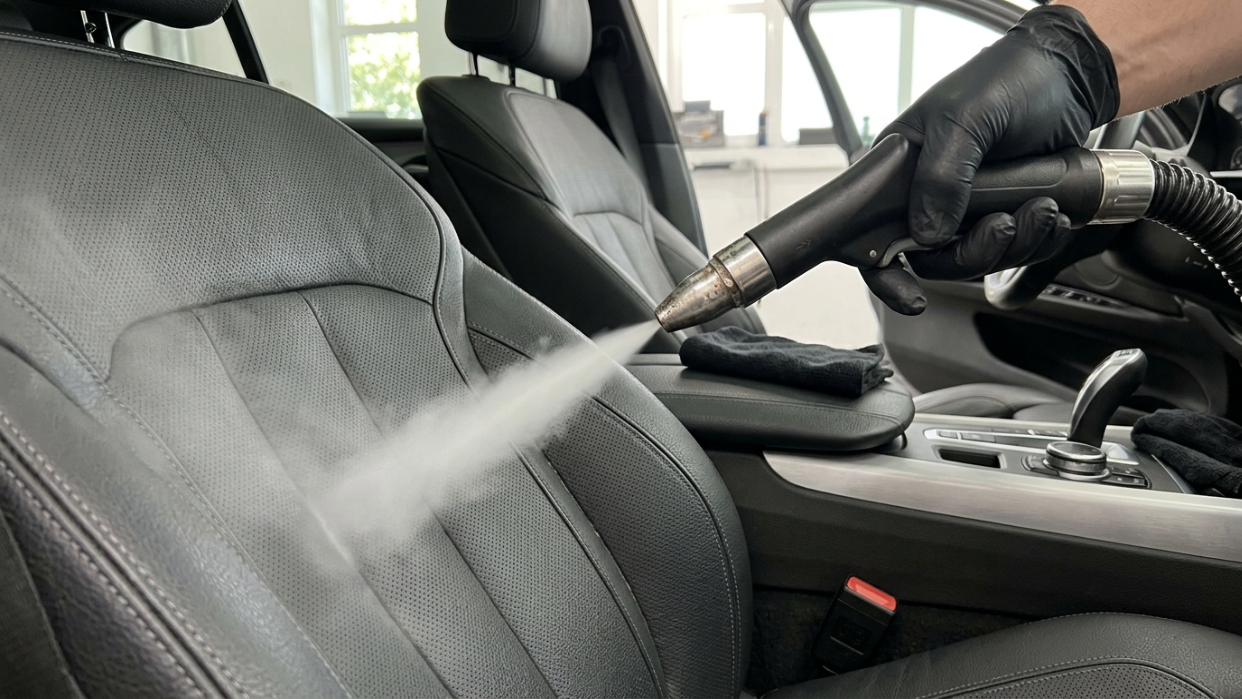
Dry vapor steam is steam with a water content below 10%, meaning it’s at least 90% dry. At temperatures between 260°F and 320°F, it carries enough thermal energy to sanitize surfaces, melt grease, and loosen grime, but it leaves so little moisture behind that fabrics, electronics, and leather don’t get soaked. This is the type of steam used in professional detailing. If a steam unit doesn’t produce dry vapor, it’s going to leave interiors damp and create more problems than it solves.
The distinction matters because consumer-grade “steam cleaners” often produce wet steam that doesn’t transmit the same energy as dry vapor. Anything below 90% dryness qualifies as wet steam, and it’s unsuitable for most detailing applications.
Vapor Steam Cleaner / Steam Vapor System
A vapor steam cleaner (also called a steam vapor system) uses superheated water to generate pressurized vapor, dispensed through a wand or nozzle. Because it’s vapor and not liquid water, the output cleans and sanitizes while leaving surfaces nearly dry. Professional units maintain sustained pressure and temperature, unlike household models that cycle on and off.
Flash Steamer
A flash steamer is a portable, non-pressurized unit that heats water on demand rather than storing it in a pressurized boiler. Flash steamers heat up fast, require no boiler permits, and work well in environments where portability matters. They’re the entry point for shops testing steam before committing to a boiler system. To understand the tradeoffs, this comparison of flash steamers versus boilers breaks down the key differences.
PSI (Pounds Per Square Inch)
PSI measures the pressure at which steam exits the boiler. Professional detailing units range from 40 PSI on entry-level boilers up to 180 PSI on industrial systems. Higher pressure means better penetration into fabrics, crevices, and textured surfaces. For embedded stains and full interior sanitization, units delivering industrial-level PSI provide meaningfully better extraction performance.
For guidance on matching PSI to specific tasks, see this PSI selection guide.
Boiler Temperature
For professional detailing results, target at least 290°F at the boiler and 240°F at the nozzle tip, with sustained pressure throughout the cleaning session. Lower-temperature household steamers can handle light surface cleaning but struggle with embedded grime, biological contamination, and baked-on residue. Temperature is what separates a tool that sanitizes from one that just gets things damp.
ASME Certification
ASME (American Society of Mechanical Engineers) certification applies to pressure vessels, including steam boilers. It confirms the boiler was built and inspected to nationally recognized safety standards. This certification becomes critical when you’re pursuing fleet contracts, meeting insurance requirements, or complying with local safety codes. Shops that plan to scale should factor ASME compliance into their equipment decisions early.
To learn how to verify certification on any unit, read this guide on reading steam boiler data plates.
UL Listing
UL (Underwriters Laboratories) listing covers electrical safety. A UL-listed steam unit has been tested for electrical hazards, grounding integrity, and safe operation under normal use conditions. Like ASME, this matters most when scaling, adding employees, or bidding on commercial fleet work where liability documentation is expected.
Continuous-Duty vs. Intermittent Use
Continuous-duty steamers maintain consistent pressure and temperature through extended work sessions without needing cool-down periods. Intermittent-use units need to reheat or repressurize between cycles. For detailing shops processing multiple vehicles per day, continuous-duty operation prevents bottlenecks. A steamer that needs 10 minutes to recover between cars costs you real money over a full day.
Detailing Menu and Business Terms
Detailing Menu
A detailing menu is a structured list of every service a shop offers, organized by package tier, with clear descriptions and starting prices. A well-built menu typically outlines each package with bullet points for what’s included and a starting price. The goal is making it easy for customers to self-select into the right tier without a lengthy consultation.
When you add steam to a detailing menu, the decision isn’t just “include it or don’t.” It’s where steam shows up: as a standard component of upper-tier packages, as a standalone add-on, or as an invisible efficiency tool that isn’t mentioned to the customer at all.
Service Tier / Package
A service tier is a bundled offering at a set price point. Most detailing menus use three to five tiers. Real-world examples from working shops include four tiers like Bronze ($130), Gold ($165–$200), Platinum ($225–$300), and Diamond ($400+). Steam cleaning typically enters at the Gold or Platinum level as a standard inclusion, or gets offered as an add-on at any tier.
Add-On Service
An add-on (or à la carte service) is an extra that customers can layer onto any base package. Steam cleaning works exceptionally well in this role because the marginal cost is near zero, you’re just using water and electricity, while the perceived value is high. Offering steam cleaning as a standalone or add-on service can boost your ticket value with minimal product cost.
Ticket Value / Average Ticket
The total dollar amount charged per vehicle visit. This is the single most important metric for a detailing business. Steam affects ticket value in two ways: directly, by creating a premium add-on customers pay for, and indirectly, by reducing the time each car takes so you can process more vehicles per day.
Many detailers add $50–$150 per vehicle for steam cleaning packages. Meanwhile, steam reduces chemical costs and cuts labor time by 20–40% per vehicle.
Extra Income Per Visit (EIPV)
EIPV measures the average revenue generated from add-ons and upsells beyond the base package. According to financial modeling for detailing businesses, boosting EIPV from $20 to $30 through smartly bundled small add-ons immediately adds $22,400 to annual top-line revenue for a busy shop. Steam is one of the highest-margin add-ons available because the ongoing cost per car is negligible.
Upsell
Suggesting a higher-value or additional service at the point of sale. One extra service per car can increase profit margin by 15–20%. Steam sanitization is a natural upsell because it addresses a concern customers already have (germs, allergens, odors) with a visible, dramatic process. Watching steam pour out of air vents sells itself.
Condition-Based Pricing vs. Flat Rate
A growing trend in the detailing industry is condition-based quoting, where the price depends on the actual state of the vehicle rather than a flat menu price. Heavy pet hair or severe staining can add $50–$150 to the base price. Some shops use a hybrid approach: flat-rate base packages with condition-based surcharges for extreme cases. Steam makes condition-based work more predictable because it handles a wider range of contamination without requiring specialized chemicals for each scenario.
Mobile Detailing vs. Shop-Based Operations
Mobile detailers bring equipment to the customer. Shop-based detailers work from a fixed location. Steam is particularly attractive for mobile operations because it dramatically reduces water consumption, just one gallon per car versus 35 gallons for a traditional wash bay. That means smaller water tanks, less weight, and the ability to work in locations without water hookups. For shop-based operations, the advantages center on speed, chemical reduction, and the ability to offer premium interior services.
Steam Detailing Application Terms
Interior Steam Detail
A full interior steam detail covers every surface inside the vehicle: seats, carpets, dashboard, center console, door panels, headliner, air vents, and cup holders. The process typically includes deep vacuuming with crevice tools, steam cleaning of all soft surfaces, leather cleaning and conditioning, stain treatment, odor elimination, and air vent sanitization.
Professional-grade steam cleaning equipment reaches temperatures over 300°F, which allows it to penetrate deep into upholstery, carpets, headliners, and air vents. This is the highest-value steam application for most detailing menus.
Steam Sanitization
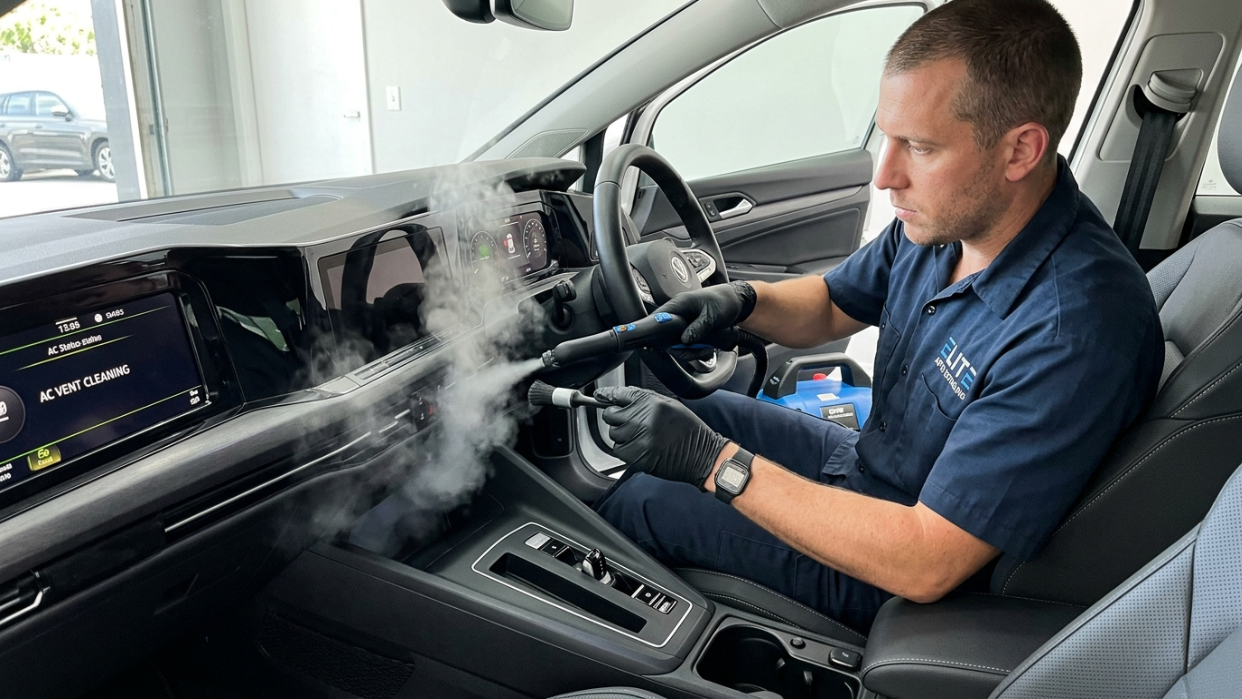
Using high-temperature steam to kill bacteria, mold, and allergens without chemicals. Post-pandemic, sanitization has become a distinct selling point. Some shops list it as a separate line item, others bundle it into their interior detail packages. The key differentiator from chemical sanitization: steam leaves zero residue, produces no fumes, and works on surfaces where chemical sprays would cause damage.
Engine Bay Steam Cleaning
Engine cleaning jobs were historically risky with traditional wash-downs because pressurized water could damage wiring harnesses, sensors, and electronic control units. Steam cuts through grease without the collateral water damage, making engine bay cleaning a service that detailers can confidently offer rather than avoid. Pricing typically runs $50–$100 as an add-on.
Hot Water Extraction vs. Steam Cleaning
This is the single most misunderstood distinction among detailers new to steam, and practitioners on Reddit’s r/AutoDetailing community consistently highlight it. Steam is for melting and loosening contaminants from hard and semi-hard surfaces: cup holders, vents, leather, dashboards. It pushes dirt around on fabric. To remove a deep stain from carpet or cloth seats, you need a hot water extractor.
The best workflow combines both: steam first to loosen and sanitize, then extraction to pull out deep-seated dirt and moisture. For a deeper comparison of these two tools, this article on commercial steamers versus carpet extractors covers the complementary relationship in detail.
Odor Elimination
Steam alone handles many odor sources by killing bacteria and lifting organic residues from surfaces. For severe cases (smoke damage, pet urine), detailers pair steam with ozone generators. The steam-then-ozone sequence is considered best practice: steam removes the physical source of odors, then ozone neutralizes airborne molecules that linger in the cabin.
Equipment Selection Terms
Canister Steamer vs. Boiler-Fed System
Canister steamers are self-contained units with a built-in water reservoir and heating element. They’re portable, relatively affordable, and suitable for shops doing a few cars per day. Boiler-fed systems use a separate, larger boiler that produces higher pressure and volume, supporting continuous-duty operation for high-volume shops.
Reddit’s auto detailing community strongly recommends avoiding cheap handheld steamers under $100. They lack the continuous steam output, temperature, and pressure needed for professional work. The minimum viable starting point, according to practitioners, is a quality canister steamer in the $150–$300 range for entry-level work, though most professionals spend $1,000–$3,000 for mid-range commercial units.
110V vs. 220V Power Requirements
110V units plug into standard U.S. outlets, making them practical for mobile detailing and shops without electrical upgrades. 220V units deliver more heating power (typically 3kW vs. 1.5kW), which means faster heat-up times, higher sustained pressure, and better performance during continuous use. If your shop already has 220V outlets (common in garages and industrial spaces), the 220V option is almost always worth choosing.
For a full breakdown, see this 110V vs. 220V steamer comparison.
Manual-Fill vs. Pump-Fill Systems
Manual-fill boilers require you to shut down, depressurize, and manually add water when the tank runs low. Pump-fill (automatic) systems connect to a water line or reservoir and refill continuously, so you never stop working. The choice depends on volume: if you’re doing two or three cars a day, manual fill is fine. At five or more vehicles daily, the downtime from manual refilling starts eating into your profits. A detailed comparison of manual-fill versus auto-fill boilers helps clarify the decision.
Nozzle Types and Attachments
Different jobs require different steam delivery tools:
Detail tip: A narrow, focused nozzle for precision work on vents, seams, crevices, and badge areas
Brush attachment: Combines steam with agitation for leather, vinyl, and textured plastic surfaces
Triangular head: Covers larger flat surfaces like seats and floor mats, often wrapped with a microfiber cloth to capture loosened dirt
Having the right attachment set is what makes a steam system versatile enough to justify its place on your menu.
Tank Capacity and Continuous Run Time
Tank capacity, measured in gallons, determines how long you can work before refilling. A 1-gallon boiler might run 30–45 minutes under moderate use. A 6-gallon unit can run for several hours. For detailing shops, the math is simple: estimate your average interior detail time, multiply by the number of cars per day, and choose a capacity that minimizes interruptions.
Steam Detailing vs Traditional Detailing Methods
Factor | Steam Cleaning | Traditional Chemical Cleaning |
|---|---|---|
Water Usage | ~1 gallon | 20–35 gallons |
Chemical Usage | Minimal | Moderate to Heavy |
Interior Dry Time | Very Fast | Moderate |
Sanitization Capability | Excellent | Depends on Product |
Mobile Friendly | Excellent | Moderate |
Environmental Impact | Low | Higher |
Consumable Costs | Very Low | Ongoing |
Key Takeaway
Steam does not completely replace traditional detailing methods, but it significantly reduces chemical dependence while improving efficiency on interiors, engine bays, vents, and hard-to-reach areas.
Financial Terms for Steam ROI
Cost Per Car
Steam’s biggest financial advantage is its near-zero consumable cost. You’re using water and electricity. No all-purpose cleaners, no interior detailers, no specialized fabric treatments for routine jobs. Steam cleaners pay for themselves quickly by reducing chemical costs and eliminating the need for multiple specialized cleaning products.
Labor Time Reduction
Steam cuts labor time per vehicle by 20–40% according to industry data. A practitioner on the Auto Geek forum reported that a full interior steam clean takes about one hour with a commercial steamer like the Optima, charging $145–$200 per car. Faster completions mean more cars per day, which is the real multiplier for a detailing business.
Equipment Payback Period
Equipment costs vary dramatically by tier:
Entry-level canister: $150–$300
Professional mid-range: $1,000–$3,000
Commercial/industrial: $3,000–$10,000+
At the entry level, a few detailing jobs cover the purchase price. Mid-range commercial units, where most serious shops land, pay for themselves within weeks to months depending on volume. The key variable is how many vehicles you process weekly and whether you charge steam as a separate line item.
Profit Margins on Steam Services
Typical detailing profit margins run 50–70%. Steam services push toward the higher end because the input costs are minimal. Gross margins of 65–75% are normal for steam cleaning operations. For every $200 job, you keep $130–$150 after direct costs. Upselling steam add-ons alongside engine bay cleaning and headlight restoration can increase average profit per customer by 20–30%.
Pricing Benchmarks
Current market rates for steam detailing services:
Steam sanitization add-on: $50–$100
Interior deep clean with steam, stain treatment, leather conditioning: $249–$289 at established shops
Full interior package including steam: $150–$300+
Heavy pet hair / severe staining surcharge: $50–$150 additional
These numbers come from real-world pricing data collected in 2026. Your local market may vary, but these ranges provide a solid starting framework.
The Internal Tool vs. Menu Item Debate
This is the most interesting strategic question when you add steam to a detailing menu, and it’s the one most guides ignore completely.
One practitioner on the Auto Geek Online Forum put it plainly: “I’m planning on it decreasing my time spent on each car, as well as giving me a better finished product. I didn’t plan on adding it as an option for the customer.” The reasoning? “I’m trying to keep my menu of services as simple as possible. Adding the steam clean as an option is just another point of confusion for the customer.”
This approach treats steam as a back-of-house efficiency tool. You charge the same prices, finish faster, and either take on more cars per day or go home earlier. The savings come from reduced chemical spending and higher throughput rather than higher ticket prices.
The opposite approach treats steam as a premium, customer-facing feature. You list “Steam Sanitized Interior” on your menu, charge $50–$100 more, and use it as a differentiator against competitors who don’t offer it.
The best shops do both. They use steam on every job for speed and quality (internal tool), and they also offer a visible, premium “deep steam sanitization” service that customers can choose to add on (menu item). This captures value on both sides.
Pros and Cons of Adding Steam Cleaning Services
Advantages
High-margin service
Low consumable costs
Reduced chemical dependency
Faster interior cleaning
Strong customer appeal
Eco-friendly positioning
Excellent mobile detailing tool
Useful for engine bays and vents
Disadvantages
Initial equipment investment
Learning curve for technicians
Some stains still require extraction
Boiler maintenance requirements
Not ideal for every exterior cleaning task
Understanding both sides helps detailers set realistic expectations and choose equipment appropriately.
The Environmental and Water Conservation Angle
Steam cleaning uses just one gallon of water per car, compared to roughly 35 gallons for a traditional wash bay. That’s a 90%+ reduction in water usage, and chemical discharge drops to near zero. This matters for three reasons:
Mobile detailers can work in water-restricted areas or locations without plumbing
Eco-conscious consumers (a growing segment) actively seek low-water, chemical-free services
Fleet contracts with corporate sustainability requirements increasingly favor providers who can document low environmental impact
The U.S. detailing industry reached $14.6 billion in 2023 with a 1.3% annual growth rate, and consumer spending on vehicle appearance is projected to grow at 3.5% annually through 2030. The eco-friendly segment of that market is growing faster than the overall average.
A Note on the Car Wash Distinction
One useful contrarian perspective comes from the car wash industry forums, where operators have questioned whether steam adds enough value in high-volume tunnel wash settings. The concern is legitimate for operations processing hundreds of cars per hour. But it doesn’t apply to detail shops, where per-vehicle time is measured in hours, not seconds, and results justify premium pricing. If you’re running a detail shop rather than a tunnel wash, the economics work in steam’s favor.
How to Structure Steam on Your Menu: Practical Framework
Here’s a straightforward approach to adding steam to your detailing menu:
Step 1: Make steam standard in your mid-tier and upper packages. Don’t list it separately at these levels. Just include “steam-cleaned interior” in the description. This improves your offering without adding decision complexity.
Step 2: Offer a “Steam Sanitization” add-on for your base package. Price it at $50–$100. Customers who choose your basic wash can upgrade to steam for a reasonable premium.
Step 3: Create a standalone “Deep Steam Interior” service. Price it at $150–$250 depending on vehicle size and condition. This captures customers who want a thorough interior treatment without a full exterior detail.
Step 4: Add condition-based surcharges. Pet hair, smoke damage, and severe staining get quoted individually. Steam handles these better than chemicals alone, and customers expect to pay more for difficult conditions.
Who Should Add Steam to Their Detailing Menu?
Steam is not equally valuable for every detailing operation.
Steam Is a Great Fit For:
Mobile detailers
Interior-focused specialists
Fleet maintenance providers
Dealership reconditioning departments
Eco-friendly detailing businesses
High-end ceramic coating shops
Steam May Be Less Critical For:
Exterior-only wash businesses
Tunnel car washes
Volume-focused express operations
Businesses processing vehicles in under 20 minutes
For most detail shops, steam provides the greatest value when interior services account for a significant percentage of revenue.
Choosing the Right Equipment Tier
The equipment you need depends entirely on your volume and business model. Here’s the decision framework:
1–3 cars per day (solo operator, mobile): A quality canister steamer or flash steamer handles this workload. Look for at least 40 PSI and continuous steam capability. Budget $500–$1,500.
4–8 cars per day (growing shop): A mid-range commercial boiler with manual fill works here. You want 60+ PSI, 290°F+ boiler temperature, and enough tank capacity to handle two to three cars between fills. Budget $1,500–$3,000.
8+ cars per day (multi-bay shop): An automatic pump-fill system with continuous-duty rating becomes necessary. Downtime from manual refilling and intermittent heating costs you real throughput at this volume. Budget $3,000–$10,000.
At any tier, look for ASME and UL certification if you plan to pursue fleet contracts, carry commercial insurance, or operate in jurisdictions with equipment safety codes.
For help comparing commercial options, the commercial steam vendor checklist provides a framework for evaluating any manufacturer’s claims.
Example Steam Detailing Pricing Structure
Many detailers struggle with where steam should fit within their menu. The following pricing framework provides a simple starting point.
Service | Suggested Price |
|---|---|
Steam Sanitization Add-On | $50–$100 |
Engine Bay Steam Cleaning | $50–$100 |
Deep Steam Interior Refresh | $150–$250 |
Premium Interior Restoration | $250–$400 |
Pet Hair + Steam Package | Add $50–$150 |
Smoke Odor + Steam Treatment | Add $75–$200 |
Example Monthly Revenue Impact
Assume:
20 vehicles per week
Steam add-on sold to 30% of customers
Average steam upgrade = $75
Calculation:
20 vehicles × 30% × $75 = $450/week
$450 × 52 weeks = $23,400 additional annual revenue
This does not include labor savings or reduced chemical expenses.
Frequently Asked Questions
Is steam cleaning a good add-on for a detailing business?
Yes. Steam cleaning has some of the highest margins in the detailing industry because the ongoing cost is nearly zero (water and electricity). Profit margins on steam services typically run 65–75%, and the add-on can increase average profit per customer by 20–30%. The equipment pays for itself within weeks to months depending on volume.
Should I list steam as a separate service or just use it internally?
Both approaches work. Some experienced detailers keep their menus simple and use steam behind the scenes to work faster and deliver better results at the same price. Others list it as a premium add-on and charge $50–$150 extra per vehicle. The highest-performing shops do both: use steam on every car for efficiency, and offer a visible “deep sanitization” upgrade for customers who want it.
What’s the difference between steam cleaning and hot water extraction?
Steam loosens and sanitizes. Extraction removes. Steam excels on hard and semi-hard surfaces like dashboards, vents, cup holders, and leather. For deep fabric stains in carpet and cloth seats, you need a hot water extractor to pull out embedded dirt and moisture. The best detailing workflow uses both tools in sequence.
How much should I charge for steam cleaning services?
Current market rates range from $50–$100 for a steam sanitization add-on, $150–$300+ for a full interior steam detail, and $249–$289 for premium packages that include steam, stain treatment, and leather conditioning. Condition-based surcharges for pet hair or smoke damage typically add $50–$150 on top.
Do I need a commercial steamer or will a consumer model work?
For professional detailing, consumer-grade handheld steamers under $100 are not adequate. They lack continuous steam output, sufficient temperature, and the pressure needed to handle embedded grime. The minimum professional starting point is a quality canister steamer in the $150–$300 range, though most shops doing this seriously invest $1,000–$3,000 in mid-range commercial units.
How much water does steam detailing use compared to traditional methods?
Steam detailing uses approximately one gallon of water per car, compared to roughly 35 gallons for a traditional wash bay. That’s a 90%+ reduction in water consumption, with chemical discharge dropping to near zero. This makes steam especially practical for mobile detailing and for winning contracts with environmentally conscious fleet customers.
What certifications should I look for in steam equipment?
ASME certification covers the boiler as a pressure vessel, confirming it meets national safety standards. UL listing covers electrical safety. Both become important when you’re scaling, hiring employees, carrying commercial insurance, or bidding on fleet contracts that require documentation. Even if they’re not required today, having certified equipment protects you as your business grows.
Can steam replace all my detailing chemicals?
Steam replaces most general-purpose interior cleaners, all-purpose cleaners, and sanitizing sprays. It won’t replace dedicated products like leather conditioner, ceramic coatings, paint correction compounds, or specialty stain removers. Think of steam as eliminating routine chemical costs while keeping specialty products in your toolkit for specific applications.


