

TL;DR
The best commercial steamer for dental labs depends on your workload, water supply, and facility requirements. Most dental lab steamers operate between 51 and 70 psi and are used to remove wax, polishing compounds, and investment residues from crowns, bridges, and dentures. Single-bench labs can get by with a manual-fill bench unit on 110V, while multi-bench operations need auto-fill or pump-fed systems with higher recovery rates. Water quality, pressure vessel compliance (ASME/UL above 15 psi), and a consistent maintenance routine matter more than raw psi numbers.
What is the best commercial steamer for a dental lab?
The best commercial steamer for a dental lab depends on daily volume: for single-bench operations, a 110V manual-fill unit like the Kerr TouchSteam or Hoffman EVD-1 is ideal for precision cleaning. For high-volume, multi-bench labs, an auto-fill 220V system like the Renfert Power Steamer 2 or Reliable 8000CD is required to ensure 24/7 steam availability without reheating downtime.
Key Recommendation: Choose a unit with a working pressure of 50 to 75 psi and ensure it meets ASME safety standards if operating above 15 psi.
What Is a Dental Lab Steamer?
A dental lab steamer (sometimes called a steam cleaning unit or bench steamer) is a pressurized or non-pressurized device that heats water and delivers a focused jet of steam. Its job is to blast away wax residue, polishing compounds, investment material, cements, and general debris from crowns, bridges, dies, dentures, and lab tools. Many technicians also use them for routine bench cleanup throughout the day.
These are not consumer garment steamers or general-purpose vapor cleaners. Dental lab models are built for precise, repeatable cleaning at the workstation, with accessories like foot pedals, focused nozzles, and steam guns designed for small prosthetic work.
What a Dental Lab Steamer Is Not
One critical distinction: a steamer is not a sterilizer. Steam cleaning removes visible contamination and surface residue, but it does not achieve the validated sterilization parameters required for semicritical or critical dental instruments. The CDC’s infection control guidance makes this clear. Steamers handle the cleaning and surface prep step in the reprocessing workflow. Autoclaves handle sterilization.
The 7 Specs That Actually Matter When Choosing a Dental Lab Steamer
Shopping for the best commercial steamer for dental labs means understanding a handful of specifications that separate a good purchase from an expensive headache. Here is what to evaluate.
1. Pressure (PSI or Bar)
Most dental lab steamers operate in a working range of roughly 3.5 to 4.5 bar, which translates to about 51 to 65 psi. This pressure range removes wax and polishing compounds quickly without over-wetting the work. For reference, the Kerr TouchSteam 33405 maxes out at 51 psi, the Renfert Power Steamer 2 operates at 4.5 bar (65.3 psi), and the Reliable 7500CD reaches 65 to 70 psi.
Higher psi is not automatically better. Some vapor cleaners advertise much higher pressures but may not integrate well at a dental bench due to hose geometry, moisture content, or lack of dental-specific accessories. For a deeper look at how pressure ratings affect performance across commercial steamers, see this guide to PSI for commercial steamers.
2. Duty Cycle
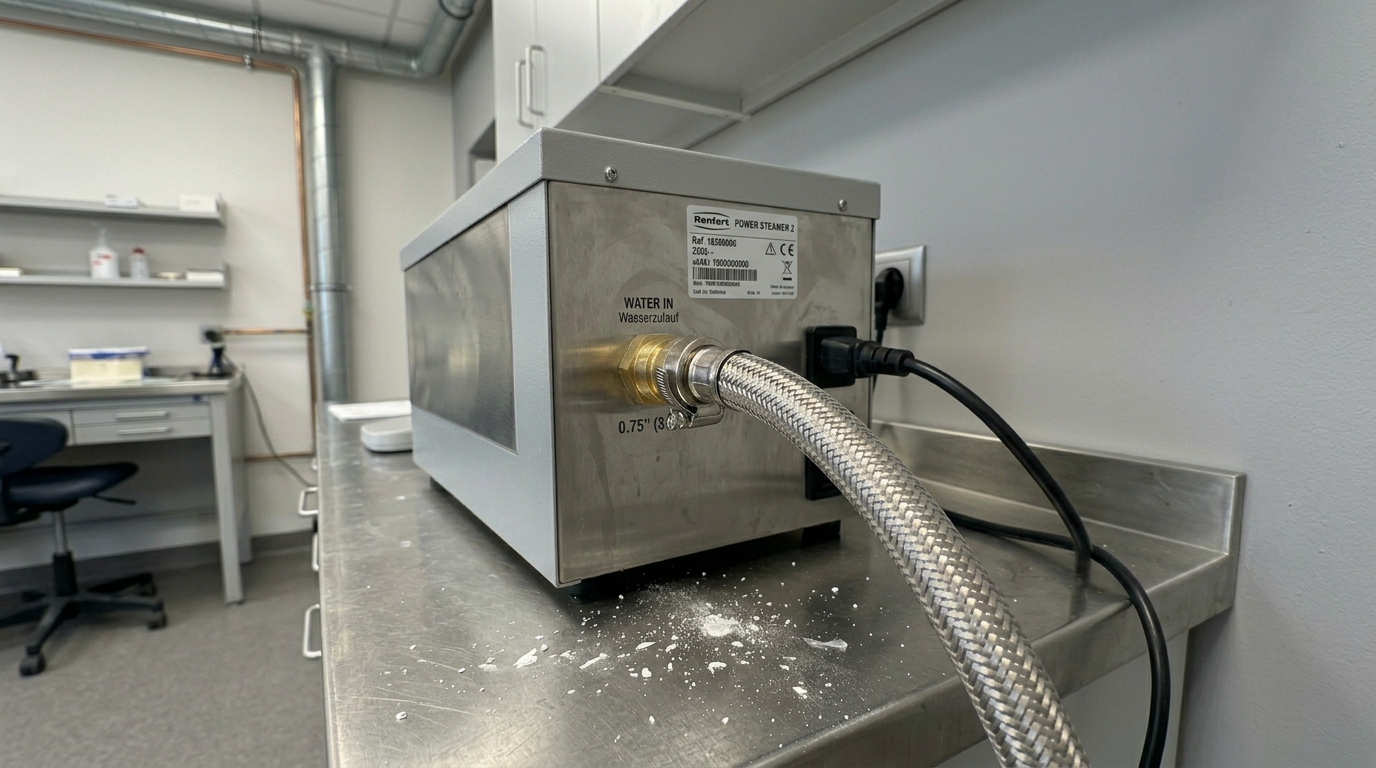
How long can the unit produce steam before it needs to pause? Manual-fill bench units work fine for intermittent use, but they require planned stops to refill and reheat. Auto-fill or pump-fed units sustain continuous steam for all-day operation across multiple benches. Renfert positions its Power Steamer 2 as providing “availability of steam at all times” thanks to its integrated pump and mains water connection.
3. Fill Method
This choice shapes your daily workflow:
Manual fill is simpler and cheaper. You pour water into the tank, wait for it to heat, and work until it runs low. Good for single-bench labs with moderate throughput.
Auto-fill connects to your water supply through a pump, feeding the boiler continuously. It eliminates downtime but requires plumbing and attention to water quality. Renfert specifies a 0.75-inch connection and 1 to 5 bar supply pressure. Wassermann cautions that direct feed should only be used where soft water is available.
4. Power (Voltage and Wattage)
A 110/120V circuit limits heater wattage and recovery speed. Expect bench units at 120V to pull around 1,200 to 1,550 watts. A 220/240V option recovers faster, supports higher throughput, and is the better choice for continuous-duty labs running multiple stations.
Before buying, check whether your facility has the right circuit. Upgrading voltage can be a significant installation cost, so it is worth understanding the trade-offs between 110V and 220V commercial steamers before committing.
5. Water Requirements
This is where many buyers get surprised. Water type is model-dependent and following the wrong advice can damage your steamer or void the warranty.
Some units require distilled water only. The Kerr TouchSteam falls into this category. Others, like the Reliable 7000/7500 series, specify tap water or a 50/50 tap-distilled mix because their conductivity probes need mineral content to function.
Practitioners on the Dental Lab Network forum confirm this can be confusing. As one technician put it, “not all lab steamers want distilled water”, and using the wrong type can cause sensor failures or accelerate scale buildup. Always check the manual before filling.
Water Requirement | Example Models | Why |
|---|---|---|
Distilled only | Kerr TouchSteam | Prevents mineral deposits; no conductivity sensor |
Tap or 50/50 mix | Reliable 7000/7500 series | Conductivity probe needs mineral content |
Soft water (for direct feed) | Wassermann Wasi-Steam | Hard water causes rapid scaling in auto-fill lines |
Softener accessory recommended | Renfert Power Steamer 2 | Available as add-on for hard water areas |
6. Safety Listings and Compliance
In the United States, any pressure vessel operating above 15 psi falls under ASME Boiler and Pressure Vessel Code (BPVC) Section VIII. Since most dental lab steamers operate well above that threshold, the ASME construction standard applies. Many facilities and insurers also expect NRTL listings like UL or cETL.
Before purchasing, confirm the model carries the appropriate certifications and documentation. This matters for inspections, insurance, and peace of mind.
7. Ergonomics and Accessories
The details that make a steamer pleasant to use eight hours a day: foot pedal control (frees both hands for holding the workpiece), fixed nozzle versus steam gun, hose length, wet/dry steam selector, sight glass, and pressure gauge. The Reliable 7500CD includes a foot pedal and steam gun. Some Wassermann models offer a wet/dry mode selector, which is useful because dry steam reduces moisture residue when cleaning wax.
Comparing Top Dental Lab Steamers (2026 Model Specs)
Use this data-backed table to help users compare at a glance.
Model | Pressure (PSI) | Water Type | Best For | Recovery Speed |
Renfert Power Steamer 2 | 65 PSI | Tap/Softened | High-Volume Labs | Fast (Auto-fill) |
Reliable 8000CD | 60 PSI | 50/50 Mix | Medium/Large Labs | Fast (Auto-fill) |
Kerr TouchSteam | 51 PSI | Distilled Only | Precision Benchwork | Medium |
Hoffman GEM-III | Pressureless | Distilled | Mall/Office Labs | N/A (Instant) |
Wassermann Wasi-Steam | 72 PSI | Softened | Heavy Industrial Use | High |
Pro-Tip: “Never use 100% distilled water in a Reliable or Reimers unit unless the manual explicitly says so. These units use conductivity probes to sense water levels; pure distilled water won’t trigger the sensor, causing the heater to run dry and burn out.” — Lead Tech, NorthStar Dental Lab.
Types of Dental Lab Steamers
Not every lab needs the same type of steamer. The three main categories each fit different workflows and facility constraints.
Non-Pressurized Flash Steamers
These units generate steam without a pressurized tank, making them the safest and simplest option for permit-sensitive environments. If your lab is inside a mall, a shared office building, or a space where pressure vessels are discouraged or prohibited, a flash steamer is the way to go. Output is lower than pressurized models, but for quick cleaning tasks on individual restorations, it gets the job done.
The Hoffman GEM-III is a good example. It is a portable, non-pressurized flash steamer with foot pedal control and dual heating elements, explicitly approved for mall environments and listed for dental applications. At $995, it is also the most accessible entry point for labs that do not need high-pressure output.
Manual-Fill Bench Boilers
The workhorse category for most dental labs. These units have a 1 to 4 liter tank, operate at 3.5 to 4.5 bar working pressure, and run on 110V in most cases. You fill the tank, wait for it to heat up, and work until it needs refilling.
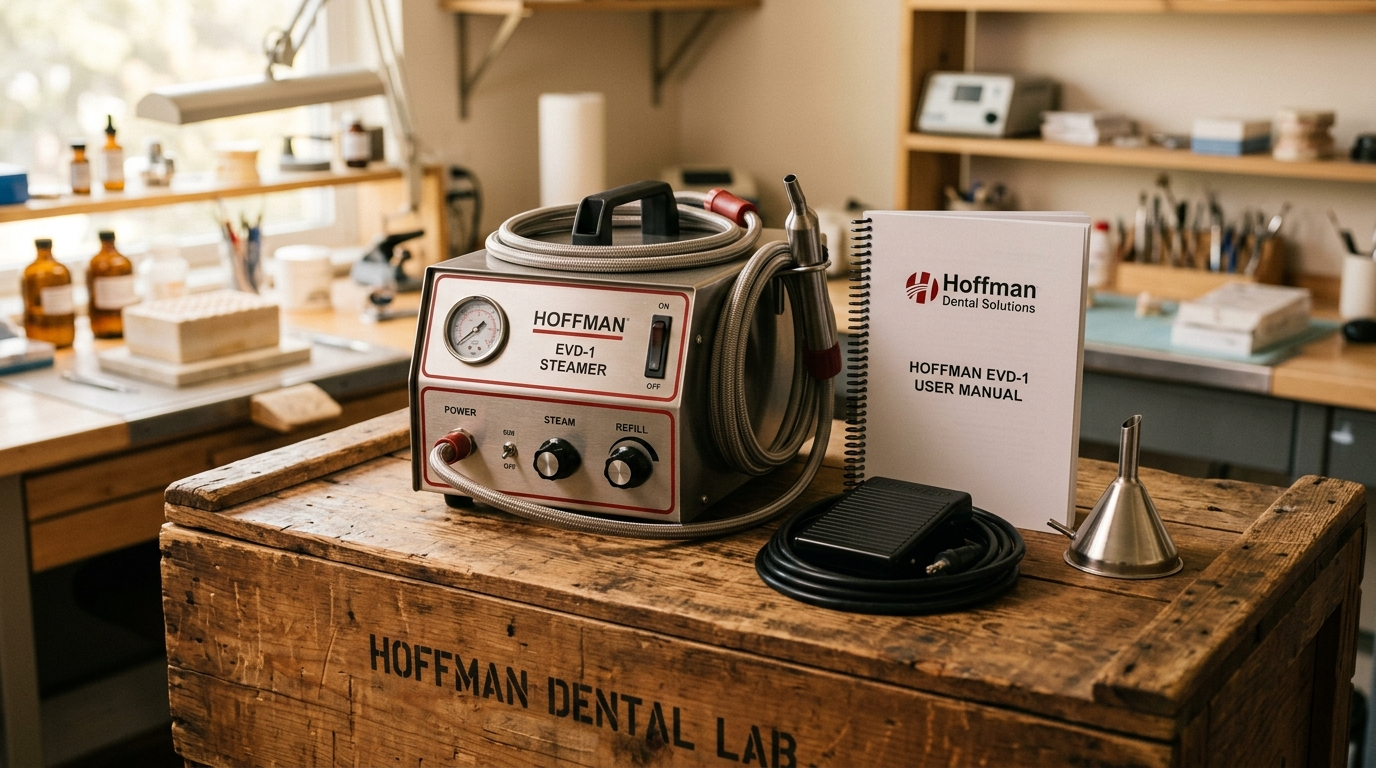
Examples include the Kerr TouchSteam (51 psi, distilled water only), the Reliable 5100/6000/7000/7500 series (up to 65 to 70 psi), and the Hoffman EVD-1 (1-gallon tank, 40 psi, 110V, ships with nozzle, foot pedal, and fill funnel).
For a single bench with low-to-moderate throughput, manual-fill units are perfectly adequate and keep costs down.
Auto-Fill and Pump-Fed Systems
When your lab runs multiple benches and needs steam available from 6 AM to 6 PM (as practitioners on the Dental Lab Network describe their schedules), manual refilling becomes a bottleneck. Auto-fill systems connect directly to your water supply through a pump, maintaining continuous steam without downtime.
The Renfert Power Steamer 2 is the dental-specific option in this category. For labs needing even more capacity with ASME/UL documentation, the Hoffman JEL11 offers a 6-gallon tank with automatic pump, 70 to 90 psi output, and is purpose-built for continuous duty across multiple workstations.
How to Choose the Best Commercial Steamer for Your Dental Lab
“Best” is not a universal answer. It is a match between your specific lab conditions and the right machine. Here is the decision framework.
Step 1: Count Your Benches and Hours
A single technician working 4 to 6 hours of active steaming per day can usually manage with a manual-fill bench unit at 3.5 to 4.5 bar on 110V. Two or more benches running all day need auto-fill capability, a larger tank (4 liters or more), and often 220V for faster recovery.
Step 2: Test Your Water
Hard water without softening accelerates scale buildup and shortens boiler life. If your water is hard, prioritize models that tolerate tap water and plan for frequent blowdown cycles. Alternatively, install a softener or RO system as the manufacturer recommends. Some auto-fill models, like the Renfert, offer a water softener accessory for exactly this reason.
Step 3: Check Your Power
A 110V/120V circuit is sufficient for light and medium duty. If you need faster recovery and continuous output, 220V/240V gives you that headroom. Check your breaker panel and plan for a dedicated circuit.
Step 4: Confirm Compliance Requirements
If the steamer operates above 15 psi (and virtually all dental lab steamers do), ask whether it meets ASME construction standards and carries a UL or cETL listing. Your insurer may require documentation, and local inspectors may ask for it. The Hoffman ELG4, for example, carries ASME and UL certification, making it straightforward for labs that need that documentation trail.
Step 5: Think About Total Cost of Ownership
The purchase price is just the beginning. Caps, solenoids, gaskets, and heating elements are consumable parts. Factor in how easy it is to source replacements, whether warranty terms are clear, and what support looks like when something breaks at 2 PM on a Tuesday. Hoffman Steam, for instance, backs its Pro line with a 3-year tank warranty plus 1-year components and offers lifetime remote technical support from factory technicians.
Quick Selection Matrix
Lab Profile | Recommended Type | Pressure | Fill Method | Voltage |
|---|---|---|---|---|
Solo bench, occasional use | Manual-fill bench steamer | 40 to 65 psi | Manual | 110V |
Two+ benches, all-day use | Auto-fill pump system or large boiler | 65 to 90 psi | Auto-fill | 220V preferred |
In-office or mall location | Non-pressurized flash steamer | N/A (pressureless) | Manual | 110V |
High throughput, ASME/UL needed | Pro-grade electric boiler | 70 to 90 psi | Auto-pump | 220V |
What Dental Lab Technicians Actually Say
Marketing specs tell one story. Technicians who run these machines daily tell another. The Dental Lab Network forum has a long-running thread on steamer reliability that is worth reading in full, but here are the key takeaways.
On Reimers steamers: Multiple technicians describe them as “workhorses,” running on tap water at continuous 80 psi, sometimes 24/7 in high-volume shops. Rebuilds are possible when components eventually wear, though costs can add up on older units.
On Reliable units: Opinions are mixed. Some praise the auto-feed volume and recovery speed. Others report issues with electrical grounding, leaks, and GFCI trips. The common thread in positive reviews is that proper installation and disciplined maintenance make all the difference.
On water confusion: Several technicians warn that using distilled water in a steamer designed for tap water (or vice versa) causes sensor malfunctions or rapid scaling. The advice is simple but often ignored: read the manual before filling the tank for the first time.
On longevity: The consensus is that steamers last years when maintained and fail fast when neglected. Weekly blowdown, descaling, correct water type, and timely gasket/cap replacement are what separate a 10-year machine from a 2-year paperweight.
Maintenance That Protects Your Investment
Every dental lab steamer, regardless of brand or price, needs routine care. Skipping maintenance is the single fastest way to destroy a boiler.
Daily
Verify water level per the manual before powering on.
Purge initial condensate before steaming workpieces. This gives you drier, more effective steam.
Weekly
Perform a full blowdown: drain and flush the tank completely. The Reliable 7000/7500 manual specifies this as a weekly requirement, and most manufacturers agree.
Check the sight glass for clarity.
Inspect caps and gaskets for wear or deformation.
Quarterly to Semiannual
Descale the tank per manufacturer instructions. Kerr recommends periodic calcium drainage for the TouchSteam.
Inspect solenoid valves and electrical contacts.
Replace worn caps and gaskets per OEM intervals.
Water Plan
Follow the manufacturer’s specification exactly. If you run hard water through an auto-fill system without softening, expect accelerated scale and shorter component life. A simple water test strip and a conversation with the manufacturer’s tech support can save thousands in repairs.
For downloadable manuals and maintenance documentation across different steamer models, Hoffman maintains a central product documents library.
Common Mistakes When Buying a Dental Lab Steamer
Buying on max PSI alone. A steamer advertising 100+ psi might be a vapor cleaner designed for industrial degreasing, not dental bench work. Check whether the hose geometry, nozzle design, and moisture content are appropriate for small prosthetic work. The Dentalcompare comparison tool is useful for seeing how purpose-built dental units differ from generic alternatives.
Ignoring water requirements. As covered above, this single oversight causes more steamer failures than any mechanical defect.
Skipping compliance checks. If your steamer operates above 15 psi and your insurer asks for ASME documentation you cannot provide, that is a problem you do not want to discover after a claim.
Underestimating duty cycle needs. A small manual-fill unit is affordable, but if your lab grows from one bench to three, you will spend more time refilling and waiting than steaming. Buy for where your lab is headed, not just where it is today.
Hoffman Steam Options for Dental Labs
Hoffman Steam (manufactured in Dushore, Pennsylvania) offers a range that covers every dental lab scenario:
Permit-sensitive or in-office spaces: The GEM-III portable flash steamer ($995) needs no boiler permits and works in malls and shared facilities.
Single bench, light duty: The EVD-1 ($1,199) delivers 40 psi from a 1-gallon tank on 110V, with foot pedal and nozzle included.
Labs needing ASME/UL documentation and higher pressure: The ELG4 Pro boiler ($1,899 to $2,099) produces 70 to 90 psi with full safety certification and a 110V starting configuration with 220V upgrade available.
Multi-bench continuous duty: The JEL11 ($7,895) runs a 6-gallon automatic pump system at 70 to 90 psi, built for labs that need steam available all day across multiple workstations.
All Pro models carry ASME and UL certification. Every unit ships with free contiguous U.S. shipping, a 30-day money-back guarantee, and lifetime remote technical support from factory technicians.
If you are not sure which model fits your lab, talk to a Hoffman factory specialist who can match your bench count, water situation, and power availability to the right unit.
Frequently Asked Questions
Can I use a dental lab steamer to sterilize instruments?
No. A dental lab steamer cleans surfaces by removing wax, compounds, and debris, but it does not achieve sterilization. The CDC’s guidance on dental infection control is clear that sterilization requires validated autoclave cycles. Steamers handle the cleaning step before sterilization.
What PSI do I need for dental lab work?
Most dental lab steamers operate between 51 and 65 psi (3.5 to 4.5 bar), which is enough to remove wax and polishing compounds without over-wetting workpieces. Some pro boilers go up to 70 to 90 psi for heavier cleaning needs. Higher is not always better; match pressure to your actual workflow.
Should I use distilled water or tap water in my steamer?
It depends entirely on the model. Some steamers (like the Kerr TouchSteam) require distilled water only. Others (like the Reliable 7500CD) need tap or a 50/50 mix because their sensors rely on mineral conductivity. Using the wrong water type can damage sensors or accelerate scaling. Check your manual.
Do dental lab steamers require ASME certification?
In the U.S., pressure vessels operating above 15 psi fall under ASME BPVC Section VIII scope. Since most dental lab steamers exceed that threshold, ASME construction standards apply. Many insurers and facility managers expect appropriate certification documentation. Look for models that carry ASME and UL or cETL listings.
How often should I drain and descale my steamer?
Most manufacturers recommend a weekly blowdown (full drain and flush). Descaling intervals vary, but quarterly to semiannual is typical depending on water hardness and usage volume. The Kerr manual specifies periodic calcium drainage, and Reliable manuals outline specific blowdown procedures.
What is the difference between a flash steamer and a bench boiler?
A flash steamer heats water on demand without a pressurized tank. It is safer for environments where pressure vessels are restricted but produces lower output. A bench boiler maintains a pressurized reservoir of hot water, delivering higher pressure and more consistent steam for intensive lab work. Flash steamers suit in-office and mall settings; bench boilers suit dedicated labs.
How long do dental lab steamers typically last?
With proper maintenance (weekly blowdown, correct water, timely gasket and cap replacement), practitioners on forums report getting many years out of quality units. Neglecting maintenance, particularly water management, is what kills steamers early. Budget for consumable parts like solenoids, gaskets, and heating elements as part of your ownership cost.
Can I run one steamer for multiple benches?
You can, but throughput will suffer with a small manual-fill unit. For two or more benches, an auto-fill or pump-fed system with a 4-liter or larger tank is the practical choice. The recovery time between uses matters as much as peak pressure when multiple technicians are waiting for steam.


