

TL;DR
The best jewelry steamer for jewelry stores depends on where you operate and how many pieces you clean daily. For most small to mid-size shops with a repair bench, the Hoffman JEL3 ($1,999) offers the strongest combination of ASME/UL certification, high pressure, and long-term support. Mall kiosks and retail counters need the permit-free Hoffman GEM-III ($995). Budget-conscious shops can start with the Reliable 5100CJ (~$936) or Hoffman EVD-1 ($1,199), while high-volume operations should look at Reimers JR/JJ series boilers built for code-heavy environments.
What is the best jewelry steamer for a professional jewelry store in 2026?
For most retail jewelry stores in 2026, the Hoffman JEL3 is the top-rated choice due to its ASME and UL certification, which ensures compliance with strict commercial insurance and local boiler safety laws. If you operate in a mall kiosk or high-traffic retail environment where pressurized boilers are prohibited, the Hoffman GEM-III is the industry standard. For budget-conscious shops, the Reliable 5100CJ offers professional-grade cleaning at a sub-$1,000 price point.
At-a-Glance Comparison Table
Model | Price (USD) | Type | Max Pressure | Best For | Warranty | Compliance |
|---|---|---|---|---|---|---|
Hoffman JEL3 | $1,999–$2,199 | Pressurized boiler (manual fill) | 70–90 PSI | Most jewelry stores with a bench | 3-yr tank, 1-yr components, lifetime remote support | ASME/UL certified |
Hoffman GEM-III | $995 | Flash/atmospheric | Non-pressurized | Mall kiosks, retail counters | 30-day return; standard warranty | No boiler permits required |
Hoffman EVD-1 | $1,199 | Pressurized boiler (manual fill) | ~40 PSI | Small shops, 110V benches | Standard warranty | Verify local rules |
Elma Elmasteam 4.5 | ~$2,349 | Pressurized boiler | 65 PSI (4.5 bar) | Precision detailing, watch/jewelry benches | Manufacturer warranty | Check local requirements |
Reliable 5100CJ | ~$936 | Pressurized boiler | 50 PSI (3.5 bar) | Budget-conscious shops | Manufacturer warranty | Confirm ASME status locally |
Reimers JR/JJ | $1,840–$3,460 | Pressurized boiler | Varies by model | High-volume, inspection-ready shops | Manufacturer warranty | Must conform to all boiler laws |
SharperTek H2O | ~$720 | Atmospheric/pulsed | “90 PSI effect” (burst) | Portable, light-duty counter work | Manufacturer warranty | No pressure vessel concerns |
How to Choose the Best Jewelry Steamer for Your Store
Before comparing models, answer five questions. They’ll narrow your options faster than any spec sheet.
Where are you located? Many malls and shopping centers prohibit pressure vessels on premises. Some states require ASME-stamped equipment and periodic inspections for pressurized boilers. Reimers states directly that “a jewelry steamer like our JJ model is a boiler and thus must conform to all boiler laws” (source). If you’re in a mall, a flash steamer like the GEM-III solves the problem entirely since it needs no boiler permits.
What’s your electrical service? Standard 110V outlets support entry-level boilers like the EVD-1, but higher-volume shops benefit from 220V models that recover pressure faster between uses. Check your panel before you order.
How many pieces per day? A boutique cleaning 10 to 20 pieces differs from a service counter handling 50 or more. Manual-fill tanks mean periodic refill stops. Shops running continuous heavy loads should consider automatic pump-fill systems like the 6-gallon JEL11 for continuous duty.
Bench or counter? Back-room benches tolerate larger, louder boilers. Front counters need compact, quiet units that won’t alarm customers. This distinction separates pro boilers from flash steamers.
Maintenance appetite? Every pressurized steamer requires regular care. Weekly blow-downs, distilled water, and annual gasket and sight glass replacement are non-negotiable if you want decades of service. If you’d rather not manage that yourself, Hoffman’s Workhorse Protection Program ships consumables automatically and includes factory reconditioning on the Essential tier.
Not sure which category you fall into? Hoffman offers a steamer selection guide that walks through the decision by use case.
2026 Compliance Update: ASME, UL, and OSHA Standards
In 2026, local fire marshals and commercial insurance providers have increased scrutiny on “pressure vessels” in retail spaces. Before purchasing, verify these three standards:
ASME “S” or “H” Stamp: Mandatory for pressurized boilers in states like Georgia, Kentucky, and California. It proves the tank can withstand the PSI it’s rated for.
UL/CSA Listing: Essential for electrical safety. Using non-UL listed equipment in a commercial shop can void your business insurance in the event of a fire.
OSHA Hazard Communication (29 CFR 1910.1200): If you use descaling chemicals or cleaning agents with your steamer, you must maintain updated Safety Data Sheets (SDS) at your “Right to Know” station.
The 7 Best Jewelry Steamers for Jewelry Stores
1. Hoffman JEL3
Best for: Most jewelry stores that need real pressure, ASME/UL compliance, and documented long-term support.
Price: $1,999 to $2,199 (manual fill; optional 220V/3kW upgrade available)
The JEL3 is the workhorse pick for the best jewelry steamer in jewelry stores that run a repair bench. It’s a 2-gallon, U.S.-made, ASME/UL-certified boiler producing 70 to 90 PSI, enough to blast polishing compound off settings and flash-dry pieces before they go back to customers.
Key features:
ASME and UL certified, so it satisfies inspectors and insurers
Adjustable controls with foot pedal for variable flow
Industrial-grade hardware designed for daily professional use
3-year tank warranty, 1-year components, unlimited lifetime remote tech support
Made in Dushore, Pennsylvania
What practitioners say: One bench jeweler on Reddit described a shop Hoffman as essentially “outliving” the entire team, reflecting the brand’s reputation for multi-decade service life (source). That kind of longevity isn’t accidental. It comes from solid tank construction and replaceable parts.
Tradeoffs:
Manual fill means stopping to refill the tank during heavy-use days. For continuous duty, look at the JEL11 with its automatic pump system.
Still requires proper maintenance: blow-downs, descaling, and gauge glass upkeep.
At roughly $2,000, it’s more than budget options, but the compliance documentation and support ecosystem justify the gap for most stores.
For shops that want this level of certification in a smaller package, the ELG4 entry-level Pro boiler offers ASME/UL certification starting at $1,899.
View the JEL3 with full specs and current pricing
2. Hoffman GEM-III
Best for: Mall kiosks, retail counters, and any location where pressure vessels aren’t permitted.
Price: $995 with free contiguous U.S. shipping and 30-day return
This is the jewelry steamer for stores that need the “sparkle moment” at the counter without the code complexity of a pressurized boiler. The GEM-III is a non-pressurized flash steamer with foot pedal control, dual heating elements, and low noise. Hoffman markets it as “approved for all malls” with “no boiler permits required” (source), which makes it the default answer for retail environments with pressure vessel restrictions.
Key features:
Non-pressurized operation, no boiler permits needed
Foot pedal activation for hands-free use
Dual heating elements for consistent output
Low noise profile suitable for customer-facing environments
What practitioners say: Practitioners on Reddit emphasize that steam’s biggest value for retail is the quick final polish and dry-off after ultrasonic cleaning (source). The GEM-III is designed for exactly that workflow.
Tradeoffs:
Shorter steam bursts and a smaller water reserve than bench boilers. This isn’t a back-room workhorse.
Lower overall steam force compared to a 70+ PSI boiler, so it won’t replace a JEL3 for heavy polishing residue removal.
Best paired with an ultrasonic cleaner rather than used as a standalone cleaning solution.
3. Hoffman EVD-1
Best for: Small shops and boutiques that want true boiler pressure from a standard 110V circuit without the Pro-line price.
Price: $1,199
The EVD-1 fills the gap between the $995 GEM-III flash steamer and the $1,999 JEL3 pro boiler. It’s a 1-gallon pressurized boiler producing roughly 40 PSI, shipping with a steam nozzle, foot pedal, and fill funnel. It’s also compatible with steam irons, brushes, and spray guns, making it expandable as your needs grow.
Key features:
1-gallon pressurized boiler at 110V (standard outlet)
~40 PSI output, enough for daily bench cleaning at modest volumes
Ships with nozzle, foot pedal, and fill funnel
Compatible with a range of Hoffman accessories
Entry point into pressurized steam without rewiring
Tradeoffs:
Lower pressure than the Pro line (40 PSI vs. 70 to 90 PSI), so it takes more passes on heavy buildup.
Manual fill with a 1-gallon capacity means more frequent refills.
Still requires the same maintenance discipline as any pressurized boiler: distilled water, blow-downs, periodic descaling.
4. Elma Elmasteam 4.5 basic HP
Best for: Bench jewelers and watch technicians who want a compact, premium steamer with a finely controllable jet.
Price: ~$2,349 (U.S. reseller example)
Elma is a German manufacturer with a strong reputation in ultrasonic and steam cleaning equipment. The Elmasteam 4.5 basic operates at 4.5 bar (roughly 65 PSI) and comes in a 115 to 120V version with an optional flexible handpiece. It mounts on a tabletop or wall, saving bench space (source).
Key features:
4.5 bar (~65 PSI) operating pressure
Compact footprint with wall-mount option
Flexible handpiece available for precision work
Established service ecosystem through European and U.S. channels
What practitioners say: Users on watch and bench forums describe Elma machines as “tough, durable, efficient and will last a lifetime” (source).
Tradeoffs:
Higher upfront cost than most alternatives at this pressure level.
European-sourced parts can mean longer service timelines in some U.S. regions.
ASME certification status should be confirmed locally, as this is a European-manufactured unit.
5. Reliable 5100CJ
Best for: Budget-conscious shops that need a broadly stocked, serviceable boiler under $1,000.
Price: ~$936 (example from Zoro; pricing varies by retailer)
The Reliable 5100CJ is one of the most widely available jewelry steamers in U.S. supply chains. It’s a 2.2-liter boiler operating at 3.5 bar (about 50 PSI) with ECO mode and foot pedal activation. Made in Italy, it has accessible manuals and FAQ documentation (source).
Key features:
2.2L boiler capacity
3.5 bar / 50 PSI operating pressure
ECO mode for energy savings during idle periods
Foot pedal activation
Widely stocked at multiple U.S. retailers
What practitioners say: A bench jeweler on Reddit noted that “Reliable steamers are good,” but flagged that the twist-on caps can be a weak maintenance point (source). Small hardware failures are a real ownership cost to factor in.
Tradeoffs:
Lower max pressure (50 PSI) than Elma or Hoffman Pro models.
ASME stamp is not prominently marketed. Confirm compliance expectations with your local inspector before purchase.
Twist-on cap design may require earlier replacement, based on user reports.
6. Reimers JR/JJ Series
Best for: High-volume stores and multi-bench operations that need industrial-grade, inspection-ready boilers.
Price: $1,840 to $3,460+ depending on model and autofill configuration (reseller pricing examples)
Reimers (Electra Steam) builds boilers with explicit acknowledgment that they are code-regulated equipment. Their website states plainly that jewelry steamers “must conform to all boiler laws” (source), which is the right framing for stores in jurisdictions that take pressure vessel rules seriously.
Key features:
Industrial-grade construction designed for high-volume daily use
Autofill variants available for continuous operation
Explicit code compliance documentation and guidance
Long track record in commercial and medical boiler applications
What practitioners say: On the Ganoksin Orchid forum, one user described buying a refurbished Reimers built in 1998 that’s “still going strong” decades later with nothing more than weekly blow-downs and basic maintenance (source).
Tradeoffs:
Highest cost tier among the models reviewed here.
Installation and ongoing inspection overhead can be significant, especially in states with active boiler programs.
May be more machine than a small, single-bench shop needs.
7. SharperTek H2O
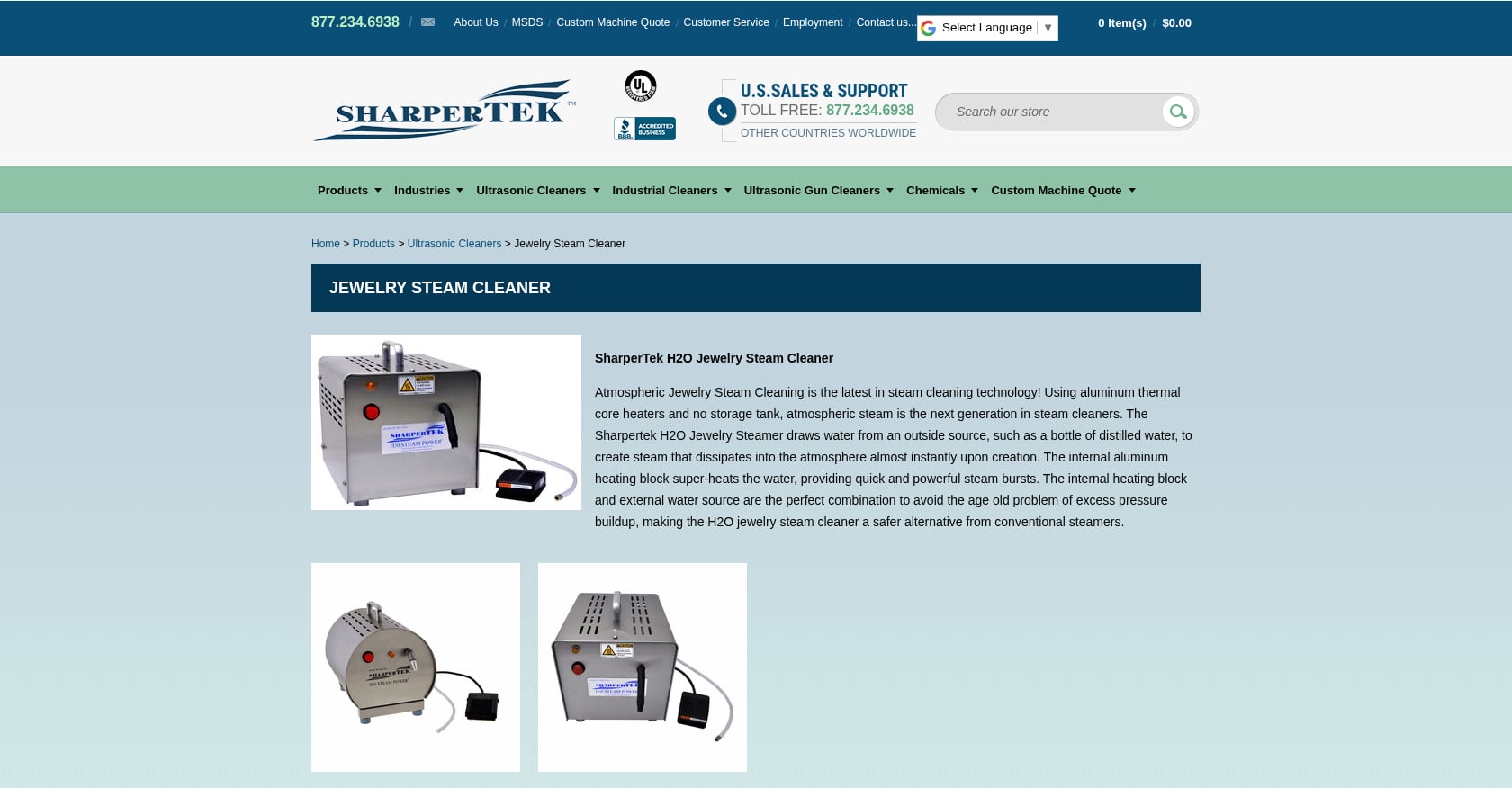
Best for: Portable, light-duty counter work where avoiding a pressure vessel matters more than continuous flow.
Price: ~$720
The SharperTek H2O is an atmospheric, on-demand unit that draws from an external water bottle with foot pedal control. It markets a “90 PSI steam pressure effect,” but the output is pulse-style rather than the continuous stream you get from a true boiler (source).
Key features:
Atmospheric operation, no pressure vessel classification
External water bottle feed
Foot pedal activation
Compact and portable
Lowest price point in this roundup
Tradeoffs:
Pulsed output with re-heat windows between bursts. Practitioners on Ganoksin note that cheap atmospheric units can deliver steam that’s “too wet” with limited control compared to foot-pedal boilers (source).
Not suitable as the sole steamer for a busy repair bench.
“90 PSI effect” is a marketing claim, not true continuous boiler pressure. Set expectations accordingly.
Which Stones Should You Never Steam?
This matters just as much as choosing the right machine. A $2,000 steamer pointed at the wrong stone will cause damage that costs far more to fix.
Safe to steam:
Diamonds (unless heavily included or fracture-filled)
Sapphires and rubies
Gold and platinum settings
Never steam these:
Pearls (heat and moisture damage the nacre)
Opals (thermal shock can cause crazing)
Turquoise (porous, absorbs moisture, can discolor)
Fracture-filled emeralds (filler can melt or leach)
Glued components (adhesive failure)
Heavily included stones (internal fractures can propagate)
The GIA confirms these guidelines and recommends defaulting to warm water with mild soap and gentle brushing for any stone you’re unsure about (source). Professional jewelers operating the best jewelry steamer for jewelry stores should keep a printed safe/unsafe chart at the bench. One wrong blast costs more than a thousand right ones save.
Maintenance That Keeps Your Steamer Running for Decades
Buying a good steamer is the easy part. Keeping it alive is where most shops fall short. Here’s what actually matters, based on MJSA and Ganoksin maintenance guidance (source):
Weekly:
Blow down the boiler to flush sediment and prevent mineral buildup
Check water levels and sight glass clarity
Monthly:
Inspect the steam nozzle and foot pedal for wear
Clean the exterior and work area
Quarterly:
Descale the tank (even with distilled water, trace minerals accumulate)
Inspect all gaskets and seals
Annually:
Replace the sight glass and washers
Review all safety valves
Document everything for insurance and inspector records
Always:
Use distilled water only. Tap water accelerates scale buildup and shortens tank life dramatically.
Practitioners on Ganoksin forums are clear about this: “Weekly blow-downs and replacing the sight glass and gaskets yearly keep boilers running for decades” (source). Skip the maintenance, and even a $3,000 unit can fail within a few years.
For stores that don’t want to track consumables or maintenance schedules themselves, Hoffman’s Workhorse Protection Program offers two tiers. The Lite plan ($216/year) ships consumables automatically and includes VIP support. The Essential plan ($280/year) adds full factory reconditioning every 24 months, a 47-point inspection, ASME/UL recertification, and an immediate hot-swap loaner machine so your bench never goes dark.
Efficiency vs. Investment: Which Steamer Fits Your Volume?
Store Type | Daily Volume | Recommended Tech | Est. Recovery Time |
Independent Boutique | 5–15 pieces | Manual Boiler (EVD-1) | 5–10 Minutes |
Full-Service Repair | 20–50 pieces | High-Pressure (JEL3) | 2–3 Minutes |
High-Volume/Mfg | 50+ pieces | Auto-Fill (JEL11/Reimers) | Instant |
Mall/Retail Counter | On-demand | Flash Steamer (GEM-III) | Instant (Pulse) |
The Real Cost of Ownership (What Most Roundups Skip)
Sticker price is just the beginning. Here’s a rough annual budget for owning a professional jewelry steamer:
Expense | Estimated Annual Cost |
|---|---|
Distilled water | $50–$100 |
Descaling solution | $30–$60 |
Sight glass + gaskets | $40–$80 |
Misc. consumables (nozzles, washers) | $30–$50 |
Staff time for maintenance (~30 min/week) | Varies |
Total consumables | ~$150–$290/year |
Compare that to the cost of a single day of downtime at a busy repair bench, and the math is obvious. Maintenance isn’t an expense. It’s insurance against lost revenue.
One more thing most roundups ignore: explosions are a real risk with poorly designed or poorly maintained pressure units. A bench jeweler on Reddit reported firsthand experience with this danger (source). Buying a certified unit and maintaining it properly isn’t cautious. It’s mandatory.
Hoffman also offers financing options including 0% APR promotions for stores where a $1,200 to $2,200 upfront cost creates cash flow strain. Spreading the cost over months while the steamer generates revenue from day one makes the economics straightforward.
Frequently Asked Questions
Will my jewelry steamer pass a boiler inspection?
It depends on two things: whether the unit carries an ASME stamp, and whether your state or city requires inspections for small electric boilers. States like Georgia and Kentucky incorporate ASME Boiler and Pressure Vessel Code into their regulations. Hoffman’s Pro line (JEL3, ELG4, JEL11 series) carries ASME/UL certification. Reimers explicitly notes that their jewelry steamers must conform to all boiler laws (source). Call your local boiler inspector before purchasing, not after.
Do malls allow pressure boilers?
Often, no. Many malls and shopping center leases restrict or prohibit pressure vessels on premises. This is also common with certain commercial insurance policies. The Hoffman GEM-III portable flash steamer is specifically positioned as “approved for all malls” because it operates without pressurized steam, requiring no boiler permits.
What electrical service do I need?
Entry-level models like the Hoffman EVD-1 and Reliable 5100CJ run on standard 110V/15A circuits. Higher-output models benefit from 220V service, which delivers faster heat-up and pressure recovery. The Hoffman JEL3 offers an optional 220V/3kW upgrade. Check your shop’s electrical panel and consult an electrician before ordering a 220V unit.
Is steam safe for all jewelry?
No. Steam is safe for gold, platinum, and most diamonds, sapphires, and rubies. It is not safe for pearls, opals, turquoise, fracture-filled emeralds, glued components, or heavily included stones. The GIA recommends warm water with mild soap for any stone you’re uncertain about (source).
How long do professional jewelry steamers last?
With proper maintenance, decades. One Ganoksin forum member reported a refurbished Reimers from 1998 still running strong (source). A Reddit user described Hoffman steamers lasting 24+ years in a working shop (source). The key variable isn’t brand. It’s maintenance discipline: weekly blow-downs, distilled water, and annual replacement of wear parts.
What’s the difference between a flash steamer and a boiler steamer?
A flash steamer (like the GEM-III or SharperTek H2O) heats water on demand and produces short bursts of steam without maintaining a pressurized tank. A boiler steamer (like the JEL3, Elma, Reliable, or Reimers) maintains a pressurized vessel of hot water and delivers continuous, controllable steam flow. Boilers produce drier, more forceful steam but require compliance considerations and regular maintenance.
Is higher PSI always better?
Not necessarily. Practitioners on the Ganoksin Orchid forum emphasize that flow control and steam “dryness” matter more than raw PSI numbers (source). A foot-pedal boiler that lets you vary flow (slower and wetter for clearing residue, faster and drier for flash-drying) outperforms a higher-PSI unit with fixed, uncontrollable output. Look for adjustable controls, not just peak pressure specifications.
Should I buy a consumer steam cleaner instead?
No. Consumer garment steamers, steam mops, and household steam cleaners lack the pressure, duty cycle, build quality, and safety certifications needed for professional jewelry store use. They won’t remove polishing compound effectively, they can’t handle daily workloads, and they carry no ASME or UL certification. For any store that values its reputation and its customers’ jewelry, a professional-grade unit is the only serious option.
Our 2026 guide is compiled through a combination of field tests in working jewelry repair shops, consultation with ASME-certified boiler technicians, and an analysis of current OSHA retail safety guidelines.


