

TL;DR
A complete commercial steam equipment checklist covers four areas: daily operational checks, weekly and monthly maintenance tasks, safety device testing, and annual compliance inspections. This guide provides field-ready checklists for each interval, along with clear definitions of every component and certification you’ll encounter. It applies to commercial electric steam boilers and generators used in trade and light industrial settings, from 1-gallon shop units to 6-gallon continuous-duty boilers.
Commercial Steam Equipment Checklist: Quick Answer
A commercial steam equipment checklist organizes inspection and maintenance tasks by frequency: daily operational checks, weekly cleaning and condition checks, scheduled safety-device testing, periodic descaling, and required professional inspections. The correct schedule depends on the boiler model, operating pressure, water quality, usage, manufacturer instructions, and local regulations.
Use this quick-reference schedule as a starting point:
Daily: Check the water level, gauge readings, hose and nozzle condition, controls, and visible leaks.
Weekly: Clean the nozzle, inspect hose routing, wipe down the equipment, and record changes in steam performance.
Monthly or as specified: Complete the prescribed safety-device checks, inspect operating controls, and perform approved blowdown procedures where applicable.
Periodically: Assess water quality, inspect for scale buildup, and descale according to the manufacturer’s instructions.
Annually or as required: Review maintenance records, verify certification documents, and arrange inspections at the frequency required by the applicable authority.
Before performing any maintenance, follow the manufacturer’s shutdown, cooling, depressurization, and electrical-isolation procedures. Never assume that a maintenance interval or inspection requirement applies to every commercial steam boiler.
Commercial Steam Equipment Maintenance Schedule
Frequency | Main checks and tasks | What to record |
|---|---|---|
Daily / before operation | Water level, gauge readings, hose and nozzle condition, controls, visible leaks | Readings, abnormalities, operator initials |
Weekly | Nozzle cleaning, hose routing, exterior condition, steam performance | Cleaning completed, visible wear, performance changes |
Monthly or manufacturer-specified interval | Approved safety-device checks, control checks, drain or blowdown tasks where applicable | Test results, service actions, defects |
Based on water quality and usage | Water treatment, scale inspection, descaling, filter or softener service | Water test results, treatment changes, service dates |
Annual or legally required interval | Professional inspection where required, records review, certification and permit verification | Inspection report, certificate expiry, corrective actions |
After a fault or repair | Appropriate inspection and functional verification before returning equipment to service | Fault description, repair details, authorization to restart |
Important: This table is a planning aid, not a universal regulatory schedule. Use the manufacturer’s manual and applicable boiler rules to establish the actual frequency and approved method for each task.
Why a Documented Checklist Matters for Commercial Steam Equipment
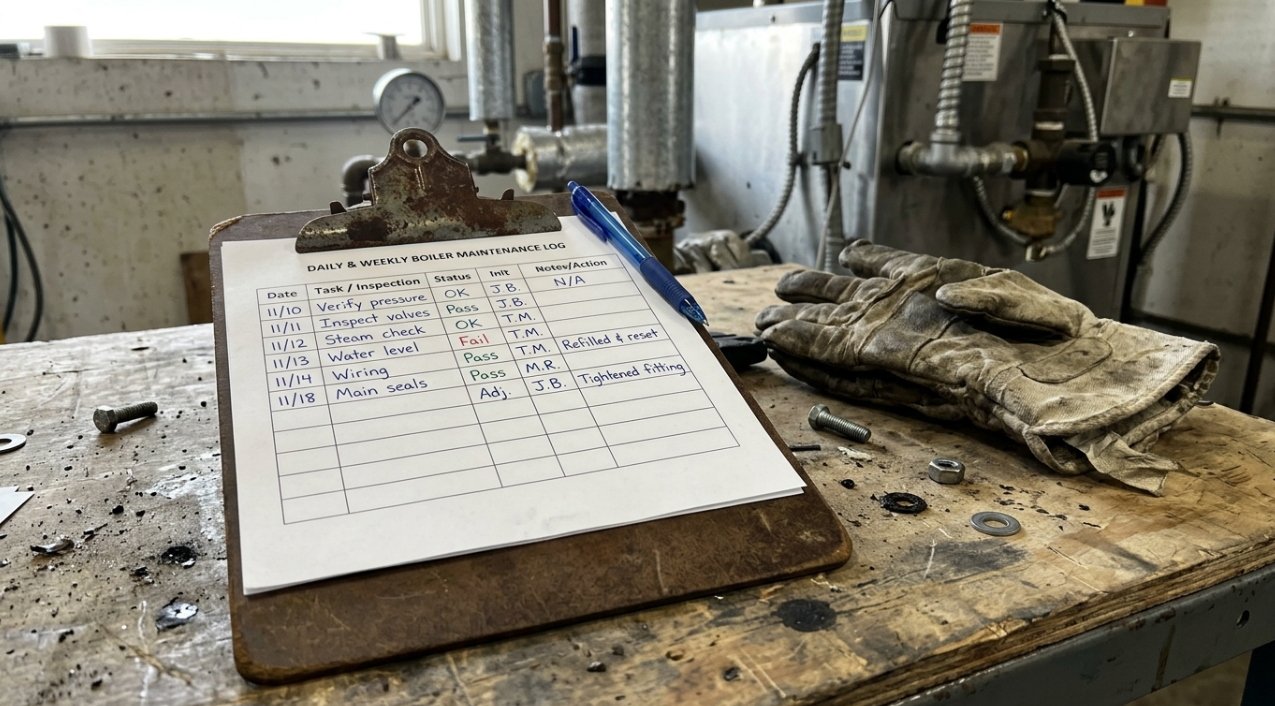
A documented commercial steam equipment maintenance checklist helps operators identify developing faults, maintain consistent performance, schedule preventive maintenance, and keep inspection records organized. It also gives maintenance teams a repeatable process for checking equipment condition and documenting corrective actions.
Without a structured inspection routine, problems such as scale buildup, leaking connections, deteriorating hoses, and malfunctioning controls can go unnoticed until they interrupt production or create a safety risk.
A checklist serves three main groups:
Operators: Complete routine checks before and during normal operation, as permitted by the operating procedure.
Maintenance teams: Schedule cleaning, inspections, repairs, and approved functional tests.
Safety and compliance personnel: Review inspection reports, equipment documentation, maintenance records, and applicable permit requirements.
Which Equipment Does This Checklist Cover?
This guide focuses on commercial electric steam boilers and steam generators used in trade shops, workshops, and light industrial settings, including jewelry cleaning, garment finishing, and similar applications.
It is intended as a general maintenance-planning resource. Some units may be classified or regulated differently depending on their design, pressure rating, capacity, installation, and intended use. It does not replace the equipment manual, qualified service instructions, or requirements set by the local Authority Having Jurisdiction (AHJ).
For a broader overview of commercial steam equipment types and their applications, Hoffman’s equipment guide covers the full range of electric steamers and boilers.
Daily Operational Checklist
These checks take less than five minutes and should happen before the first steam draw of every shift. They catch the problems that escalate into failures if left overnight or over a weekend.
Water Level (Sight Glass Check)
The sight glass is a transparent tube or window mounted on the side of the boiler that shows the current water level. Water should be visible at or near the midpoint. If the glass is empty, the tank is dangerously low. If water reaches the top, the tank is overfilled, which causes spitting (hot water droplets ejected from the nozzle instead of dry steam).
Daily action: Verify water level is visible in the sight glass before energizing the unit. On manual-fill boilers, top off as needed. On auto-fill (pump-fill) systems, confirm the pump cycles correctly and the reservoir has adequate supply.
Pressure Gauge Reading
Confirm the pressure gauge reads zero when the unit is cold and climbs to the normal operating range during heat-up. For most commercial electric boilers in trade applications, normal operating pressure falls between 40 and 90 PSI. A gauge that reads above zero when the unit is cold and depressurized may indicate a stuck gauge or a valve that didn’t fully vent.
Daily action: Record the cold-start gauge reading and the stabilized operating pressure. Flag any deviation greater than 5 PSI from baseline.
Hose and Nozzle Visual Inspection
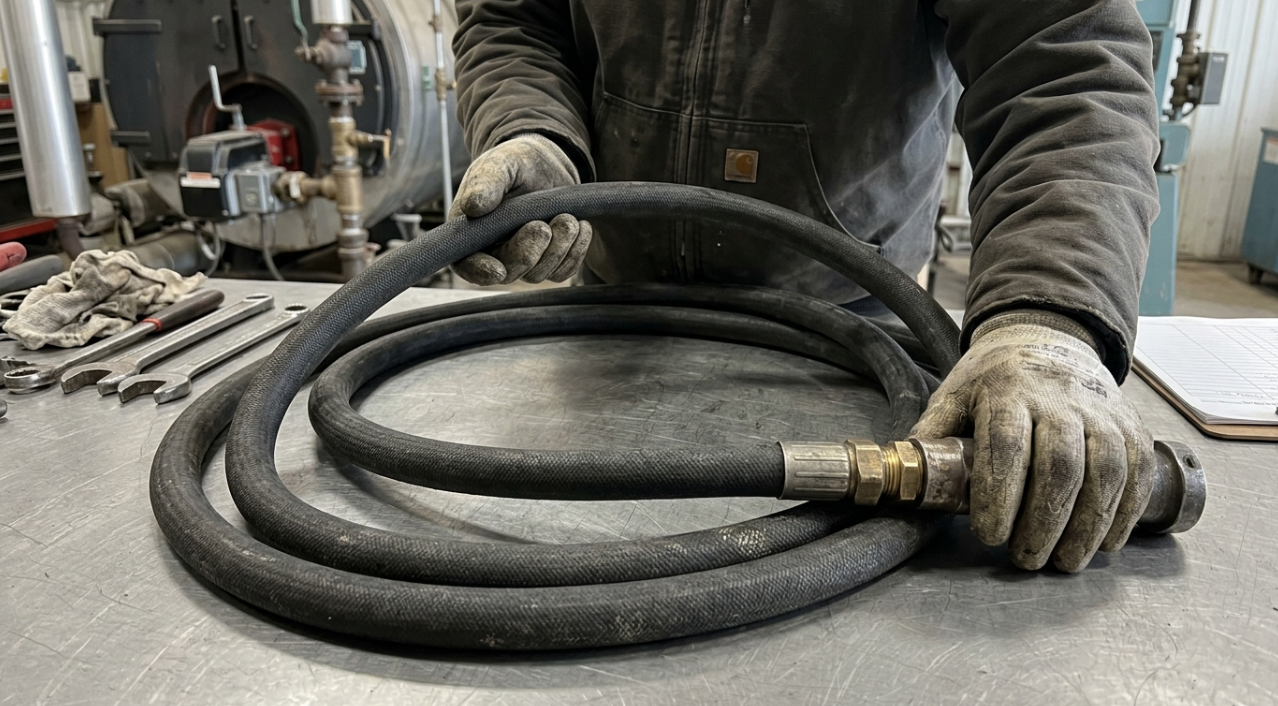
The steam hose is the reinforced flexible line connecting the boiler to the nozzle or wand. Commercial steam hoses carry pressure ratings typically ranging from 50 to 150 PSI with temperature tolerances up to 400°F. The nozzle (or wand) is the output tool that directs steam onto the workpiece.
Daily action: With the unit off and cool, run a gloved hand along the full length of the hose. Check for soft spots, cracks, kinks, or bulges. Inspect the nozzle tip for mineral blockage or physical damage. A partially blocked nozzle reduces effective steam pressure at the point of work.
For trade-specific nozzle maintenance, see this jewelry steam cleaning guide.
Foot Pedal and Controls
If the unit uses a foot pedal control (a floor-mounted switch that activates steam flow), test it before the first use of the day. The pedal should engage cleanly and release without sticking.
Daily action: Activate the foot pedal and confirm steam flows promptly. Release and confirm steam stops immediately. A sticky or delayed pedal is both a performance problem and a safety issue.
Leak Check
Daily action: Visually inspect the area around the boiler base, all fittings, the hose connection points, and the drain valve for any signs of water or steam leakage. Even small weeping leaks indicate seal degradation that will worsen under pressure.
What to Do When a Commercial Steam Equipment Check Fails
A maintenance checklist is useful only when operators know how to respond to an abnormal result. Record the issue, follow the manufacturer’s shutdown procedure, and keep equipment out of service when a safety-critical defect makes continued operation unsafe.
Finding | Recommended response |
|---|---|
Water level is outside the approved operating range | Do not operate the boiler until the cause is assessed and the correct water level is restored using the approved procedure. |
Pressure reading is abnormal or inconsistent | Stop and investigate according to the operating manual. Do not rely on a suspect gauge to establish that the boiler is safe. |
Hose, nozzle, or fitting is damaged or leaking | Stop use, isolate the equipment as required, and allow it to cool and depressurize before authorized inspection or replacement. |
Safety device fails its prescribed test | Do not bypass the device or continue operating equipment that depends on it for safe operation. Arrange qualified service. |
Steam output or recovery time changes significantly | Record the symptoms and check for approved causes, such as scale buildup, water-supply problems, or a developing component fault. |
Electrical damage, burning odor, or unexpected control behavior occurs | Stop operation when safe to do so and have the equipment assessed by a qualified technician. |
Record every failure: Include the date, equipment identification, observed symptom, action taken, person responsible, repair details, and authorization to return the equipment to service.
Never loosen pressurized fittings, open a hot boiler, or remove a component until the equipment has been isolated and made safe according to its manufacturer’s procedure.
Weekly and Monthly Maintenance Checklist
These tasks address the gradual wear and mineral accumulation that daily checks can’t catch. They form the core of any preventive maintenance (PM) schedule for commercial steam equipment.
Weekly Tasks
Nozzle cleaning: Remove and clean the steam nozzle to clear mineral deposits. Soak in a commercial descaling solution if buildup is visible. Mineral deposits are the primary cause of reduced steam output at the nozzle tip.
Hose routing check: Confirm the steam hose has no sharp bends, is not pinched against furniture or walls, and routes downward from the boiler to the nozzle. Improper routing traps condensation and causes spitting.
Wipe down exterior surfaces: Remove dust and moisture from the boiler cabinet, controls, and gauge faces. Accumulated moisture near electrical connections creates corrosion risks.
Performance monitoring: Note whether recovery time (how quickly the boiler returns to full operating pressure after a steam draw) has increased compared to baseline. Increasing recovery time is often the earliest sign of scale buildup on the heating element.
Monthly Tasks
Pressure Relief Valve (PRV) test: The PRV (also called the safety valve) is a spring-loaded valve that automatically opens to vent steam if internal pressure exceeds the safe limit. Pull the test lever, confirm the valve vents freely, and release. The valve should reseat cleanly with no weeping afterward. If it leaks or fails to reseat, replace it immediately. For a full walkthrough of safety device requirements, see the steam boiler safety requirements guide.
Low-Water Cutoff (LWCO) test: The LWCO is an automatic safety switch that shuts off the heating element if the water level drops below a safe minimum. Experienced boiler operators on forums like DIYChatroom recommend exercising the LWCO floats monthly, just enough to clear sediment and confirm the mechanism trips correctly. On manual-fill boilers, where operator distraction can lead to low-water conditions, this test is especially important.
Blowdown: Open the drain valve at the bottom of the boiler to flush out accumulated sediment, sludge, and mineral debris. This clears the lowest point in the tank where deposits naturally settle. On larger continuous-duty commercial boilers, some operators blow down one to four times daily. For smaller shop units (1 to 6 gallons), monthly blowdown is standard practice. Confirm the drain valve seats properly after closing.
Pressurestat calibration check: The pressurestat (also called the operating control) is an adjustable switch that monitors boiler pressure and cycles the heating element on and off to maintain the desired operating range. Compare the gauge pressure at which the element cycles off against the pressurestat setpoint. If they don’t match, the pressurestat needs recalibration.
High-limit control verification: The high-limit control is a manual-reset safety switch set approximately 5 to 10 PSI above normal operating pressure. If pressure reaches this limit, it locks out the heating element entirely. If the high-limit is tripping frequently, the pressurestat is likely drifting out of calibration.
The full breakdown of tasks by frequency is available in the commercial steam boiler maintenance checklist.
Water Quality and Descaling Checklist
Water quality affects scale formation, corrosion, heating-element performance, and maintenance frequency in commercial electric steam equipment. The appropriate treatment depends on the boiler design, the incoming water supply, operating conditions, and the manufacturer’s water-quality specifications.
How to Check for Scale Buildup
Scale is a mineral deposit that forms when dissolved substances in water accumulate on heated surfaces or inside the boiler. Excessive deposits can interfere with heat transfer, reduce performance, and increase the likelihood of component damage.
Monitor these indicators:
Steam output or recovery time changes compared with the normal baseline.
Visible mineral deposits appear around approved inspection points or nozzle openings.
Water quality results fall outside the manufacturer’s specified range.
Maintenance records show increasingly frequent cleaning or scale-related service.
These symptoms can have other causes, so confirm the diagnosis before selecting a treatment.
Descaling Schedule
Do not apply a single descaling interval to every commercial steam generator. Establish the schedule using the manufacturer’s instructions, water-quality results, operating hours, and observed scale accumulation.
When descaling is required:
Confirm that the proposed cleaning product is approved for the specific boiler materials and components.
Follow the manufacturer’s shutdown, cooling, draining, and cleaning procedure.
Inspect accessible components for deposits, corrosion, leaks, or damage as directed.
Rinse and return the equipment to service only as instructed by the manufacturer.
Record the service date, cleaning method, products used, and findings.
Water Treatment Options
Water testing: Measure the relevant water-quality parameters using an appropriate test method. Hardness alone may not identify every water-quality issue.
Water softening: May reduce hardness-related scale when the equipment manufacturer permits it. Softening does not remove every dissolved substance.
Distilled or deionized water: May be appropriate for certain machines, but only when its use meets the manufacturer’s requirements. Very low-mineral water is not automatically suitable for every boiler design.
Filtration: Can address selected particles or contaminants, depending on the filter type. Ordinary particulate filtration does not necessarily remove dissolved hardness minerals.
Document the treatment method and test results so the maintenance schedule can be adjusted to actual operating conditions.
The water quality standards guide explains how to test your local water and choose the right treatment method.
Safety Device Inspection Checklist
Safety devices are the non-negotiable items on any commercial steam equipment checklist. Every one of them requires periodic testing, and every test should be documented with dates and results.
Pressure Relief Valve (PRV / Safety Valve)
What it does: Automatically opens to vent steam if internal pressure exceeds the safe limit. It’s the last line of defense against a pressure vessel rupture. Every ASME-certified boiler ships with one. It should never be blocked, modified, or removed.
Test frequency: Monthly at minimum.
Test procedure: Pull the test lever, confirm it vents freely, release, and verify it reseats without leaking.
Failure action: Replace immediately. A PRV that doesn’t reseat or that weeps during normal operation is not serviceable in the field.
Low-Water Cutoff (LWCO)
What it does: Shuts off the heating element if the water level drops below a safe minimum. Running a boiler dry can cause the vessel to overheat in seconds.
Test frequency: Monthly.
Test procedure: Exercise the float mechanism to clear sediment and confirm the safety switch trips. On electronic LWCO devices, follow manufacturer test instructions.
High-Limit Control
What it does: A manual-reset safety switch that locks out the heating element if pressure exceeds the pressurestat setpoint by approximately 5 to 10 PSI.
Test frequency: Verify function during monthly pressurestat calibration checks.
Red flag: Repeated high-limit trips indicate the pressurestat is failing, not that the high-limit itself is faulty.
LOTO (Lockout/Tagout) Procedure
A safety procedure that ensures equipment is de-energized and cannot be accidentally restarted during maintenance. For electric boilers: disconnect power (unplug or switch off the breaker), attach a lock to prevent reconnection, and tag the equipment with a maintenance notice.
Even for small cord-and-plug boilers, OSHA expects documented LOTO procedures. Your safety checklist should include a written LOTO protocol, even a simple one-page document. The OSHA steam equipment safety guide covers what documentation small operations actually need.
PPE Requirements
Common PPE for commercial steam equipment operators:
Heat-resistant gloves
Safety glasses or face shield
Closed-toe shoes
Long sleeves when operating high-pressure nozzles
OSHA requires a written PPE hazard assessment, which identifies the hazards (steam burns, hot surfaces, pressurized water) and specifies protective measures. This document belongs in your compliance binder.
Annual Compliance and Certification Checklist
This section covers the regulatory items that inspectors, insurance carriers, and local authorities will verify. Missing any of them can result in fines, denied insurance claims, or forced shutdown.
ASME Certification (Stamps: “S” and “H”)
The American Society of Mechanical Engineers certifies pressure vessels through a manufacturing and inspection process. Boilers that pass receive a stamp physically affixed to the vessel: “S” for power boilers (steam) or “H” for heating boilers. This stamp confirms the vessel was designed, built, and tested to ASME safety standards.
Checklist action: Verify the ASME stamp is present and legible on the vessel. Confirm documentation (manufacturer’s data report) is on file.
UL Certification
Underwriters Laboratories certification covers the electrical safety of the boiler’s components: wiring, controls, heating elements, and enclosures. It’s separate from ASME (which covers the pressure vessel) and equally important.
Checklist action: Verify UL listing mark on the equipment nameplate. Many landlords, insurers, and local jurisdictions require UL listing for commercial electrical equipment.
Boiler Pressure Ratings, ASME Certification, and Compliance
A commercial steam boiler’s pressure rating is an important part of its compliance requirements, but pressure alone does not determine every applicable inspection, certification, or permitting obligation. Equipment classification, construction code, installation, jurisdiction, and intended use also matter.
What Does the 15 PSI Threshold Mean?
A rating of 15 pounds per square inch gauge (psig) is commonly associated with the low-pressure limit for steam heating boilers under applicable heating-boiler rules. However, it should not be used as a universal rule for classifying every commercial steam generator.
Before purchasing or operating equipment, verify:
The manufacturer’s stated maximum allowable working pressure (MAWP).
The intended operating pressure and equipment classification.
The applicable ASME construction code and certification, if required.
Local requirements for installation, inspection, permits, and operator qualifications.
Any additional requirements imposed by the insurer or property owner.
Do not infer that a boiler is exempt from inspection or certification solely because it has a small tank or low capacity.
How to Verify ASME Certification
The American Society of Mechanical Engineers (ASME) administers certification programs covering different categories of boilers and pressure equipment.
Checklist actions:
Locate the equipment nameplate and applicable code markings.
Obtain the manufacturer’s documentation and applicable data report.
Confirm that the certification corresponds to the equipment’s actual construction and classification.
Ask the manufacturer or authorized inspector which certification requirements apply to the installation.
Do not assume that every commercial steam generator requires both an S stamp and an H stamp. The applicable certification depends on the equipment category and construction code.
How to Verify Electrical Safety Certification
Electrical certification is separate from pressure-vessel construction certification. Where a UL listing or another recognized electrical product certification is required, verify the exact model, applicable certification mark, and documentation.
Do not assume that a certification requirement is identical in every jurisdiction. Confirm the applicable electrical code and local approval requirements before installation.
Authority Having Jurisdiction (AHJ)
The Authority Having Jurisdiction is the organization or official responsible for enforcing the applicable requirements at the installation site. Depending on the location and equipment, this may be a boiler inspection agency, building department, or another authorized body.
Checklist actions:
Confirm which agency regulates the equipment.
Ask whether a permit, initial inspection, periodic inspection, or operating certificate is required.
Verify inspection deadlines and any operator qualification requirements.
Keep applicable permits, reports, certificates, and corrective-action records accessible.
Use the requirements provided by the relevant authority rather than assuming that a particular inspection interval applies to every commercial steam boiler. The compliance checklist guide walks through what this threshold means for specific operations.
AHJ (Authority Having Jurisdiction)
The local government body responsible for enforcing boiler safety regulations. This could be a state boiler board, a city fire marshal, or a county building department. Requirements vary significantly by location.
Checklist action: Before installing any commercial steam equipment, contact your AHJ to confirm permit requirements, inspection frequency, and whether operator licensing applies. The boiler permit requirements guide helps identify your local AHJ and understand their requirements.
Certificate of Inspection / Operating Permit
A document issued after a successful inspection by the AHJ’s authorized inspector, confirming the boiler meets all applicable safety standards and may legally operate. Most jurisdictions require this certificate to be displayed near the equipment.
Checklist action: Confirm the current certificate’s expiration date. Schedule the next inspection at least 60 days before expiration.
Annual Inspection Preparation Checklist
Before the inspector arrives, confirm:
[ ] ASME stamp visible and legible on the vessel
[ ] UL listing mark on nameplate
[ ] Manufacturer’s data report on file
[ ] Current Certificate of Inspection posted
[ ] Maintenance log with documented PRV tests, LWCO tests, and blowdown records
[ ] Written LOTO procedure available
[ ] Written PPE hazard assessment available
[ ] Pressurestat calibration current
[ ] All safety devices (PRV, LWCO, high-limit) functional and tested within the last 30 days
[ ] Water treatment records (if applicable)
[ ] Insurance documentation current
Equipment Specification Checklist (Pre-Purchase)
For operators or maintenance teams evaluating new commercial steam equipment, these specification items should be verified before purchase.
PSI Rating
The operating pressure in pounds per square inch. Consumer handheld steamers produce 30 to 45 PSI. Commercial units for trades like jewelry cleaning, hat shaping, garment finishing, and upholstery typically operate at 40 to 90 PSI. Higher pressure drives steam into porous surfaces and small crevices more effectively.
Checklist action: Specify the minimum PSI required for your application before comparing models. The PSI requirements guide provides application-specific benchmarks.
Tank Capacity
The volume of water the boiler holds (typically 1 to 6 gallons for commercial electric units). Determines how long you can produce steam before refilling on manual-fill systems, or how much reserve you have during peak demand on auto-fill systems.
Manual Fill vs. Pump Fill (Auto-Fill)
Manual fill means pouring water into the tank by hand and waiting for it to heat before resuming work. Pump fill (auto-fill) uses an automatic system to replenish water as steam is consumed, allowing continuous operation. For a deeper comparison, the guide on manual vs. auto-fill boilers breaks down the trade-offs.
Checklist action: Match fill type to duty cycle. Intermittent use (a few steam draws per hour) works fine with manual fill. Continuous or high-volume use demands auto-fill.
Voltage and Electrical Requirements
110V/120V single-phase: Standard wall outlets. Supports smaller boilers, typically 1.5 kW heating elements.
220V/240V single-phase: Requires a dedicated circuit. Supports 3 kW elements and faster recovery.
220V three-phase: For larger continuous-duty boilers. May require an electrician for installation.
Checklist action: Verify available electrical service at the installation site before ordering equipment. This is a hard constraint that cannot be worked around without electrical upgrades. The installation requirements guide covers this in detail.
Duty Cycle (Intermittent vs. Continuous)
Intermittent duty means the boiler handles periodic steam bursts with recovery time between uses. Continuous duty means uninterrupted steam production for extended periods. Buying a boiler with the wrong duty cycle is the most expensive specification mistake: an intermittent unit forced into continuous service will overheat, scale up faster, and fail prematurely.
BHP (Boiler Horsepower)
A traditional measure of steam output capacity. One BHP equals approximately 34.5 pounds of steam per hour. Most commercial electric boilers for shop and light industrial use produce well under 1 BHP, which is adequate for trade applications. Don’t confuse it with motor horsepower.
Certifications (Pass/Fail)
[ ] ASME stamp documented
[ ] UL listing confirmed
[ ] Manufacturer can provide copies of both certifications
If the seller cannot provide documentation of ASME and UL certification, that is a disqualifying finding.
Additional Purchase Considerations
Trade-specific bundles: Pre-configured packages that include the boiler plus accessories specific to your application (shaping heads for hat work, precision nozzles for jewelry, steam irons for garment finishing). Bundles eliminate compatibility guesswork and reduce setup time. Browse Hoffman’s trade-specific packages for examples.
Protection and maintenance plans: Subscription services that bundle preventive maintenance, consumable shipments, factory reconditioning, loaner equipment, and priority support into predictable costs. When comparing brands, check whether the manufacturer offers these and what they actually include.
Factory reconditioning availability: A comprehensive refurbishment process where the boiler is returned to the manufacturer for disassembly, cleaning, descaling, component replacement, pressure testing, and recertification. This extends equipment life without the cost of a new unit. Hoffman offers factory reconditioning through their Workhorse Essential protection plan.
Factory-direct vs. distributor: Factory-direct purchases eliminate middleman markup and provide direct access to the engineers who built the equipment. Published, transparent pricing makes comparison straightforward.
Quick-Reference: Complete Commercial Steam Equipment Checklist
Daily (Before Each Shift)
[ ] Water level visible at midpoint in sight glass
[ ] Pressure gauge reads zero when cold
[ ] Hose inspected for cracks, kinks, bulges
[ ] Nozzle tip clear of blockage
[ ] Foot pedal engages and releases cleanly
[ ] No visible leaks at fittings, base, or drain valve
Weekly
[ ] Nozzle removed and cleaned
[ ] Hose routing confirmed (no sharp bends, proper drainage)
[ ] Exterior surfaces wiped down
[ ] Recovery time noted and compared to baseline
Monthly
[ ] PRV tested (pull lever, confirm vent, verify reseat)
[ ] LWCO exercised and trip confirmed
[ ] Blowdown performed, drain valve reseated
[ ] Pressurestat calibration spot-checked against gauge
[ ] High-limit control function verified
Semi-Annual (Every 6 to 12 Months)
[ ] Full descaling/deliming performed
[ ] Steam lines, hoses, and connections inspected during descale
[ ] Tank interior inspected for pitting or corrosion
[ ] Water treatment system serviced (filter or softener cartridge replaced)
[ ] Heating element condition assessed
Annual
[ ] Professional inspection by AHJ-authorized inspector
[ ] Certificate of Inspection renewed and posted
[ ] ASME stamp verified legible
[ ] All maintenance logs reviewed and organized
[ ] LOTO procedure reviewed and updated
[ ] PPE hazard assessment reviewed
[ ] Insurance documentation confirmed current
[ ] Factory reconditioning evaluated (if on protection plan cycle)
For the next step, request a virtual demo from Hoffman to see how these checklist items apply to actual equipment built for trade and light industrial applications.
Frequently Asked Questions
What is a commercial steam equipment checklist used for?
It’s a structured reference that guides daily operations, preventive maintenance, safety device testing, and regulatory compliance for commercial steam boilers and generators. Different checklists serve different intervals (daily through annual), but all of them track the same core components and safety devices.
How is a commercial electric boiler checklist different from a gas boiler checklist?
Electric boiler checklists eliminate all combustion-related items: burner tuning, combustion analysis, fuel train inspection, stack temperature monitoring, and gas leak testing. The focus shifts to electrical connections, heating element condition, water quality, and scale prevention.
How often should I descale my commercial steamer?
Every 6 to 12 months, depending on water hardness and usage volume. Shops using untreated tap water in hard-water areas may need more frequent descaling. Distilled or deionized water and inline water softeners extend the interval significantly.
What does the 15 PSI threshold mean for compliance?
It’s the dividing line between low-pressure (ASME Section IV) and high-pressure (ASME Section I) boiler classifications. Most commercial steamers for trade and light industrial applications operate above 15 PSI, placing them in the high-pressure category. This triggers requirements for annual inspections, specific safety devices, and in many jurisdictions, an operating permit.
Do I need an ASME-certified boiler?
In most jurisdictions, yes, if the boiler operates above 15 PSI. ASME certification is also typically required for insurance coverage and may be required by your landlord or local AHJ regardless of pressure rating. Treat it as a non-negotiable specification.
What is the most common cause of commercial steamer failure?
Scale and mineral buildup on the heating elements. This is consistently identified across trade publications and practitioner communities as the primary failure mode for electric steam equipment. Water quality management (distilled water, softeners, regular descaling) is the most effective preventive measure.
How do I find out what permits my operation needs for a steam boiler?
Contact your AHJ (Authority Having Jurisdiction), typically your state’s boiler inspection division or local fire marshal’s office. Requirements vary by state, county, and sometimes city. Some jurisdictions exempt boilers below certain size thresholds, while others require permits for all pressure vessels regardless of capacity.
What should I check on my commercial steamer every day?
At minimum: verify the water level in the sight glass, confirm the pressure gauge reads within normal operating range, visually inspect the hose and nozzle for damage, test the foot pedal for responsiveness, and check the area around the boiler for signs of leaks. These five checks take less than two minutes and catch most developing problems before they become failures.


