

Buying a commercial steamer or electric boiler for the first time means running into unfamiliar terms. What does ASME certification actually guarantee? Is 110V enough for your shop, or do you need 220V? What’s the difference between a flash steamer and a pressurized boiler? This commercial steam glossary answers those questions and dozens more, written specifically for small business owners and light industrial operators.
What is Commercial Steam? Commercial steam is water vapor generated under controlled conditions for professional use. In the context of small businesses (jewelry stores, hat shops, dry cleaners, upholstery studios, and similar trades), commercial steam typically means saturated steam produced by an electric boiler or flash steamer, delivered at pressures ranging from near-zero up to 90 PSI depending on the application.
Understanding these terms helps you choose the right commercial steam equipment, ask better questions before you buy, and operate your equipment safely. This guide covers everything from steam basics and equipment types through safety certifications, electrical requirements, and maintenance vocabulary.
The Fundamentals: Types of Steam
Most small business applications use one of these foundational types of commercial steam. This section of the commercial steam glossary covers the basics you need to know first.
Saturated Steam
Saturated steam is the workhorse for most commercial cleaning, finishing, and shaping tasks. It’s steam that exists at the exact boiling point temperature for its pressure, perfectly balanced between water and vapor. Because of this, it holds a massive amount of energy (called latent heat) that it releases very efficiently upon contact with a cooler surface. This rapid, even energy transfer makes it ideal for jewelry cleaning, garment finishing, hat shaping, and sterilization.
- Key Advantage: The temperature of saturated steam is directly controlled by its pressure. At 40 PSI, saturated steam is about 287°F. At 90 PSI, it reaches roughly 331°F. This predictable relationship makes it easy to dial in the right heat for a specific job.
- Why It Matters for Your Shop: When you see a boiler rated at 90 PSI (like Hoffman’s Pro and industrial models), that number tells you exactly how hot the steam will be. Higher pressure means higher temperature and more cleaning or shaping power.
Hoffman Steam’s electric boilers are designed to produce high quality saturated steam, which is exactly what small businesses need for everyday commercial applications.
Quick Comparison: Saturated vs. Superheated Steam
| Feature | Saturated Steam | Superheated Steam |
|---|---|---|
| Moisture Content | Contains tiny water droplets | 100% dry vapor |
| Best Use Case | Cleaning, Sterilizing, Finishing | Power Plants, Turbines |
| Heat Transfer | High (Immediate release) | Low (Acts like hot air) |
| Relevant To Small Business? | Yes, this is what you’ll use | No, power generation only |
Superheated Steam
If saturated steam is heated even further beyond its boiling point at the same pressure, it becomes superheated steam. This steam is completely dry and hotter, but it’s actually bad at transferring heat to surfaces. Its heat transfer is more like hot air than steam. Small business owners won’t encounter superheated steam in their equipment. It exists almost exclusively in power plants where it spins turbines. If you see this term, it’s not relevant to your buying decision.
Flash Steam
Flash steam is created instantly when water contacts a very hot surface, converting immediately to steam without requiring a pressurized tank. This principle is what makes non-pressurized portable steamers possible.
- Why It Matters: Flash steamers operate without a pressure vessel, which means no boiler permits, no ASME requirements, and much simpler operation. The tradeoff is lower steam volume and pressure compared to a true boiler.
- Example: Hoffman Steam’s portable GEM III uses flash steam technology to produce on-demand steam, making it safe and practical for retail or mall environments where a pressurized boiler would be impractical. For a deeper comparison, see the guide on flash steamer vs. boiler.
Utility Steam
Utility steam is the general purpose steam produced by your boiler for everyday tasks. In a small business context, this is the steam coming from your electric boiler that you use for cleaning jewelry, shaping hats, finishing garments, or powering a steam iron. It’s generated from treated (or at least clean) water and is suitable for most commercial applications.
Steam Purity and Quality
Not all steam is created equal. Even within the saturated steam your boiler produces, quality varies. This part of the commercial steam glossary clarifies those differences.
Steam Quality (Dryness Fraction)
Steam quality measures how much of a steam mixture is actual vapor versus liquid water droplets, expressed as a percentage. For example, steam with 95% quality is 95% dry vapor and 5% liquid water by mass.
- Why It Matters: Water droplets carry no useful heat energy. Lower quality steam means less effective cleaning and finishing, and it can spit water from your steam nozzle or wand. A steam quality of 95% or higher is desirable for efficient operation.
- Practical Tip: If your steamer seems to be spraying water instead of delivering consistent steam, the steam quality may be low. Common causes include overfilling the boiler, operating at too low a pressure, or mineral buildup on heating elements.
Wet Steam
Wet steam is saturated steam carrying visible water droplets, meaning its quality is below 100%. It’s almost impossible to produce perfectly dry steam from any boiler, as some water always carries over with the vapor. Steam directly from a boiler typically contains around 3 to 5 percent water by mass, giving it a quality of 95% to 97%. This is normal and perfectly acceptable for commercial use.
Clean Steam
Clean steam is high purity steam free of boiler additives and contaminants, made using purified feedwater in dedicated stainless steel generators. For most small businesses using electric steamers, clean steam isn’t a requirement. But if you work in a dental lab, medical environment, or food-adjacent application, understanding the water quality standards behind clean steam production may be relevant.
For a compact, ASME/UL certified boiler with a stainless cabinet, see the Hoffman Pro JEL3.
Culinary Steam
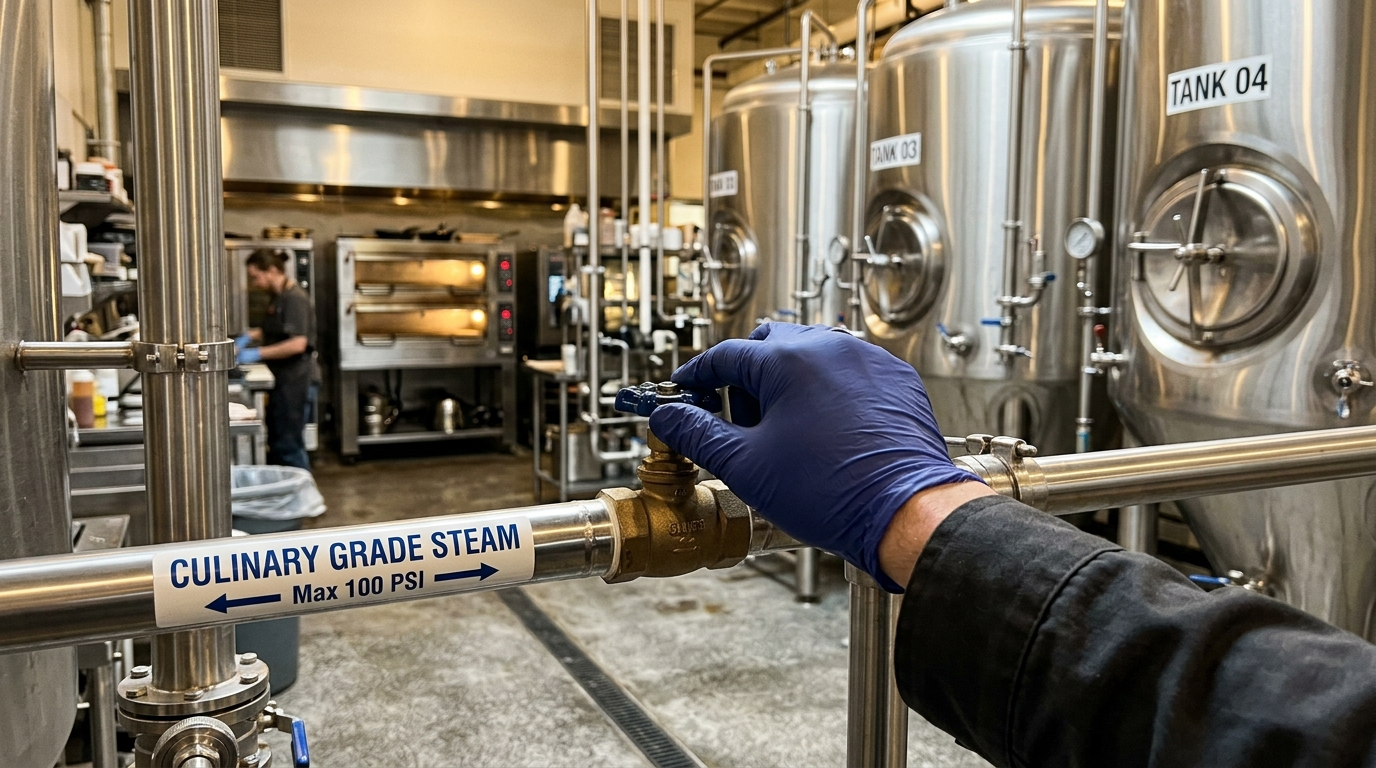
Culinary steam is steam that is safe for direct contact with food. To earn the “culinary grade” label, steam must be clean, dry, and free from any boiler additives.
- The Standard: In the United States, culinary steam is defined by the 3-A Sanitary Standard 609-03, which ensures its purity for food processing.
- Who Needs This: If your business involves steam contact with food or beverages, you need equipment rated for culinary steam. If you’re unsure what your application requires, start with the quick selector, Which Steamer is Right for Me?.
Types of Commercial Boilers and Steamers
The design of your steam equipment determines how it heats water, how much steam it produces, and what applications it handles. This commercial steam glossary section focuses on the boiler and steamer types most relevant to small businesses.
Electric Boiler
An electric boiler uses electrical heating elements or electrodes to heat water and produce steam, with no combustion, no fuel lines, and no flue or chimney required. This is the type of boiler most small businesses will buy and operate. Electric boilers are compact, quiet, and simple to install since they only need a water supply and an electrical connection.
- Key Advantage: No gas lines, no venting, no combustion byproducts. You can install an electric boiler in a mall kiosk, a back room, or a small workshop without extensive facility modifications.
- Common Capacities: Small commercial electric boilers typically range from 1 gallon (like the Hoffman EVD-1) up to 6 gallons (like the Hoffman JEL11 series). Larger continuous-duty units exist for shops with higher demand.
Flash Steamer (Non-Pressurized)
A flash steamer produces steam on demand by dripping water onto a superheated element. Because there is no stored volume of pressurized water, these units operate at or near atmospheric pressure. No boiler permit is required, and they’re safe for environments where a pressurized boiler would be impractical or not allowed.
- Best For: Retail jewelry counters, mall kiosks, light cleaning tasks, and any location where simplicity and portability matter most.
- Tradeoff: Lower steam volume and pressure compared to a true boiler. A flash steamer won’t power a steam iron or provide 90 PSI output, but for quick jewelry cleaning or light garment touch-ups, it does the job well.
Manual Fill Boiler
A manual fill boiler requires the operator to add water by hand, typically through a fill funnel or port on top of the unit, before turning it on or when the water level gets low. Most entry-level and mid-range commercial boilers use manual fill. The process is straightforward: you pour in distilled or softened water, let the boiler heat up, and work until the water level drops.
- Pros: Lower cost, simpler design, fewer components to maintain.
- Cons: You must stop work to refill, and there’s downtime while the fresh water heats up. For intermittent or light-use applications, this is rarely a problem.
Pump Fill (Automatic/Continuous Fill) Boiler
A pump fill boiler connects to a water supply and automatically adds water as needed, allowing continuous operation without operator intervention. An internal pump draws water from a reservoir or direct water line and maintains the correct water level inside the boiler during use.
- Best For: Shops that run steam all day (dry cleaners, busy hat shops, production environments, shrink wrap packaging lines). If you can’t afford downtime to refill and reheat, a pump fill system is the right choice.
- Example: Hoffman’s JEL11 automatic and RHPG series are pump fill boilers designed for continuous-duty industrial use.
Continuous-Duty Boiler
A continuous-duty boiler is designed to run for extended periods (a full work shift or longer) without needing to cool down or shut off. These units feature automatic water feed systems, robust heating elements, and components rated for sustained operation. If your shop runs steam for hours at a time, you need a boiler rated for continuous duty rather than intermittent use.
Package Boiler
A package boiler is a factory-assembled unit that arrives ready to install and operate. Unlike large industrial boilers that are built on-site piece by piece, a package boiler ships as a complete system with heating elements, controls, and vessel all integrated. Every small commercial boiler you’ll encounter from companies like Hoffman Steam is a package boiler, though the term is more commonly used in larger industrial settings.
Fire Tube Boiler
In a fire tube boiler, hot combustion gases flow through tubes surrounded by water inside a shell. The heat passes through the tube walls and into the water, producing steam. You’ll see this term in broader boiler literature. Small commercial electric boilers don’t use this design, but it’s worth knowing the term if you’re comparing equipment types or reading industry guides.
Water Tube Boiler
A water tube boiler reverses the design: water flows inside the tubes, and heat surrounds them on the outside. This allows higher pressures and faster steam generation. Again, this design applies to larger industrial installations rather than small commercial electric boilers, but the term appears frequently enough that it belongs in any commercial steam glossary.
Electrical and Power Terms
Understanding electrical requirements is critical when buying a commercial steamer. The wrong voltage or wiring setup means your boiler won’t work, or worse, it creates a safety hazard. These are among the most practically important entries in this commercial steam glossary for buyers.
110V (120V) vs. 220V (240V)
These numbers refer to the voltage of the electrical circuit powering your boiler. Standard household and most retail outlets in the United States provide 110V (technically 120V). Larger equipment often requires 220V (technically 240V), which needs a dedicated circuit and a different outlet, similar to what an electric dryer or oven uses.
- 110V Models: Plug into a standard outlet. Convenient for small shops, kiosks, and retail locations. The tradeoff is lower wattage, which means slower heat-up times and lower steam output. The Hoffman EVD-1 and base ELG4 are 110V units.
- 220V Models: Require a dedicated circuit installed by an electrician. They deliver more power (typically 3kW vs. 1.5kW), which means faster recovery and more steam volume. Many Hoffman Pro models offer a 220V upgrade option.
- Buying Tip: Before ordering, check what electrical service your location provides. If you’re in a mall or older building with limited electrical capacity, a 110V model may be your only option. For a dedicated workshop, 220V is almost always worth the electrician’s fee.
Single Phase vs. Three Phase Power
Single phase power is the standard electrical service in homes and small commercial spaces. Three phase power is a more powerful electrical distribution system typically found in industrial buildings, factories, and some larger commercial spaces. Larger boilers (like Hoffman’s JEL11M series) may be available in both single phase and three phase configurations.
- How to Check: Look at your electrical panel or ask your building manager. If your facility has three phase power available, it gives you access to higher-output boiler options. If not, you’ll choose a single phase model.
Kilowatt (kW) Rating
The kilowatt rating tells you how much electrical power the boiler’s heating elements consume. Higher kW means faster heat-up, quicker recovery after heavy steam use, and generally more steam output. A 1.5kW boiler (typical 110V unit) heats more slowly than a 3kW boiler (typical 220V unit). When comparing models, the kW rating is one of the most direct indicators of performance.
Recovery Time
Recovery time is how long it takes a boiler to return to full operating pressure after heavy steam use or after adding fresh water. A boiler with a higher kW rating and smaller tank recovers faster. This matters most in busy shops where you’re using steam frequently throughout the day. Slow recovery means waiting between tasks.
Duty Cycle
Duty cycle describes how long a piece of equipment can operate continuously before it needs to rest or be serviced. A flash steamer might have a limited duty cycle (designed for short bursts), while a continuous-duty boiler is built to run all day. Match the duty cycle to your actual usage pattern. If you steam jewelry for five minutes every hour, you don’t need a continuous-duty unit. If you’re running a steam iron eight hours a day, you do.
Pressure Terms and What They Mean for Your Business
Pressure is the single most referenced specification when buying commercial steam equipment. These terms help you understand what the numbers mean and why they matter.
PSI (Pounds per Square Inch)
PSI is the standard unit for measuring steam pressure in the United States. When a boiler is rated at 40 PSI or 90 PSI, it tells you the maximum operating pressure of the steam it produces. Higher PSI means hotter steam and more force at the nozzle or wand tip. For cleaning stubborn grime on jewelry or shaping a stiff felt hat, higher PSI matters.
The OSHA 15 PSI Threshold
This is one of the most important regulatory facts in this commercial steam glossary. Under OSHA and most state boiler regulations, steam boilers operating at 15 PSI or below are classified as “low pressure” and are subject to fewer regulatory requirements. Boilers operating above 15 PSI are classified as “high pressure” and typically require ASME certification, periodic inspections, and in some jurisdictions, a boiler permit or licensed operator.
- What This Means for You: If your boiler operates above 15 PSI (and most commercial models producing 40 to 90 PSI do), you should ensure it carries ASME certification and that you comply with your state’s inspection requirements. The certification isn’t optional, it’s a legal and insurance requirement in most states.
- Flash Steamers: Non-pressurized flash steamers like the GEM III operate below 15 PSI, which is one reason they’re popular for retail locations where boiler permits would be a hassle.
Working Pressure (MAWP)
Working pressure, or maximum allowable working pressure (MAWP), is the highest pressure at which a boiler is designed to operate safely. This value is stamped on the boiler’s data plate and determines the set point for safety valves. Operating above working pressure is dangerous and a code violation. When you see a Hoffman boiler rated at 70 or 90 PSI, that’s the MAWP.
Gauge Pressure vs. Absolute Pressure
Gauge pressure is what the pressure gauge on your boiler reads, which is pressure above atmospheric. Absolute pressure adds atmospheric pressure (about 14.7 PSI at sea level) to the gauge reading. When your boiler gauge reads 40 PSI, the absolute pressure inside is actually about 54.7 PSI. You don’t need to worry about this distinction for daily operation, but it shows up in steam tables and technical specifications.
Atmospheric Pressure
Atmospheric pressure is the force exerted by the weight of air at a given location, approximately 14.7 PSI at sea level. It determines the boiling point of water: at sea level, water boils at 212°F. At higher altitudes, atmospheric pressure is lower, so water boils at a lower temperature. If your shop is at high altitude, your boiler may behave slightly differently than specs suggest.
Vapor Pressure
Vapor pressure is the natural pressure exerted by water vapor in equilibrium with liquid water at a given temperature. A liquid boils when its vapor pressure equals the pressure of its surroundings. This principle is the foundation of how boilers work: to create steam at 90 PSI, a boiler must heat water until its internal vapor pressure reaches 90 PSI, at which point it boils.
Safety Certifications and Standards
Certifications aren’t just stickers on a box. They have real implications for insurance, legal compliance, and whether your boiler is safe to operate. Every buyer should understand these terms.
ASME Certification
ASME (American Society of Mechanical Engineers) certification means the boiler’s pressure vessel was designed, fabricated, and tested according to the ASME Boiler and Pressure Vessel Code. This is the recognized safety standard for pressure vessels in the United States and Canada.
- Why It Matters for Buyers: Most states require ASME certification for any steam boiler operating above 15 PSI. Without it, your insurance carrier may deny coverage, and your local boiler inspector may shut the unit down. Practitioners on Reddit’s r/BenchJewelers have noted that some cheaper imported steamers lack ASME stamps, which can create compliance headaches down the road.
- How to Verify: Look for the ASME stamp (a cloverleaf-shaped mark) on the boiler’s data plate. Hoffman’s Pro line models carry ASME certification.
UL Listing
UL (Underwriters Laboratories) listing means the boiler’s electrical components have been tested and certified for safety. A UL-listed boiler has passed testing for electrical safety, fire risk, and shock hazard. Many commercial landlords, building codes, and insurance policies require UL-listed electrical equipment.
- Why It Matters for Buyers: A boiler without UL listing may not meet the electrical code requirements for your building, which can affect your lease or insurance. Like ASME, this isn’t something to skip to save a few hundred dollars.
Data Plate (Nameplate)
The data plate is a metal plate permanently attached to your boiler that displays critical specifications: manufacturer, model number, serial number, MAWP, ASME stamp (if applicable), voltage, wattage, and capacity. Your boiler inspector will reference this plate during inspections. Learn to read and understand your data plate so you can answer questions about your equipment.
Boiler Permit / Registration
Many states and municipalities require boilers operating above 15 PSI to be registered with the local boiler authority and inspected on a regular schedule (typically annually). Requirements vary by state. Some states exempt small electric boilers under certain thresholds. Check with your local jurisdiction before installation.
Safety Devices
Safety devices prevent dangerous failures. Every operator should know these terms and understand boiler safety requirements before turning on any equipment.
Pressure Relief Valve (Safety Valve)
A pressure relief valve is the last line of defense against over-pressurization. It opens automatically when boiler pressure exceeds a preset limit, venting steam to the atmosphere and preventing an explosion. Every ASME-coded boiler must have at least one. These valves should never be tampered with, blocked, or bypassed under any circumstances. The valve is set to open at or below the boiler’s MAWP.
Low Water Cutoff (LWCO)
A low water cutoff automatically shuts down the boiler’s heating element if the water level drops below a safe minimum. Operating a boiler without enough water causes the metal to overheat and can result in a catastrophic failure. This device is mandatory on virtually all commercial boilers and requires regular testing. Understanding the safety features on your equipment is essential for any operator.
- Practical Note: On manual fill boilers, the low water cutoff is especially important because it’s your backup if you forget to check the water level. Test it according to your manufacturer’s schedule.
Fusible Plug
A fusible plug is a threaded metal plug with a core made of a low-melting-point alloy (typically tin or bismuth). It’s installed at a point that should always be submerged in water. If the water level drops dangerously low and the plug is exposed to excessive heat, the alloy melts, releasing steam and alerting operators to the dangerous condition. It’s a backup safety device.
Limit Switch
A limit switch is an electrical switch that shuts down operation when a measured parameter (pressure, temperature, or water level) reaches a predetermined limit. Limit switches serve as secondary safety controls, backing up the primary control devices. On small electric boilers, these are typically wired to cut power to the heating element if pressure or temperature exceeds safe levels.
Boiler Components and Parts
Knowing what each part does makes maintenance conversations, inspection reports, and troubleshooting much easier. This section focuses on the components you’ll encounter in small commercial electric boilers.
Heating Element / Electrode
In electric boilers, heating elements (or electrodes) are the components that generate heat by passing electrical current through resistance wire submerged in water. They replace the burner and combustion chamber found in fuel-fired boilers. Electrode condition directly affects steam output and heat-up speed. Over time, mineral deposits form on elements, reducing their efficiency. Periodic descaling keeps them working properly.
Gauge Glass (Sight Glass)
A gauge glass provides a direct visual indication of the water level inside the boiler. It’s a transparent tube mounted on the outside of the boiler that connects to the water space. Operators use it to verify that water levels are within the safe operating range. On manual fill boilers, checking the gauge glass before and during operation is one of the most important habits to develop.
Control Panel
The control panel is where operators monitor and adjust boiler operation. On small commercial boilers, it typically includes a power switch, a pressure gauge, indicator lights, and sometimes a digital temperature display. More advanced units include programmable controls that automate startup and shutdown sequences.
Pressure Gauge
A pressure gauge displays the current steam pressure inside the boiler in PSI. It’s one of the most frequently referenced instruments during operation. A properly functioning pressure gauge is required for safe operation, and most inspection authorities will check its calibration during boiler inspections.
Water Column
A water column is a device mounted on the boiler that houses the gauge glass and connects to the low water cutoff controls. It provides a calm space for accurate water level measurement, away from any turbulence inside the boiler. Regular maintenance of the water column is critical for safe operation.
Fill Funnel / Fill Port
On manual fill boilers, the fill funnel or fill port is where you add water. It’s typically located on top of the unit. You pour in distilled or softened water through this opening. Some models include a valve that must be opened and closed before and after filling. Always follow the manufacturer’s instructions for water levels to avoid overfilling.
Steam Nozzle / Steam Wand
The steam nozzle or wand is the delivery point where steam exits the boiler for use. Nozzles come in different shapes and sizes for different applications. A focused nozzle works well for jewelry cleaning, while a broader wand suits garment finishing. Some boilers include a steam nozzle as standard, while others offer it as an accessory.
Foot Pedal Control
A foot pedal control lets operators trigger steam delivery hands-free by pressing a floor pedal. This is particularly useful for jewelers, hat shapers, and anyone who needs both hands free while working. The GEM III and EVD-1 both include foot pedal control as a standard feature.
Spray Gun
A spray gun attachment combines steam with a fine mist of water for applications that benefit from moisture along with heat, such as upholstery work, garment finishing, or taxidermy. Some Hoffman models (like the JEL3S) include an electronic spray gun.
Expansion Tank
An expansion tank accommodates the increase in water volume that occurs when water is heated. Without one, the pressure in a closed system would rise uncontrollably as water expands. The tank contains a bladder or air cushion that compresses as water volume increases, keeping system pressure within safe limits.
Check Valve
A check valve allows fluid to flow in only one direction. In steam and boiler systems, check valves prevent backflow in feedwater lines. On pump fill boilers, a check valve ensures that boiler pressure doesn’t push water backward into the supply line.
Pressure Reducing Valve
A pressure reducing valve automatically reduces a higher upstream pressure to a constant, lower downstream pressure. In some commercial steam setups, these valves step down boiler pressure to the level required by a specific attachment or process (for instance, reducing 90 PSI boiler output to 40 PSI for a particular steam iron).
Gasket
A gasket is a sealing material placed between two joined surfaces (flanges, handhole plates, or covers) to prevent steam or water leakage. Gaskets degrade over time due to heat and pressure cycling, so periodic inspection and replacement is part of routine maintenance.
Boiler Performance Metrics
These terms help you compare equipment and understand whether a boiler matches your needs. Understanding the specs on your equipment prevents undersizing or oversizing.
Gallon Capacity
Gallon capacity refers to the volume of water the boiler tank holds. Larger tanks produce more steam before needing a refill (on manual fill models) and generally sustain longer periods of continuous use. Hoffman’s lineup ranges from 1 gallon (EVD-1) to 6 gallons (JEL11 series). Choose capacity based on how much steam you use in a typical work session.
Boiler Efficiency
Boiler efficiency is the percentage of electrical energy that converts into usable steam energy. Electric boilers are inherently more efficient than fuel-fired boilers because there’s no combustion loss, no flue gas, and no exhaust heat escaping up a chimney. Small commercial electric boilers typically convert over 95% of their electrical input into steam. Regular maintenance, including descaling, keeps efficiency high.
Boiler Horsepower (BHP)
Boiler horsepower is a unit used to rate a boiler’s steam output capacity. One boiler horsepower equals the ability to evaporate 34.5 pounds of water per hour at 212°F. Small commercial boilers are rated at a fraction of a BHP. You’ll encounter this term more often in larger equipment specs, but it’s useful for understanding how different boilers compare in raw steam output.
Water Treatment Terms
Water quality has a direct impact on boiler performance, efficiency, and lifespan. Even on small electric boilers, ignoring water quality is one of the fastest ways to shorten equipment life and reduce steam quality.
Distilled Water
Distilled water has been boiled and recondensed to remove minerals, chemicals, and impurities. Many small commercial boiler manufacturers recommend distilled water for manual fill boilers because it reduces mineral buildup on heating elements and tank walls. While it adds a small ongoing cost, it significantly extends the interval between descaling.
Water Softener
A water softener removes calcium and magnesium ions from water, replacing them with sodium ions through an ion exchange process. Hard water (high in calcium and magnesium) is the primary cause of scale formation inside boilers. For pump fill boilers connected to a water supply, a water softener upstream of the boiler is one of the simplest ways to prevent scaling problems.
Total Dissolved Solids (TDS)
Total dissolved solids is the concentration of all dissolved minerals, salts, and organic matter in the boiler water. As steam leaves the boiler, dissolved solids stay behind and become more concentrated over time. High TDS levels cause foaming, water carryover in the steam, and scaling. Regular blowdown is the primary method for controlling TDS in larger boilers. On small manual fill units, draining and refilling with clean water accomplishes the same thing.
Scaling
Scaling is the buildup of mineral deposits (primarily calcium and magnesium compounds) on the internal surfaces of a boiler, especially on heating elements. Even a thin layer of scale acts as insulation between the element and the water, forcing the boiler to work harder and take longer to produce steam. Scale buildup is the most common cause of heating element failure in small commercial boilers. For best practices, see the descaling guide.
Essential Steam Maintenance Terms
Understanding maintenance vocabulary makes it easier to follow maintenance checklists and communicate with technicians. These are among the most practically useful entries in any commercial steam glossary.
- Blowdown: The process of draining water from the boiler to remove sludge and concentrated minerals. On small electric boilers, this may be as simple as draining the tank periodically. On larger units with automatic blowdown valves, it happens on a scheduled basis.
- Descaling: The process of removing mineral scale buildup from heating elements and interior surfaces using a chemical descaling solution (typically citric acid or a manufacturer-recommended product). Regular descaling is the single most important maintenance task for small electric boilers.
- Steam Trap: A valve device that discharges condensate (liquid water) from steam lines without letting live steam escape. On larger commercial setups with extended steam distribution piping, steam traps keep the lines clear and efficient.
- Condensate: The liquid water that forms when steam cools and returns to its liquid state. In small boiler setups, condensate typically drains away. In larger systems, a condensate return system collects this hot water and sends it back to the boiler to save energy and water.
- Water Hammer: A violent banging noise in steam pipes caused when slugs of condensate are picked up by fast-moving steam and slammed into a fitting or valve. This is not a normal sound. The force is powerful enough to break pipes and damage equipment. Studies have shown that up to 82% of steam systems experience some form of water hammer, often due to poor condensate drainage. If you hear banging, shut down and investigate.
- Reconditioning: Factory reconditioning involves returning a boiler to the manufacturer for a complete overhaul, including inspection, cleaning, parts replacement, and recertification. Hoffman’s Workhorse Essential plan includes factory reconditioning every 24 months with a 47-point inspection and ASME/UL recertification.
Other Useful Terms
A few additional entries round out this commercial steam glossary for small business buyers.
Steam Quality for Specific Applications
Different businesses need different things from their steam. Here’s a quick reference:
| Application | Typical PSI Needed | Key Requirement |
|---|---|---|
| Jewelry Cleaning | 40 to 90 PSI | High pressure for removing polishing compounds |
| Hat Shaping | 40 to 90 PSI | Consistent volume to soften felt |
| Garment Finishing | 30 to 60 PSI | Moderate, even steam for wrinkle removal |
| Retail / Mall Kiosk | Non-pressurized | No boiler permit, 110V, portable |
| Shrink Packaging | 60 to 90 PSI | Continuous duty, pump fill |
| Dental / Medical Cleaning | 40 to 90 PSI | Clean water supply, consistent output |
Feedwater
Feedwater is the water supplied to the boiler to be converted into steam. For small commercial boilers, feedwater is either poured in manually (distilled or softened water) or pumped in automatically from a connected water supply. The quality of feedwater directly determines how much scale builds up inside your boiler and how often you’ll need to descale.
Carryover
Carryover occurs when water droplets are picked up by exiting steam and delivered through the nozzle or wand. It causes spitting, uneven steam delivery, and can leave water marks on fabrics or finished goods. Common causes include overfilling the boiler, high TDS levels in the water, or running the boiler too hard for its capacity.
Foaming
Foaming happens when dissolved solids, oils, or contaminants in the boiler water cause the surface to froth. This froth gets carried into the steam, reducing steam quality and causing carryover. Using clean feedwater and performing regular blowdown prevents foaming in most cases.
Putting It All Together
This commercial steam glossary covers the terms that matter most for small business owners and light industrial operators buying and running electric steamers and boilers. From understanding the difference between a flash steamer and a pressurized boiler to knowing why ASME certification and the OSHA 15 PSI threshold affect your buying decision, these terms are the foundation for making smart equipment choices.
One user on Reddit’s r/jewelers reported using two Hoffman steamers over 30 years, with the first lasting 24 years. That kind of longevity comes from choosing the right equipment, understanding how it works, and maintaining it properly. The vocabulary in this glossary gives you the knowledge to do all three.
If you have questions about what kind of steam equipment your application needs, or if you’re looking for durable, American made steam equipment, the team at Hoffman Steam can help. Get in touch here.
Frequently Asked Questions (FAQ)
1. Do I need a boiler permit for a commercial steamer?
It depends on the operating pressure and your state’s regulations. Non-pressurized flash steamers (like the GEM III) don’t require permits. Pressurized boilers operating above 15 PSI typically do, though some states exempt small electric boilers. Check with your local boiler authority before purchasing.
2. Should I choose 110V or 220V for my commercial steamer?
If your shop has standard outlets and you need a compact, entry-level boiler for intermittent use, 110V works fine (see the Hoffman EVD-1). If you need faster heat-up, higher steam volume, or plan to run steam for hours at a stretch, 220V delivers significantly better performance. Many Hoffman Pro models offer a 220V upgrade option.
3. What’s the difference between a flash steamer and a boiler?
A flash steamer produces steam on demand with no pressurized tank, operating at or near atmospheric pressure. A boiler stores heated water under pressure and delivers steam at higher PSI with greater volume. Flash steamers are simpler and permit-free but lower output. Boilers are more powerful but require safety certifications and potentially permits. See the full flash steamer vs. boiler comparison.
4. Why does ASME certification matter when buying a commercial boiler?
ASME certification means the boiler was built to meet recognized safety standards for pressure vessels. Most states legally require it for boilers above 15 PSI. Without it, you may face insurance issues, fail inspections, or be unable to legally operate the equipment. Always verify the ASME stamp on the data plate before buying.
5. What is the most common type of steam for commercial use?
Saturated steam is what virtually all small commercial boilers produce and what most business applications require. Its excellent heat transfer properties and predictable temperature-to-pressure relationship make it effective for cleaning, finishing, shaping, and sterilization.
6. How often do I need to descale my commercial boiler?
Descaling frequency depends on water quality and usage volume. With distilled water, you may go months between descaling. With hard tap water, it could be needed every few weeks. If your boiler takes longer to heat up or produces less steam than usual, scale buildup is likely the cause. See the descaling guide for step-by-step instructions.
7. What should I do if I hear banging noises in my steam lines?
Banging or hammering sounds indicate water hammer, which is a serious condition. Shut down the equipment, allow it to cool, and check for condensate buildup in the lines. This is not a normal operating sound. The force from water hammer can break pipes and damage equipment. If the problem persists, contact your equipment manufacturer or a qualified technician.
8. Manual fill or pump fill: which is right for my business?
Manual fill boilers cost less and are simpler to maintain, making them a good fit for intermittent use (jewelry cleaning, occasional hat shaping, light garment work). Pump fill boilers are the right choice for continuous-duty applications where you can’t afford downtime to refill and reheat, like busy dry cleaning operations, production hat shops, or shrink wrap packaging lines.


