

TLDR
Commercial steamer cost ranges from about $200 for a professional garment steamer to over $9,500 for an industrial automatic pump-fill electric boiler. Most small businesses buying pressurized boiler equipment for jewelry cleaning, hat shaping, tailoring, or light manufacturing should budget between $1,000 and $8,000. The sticker price is only part of the total cost: accessories, electricity, water treatment, maintenance, and potential downtime all affect what you actually pay over the life of the equipment.
Commercial Steamer Cost: Quick Answer
Commercial steamer cost typically ranges from about $200 for a professional garment steamer to $9,500 or more for an industrial automatic pump-fill electric boiler. For small businesses using pressurized steam for jewelry cleaning, hat shaping, tailoring, or similar commercial work, a practical equipment budget is often $1,000 to $8,000, depending on pressure, capacity, electrical requirements, certification, and accessories.
The right price depends on the job. A garment steamer may cost a few hundred dollars, while a pressurized commercial boiler can cost several thousand dollars. Businesses should also budget for electricity, water treatment, maintenance, replacement parts, inspections where required, and potential downtime.
Quick rule: Buy based on the required steam pressure, daily workload, capacity, and compliance requirements rather than the lowest advertised price.
How Much Does a Commercial Steamer Cost?
The first thing to sort out is what kind of commercial steamer you need. The term covers everything from a basic garment steamer to a pressurized electric boiler to a full industrial steam system, and the price gap between these categories is enormous.
Here is a quick breakdown of what businesses actually pay across the market:
Steamer Type | Typical Price Range | Best For |
|---|---|---|
Professional garment steamer | $200 to $500 | Clothing touch-ups, light fabric care, boutiques |
Portable commercial flash steamer | ~$995 | Retail and mall settings where no boiler permit is needed |
Small commercial boiler (1 to 2 gallon) | $1,199 to $2,599 | Jewelry cleaning, tailoring, hat shaping, small shops |
Large commercial boiler (6 gallon) | $4,495 to $7,895 | Higher-volume trade work with longer runtime |
Industrial automatic pump boiler | $6,999 to $9,499 | Continuous-duty light industrial applications |
Full industrial steam boiler | $4,000 to $60,000+ | Large capacity factory and plant systems |
Professional garment steamers like the Jiffy Pro-Line run around $289 to $432 depending on configuration. These are good tools for clothing care, but they are not the same as pressurized boiler systems built for jewelry, hat shaping, or production steam.
Hoffman Steam’s commercial electric steamers range from $995 for the portable GEM-III flash steamer up to $9,499 for the RHPG-36 industrial automatic pump-fill boiler. Factory-remanufactured units start at $999 for buyers who need commercial-grade equipment on a tighter budget.
Compare commercial steamer types to understand which category fits your shop.
Commercial Steamer Price Range by Type
Commercial Steamer Type | Typical 2026 Price Range | Typical Business Use |
|---|---|---|
Professional garment steamer | $200–$500 | Clothing stores, boutiques, garment touch-ups |
Portable commercial flash steamer | Around $1,000 | Retail, mall, mobile or permit-sensitive environments |
Small commercial boiler | $1,200–$2,600 | Jewelry cleaning, tailoring, hat shaping |
Large commercial boiler | $4,500–$7,900 | Higher-volume trade work |
Automatic pump-fill electric boiler | $7,000–$9,500+ | Continuous-duty commercial or light industrial work |
Large industrial steam boiler | $4,000–$60,000+ | Manufacturing and high-volume process steam |
These ranges are broad because “commercial steamer” covers several different equipment categories. Pressure, boiler capacity, electrical power, fill method, certification, accessories, and intended duty cycle can substantially change the final purchase price.
What “Commercial Steamer” Actually Means
The confusion around commercial steamer cost starts with the word “commercial.” It can refer to at least four different types of equipment, and each one serves a different job at a different price point.
Commercial Garment Steamer
Designed for removing wrinkles, refreshing fabrics, and light finishing work. Boutiques, clothing stores, and uniform services use these. Prices typically run $200 to $500 for professional models. This is the lowest-cost tier, and it works well for its intended purpose. But a garment steamer does not produce the pressurized steam needed for jewelry cleaning, hat shaping, or production-level work.
Jewelry Steam Cleaner
Used to blast polishing compound, fingerprints, and residue off rings, watches, and other pieces. Many jewelry steamers are actually small boilers. Reimers, for example, describes its jewelry steamers as pressure vessels that must conform to boiler laws and carry Form P2A documentation. Reseller prices for commercial jewelry steamers run from about $1,000 to over $4,500 depending on capacity and features.
Hat Steamer
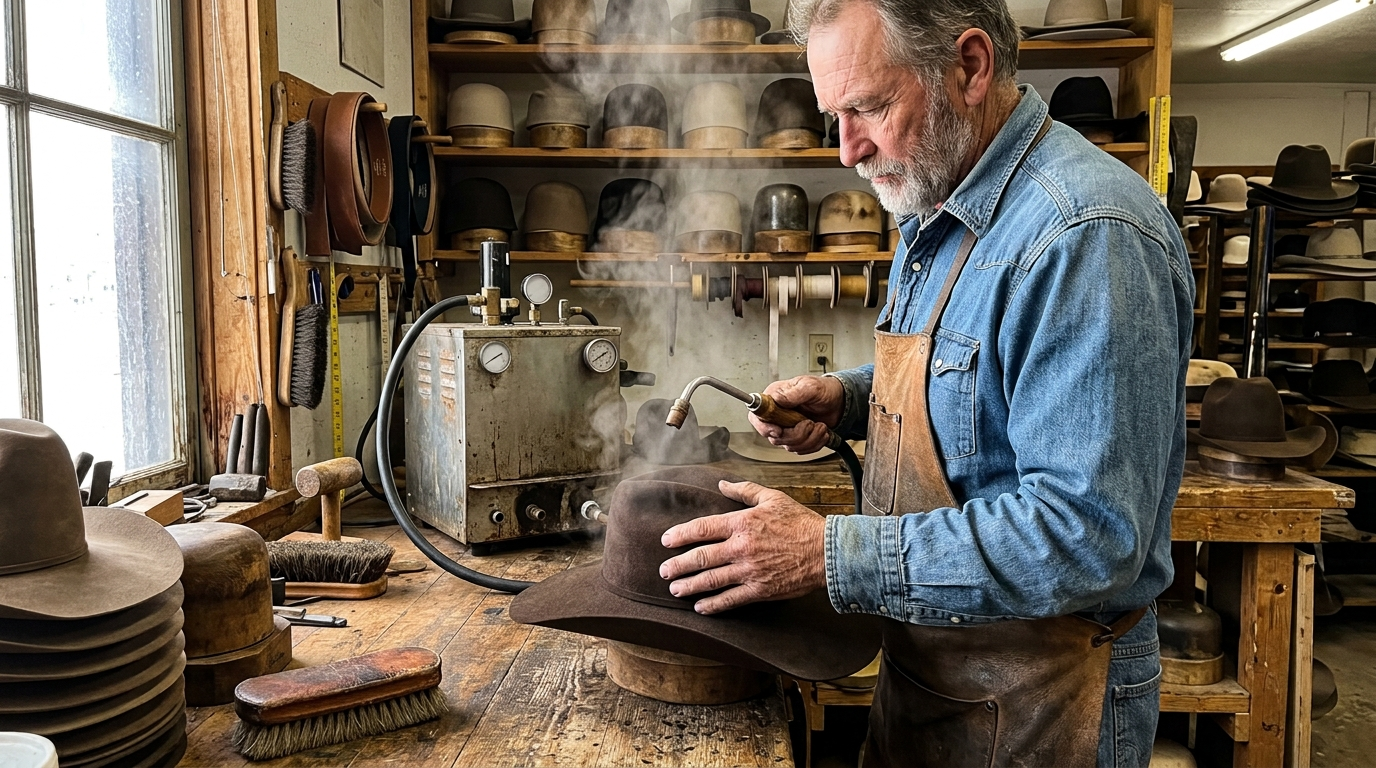
Hat shops use steam to shape felt, straw, and western hats. This typically requires a boiler with a steam wand or specialized attachment. Hoffman Steam’s hat shop bundles range from $2,149 to $4,895.
For a deeper look at hat-specific requirements, see the hat shop buyer’s guide.
Commercial Electric Steam Boiler
A boiler-based steam generator that powers accessories like irons, brushes, wands, and spray guns. This is the most versatile category for small commercial and light industrial users. ASME classifies electric boilers under Section I power boiler certificates. Prices for small commercial electric boilers typically run from about $1,200 to $10,000 depending on capacity, pressure, fill system, and certification.
What This Article Does Not Cover
This guide focuses on commercial electric steam equipment for trades and light industry. It does not cover household handheld steamers, steam mops, consumer multipurpose cleaners, building heat boilers, gas-fired boilers, restaurant food steamers, or large plant boiler systems.
Glossary of Terms That Affect Commercial Steamer Cost
The price of a commercial steamer depends on specifications most buyers have never compared before. These are the terms that matter, defined in plain language.
Purchase Price vs. Total Cost of Ownership
The purchase price is what you pay upfront for the machine. Total cost of ownership (TCO) is what you pay over the equipment’s life: the machine itself, accessories, electricity, water treatment, descaling, replacement parts, inspections, and downtime.
A $2,000 machine that lasts 15 years costs roughly $133 per year before operating expenses. A $400 machine replaced every two years costs $200 per year, and that is before you count lost productivity during each replacement cycle.
PSI
Pounds per square inch, a measure of steam pressure. Higher PSI generally means stronger, steadier steam delivery, which matters for tasks like jewelry cleaning or pressing. Hoffman’s EVD-1 produces 40 PSI. More pressure usually means more safety controls and higher equipment cost.
kW
Kilowatts, the electrical power draw of the steamer. kW directly affects how much steam the unit can produce and how much electricity it costs to run. Hoffman’s base ELG4 draws 1.5 kW; optional upgrades push it to 3 kW at 220V. A 1.5 kW machine at full draw costs about $0.21 per hour to operate at current U.S. commercial electricity rates. More on the math in the operating cost section below.
110V vs. 220V
Voltage requirement for the machine. A 110V steamer plugs into standard U.S. outlets, which makes placement simple. A 220V unit can support higher power draw and more steam output but may require electrical work. Hoffman’s EVD-1 and base ELG4 models run on 110V, with optional 220V upgrades available on several models.
For a full breakdown of power specifications, read the specs and power guide.
Manual Fill vs. Automatic Pump Fill
Manual fill means you add water by hand. Automatic pump fill means a pump feeds water into the boiler continuously. Manual fill costs less and keeps the system simpler, but you need to stop and refill during heavy use. Automatic fill costs more but supports longer duty cycles without interruption. Hoffman’s JEL11 automatic pump system is priced at $7,895 compared to $4,495 for the manual-fill JEL11M.
ASME
The American Society of Mechanical Engineers sets the Boiler and Pressure Vessel Code (BPVC). ASME certification is not a marketing badge. It means the equipment was designed, fabricated, and inspected according to pressure-vessel safety standards. For commercial steam equipment, ASME certification can matter for inspections, insurance, and facility approval.
UL
UL listing indicates testing and certification to applicable safety standards. For commercial steam equipment, UL certification is often relevant to buyer confidence, insurance requirements, and electrical safety expectations. Hoffman’s ELG4 is ASME/UL certified.
For more on what these certifications mean in practice, see the ASME/UL compliance guide.
Form P2A
The manufacturer’s data report for electric boilers under ASME BPVC. This is the paperwork an inspector may ask for when a pressurized boiler is subject to jurisdictional rules. ASME lists P-2A as the data report for electric boilers. Reimers warns that without this form, an inspector can tag a boiler as unusable.
Blowdown
Removing water from a boiler to control dissolved solids and sludge. Too little blowdown can cause mineral deposits and steam-quality problems. Too much wastes water, energy, and chemicals. The U.S. Department of Energy identifies blowdown control as a critical boiler maintenance practice.
Practitioners on Reddit’s industrial maintenance forum echo this point. Several users warned against changing blowdown schedules just to save money without understanding the boiler’s water chemistry and the requirements of the authority having jurisdiction.
Duty Cycle
How long and how often a steamer can operate under real workload before it needs to cool down or rest. A cheap steamer may make steam, but surviving daily commercial use is a different question entirely. Practitioners on Reddit’s auto detailing forum make this distinction bluntly: one user called cheap plastic steamers “literally garbage” for commercial settings because they are not repairable and do not hold up under continuous use.
Refurbished
Used equipment restored by the factory or an authorized seller. A refurbished unit can cut upfront commercial steamer cost significantly. Hoffman’s Refurbished JEL3 Workhorse Bundle is priced at $999 and includes a 1-year warranty plus a 2-year Workhorse Essential plan covering factory reconditioning, inspections, and a loaner unit.
What Changes the Price?
Seven factors drive commercial steamer cost from one price tier to the next.
1. Steamer type. A garment steamer and a pressurized boiler are not interchangeable tools. The garment steamer costs less because it does less.
2. Pressure and boiler construction. Pressurized equipment costs more because it requires stronger vessel construction, safety valves, pressure gauges, blowdown valves, and sometimes ASME documentation.
3. Capacity. More gallons means more steam output and longer runtime. Hoffman’s product line scales from 1 gallon ($1,199) to 6 gallons ($4,495 to $7,895), with industrial models going higher still.
4. Fill system. Manual fill is cheaper upfront. Automatic pump fill costs more but supports heavier daily use without interruption.
5. Electrical requirements. A 110V unit is simpler to install. A 220V or higher-kW unit supports more steam production but may require electrical planning and additional wiring.
6. Certification. ASME/UL certified equipment costs more to manufacture, and that cost is passed to the buyer. But it can matter for inspections, insurance, and buyer confidence.
7. Accessories and bundles. Steam nozzles, foot pedals, spray guns, wands, brushes, carts, and trade-specific bundles all add to the total. Hoffman’s hat shop bundles range from $2,149 to $4,895, and clothing store bundles run from $1,408 to $2,379.
If you are unsure about what capacity your shop needs, the boiler sizing guide walks through how to match capacity to workload.
Commercial Steamer Cost Breakdown: Where Your Money Goes
The equipment price is only one part of the total commercial steamer budget. Before comparing two machines, separate the purchase price from the costs required to install, operate, maintain, and eventually replace the equipment.
Cost category | What can affect the cost |
|---|---|
Equipment | Boiler size, pressure, construction, controls and brand |
Accessories | Wands, hoses, irons, spray guns, brushes and specialty attachments |
Electrical installation | 110V vs. 220V, circuit capacity, wiring and electrician labor |
Water supply | Manual filling, plumbing connections, filtration and treatment |
Installation | Equipment placement, connections and site preparation |
Compliance | Inspections, registration, documentation and certification where applicable |
Operating energy | kWh consumed and local electricity rates |
Maintenance | Descaling, blowdown, water treatment and replacement parts |
Downtime | Lost production while equipment is being repaired |
Financing | Interest, fees and payment terms if equipment is financed |
For a small shop, the equipment purchase may represent most of the initial expense. For a higher-volume operation, installation, maintenance, energy consumption, and downtime can become much more important to the total cost of ownership.
Operating Cost: How to Estimate Electricity
The purchase price gets the most attention when people search for commercial steamer prices, but electricity is a recurring cost that adds up fast.
The formula is straightforward:
kW x hours used x electricity rate = estimated energy cost
The current U.S. commercial electricity average is 13.97 cents per kWh year-to-date through July 2026, according to the EIA’s Electric Power Monthly.
Here is what that looks like in practice:
Power Draw | Cost per Hour | Monthly Cost (8 hrs/day, 22 days) |
|---|---|---|
1.5 kW | ~$0.21 | ~$37 |
3 kW | ~$0.42 | ~$74 |
10 kW | ~$1.40 | ~$246 |
These are full-draw estimates. Actual costs will be lower because thermostats cycle, and the heating element is not running at maximum power continuously. Your local electricity rate may also differ from the national average. But this gives you a reasonable starting point for budgeting.
For a 1.5 kW unit like Hoffman’s base ELG4, annual electricity cost at these full-draw rates would be roughly $440. The actual figure depends on daily hours of use and local utility pricing.
Maintenance Costs Most Buyers Forget
The sticker price on a commercial steamer is where most comparison shopping begins, but maintenance is where long-term cost separates a good investment from an expensive mistake.
What to Budget For
Water treatment and descaling
Blowdown supplies and procedures
Replacement hoses, nozzles, and gaskets
Solenoid valves and heating elements
Sight glass parts and safety valves
Periodic inspections and recertification (where applicable)
Downtime or loaner costs during repairs
The Department of Energy recommends routine inspection, steam-trap checks, blowdown control, water treatment, and waterside inspection as standard boiler maintenance practices. These recommendations apply to small commercial boilers too, not just large industrial systems.
Water Treatment Is Not Optional
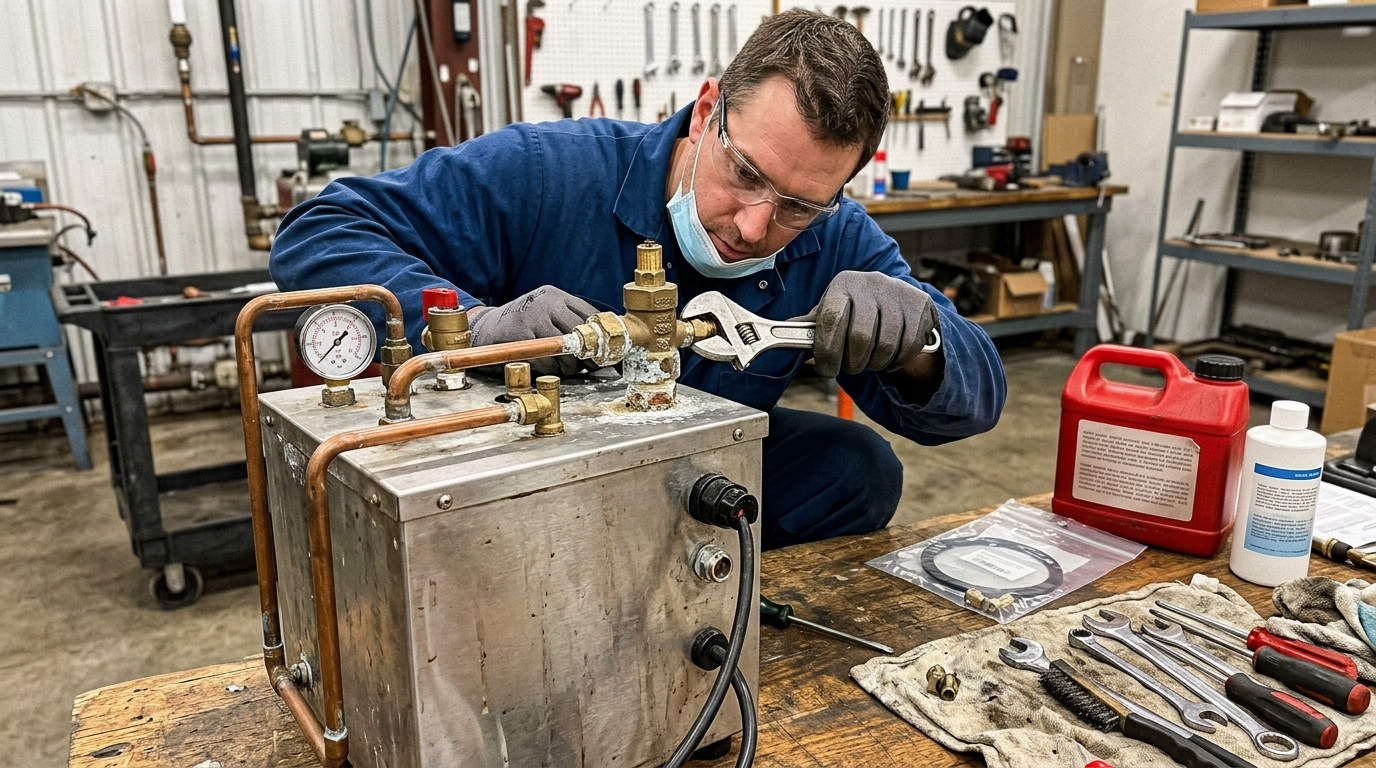
A steam boiler is only as good as its feedwater. Hard water creates scale buildup that reduces heat transfer and shortens equipment life. Practitioners on LinkedIn who work with steam systems consistently frame feedwater quality as the single most important factor in protecting both the boiler and the operating budget.
Dry-cleaning practitioners on Reddit report using water softeners, boiler treatment chemicals, and dedicated chemical service companies as standard practice. One user warned that soft water alone is not enough and can still damage a boiler and related steam lines without proper chemical treatment.
Parts Availability Matters
In a dry-cleaning equipment discussion on Reddit, one practitioner noted that well-maintained machines can last a long time, but parts availability becomes the hardest problem when something eventually breaks. This is worth considering before buying from any manufacturer with limited U.S. parts support.
Hoffman addresses this with two protection plans. The Workhorse Lite plan runs $216 per year and includes automatic consumable shipments, a 20% parts discount, and VIP support. The Workhorse Essential plan at $280 per year adds full factory reconditioning every 24 months, a 47-point inspection, parts and labor coverage, ASME/UL recertification, and an immediate hot-swap loaner unit.
For more on planning these expenses, see the maintenance cost budgeting guide.
When a Cheap Steamer Becomes the Expensive Choice
There is nothing wrong with buying a $300 garment steamer if all you need is wrinkle removal. The problem starts when a business buys the cheapest available option for work that demands commercial-grade equipment.
Situation | Better Fit |
|---|---|
Occasional garment touch-up | Professional garment steamer ($200 to $500) |
Daily jewelry bench cleaning | Pressurized jewelry steamer or boiler ($1,200 to $4,500+) |
All-day hat shaping | Boiler with hat attachment or trade bundle ($2,149 to $4,895) |
Tailoring and pressing | Boiler compatible with irons and brushes ($1,199 to $2,599) |
Continuous light manufacturing | Automatic pump-fill boiler ($6,999 to $9,499) |
Budget-sensitive but serious commercial use | Factory-remanufactured unit with warranty ($999+) |
One jeweler on Reddit shared that they had used two Hoffman steamers in 30 years, with the first lasting 24 years and needing only one repair. On the Ganoksin jewelry forum, another practitioner described a decades-old commercial steamer still working after basic overhaul and maintenance.
The math favors longevity. A $2,000 machine that lasts 15 years costs $133 per year. A $400 machine that fails after two years of heavy use costs $200 per year, before you count the days the shop sat idle waiting for a replacement.
Find the right steamer for your business type and workload.
Downtime Is the Real Hidden Cost
In steam-dependent businesses, the real cost of equipment failure is not the repair bill. It is the lost production. A dry-cleaning practitioner on Reddit put it simply: if the boiler goes down, the shop cannot operate. LinkedIn posts from steam-system professionals make the same point at a facility level, noting that unplanned steam downtime should never be treated as just a repair expense because it can shut down the entire workflow.
If the steamer is part of revenue-producing work, a cheaper machine is not cheaper when it stops the bench, press, or production line.
Permits, Inspections, and Documentation
Not every commercial steamer requires a permit or inspection. The distinction depends on whether the unit is a pressurized boiler and what your local jurisdiction requires.
A non-pressurized flash steamer like Hoffman’s GEM-III ($995) does not store pressurized steam in a boiler vessel, so no boiler permit is needed. That makes it straightforward for mall, retail, and smaller trade environments.
A pressurized boiler steamer is different. If the machine stores water and steam under pressure, it may be subject to boiler laws, ASME documentation requirements, and periodic inspection. Reimers states explicitly that its JJ jewelry steamer is a boiler that must conform to boiler laws and that each unit requires Form P2A documentation signed by a commissioned National Board Boiler Inspector.
Before buying a pressurized commercial steamer, ask these three questions:
Does the manufacturer provide ASME/UL documentation?
Does my jurisdiction require boiler registration or inspection?
What Form P2A or manufacturer’s data report ships with the unit?
Boiler rules vary by state and municipality. The safest approach is to contact both the manufacturer and your local authority having jurisdiction before placing an order.
For more on safety and compliance, see the light manufacturing compliance guide.
Buyer Checklist: Questions to Ask Before Comparing Prices
Before you compare commercial steamer costs, answer these questions. They will narrow your options faster than browsing product pages.
What job does the steamer need to do? Garment steaming, jewelry cleaning, hat shaping, pressing, spraying, shrink packaging, or production steam?
Do I need pressurized steam, and at what PSI?
How many hours per day will it run?
Manual fill or automatic fill?
Is 110V enough, or do I need 220V?
Will my shop need electrical work to support the unit?
Does the unit need ASME/UL documentation for my jurisdiction?
What accessories are included, and what costs extra?
What replacement parts are available, and from where?
What water treatment or descaling schedule does the manufacturer recommend?
What happens if the unit goes down? Is a loaner or hot-swap available?
Is refurbished equipment a smart option for my budget?
Can I finance or lease the equipment instead of paying upfront?
If you know what you need but want to explore payment options, see the equipment financing guide.
Frequently Asked Questions
How much does a commercial steamer cost?
Commercial steamer cost ranges from about $200 for a professional garment steamer to over $9,500 for an industrial automatic pump-fill electric boiler. Most small businesses buying pressurized boiler equipment for jewelry, hats, tailoring, or similar work spend between $1,000 and $8,000. Full industrial steam boilers can exceed $60,000, but that is a different market from small commercial use.
Why do some commercial steamers cost $300 and others cost $3,000?
Because they are different tools. A $300 garment steamer is designed for fabric touch-ups. A $3,000 pressurized boiler steamer is built for stronger steam output, accessories like spray guns and wands, daily commercial duty cycles, and sometimes ASME/UL certification. The price reflects construction quality, pressure capability, capacity, safety features, and documentation.
Is a pressurized commercial steamer always better?
Not always. Pressure matters when the job demands it, like blasting residue off jewelry or shaping hats with consistent steam. A boutique touching up garments a few times a day may not need pressurized equipment at all. Match the steamer to the work, not the other way around.
Do commercial steamers require permits?
Some do, some do not. Non-pressurized steamers generally do not require boiler permits. Pressurized boiler steamers may be subject to boiler laws, inspection requirements, and ASME documentation depending on your jurisdiction. Ask the manufacturer about Form P2A documentation and check with your local authority before buying.
How much does it cost to run a commercial steamer?
At the current U.S. commercial electricity average of 13.97 cents per kWh, a 1.5 kW unit costs about $0.21 per hour at full draw. A 3 kW unit costs about $0.42 per hour. Actual costs depend on duty cycle, thermostat cycling, daily hours of use, and your local electricity rate.
What hidden costs should I budget for?
Budget for accessories, water treatment supplies, descaling, blowdown, replacement parts (hoses, nozzles, valves, heating elements), inspections where applicable, electricity, and potential downtime. These items can add hundreds of dollars per year to the total cost of ownership.
Is refurbished commercial steam equipment worth buying?
It can be a strong option if the unit is factory-remanufactured with a warranty and active parts support. Hoffman’s Refurbished JEL3 Workhorse Bundle is priced at $999 and includes a 1-year warranty plus a 2-year Workhorse Essential plan covering factory reconditioning, inspections, and a loaner unit.
How long do commercial steamers last?
With proper maintenance, commercial electric steam boilers can last well over a decade. One jeweler on Reddit reported using two Hoffman steamers across 30 years, with the first lasting 24 years. Longevity depends on water treatment, descaling habits, timely parts replacement, and consistent maintenance.


