

TL;DR
Commercial steamer recovery time is how long a steamer takes to return to usable steam output after a burst, load, or pressure drop during work. It matters more than heat-up time for shops running repeated jobs because it directly controls how long workers wait between tasks. Recovery depends on boiler reserve, wattage, water quality, refill temperature, and operator technique. Buyers should test recovery under real working conditions, not trust vague “fast recovery” claims.
What Recovery Time Actually Means
Commercial steamer recovery time is the interval between “I just used steam” and “the machine is ready to deliver full steam again.” More precisely, it measures how long a steamer, steam generator, or electric boiler takes to return to usable steam output after demand causes a drop in pressure, temperature, or steam volume.
This happens constantly during real work. A jeweler releases a burst to blast polishing compound off a ring setting. A hat shaper steams heavy felt until the crown is pliable. A garment finisher runs steam through an iron across a dozen suits. Every time steam leaves the machine faster than the heating system can replace it, performance drops. Recovery time is the climb back.
One commercial steamer sizing guide defines recovery as the interval needed for a unit to return to full steam after a load is introduced, and states that this number can determine effective output more than peak capacity source.
If you are comparing commercial steamers for your shop, recovery time is the spec that separates a machine that gives one strong burst from a machine that keeps up all day.
Compare commercial steamers matched to small business workflows.
What Is Commercial Steamer Recovery Time?
Commercial steamer recovery time is the time a steamer or steam boiler takes to return to a defined operating condition after steam use causes pressure, temperature, or output to drop. Unlike heat-up time, which measures how long a machine takes to warm up from a cold start, recovery time shows how well it handles repeated work throughout the day.
For commercial buyers, the most useful recovery measurement is the time required to restore usable steam at the working attachment after a realistic burst or load. The result depends on boiler capacity, heating power, refill water temperature, water quality, machine design, and the way the steamer is used.
The buying rule: Compare recovery times only when the machines have been tested under the same conditions, including burst duration, starting state, electrical supply, attachment, and the definition of “ready.”
Recovery Time vs. Heat-Up Time
This is the most common confusion buyers face. Heat-up time and recovery time measure two different things.
Heat-up time is how long a steamer takes to reach operating temperature or pressure from a cold start. It tells you how long the machine needs after you flip the switch in the morning.
Recovery time is how long the machine takes to rebound after steam is used. It tells you how long workers wait between jobs during the workday.
A machine can heat up fast and still recover slowly. A small flash steamer might reach operating temperature in minutes but struggle to rebuild after three heavy bursts in a row. Conversely, a larger boiler may take longer to heat from cold but recover better under repeated demand because it holds more hot water and stored energy.
Spec | What it measures | When it matters |
|---|---|---|
Heat-up time | Cold start to ready | Opening the shop, first job of the day |
Recovery time | Rebound after steam use | Every job after the first one |
Runtime | Total operating time before refill | Long batches, continuous-duty work |
Duty cycle | How long a machine can run without degrading | Production environments |
A thermal engineering article on boiler systems makes the relevant point that wattage affects how quickly a system recovers after water is used, while boiler mass and thermal inertia help reduce performance drops during repeated demand cycles source. The principle applies directly to commercial steamers: wattage alone does not guarantee fast recovery, but it is one important factor.
Why Recovery Time Matters More Than You Think
Capacity tells you what fits. Recovery time helps determine what actually gets finished.
Here is a simple way to see the impact. Think of every steaming job as a cycle with three parts: active steaming time, handling time (repositioning the item, loading the next piece), and recovery time.
Effective cycles per hour = 60 ÷ (steaming time + handling time + recovery time)
With a 10-second recovery:
30 seconds steaming + 20 seconds handling + 10 seconds recovery = 60-second cycle
That gives 60 cycles per hour.
With a 40-second recovery:
30 seconds steaming + 20 seconds handling + 40 seconds recovery = 90-second cycle
That gives 40 cycles per hour.
The difference is a 33% reduction in output without changing anything except recovery time. Over an eight-hour shift, that gap compounds into dozens of lost jobs and significant labor cost sitting idle.
This math is why steamer recovery time belongs in every equipment comparison. It is not an abstract engineering detail. It is a throughput number.
How to Calculate the Labor Cost of Slow Steamer Recovery
Recovery time affects labor productivity because workers may have to wait before they can complete the next steaming cycle.
Use this formula to estimate the time lost to recovery:
Daily recovery time = Jobs per day × Average recovery time per job
For example, suppose a shop processes 100 jobs per day and a machine requires an average of 20 seconds of recovery per job.
Daily recovery time: 100 × 20 seconds = 2,000 seconds, or 33.3 minutes.
Over 22 working days: approximately 12.2 hours of recovery time per month.
This is a simplified estimate. It assumes recovery time occurs separately for every job and that the worker cannot perform another productive task while waiting. In practice, some recovery may overlap with handling or setup.
To estimate the potential productivity benefit of a faster machine, compare the measured recovery times under the same working conditions:
Potential time saved = Jobs per day × (Current recovery time − New recovery time)
Multiply the result by the number of working days to estimate monthly time saved.
Use the result alongside equipment price, maintenance costs, energy use, and expected production demand when evaluating whether a faster-recovering machine justifies its additional cost.
The Four Types of Recovery Time
Spec sheets rarely explain what kind of recovery they are measuring. That ambiguity makes comparison shopping difficult. There are actually four distinct types of recovery, and they apply to different equipment and trades.
Pressure Recovery
This is the time for a pressurized boiler to return to its target pressure range after steam is released through a nozzle, wand, or iron. It matters most for jewelry steamers, hat shaping boilers, steam irons, and spray guns. If your steamer’s gauge drops from 60 PSI to 30 PSI after a burst, pressure recovery is how long the climb back to 60 takes.
For anyone troubleshooting pressure issues, there is a helpful low steam pressure checklist worth reviewing.
Steam-Flow Recovery
This measures how long the steamer takes to return to full visible and functional steam output after a burst or continuous draw. It is most relevant for flash steamers, garment steamers, and portable units where the user watches the steam plume rather than a pressure gauge.
Temperature Recovery
This is the time for the steam chamber, boiler water, or heated surface to return to target temperature after cold product is loaded, a door is opened, or cool refill water enters the system. A 2025 patent application on steam cooking systems notes that refilling with room-temperature water can lower water temperature enough to interrupt steam generation entirely source. The same principle applies to any commercial steamer that accepts cold makeup water during operation.
Workflow Recovery
This is the one that matters most to shop owners. Workflow recovery is the time until the operator can continue productive work without waiting. It accounts for all three types above plus any indicator delay, refill step, or adjustment.
A spec sheet might define recovery as pressure recovery or temperature recovery. A business owner should focus on workflow recovery: how long does the employee actually wait before the next ring, hat, garment, or part can be processed?
What Affects Commercial Steamer Recovery Time
Recovery is not a fixed number. It changes based on machine design, installation, maintenance, and how the operator uses the equipment.
Boiler Reserve
A boiler with more hot water holds more stored energy. It can deliver multiple bursts before pressure or temperature drops noticeably. The tradeoff is that larger boilers take longer to heat from cold and may require more maintenance. EPA WaterSense frames this choice clearly: boiler-based steamers suit high-volume or made-to-order work because steam is available in high volume without refilling, while boilerless units may fit lower-volume use with less maintenance source.
Wattage and Heating Elements
Higher wattage can restore temperature and pressure faster, but wattage alone does not prove fast recovery. A 3kW element in a well-insulated boiler with the right water volume will outperform a 3kW element in a poorly insulated tank with too much water mass. Design matters as much as raw power.
Electrical Supply
The difference between 110V and 220V configurations can change how much heating power reaches the element. For shops evaluating this tradeoff, there is a detailed comparison of 110V vs. 220V steamers worth reading. In general, higher-power configurations can support faster steam generation, but actual recovery should be tested under the workload and attachments the shop will use.
Cold Refill Water
Every time cool water enters a hot boiler, the system must spend energy reheating before it can produce steam again. This is one of the most overlooked factors in steamer recovery time. Shops that refill mid-session with cold tap water will see longer recovery than those using preheated or room-temperature water.
Manual Fill vs. Automatic Fill
Manual-fill units are simpler and require no plumbing, but uptime depends on the operator refilling at the right time and not running the tank too low. Auto-fill systems maintain water level automatically, reducing interruptions but introducing cold water during operation. The tradeoffs are significant enough to warrant a full comparison.
Water Quality and Scale
Scale buildup on heating elements acts like insulation, slowing heat transfer from the element to the water. Over time, this makes recovery progressively worse. EPA WaterSense notes that hard water and mineral buildup can cause decreased efficiency and component damage source.
Practitioners on Reddit and Ganoksin consistently connect steamer longevity with care habits: using distilled water, flushing regularly, performing blowdown, and never running the machine near empty. Ganoksin’s shop maintenance guide recommends weekly blowdown for standard boiler-type steamers according to manufacturer instructions source.
A steamer that recovered well when new can recover poorly after months of scale buildup. Understanding water quality standards for steam equipment helps prevent that.
Hose, Nozzle, and Attachment
Longer hoses, restrictive nozzles, and oversized attachments all change how steam reaches the work surface. A machine might recover to operating pressure at the boiler while the operator still waits for adequate steam at the nozzle tip. Always test recovery with the actual attachments your shop will use.
Operator Technique
Recovery time is not purely a machine spec. The operator can make it better or worse. A GemOro steamer manual advises using short one- or two-second bursts with brief delays between them so the steamer can rebuild pressure. Continuous, heavy draws will always stress recovery more than disciplined burst patterns.
See current steamer pricing across different capacity tiers.
Recovery Time by Trade
Jewelry Cleaning
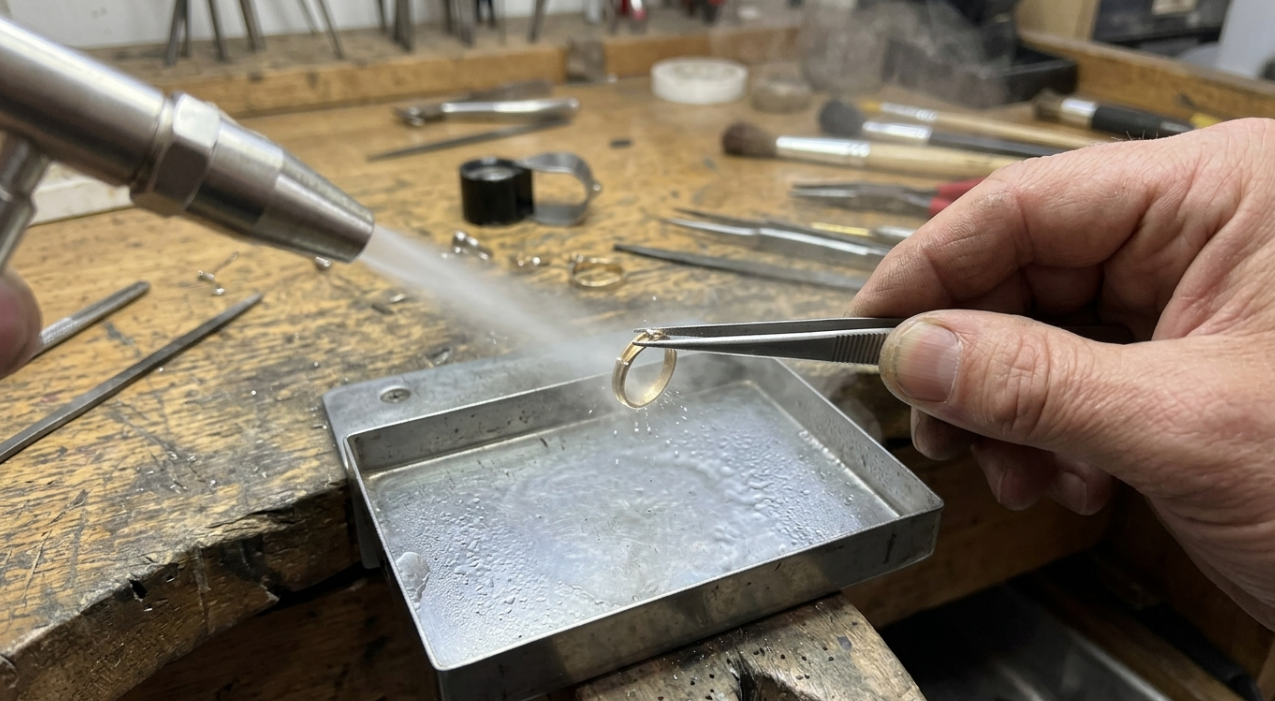
Jewelry work typically involves repeated short bursts to remove polishing compound, oils, and residue from settings and stones. A bench jeweler producing 25 to 35 custom pieces per week may trigger dozens of steam bursts daily. If recovery is slow, staff pause between every ring.
Practitioners on Reddit describe the buying decision in practical terms. In one r/jewelers thread, a small fine jeweler asked for recommendations for a unit that was not connected to a waterline, was easy to maintain, and could handle steady shop use. One commenter recommended a Hoffman Pro JEL3, while another noted that pipe replacement fixed dirty-looking steam output.
What matters for jewelers is not just pressure or PSI. It is whether recovery keeps pace with the work. One r/jewelers thread includes a user reporting “2 Hoffman’s in 30 years,” with the first lasting 24 years after one repair. That kind of durability ties directly to recovery over time: a machine that maintains performance for decades clearly holds its recovery characteristics when properly maintained.
A caution worth noting: GIA warns that some treated or filled gemstones should not be exposed to rapid temperature changes, and steam cleaning involves extreme temperatures that can damage certain included or sensitive stones source.
Hat Shaping
Hat shaping requires sustained steam to penetrate felt and keep the material workable while the shaper manipulates crown and brim. The issue is not just a strong initial burst. The hat maker needs enough steam throughout the shaping window, which can last 15 to 30 seconds or longer.
Practitioners on The Fedora Lounge draw a clear line between weak steam sources and dedicated steamers. One member noted that a kettle did not produce enough steam for serious work, while a tabletop steamer provided a larger plume and more working time between steaming and shaping. In a Reddit r/CowboyHats thread about buying a steamer for a Western store, one commenter said that for professional shaping, they would buy a Hoffman Pro Line hat shaper bundle.
For hat shops, recovery time determines whether back-to-back customer fittings flow smoothly or create awkward waits. It should be tested with the actual hat material and shaping head, not just open steam in the air.
Garment Finishing
Garment finishing and pressing involve steam irons, wands, or nozzle work across racks of clothing. Recovery time here translates directly into seconds per garment, which scales into labor cost over a full day.
A garment steamer guide from a commercial equipment supplier argues that recovery time is more important than cold heat-up time, because buyers should ask how quickly a boiler regains full pressure after several minutes of heavy steaming. The guide also recommends focusing on sustained steam output rather than peak wattage alone.
A machine that saves 20 seconds per garment might cost more upfront, but in a shop steaming 100 garments a day, that is 33 minutes of recovered labor. Over a month, the math favors the faster-recovering machine.
Upholstery and Light Industrial Work
Upholstery restoration, taxidermy, shrink packaging, and light manufacturing often require longer bursts or continuous steam. Recovery time should be tested after the longest realistic burst, not after a quick tap of the foot pedal.
Hose length and attachment type can change the apparent recovery in these applications. A 12-foot hose with a wide nozzle draws more steam per second than a short hose with a tight tip. The machine may be recovering at the boiler, but the operator feels a delay at the working end.
For continuous-duty applications, the machine must be sized for sustained output. Recovery time is part of that calculation, but so is overall capacity and duty cycle.
Explore electric steam boilers built for small business and light industrial use.
Commercial Steamer Recovery Requirements by Application
Application | Typical steam demand | What to prioritize | How to test recovery |
|---|---|---|---|
Jewelry cleaning | Short, repeated bursts | Consistent pressure and repeatable steam output | Run repeated bursts through the actual jewelry nozzle and measure the time until usable output returns |
Hat shaping | Sustained bursts during shaping | Steam availability throughout the shaping process | Steam the actual felt material for a realistic interval, then check whether output returns before the next job |
Garment finishing | Repeated or extended steam draws | Stable output across multiple garments | Test with the actual iron or wand while processing a representative batch |
Upholstery restoration | Variable bursts, sometimes extended | Adequate output with the intended hose and attachment | Repeat the longest typical steaming cycle and measure interruptions |
Light industrial work | Potentially sustained, high-volume demand | Rated output, duty cycle, and suitability for continuous operation | Test at the expected production demand and confirm that the machine is rated for that operating pattern |
Buying takeaway: Choose a steamer for its ability to meet your real steam demand, not simply for its tank size, peak pressure, or advertised heat-up time. If your work requires continuous output, confirm the machine’s rated capacity and duty cycle as well as its recovery performance.
How to Test Recovery Time Before Buying
Most product pages say “fast recovery” without defining the test condition. That phrase means nothing unless you know what happened before the measurement. Here is a practical field test you can perform or ask a dealer to demonstrate.
Step-by-Step Burst Recovery Test
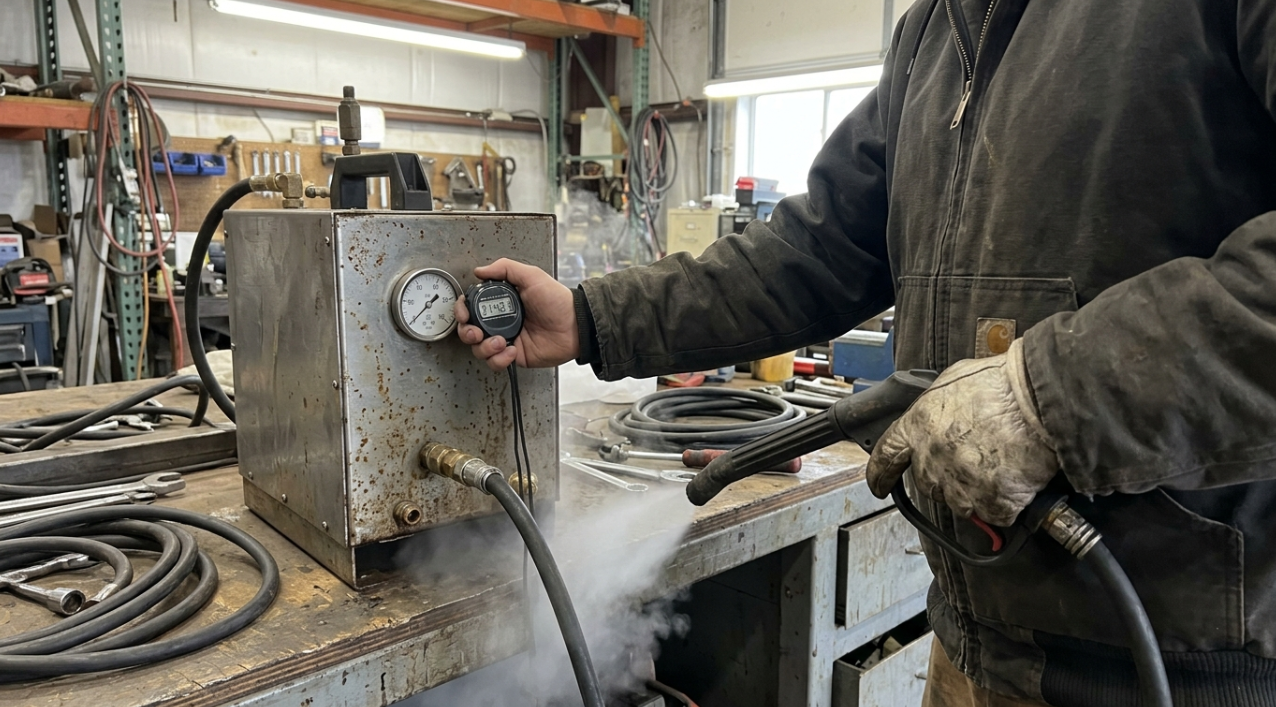
Fill and heat the machine according to the manufacturer’s instructions.
Wait until the gauge, ready light, or indicator shows the machine is at full operating condition.
Record starting pressure or readiness state.
Release steam for a realistic work interval. For jewelry, that is 2 to 10 seconds. For hat shaping, 15 to 30 seconds. For garment finishing, 30 to 60 seconds. For upholstery, use your actual attachment and longest typical burst.
Stop steaming.
Start a timer immediately.
Stop the timer when the machine returns to the same ready condition: target pressure, ready light, stable steam output, or target temperature.
Repeat at least 10 times.
Record both average recovery and worst-case recovery.
Repeat the entire sequence after 30 to 60 minutes of normal use to check whether recovery slows as the machine heats, scales, or cycles.
What to Record
Note the voltage and circuit, starting and lowest pressure, time to return to target, water type, fill level, attachment used, burst duration, ambient temperature, whether the machine refilled during the test, and whether steam quality became wetter or weaker over repeated cycles.
Average recovery is useful for planning. Worst-case recovery is what workers actually feel during a rush.
Better Spec Language to Look For
Weak: “Fast recovery.”
Better: “Returns from 40 PSI to 60 PSI in 25 seconds after a 10-second burst through the standard jewelry nozzle.”
Weak: “Continuous steam.”
Better: “Maintains usable steam through 20 consecutive 15-second bursts with less than 10 seconds average recovery between bursts.”
If a manufacturer cannot describe the test condition, treat the recovery claim with skepticism.
How to Compare Commercial Steamer Recovery Specifications
Commercial steamer manufacturers may describe recovery using different measurements. One may report the time needed to restore boiler pressure, while another may measure the return of usable steam output. These figures should not be compared directly unless the test methods are equivalent.
Use the following checklist when evaluating manufacturer claims:
Specification | What to verify |
|---|---|
Recovery time | The starting condition, target condition, and elapsed time |
Starting pressure | The pressure immediately before steam demand begins |
Pressure drop | The lowest pressure reached during the test, if pressure is the measurement |
Burst duration | How long steam is released and whether demand is continuous or intermittent |
Steam output | Whether the manufacturer measures output at the boiler or working attachment |
Electrical supply | Actual voltage and available power during testing |
Refill conditions | Whether the tank was refilled during the test and the temperature of incoming water |
Repeated-cycle performance | Whether recovery remains consistent across multiple cycles |
A useful manufacturer specification describes both the result and the conditions under which it was measured.
For example, “recovers in 25 seconds” is less informative than a documented test showing the starting operating state, duration of steam use, target state, attachment, and electrical configuration.
If two manufacturers use different test methods, treat their recovery figures as separate reference points rather than a direct performance ranking. Ask both suppliers to demonstrate the machines using the same practical test wherever possible.
What Is a Good Commercial Steamer Recovery Time?
There is no single recovery-time benchmark that applies to every commercial steamer. A suitable recovery time depends on the machine’s design, the type of work being performed, and how frequently steam is used.
For example, a jewelry shop using short bursts may need consistent pressure and a quick return to usable output between pieces. A garment-finishing business may place greater importance on sustained steam output across a batch of garments. A light industrial operation may need a machine rated for continuous use rather than one optimized for intermittent bursts.
When evaluating recovery performance, consider three questions:
Does the machine recover before the next job is ready? If recovery finishes while the operator repositions the item, it may not create a meaningful workflow delay.
Does output remain usable under repeated demand? A strong first burst is not enough if pressure or steam volume drops during a busy session.
Does the machine meet your production requirements? If the equipment cannot maintain the necessary output, a faster recovery time alone may not solve the problem.
Do not treat a manufacturer’s recovery claim as a universal benchmark. Compare machines using the same burst duration, attachment, electrical supply, starting condition, and definition of usable output.
If no comparable recovery data is available, request a demonstration and record the results under your expected working conditions.
A Quick Note on the Physics
When a pressurized steamer drops pressure, it is not just losing force at the nozzle. In saturated steam systems, pressure and temperature are linked. Spirax Sarco’s saturated steam tables show that steam at 40 psig sits at roughly 286°F, while steam at 70 psig reaches about 316°F source. A pressure drop means a temperature drop, which means less energy reaching the work surface.
Recovery time is the machine’s climb back to that operating condition, both the pressure and the temperature that comes with it. This is why boiler reserve helps: a large volume of hot water at the right temperature provides a buffer against momentary demand spikes.
Commercial Steamer Buying Checklist: 7 Things to Verify
Before purchasing a commercial steamer, confirm these seven points:
Recovery test conditions: Ask how long the machine takes to recover after a specified burst or load, and what operating condition defines recovery.
Usable steam output: Confirm that the machine delivers enough steam at the working attachment, not just at the boiler.
Electrical compatibility: Verify the required voltage, current, circuit capacity, and installation requirements with the manufacturer or a qualified electrician.
Demand and capacity: Match rated steam output and boiler reserve to the number of jobs, burst duration, and operating pace expected in your shop.
Refill method: Determine whether manual or automatic filling suits your workflow, and ask how refill water affects output during operation.
Water treatment and maintenance: Check water-quality requirements, descaling procedures, blowdown instructions where applicable, and maintenance costs.
Duty cycle and support: Confirm whether the machine is rated for intermittent or continuous use, and review warranty coverage, replacement parts, and service availability.
Before making a final decision, request a demonstration using the attachment and operating pattern your business will actually use. Record recovery performance over repeated cycles rather than relying on a single demonstration burst.
Questions to Ask Before Buying
Use these questions when comparing commercial steamer options or requesting a demonstration:
What does the manufacturer mean by “recovery time”? Recovery to what: pressure, temperature, ready light, or steam output?
What was the burst length or load condition used in testing?
Was the unit tested on 110V, 220V, or three-phase power?
Was the actual hose, nozzle, or attachment used during the recovery test?
How does recovery change after 30 minutes of repeated use?
Does recovery slow as the tank level drops?
Does automatic fill introduce cold water during use, and if so, how does that affect recovery?
What water treatment is required to maintain recovery performance over time?
What maintenance prevents scale-related slowdowns?
Is the machine intended for intermittent use or continuous duty?
What happens if two operators draw steam back-to-back?
These questions separate serious commercial equipment from machines marketed with vague performance claims.
Matching Recovery to Your Workflow
Recovery time is the commercial steamer spec that tells you whether a machine can keep working after the first impressive burst. It matters more than heat-up time for any shop running repeated jobs. It matters more than tank size if the heating system cannot keep pace with demand. And it matters more than price if slow recovery costs you labor hours every week.
The right approach is to match the steamer to the way your shop actually uses steam: short bursts for jewelry, sustained plumes for hat shaping, continuous iron work for garments, or heavy draws for upholstery and industrial tasks. Different work patterns stress different aspects of recovery, and the machine should be sized accordingly.
Browse Hoffman’s commercial steamer guide to compare portable flash steamers, shop boilers, and larger electric boilers by real workflow rather than brochure terms.
Frequently Asked Questions
Is recovery time the same as heat-up time?
No. Heat-up time is from cold start to usable steam. Recovery time is how long the machine takes to return to usable steam after demand causes a drop in pressure, temperature, or output. A machine can heat up fast and still recover slowly under repeated bursts.
Why does recovery time matter more than tank size?
Tank size tells you how much water the machine holds. Recovery time tells you whether the machine can keep up after steam is used. A larger tank can help by providing more thermal reserve, but wattage, boiler design, refill method, water quality, and operator technique all play a role too.
Does higher PSI mean faster recovery?
Not necessarily. PSI measures pressure, not how quickly the machine rebuilds that pressure after a burst. A high-PSI machine with an undersized heating element can still take a long time to recover.
What slows down commercial steamer recovery time?
Common causes include undersized heating elements, insufficient power supply, cold refill water entering the boiler, low water level, scale buildup on heating elements, long or restrictive hoses, oversized attachments, poor maintenance habits, and demanding burst patterns that exceed the machine’s designed output rate.
How do I test recovery time myself?
Start at the machine’s operating pressure or ready state. Release steam for a realistic burst using your actual attachment. Stop steaming, start a timer, and record how long the machine takes to return to the same ready condition. Repeat at least 10 times and note both average and worst-case recovery. Test again after 30 to 60 minutes of normal use.
Does water quality affect steamer recovery time?
Yes. Hard water causes mineral scale on heating elements, which acts like insulation and reduces heat transfer efficiency. EPA WaterSense notes that hard water and mineral buildup can decrease efficiency and damage components over time. Using filtered, softened, or distilled water and performing regular descaling helps maintain the recovery performance the machine had when new.
Can maintenance improve recovery time?
Maintenance preserves recovery performance rather than improving it beyond the machine’s design. Scale removal, proper water treatment, scheduled blowdown, and not running the machine too low all keep heat transfer and steam production closer to intended performance. Ganoksin recommends weekly blowdown for standard boiler-type steamers following manufacturer instructions.
Is recovery time or price more important for a production shop?
For any shop where workers steam repeatedly throughout the day, recovery time has a direct impact on throughput and labor cost. A cheaper machine with slow recovery can cost more in lost productivity than a more capable machine with faster recovery. The throughput formula (cycles per hour based on steaming time plus handling time plus recovery time) makes this tradeoff concrete and calculable.


