

TL;DR
Dental lab steam boiler maintenance covers the routine tasks that keep small electric steamers running safely and efficiently, from daily blowdown procedures to annual descaling. The number one enemy is mineral scale buildup, which can cause 20-25% efficiency loss from just an eighth of an inch of deposits. Using distilled water, testing safety devices weekly, and following a structured maintenance schedule can stretch a dental steamer’s lifespan from 5 years to over 20. This guide defines every maintenance term a dental lab tech needs to know and maps each one to specific actions.
Dental lab steam cleaners are essential tools for fabricating crowns, bridges, dentures, zirconia restorations, and CAD/CAM milled appliances. They produce steam at 45 to 80 PSI from compact electric tanks, typically holding 1 to 6 gallons of water. That makes them fundamentally different from the building-sized HVAC boilers that dominate most “boiler maintenance” search results online.
Yet the maintenance principles still apply. Neglect a small electric steamer and you will deal with clogged solenoid valves, failed heating elements, pressure faults, and unexpected downtime right in the middle of a case deadline.
This guide translates industrial boiler maintenance language into practical dental lab terms and gives you a schedule you can actually follow.
Exploring steamer options for your dental lab? Check out the best steamers for dental labs to compare models, capacities, and certifications.
Many dental lab steam boiler failures are preventable with routine maintenance. For most electric dental steamers, daily blowdown, weekly safety checks, monthly inspections, and annual descaling are enough to prevent mineral buildup, protect heating elements, reduce repair costs, and extend equipment life from approximately 5 years to more than 20 years.
The three highest-impact maintenance tasks are:
Use the correct water recommended by the manufacturer (usually distilled water)
Perform daily blowdown to remove sediment
Descale the boiler before mineral buildup affects heating performance
Following a documented maintenance schedule also improves workplace safety, reduces unexpected downtime, and helps meet inspection or insurance requirements for commercial steam equipment.
Why Dental Lab Steam Boiler Maintenance Matters
The core problem is simple: minerals in water become scale on metal. A layer of scale just one-eighth of an inch thick can cause 20-25% efficiency loss and puts serious heat stress on the boiler’s metal components. Even a single millimeter of limescale can reduce heating efficiency by over 10%, increasing electricity consumption and shortening component life.
For dental lab steamers specifically, the consequences go beyond energy waste. Mineral buildup clogs the narrow solenoid valves and steam jets that regulate flow. A stuck valve can cause a cleaning cycle to fail outright or, in a worst-case scenario, trigger a pressure fault that takes your unit offline.
Practitioners on the Dental Lab Network forums confirm this reality. One lab owner reported that a well-maintained Reimers unit ran for over 20 years at 8 hours a day, 5 days a week. Another described steamers as “disposable equipment” that only lasted about 5 years before trouble started. The difference between those two outcomes is almost entirely maintenance.
Maintenance at a Glance
Task | Frequency | Time Required | Why It Matters |
|---|---|---|---|
Check water level | Daily | 30 seconds | Prevents dry firing |
Blowdown | Daily | 1 minute | Removes sediment |
Inspect pressure gauge | Daily | 30 seconds | Detects abnormal pressure |
Test LWCO | Weekly | 2 minutes | Protects heating element |
Test relief valve | Weekly | 2 minutes | Confirms safety function |
Clean sight glass | Weekly | 2 minutes | Ensures accurate water readings |
Inspect gaskets | Monthly | 5 minutes | Prevents leaks |
Descale | Annually (Quarterly for hard water) | 30–60 minutes | Removes mineral scale |
How Dental Lab Steam Boilers Fail
Most dental steamers fail gradually rather than suddenly. Understanding the early warning signs allows you to schedule maintenance before the equipment stops working.
Early Warning Signs
Longer heating times
Reduced steam pressure
Steam sputtering
Water leaks
Steam leaking around fittings
Pressure gauge fluctuations
Louder heating noises
White mineral deposits around fittings
Safety valve dripping
Steam nozzle clogging
Serious Warning Signs
Boiler repeatedly trips breakers
Low-water alarm activates unexpectedly
Pressure exceeds normal operating range
Steam stops completely
Burning smell
Visible corrosion inside the tank
If any serious warning signs appear, discontinue operation until the unit is inspected.
Core Glossary: Water Management Terms
Blowdown
Blowdown is the process of draining water from the boiler to eliminate impurities, suspended solids, and sludge. For dental lab steamers, this means opening the blowdown valve (sometimes called the drain cock) at the base of the tank and releasing water until the sediment clears.
The amount of blowdown required depends directly on your water quality. Better water means less blowdown. For dental lab units, a daily pressure blowdown is standard practice. Many dental steamer manufacturers design their units with easy-access blowdown valves specifically for this purpose.
Feedwater
Feedwater is simply the water you put into your boiler. Its quality determines your entire maintenance burden. Clean feedwater means less scale, less corrosion, fewer clogged valves, and longer intervals between deep cleaning.
Total Dissolved Solids (TDS)
TDS measures the mineral content in your water, expressed in parts per million (ppm). Higher TDS means more minerals depositing inside your tank with every heating cycle. Weekly TDS testing helps you predict when descaling will be needed.
Water Hardness
Water hardness measures calcium and magnesium concentration specifically. These two minerals are the primary drivers of limescale formation in dental lab steamers. Hard water areas (above 120 ppm) will require more frequent descaling and blowdown procedures.
Descaling
Descaling is the chemical removal of mineral deposits from inside the boiler tank and on heating elements. The process relies on an acid reacting with alkaline mineral buildup. A common solution is one part white vinegar mixed with two parts distilled water, though a stronger 50/50 ratio works for heavier deposits.
One important caution: some manufacturers warn against household acids like vinegar because they can damage rubber seals, electronic sensors, and other sensitive components. Always check your unit’s manual first. If your manufacturer specifies an approved descaling agent, use that instead. For general dental lab steamers, descaling should happen at least annually, with quarterly cleaning recommended for labs using hard water.
For a deeper understanding of what specs and certifications your steamer should carry, read our guide to dental lab steamer requirements.
Core Glossary: Boiler Components That Need Maintenance
Heating Element (Internal vs. External)
This is one of the most important distinctions in dental lab steam boiler maintenance, and almost nobody talks about it clearly.
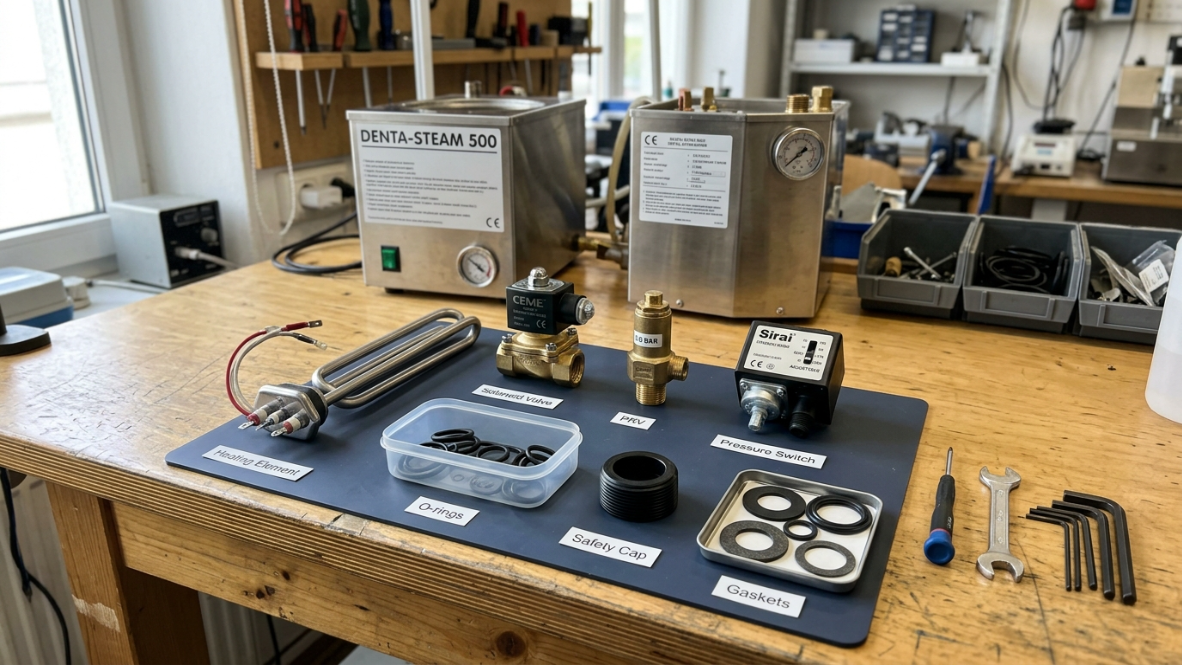
Internal heating elements sit directly inside the water reservoir, submerged in the water. They heat efficiently but are exposed to every mineral in your feedwater. These units generally require distilled water and periodic chemical descaling to prevent mineral buildup or corrosion on the element itself.
External heating elements wrap around the outside of the reservoir. The water never touches the element directly. Units with stainless steel reservoirs and external heating elements require the least maintenance, needing only periodic water flushing to clean out sediment. The stainless steel composition is practically immune to rust and corrosion.
When evaluating steamers, the tank material and heating element location should be among your first questions. They determine how much maintenance work you are signing up for.
Solenoid Valve
The solenoid valve is an electromagnetically controlled valve that regulates the flow of steam and water. In dental lab steamers, solenoid valves are arguably the most common failure point.
Problems include valves not opening or closing properly, leaking, overheating, or failing due to debris and mineral buildup in the valve body. When a solenoid valve fails, your steamer either produces no steam, produces steam continuously (dangerous), or leaks.
Some newer dental steamer designs, like the Renfert POWER steamer, now feature user-replaceable solenoid valves with larger diameters and optimized flow. This is a significant design improvement because it lets labs replace a failed valve in minutes rather than sending the entire unit out for repair.
Low-Water Cutoff (LWCO)
The low-water cutoff is a safety device that shuts down the heating element when water drops below a safe level. Running a boiler dry is one of the fastest ways to destroy a heating element, and the LWCO prevents that.
A stuck or malfunctioning LWCO is the single most dangerous unchecked component in any boiler. Under ASME CSD-1 standards, weekly evaporation testing of the LWCO is non-negotiable. For dental lab units, this means verifying that the low-water indicator or cutoff switch is functioning properly every week, without exception.
Pressure Relief Valve (Safety Valve)
The pressure relief valve opens automatically if internal pressure exceeds a safe threshold, preventing a catastrophic failure. These valves must be tested periodically by lifting the test lever to confirm they open and reseat properly. A valve that fails to open is a safety hazard. A valve that fails to reseat will leak steam continuously.
Typical dental lab steamers include multiple safety systems. For example, common configurations include a pressure switch, thermostat protection, safety cap with safety valve, and a low-water indicator, all of which need periodic verification.
Sight Glass
The sight glass is a transparent tube or window on the side of the boiler that shows the water level inside the tank. Keeping the sight glass clean and checking it before each use prevents the boiler from running with insufficient water. Mineral deposits can cloud the glass over time, making readings unreliable if not cleaned regularly.
Pressure Switch (Pressuretrol)
The pressure switch, sometimes called a pressuretrol, monitors internal steam pressure and controls when the heating element activates and deactivates. If the pressure switch drifts out of calibration, your steamer may not reach adequate cleaning pressure or may overshoot its rated PSI. Checking the operating pressure against the manufacturer’s specifications should be part of monthly maintenance.
Safety Cap
The safety cap is a threaded cap that provides access to the boiler’s interior and typically incorporates a secondary pressure relief mechanism. On dental lab units, safety caps are a common replacement item. Forum users on the Dental Lab Network report replacement costs around $100, making it one of the more affordable maintenance parts.
To understand the broader safety framework for steam equipment, see our commercial steam boiler safety guide.
Core Glossary: Maintenance Actions
Draining and Flushing
A complete drain and flush involves emptying all water from the tank, rinsing with clean water, and refilling. This removes loose sediment before it hardens into scale. For dental lab steamers, end-of-day draining is ideal. At minimum, perform a full flush weekly. Never allow water to sit and settle for long periods inside the tank, as this accelerates mineral deposition.
Gasket and O-Ring Replacement
Gaskets and O-rings are the rubber or silicone seals that prevent steam and water leaks at connection points. Heat and pressure degrade these seals over time. Signs of failing seals include visible steam leaking from joints, water pooling around the base of the unit, and gradual pressure loss during operation. Most dental steamer manufacturers sell replacement seal kits, and changing them is straightforward with basic tools.
Factory Reconditioning (Rebuild)
A factory reconditioning is a complete tear-down, inspection, repair, and reassembly of the steamer by the manufacturer or authorized service center. This typically includes replacing the tank if corroded, installing new circuit boards, solenoid valves, pressure controls, switches, and seals.
Here’s where cost reality matters. One dental lab owner on the Dental Lab Network shared that a rebuild estimate for a 2-gallon Reimers unit came to almost $800, covering the tank, circuit board, solenoid, pressure control, and several switches. On a smaller unit, that can approach the cost of buying refurbished equipment outright.
For labs weighing these numbers, Hoffman offers a refurbished JEL3 Workhorse bundle at $999 with a 1-year warranty and 2-year Workhorse Essential plan that includes factory reconditioning every 24 months with a 47-point inspection.
Core Glossary: Compliance and Certification Terms
ASME BPVC (Boiler and Pressure Vessel Code)
The ASME Boiler and Pressure Vessel Code is the engineering standard that governs how pressure vessels (including steam boilers) are designed, fabricated, and inspected. A boiler carrying the ASME “S” (Power) or “H” (Heating) stamp has been built to these standards. For dental labs, ASME certification is particularly important because most dental steamers operate above 15 PSI, placing them in the high-pressure boiler category.
National Board Registration
The National Board of Boiler and Pressure Vessel Inspectors maintains a registry of pressure vessels. An NB registration number on your boiler’s data plate confirms it has been manufactured by an authorized shop and can be legally operated and insured.
Certificate of Inspection
Most states require boilers to hold a current Certificate of Inspection. High-pressure boilers (above 15 PSI) typically need annual inspection. Low-pressure boilers (15 PSI and below) usually require inspection every two years, though requirements vary by state. Maintaining a daily log of water levels, pressure, and temperature is critical here. Inspectors view consistent record-keeping as proof of safe operation.
UL Listing
UL (Underwriters Laboratories) listing certifies that the electrical components of the boiler meet safety standards for commercial use. For electric dental lab steamers, UL listing covers the wiring, heating elements, controls, and overall electrical safety of the unit. Some jurisdictions and insurance carriers require UL listing for commercial equipment.
For more on how to read your boiler’s data plate and verify these certifications, see our guide on reading steam boiler data plates.
Dental Lab Steam Boiler Maintenance Schedule
This schedule is adapted specifically for small electric dental lab steamers, not large industrial or gas-fired boilers.
Daily Tasks
Check water level via the sight glass before powering on
Perform a brief pressure blowdown to flush sediment
Verify the pressure gauge reads within normal operating range (typically 45-80 PSI)
Listen for abnormal noises (knocking, hissing from unexpected locations)
Visually inspect for leaks around fittings, hoses, and the steam nozzle
Log water level, pressure, and temperature readings
Weekly Tasks
Test the low-water cutoff by allowing water to drop below the sensor and confirming the unit shuts down
Test the pressure relief valve by lifting the test lever briefly
Check feedwater quality (pH, hardness, TDS) if using anything other than distilled water
Clean the sight glass if mineral film is visible
Inspect the steam nozzle or handpiece for mineral deposits or blockage
Monthly Tasks
Inspect the heating element connections (for external element units, check for discoloration or loose wiring; for internal element units, look for visible scale through the tank opening)
Check the pressure switch calibration against rated PSI
Inspect gaskets and O-rings for wear, cracking, or compression set
Clean or replace the water inlet filter if your unit has one
Review your maintenance log for patterns (increasing blowdown frequency, slow pressure recovery, etc.)
Annually
Perform a full descaling using the manufacturer-approved method
Schedule a professional inspection if required by your state (mandatory for high-pressure units above 15 PSI)
Replace gaskets and O-rings as preventive maintenance, even if they appear functional
Test all safety systems comprehensively
Evaluate whether a factory reconditioning is warranted based on age and condition
Labs with hard water or heavy daily usage should shift to quarterly descaling rather than annual.
The Distilled Water Question
This is one of the most confusing topics in dental lab steam boiler maintenance because manufacturers give contradictory advice.
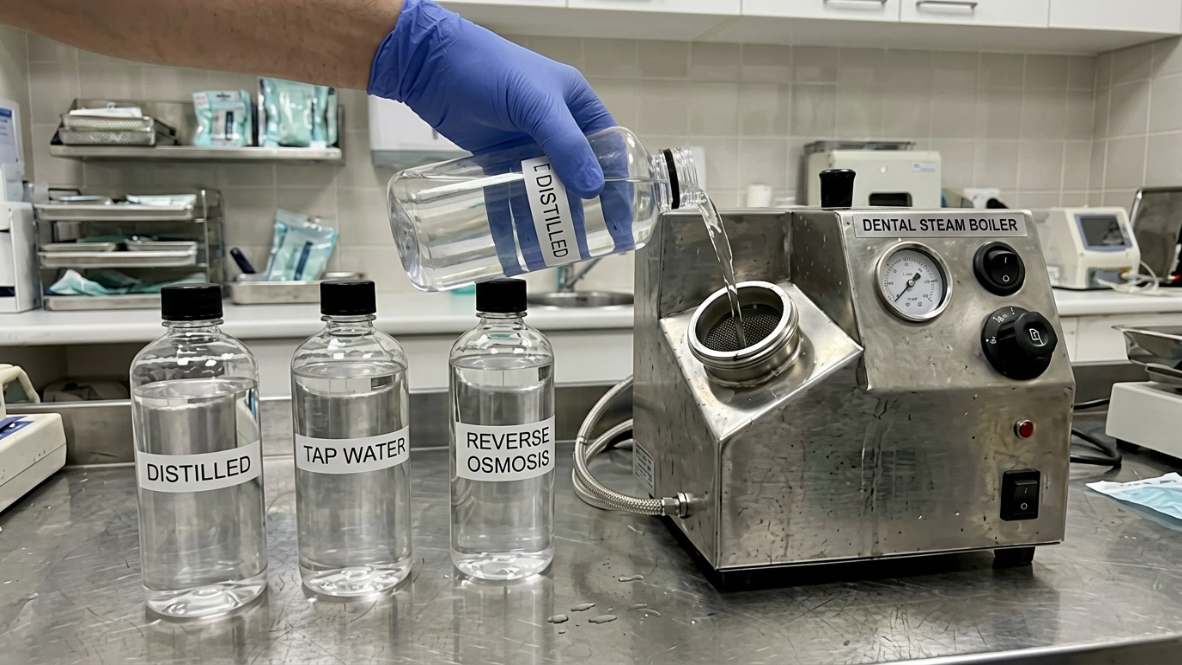
Most dental steamer manufacturers recommend distilled water. The logic is straightforward: distilled water contains virtually no minerals, so it produces virtually no scale. Your maintenance burden drops dramatically.
However, some units actually require minerals in the water. Certain steamer models use conductivity-based sensors to detect water level, and these sensors need dissolved minerals to function. At least one manufacturer explicitly states in its manual not to use distilled water for this reason. Forum users on the Dental Lab Network have confirmed encountering this contradiction firsthand.
The rule of thumb: check your owner’s manual. If it says distilled, use distilled. If it says tap water, use tap water. If it says nothing, distilled is the safer default for units with external heating elements and stainless steel tanks. For units with internal heating elements, distilled water is almost always the right choice because it protects the element from direct mineral contact.
If your lab is in a hard water area and must use tap water, consider installing an inline water softening system. This removes the calcium and magnesium that cause the worst scale buildup without stripping all minerals from the water.
Water Types Compared
Water Type | Scale Formation | Suitable for Most Steamers? | Notes |
|---|---|---|---|
Distilled Water | Very Low | Yes | Preferred for most units |
Deionized Water | Very Low | Sometimes | Verify manufacturer guidance |
Reverse Osmosis Water | Low | Usually | Depends on remaining mineral content |
Softened Water | Moderate | Sometimes | Removes hardness but not all dissolved solids |
Tap Water | High | Only if manufacturer recommends | Requires more frequent maintenance |
Common Dental Lab Steamer Maintenance Mistakes
Running the Boiler Dry
This is the mistake that kills steamers fastest. One lab owner on the Dental Lab Network described technicians using the steamer as a “boil out tank” and draining all the water, which destroys heating elements. The low-water cutoff exists to prevent this, but only if it is functioning and has not been bypassed or neglected.
Using Tap Water in a Distilled-Water Unit
A steamer designed for distilled water will accumulate scale far faster on tap water. Internal heating elements are especially vulnerable. The small cost savings on water leads to large repair bills.
Skipping Blowdown Because “It’s Just a Small Steamer”
Scale does not care about the size of your boiler. A benchtop dental steamer accumulates minerals at the same rate per gallon as a building boiler. Daily blowdown takes less than a minute and prevents the gradual buildup that leads to clogged valves and failed elements.
Ignoring Slow Pressure Loss
If your steamer takes longer to reach operating pressure than it used to, or if pressure drops during use, something is failing. Common causes include a worn solenoid valve, degraded gaskets, or scale insulating the heating element. Addressing these early is cheap. Waiting until the steamer fails completely is not.
Not Keeping a Maintenance Log
Beyond compliance requirements, a maintenance log reveals trends. If you are descaling more frequently, your water quality may have changed. If blowdown produces more sediment than usual, scale is accumulating faster. These patterns warn you before a failure happens. Inspectors also view consistent record-keeping as evidence of safe operation, which matters if your unit ever requires a formal inspection.
Letting Employees Self-Train
As one dental lab forum member put it, “the biggest issue with any piece of equipment is maintenance and how your employees use it.” New technicians should receive explicit training on proper steamer operation, including how to perform blowdown, when and how to refill, and what warning signs to report.
Typical Dental Lab Steam Boiler Maintenance Costs
Item | Typical Cost |
|---|---|
Distilled water | Low |
Replacement gasket kit | Low |
Solenoid valve | Moderate |
Heating element | Moderate |
Annual descaling solution | Low |
Professional inspection | Moderate |
Factory rebuild | High |
When to Repair vs. Replace Your Dental Lab Steamer
The repair-or-replace decision comes down to three numbers: the cost of the repair, the age of the unit, and the cost of equivalent replacement equipment.
A factory rebuild on a 2-gallon dental steamer can run around $800 when you factor in tank replacement, circuit board, solenoid valve, pressure control, and switches. If the unit is 15 years old and has been well maintained, that rebuild might buy another decade of service. If it is 8 years old and has been neglected, you may be rebuilding again in 3 years.
The lifespan data tells a clear story. A well-maintained steam boiler can serve reliably for 20-30 years. Neglected units might need replacement in as little as 5 to 10 years. Maintenance is not just an operating cost; it is the primary factor that determines whether your steamer is a long-term asset or a recurring expense.
For labs considering new equipment, Hoffman Steam offers dental lab steamers with ASME/UL certification, stainless steel construction, and protection programs that include factory reconditioning, a 47-point inspection, and hot-swap loaner machines to eliminate downtime during service.
The Emerging Role of Limescale Indicators
Newer dental steamer models are beginning to include smart limescale indicators that monitor mineral buildup and alert you when descaling is needed. This takes the guesswork out of dental lab steam boiler maintenance scheduling and prevents both premature descaling (wasting time and chemicals) and delayed descaling (risking component damage). If you are shopping for a new unit, this feature is worth prioritizing.
Translation Table: Dental Lab Language vs. Boiler Engineering Language
One of the persistent problems in dental lab steam boiler maintenance is that dental techs and boiler engineers use completely different vocabulary for the same things. Here is a quick reference:
Dental Lab Term | Boiler Engineering Term |
|---|---|
Steam gun / handpiece | Nozzle / steam wand |
Blowdown valve | Drain cock / bottom blowdown valve |
Tank cleaning | Descaling / chemical cleaning |
Drain and refill | Blowdown and feedwater cycle |
Safety cap | Pressure relief device / PRV cap |
Water light / low water indicator | Low-water cutoff (LWCO) |
Steamer | Steam boiler / steam generator |
Buildup / crud | Scale / mineral deposits / fouling |
Understanding both sets of terms helps when reading manufacturer manuals (which tend toward engineering language) and when communicating with repair technicians or inspectors.
For a broader glossary of steam equipment terminology, see our dental lab steam cleaner terms guide.
Key Takeaways
Mineral scale is the leading cause of dental lab steam boiler failure.
Daily blowdown removes sediment before it becomes hard scale.
Distilled water is recommended for most dental steamers unless the manufacturer specifies otherwise.
Weekly testing of the low-water cutoff and pressure relief valve improves safety.
Annual descaling restores efficiency and protects heating elements.
Keeping a maintenance log helps identify problems before they lead to costly repairs.
External heating elements and stainless steel tanks generally require less maintenance than internal-element designs.
Frequently Asked Questions
How often should I descale my dental lab steamer?
At minimum, once per year. If you use tap water or are in a hard water area, descale quarterly. If you use distilled water and perform daily blowdown, annual descaling is usually sufficient. Monitor your maintenance log for signs that scale is building faster than expected, such as slower heat-up times or reduced steam pressure.
Can I use tap water in my dental lab steam boiler?
It depends on the unit. Most manufacturers recommend distilled water because it dramatically reduces scale buildup. However, some steamers with conductivity-based water level sensors require mineral content in the water to function properly. Always follow your specific manufacturer’s instructions.
What is the most common cause of dental lab steamer failure?
Mineral scale buildup, followed closely by solenoid valve failure (often caused by mineral debris). Employee misuse, particularly running the unit dry, is the third most common cause. All three are preventable with proper dental lab steam boiler maintenance.
How long should a dental lab steamer last?
With consistent maintenance, 20 years or more. Forum users report units running reliably for over two decades with daily use. Without maintenance, expect 5 years or less before significant repairs are needed.
Do I need an ASME-certified steamer for my dental lab?
Most dental steamers operate at 45-80 PSI, which places them well above the 15 PSI threshold for high-pressure boiler classification. ASME certification ensures the vessel was designed and built to withstand these pressures safely. Many states require ASME certification for boilers operating above 15 PSI, and insurance carriers may require it as well. Learn more about dental lab steamer specs and standards.
How do I test the low-water cutoff on my dental steamer?
Allow the water level to drop below the sensor level (without the heating element running) and verify that the unit shuts down or triggers an alarm. This should be done weekly per ASME CSD-1 standards. Never operate a steamer with a malfunctioning low-water cutoff.
Is a factory rebuild worth the cost?
It depends on the unit’s age and condition. A rebuild on a 2-gallon unit can cost around $800. If the unit is structurally sound and relatively young, a rebuild can extend its life by many years. If the unit is already old and showing multiple issues, a refurbished or new steamer with a protection plan may be the better investment.
What is the difference between internal and external heating elements for maintenance?
Internal heating elements sit inside the water and are directly exposed to minerals, requiring distilled water and more frequent descaling. External heating elements wrap around the outside of the tank, avoiding direct water contact. Units with external elements and stainless steel tanks require the least maintenance overall, primarily just periodic flushing.


