

TL;DR
Dental lab steam cleaners remove wax, polishing compounds, and investment material from restorations during fabrication. They are not autoclaves or ultrasonic cleaners. Most dental labs need wet steam at 50 to 80 PSI, a boiler tank sized for a full shift, and distilled water to prevent mineral buildup. This guide defines every technical term you will encounter when researching, buying, or maintaining a dental lab steam cleaner.
A dental lab steam cleaner is one of those tools that seems simple until you start reading spec sheets. PSI, bar, wet steam, dry steam, ASME certification, flash steamers, auto-fill systems. The jargon piles up fast, especially when suppliers assume you already speak the language.
This dental lab steam cleaner guide breaks down every term that matters for your daily workflow. Whether you run a six-person crown and bridge lab or manage a high-volume military dental facility, you will find practical definitions here, not abstract engineering concepts. Each entry explains what the term means and why it affects your work.
For a side-by-side comparison of specific models by lab size, see our dental lab steamer buyer’s guide.
Before getting into individual terms, it helps to clear up the single biggest source of confusion in this space: the difference between steam cleaners, autoclaves, and ultrasonic cleaners. These three machines serve different purposes, and mixing them up leads to bad purchasing decisions.
Browse Hoffman’s full steamer lineup to see which models fit dental lab applications.
Quick Answer: What Is a Dental Lab Steam Cleaner?
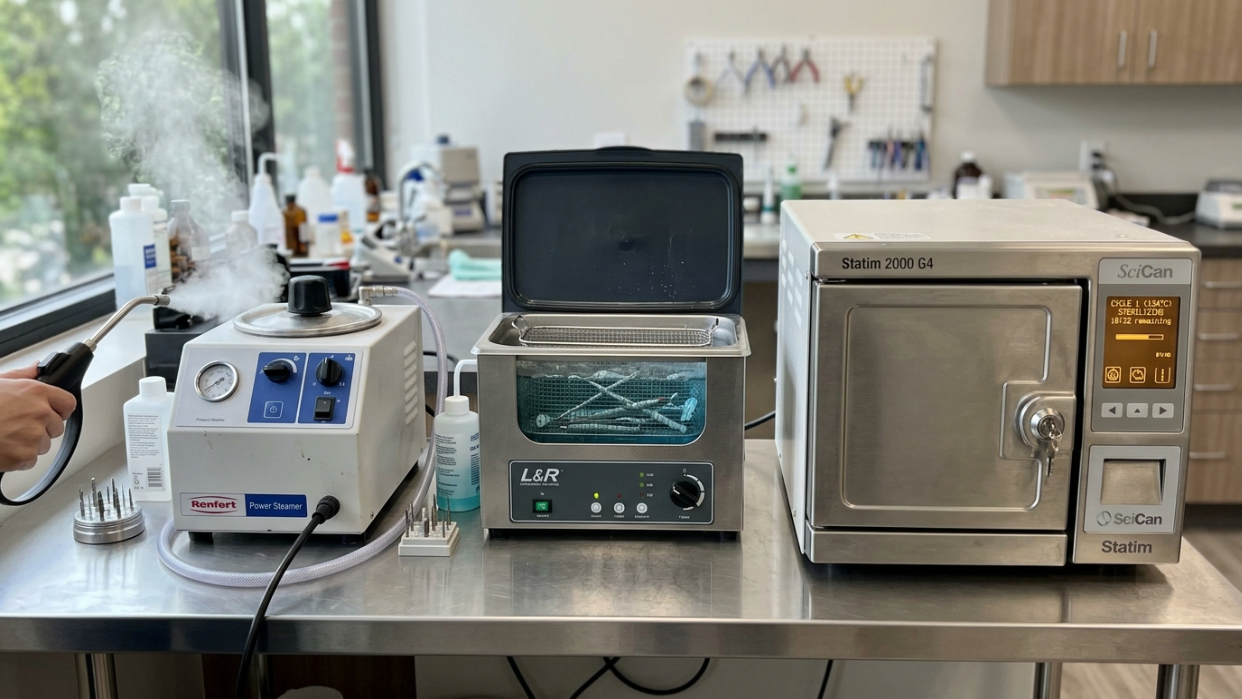
A dental lab steam cleaner is a high-pressure cleaning device used during dental restoration fabrication to remove wax, polishing compounds, investment material, and residues from crowns, bridges, dentures, and CAD/CAM restorations. It uses pressurized wet or dry steam (typically 50–80 PSI) and is not the same as an autoclave or ultrasonic cleaner. Autoclaves sterilize instruments, ultrasonic cleaners clean tools using cavitation, while steam cleaners clean restorations during production.
Steam Cleaner vs. Autoclave vs. Ultrasonic Cleaner
This confusion shows up constantly. One dental supply site ranking for steam cleaner queries is actually about ultrasonic cleaners, which tells you how muddled the categories have become.
Here is the straightforward distinction:
Steam cleaner: Uses pressurized steam to remove wax residue, polishing compounds, investment material, and disclosing agents from dental restorations (crowns, bridges, dentures, zirconia, 3D-printed resins, CAD/CAM appliances). It cleans the workpiece, not the instruments.
Ultrasonic cleaner: Uses high-frequency sound waves to create cavitation bubbles that scrub debris off instruments. This is a pre-sterilization step for reusable tools.
Autoclave (steam sterilizer): Uses high-pressure steam at 121°C or higher to kill all microorganisms on patient-contact instruments. It sterilizes, not cleans. Per OSHA guidance, there is no specific OSHA standard on autoclaving, though the Bloodborne Pathogens Standard applies broadly to dental workplaces. CDC guidelines fill in the sterilization protocols.
The takeaway: your steam cleaner handles restorations during the fabrication process. Your autoclave handles instruments between patients. They are not interchangeable.
Key Differences Between Steam Cleaner, Autoclave, and Ultrasonic Cleaner
Device | Primary Function | What It Cleans | Typical Use Stage | PSI/Mechanism |
|---|---|---|---|---|
Steam Cleaner | Removes fabrication residue | Crowns, bridges, dentures | During production | 50–80 PSI wet steam |
Ultrasonic Cleaner | Removes debris via cavitation | Dental instruments | Pre-sterilization | Sound wave cavitation |
Autoclave | Sterilizes instruments | Surgical tools | Post-cleaning sterilization | 121°C+ pressurized steam |
Steam Types and Output Terms
Wet Steam
Wet steam contains a higher percentage of water droplets suspended in the vapor. For most dental laboratory work, including removing wax, polishing residue, and disclosing media, wet steam works best. The additional moisture provides better flushing action, physically carrying away debris rather than just loosening it.
This is a point that general steam cleaner guides miss entirely. They tend to champion dry steam for everything. In a dental lab, you want the moisture.
Dry Steam (Dry Vapor Steam)
Dry steam contains only 5 to 10% moisture, meaning it is 90 to 95% “dry”. This type of steam is better suited for sanitization and situations where you want surfaces to dry quickly. In dental contexts, dry steam matters more for equipment sanitization than for cleaning restorations. If you are removing investment material or polishing compound from a crown, dry steam alone will not flush the debris as effectively.
Steam Pressure (PSI / Bar)
PSI (pounds per square inch) and bar are units measuring the force of steam output. One bar equals roughly 14.5 PSI. Dental lab steam cleaners typically operate between 50 and 80 PSI (3.5 to 5.5 bar).
Entry-level dental units often produce around 50 PSI (3.5 bar), which handles routine wax removal and general cleanup. Higher-end units push 70 to 90 PSI for continuous heavy use.
Here is the nuance that spec sheets will not tell you: too much pressure can damage stone dies and fragile porcelain. As one veteran on Dental Lab Network put it, “As for pressure, its never been an issue, anything more than what this unit will produce will degrade dies.” Having adjustable pressure lets you dial back for veneers and other delicate work while still having headroom for stubborn investment material.
For a deeper explanation of how PSI choices affect commercial steam work, see our PSI guide for commercial steamers.
Flash Steam / Flash Steamer
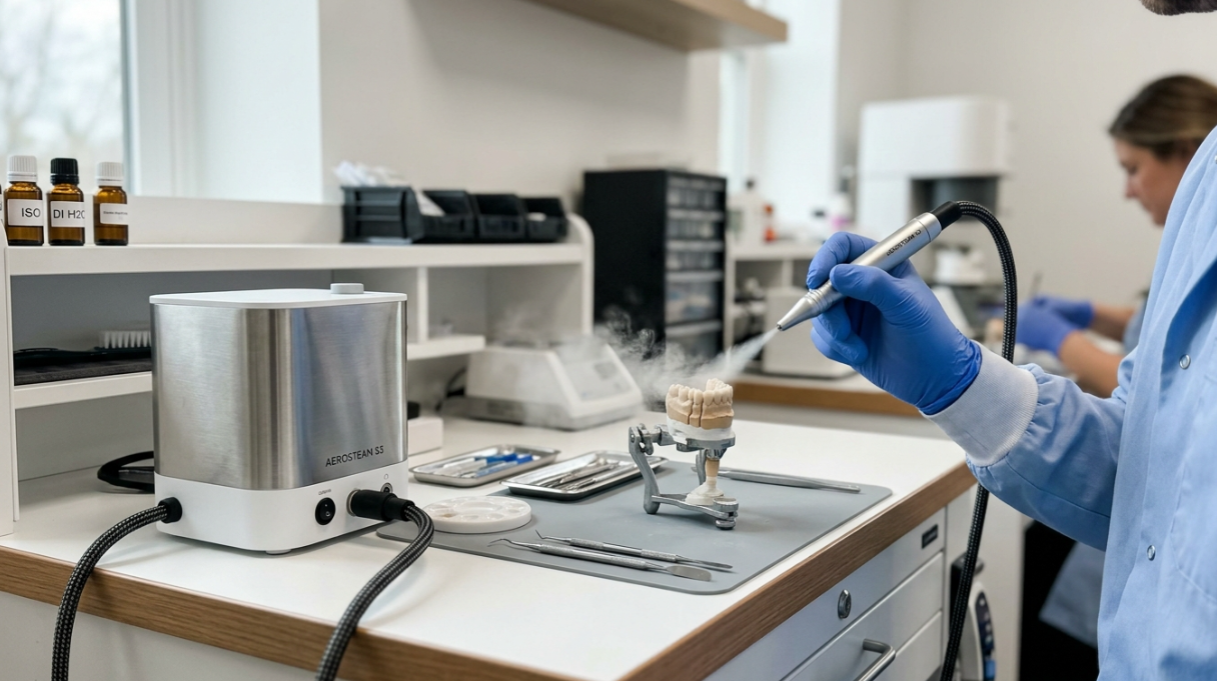
A flash steamer generates steam on demand by dripping water onto a superheated element. There is no pressurized boiler tank. This matters for dental labs in shared spaces, mall locations, or buildings with strict codes, because non-pressurized flash steamers typically require no boiler permits.
The tradeoff is lower sustained output compared to a full boiler system. Flash steamers work well for lighter-duty cleaning or as a secondary station. Hoffman’s GEM-III is a portable flash steamer designed specifically for environments where a pressurized vessel would create permitting headaches.
For a detailed comparison of the two architectures, read flash steamer vs. boiler differences.
Operating Temperature
Most dental lab steam cleaners produce steam at 105°C (221°F) or higher. Temperature affects cleaning effectiveness because hotter steam dissolves wax and softens polishing compounds faster. Below 100°C, you are essentially just spraying hot water. Effective steam cleaning requires temperatures well above the boiling point of water at your elevation.
Steam Gun / Steam Nozzle
This is the business end of the steamer, where steam exits and hits your workpiece. Two configurations dominate dental labs:
Built-in nozzle: Mounted over a sink or basin, this design frees up both hands so you can hold and manipulate the restoration. It also contains overspray better. Most dental labs prefer this setup.
Handheld steam gun: Offers more freedom of movement but has a known annoyance. Condensation builds up in the hose connecting the gun to the boiler, and that accumulated water gets expelled as a cold burst before the steam arrives. Practitioners on Dental Lab Network frequently mention this as a minor but persistent frustration with handheld configurations.
Common Mistakes When Choosing a Dental Lab Steam Cleaner
Many dental labs make costly errors when selecting steam equipment:
Confusing steam cleaners with autoclaves or ultrasonic cleaners
Choosing dry steam when wet steam is required for debris removal
Underestimating boiler size needs for multi-technician workflows
Using tap water instead of distilled water, causing mineral scale damage
Ignoring ASME certification requirements for insurance compliance
Buying consumer-grade steamers not rated for continuous lab use
Avoiding these mistakes significantly extends equipment lifespan and improves workflow efficiency.
Boiler and Tank Terms
Boiler Capacity
Measured in gallons or liters, boiler capacity determines how long your steamer runs before it needs a refill. The goal is simple: fill it in the morning and not think about it again until the end of the day.
Practical sizing thresholds from industry guidance:
Labs with 6 or fewer technicians: A half-gallon reservoir or slightly larger works well. A 1-gallon commercial steamer provides comfortable headroom for small operations.
Labs with more than 6 technicians: Look for 1.5 gallons or more. High-production labs and military dental facilities should consider units above 1.5 gallons or models with continuous water-feed capability. For these environments, a 6-gallon ASME-certified boiler eliminates refill interruptions entirely.
Recommended Steam Cleaner Size by Dental Lab Type
Lab Size | Recommended Boiler Size | Steam System Type | Notes |
|---|---|---|---|
Small lab (1–6 techs) | 0.5–1 gallon | Manual fill | Cost-efficient, low volume |
Medium lab (6–12 techs) | 1–1.5 gallons | Manual or auto-fill | Balanced productivity |
Large lab (12+ techs) | 1.5+ gallons | Auto-fill recommended | Continuous workflow required |
High-volume facility | 3–6 gallon ASME boiler | Continuous feed | Military / industrial labs |
Manual Fill vs. Auto-Fill (Pump-Fill)
Manual fill means you shut down the unit, wait for pressure to drop, open the cap, add water, close it back up, and wait for the boiler to reach operating pressure again. This can cost 10 to 15 minutes of downtime per refill.
Auto-fill (pump-fill) systems connect to a water supply line and replenish the boiler continuously, so work never stops. This is a significant productivity advantage in labs running multiple technicians simultaneously.
The cost difference between manual-fill and auto-fill models is substantial, so smaller labs often find manual fill perfectly adequate. High-volume operations that cannot afford downtime should budget for pump-fill. For more on this decision, see our breakdown of manual-fill vs. auto-fill boilers.
Pressure Vessel
The sealed tank where water is heated under pressure to generate steam. Pressure vessels are subject to engineering standards and, depending on your jurisdiction, may require inspection or permitting. Insurance companies and building codes sometimes require that pressure vessels carry specific certifications (more on that in the safety section below).
Heating Element (Internal vs. External)
Where the heating element sits relative to the water reservoir has a direct impact on how much maintenance your steamer will need.
External heating element: Wrapped around the outside of the reservoir. The stainless steel tank is practically immune to rust and corrosion. These units are more forgiving of tap water and require less frequent chemical cleaning.
Internal heating element: Submerged inside the water. Mineral deposits form directly on the element, reducing efficiency and eventually causing failure. These units generally require distilled water and periodic chemical descaling.
If your lab is in an area with hard water and you know your team will occasionally forget to use distilled water, an external-element design gives you much more margin for error.
Blowdown Valve
A valve at the bottom of the boiler that allows you to drain sediment and mineral-heavy water without fully emptying the tank. Regular blowdown (weekly or per manufacturer instructions) extends boiler life by preventing sediment accumulation where it does the most damage: at the bottom of the vessel near the heating element.
Eco Mode / Standby Mode
Some commercial steamers reduce power consumption during idle periods by maintaining a lower holding temperature. In a dental lab, there are natural pauses in steaming activity throughout the day. Eco mode prevents the boiler from cycling at full power during those gaps, saving energy without requiring a full restart when the next restoration needs cleaning.
Safety and Certification Terms
ASME Certification
The ASME Boiler and Pressure Vessel Code (BPVC) is published by the American Society of Mechanical Engineers. It establishes rules for the design, fabrication, inspection, testing, and certification of boilers and pressure vessels.
Why dental labs should care: many insurance policies and local building codes require ASME-stamped equipment when a pressurized steam vessel is involved. An uncertified steamer could create a coverage gap in your liability insurance, something you probably will not discover until you need to file a claim. Hoffman’s Pro Line models carry ASME certification, which is worth noting because many dental-branded steamers imported from overseas carry CE or ETL approval but not ASME stamps.
For a wider discussion of commercial steam safety standards, read our commercial steam boiler safety guide.
UL Listing
UL (Underwriters Laboratories) tests electrical products for safety. A UL listing means the product has been evaluated for fire, shock, and casualty hazards. It is different from ASME certification: ASME covers the pressure vessel, while UL covers the electrical components. Ideally, your steamer carries both.
Pressure Switch
An automatic device that monitors boiler pressure and shuts off the heating element when pressure reaches the set maximum. When pressure drops (because you used steam), the switch re-engages the element. This prevents dangerous overpressure situations and is a standard feature on any properly designed commercial steamer.
Safety Cap / Safety Valve
A mechanical backup to the pressure switch. If the pressure switch fails and pressure continues to build, the safety valve opens to release excess steam before the vessel reaches dangerous levels. Never tamper with, disable, or modify a safety valve. It is the last line of defense.
Low Water Indicator / Dry-Fire Protection
A sensor that detects when the water level drops below a safe minimum. Without it, the heating element continues to fire with no water to heat, which can burn out the element, damage the vessel, or create a fire hazard. Any steamer worth buying for professional use includes this feature.
Water Quality Terms
Water quality is the single most discussed maintenance topic among dental lab technicians who use steam cleaners. Get this right and your steamer lasts decades. Get it wrong and you are replacing parts constantly.
Distilled Water
Water that has been boiled into vapor and condensed back into liquid, leaving minerals and impurities behind. Using distilled water in your steam cleaner prevents mineral deposits from forming inside the boiler, on heating elements, and in valves and plumbing.
This is not optional. Practitioners on Dental Lab Network are emphatic about it. One user summed up the community consensus: “I found out the hard way that steamers love distilled water.” A study referenced by Hu-Friedy/HuFriedyGroup found that more than 50% of dental professionals reported primarily using distilled water for their sterilization center equipment, and the same logic applies to lab steam cleaners.
Total Dissolved Solids (TDS)
A measurement (in parts per million, ppm) of dissolved minerals, salts, and metals in water. Higher TDS means more minerals that will deposit inside your boiler. Distilled water typically has a TDS below 10 ppm. Your tap water might be anywhere from 50 to 500+ ppm depending on your municipal supply. A cheap TDS meter (under $15) can tell you exactly what you are dealing with.
Scale / Mineral Buildup
The crusty, calcium-white deposits that form inside boilers, on heating elements, and around valves when you use non-distilled water. Scale acts as insulation on heating elements, forcing them to work harder and eventually overheat. It narrows valve openings, clogs plumbing, and decreases the efficiency and functionality of the steam generator over time, similar to lime deposits around a showerhead but with more expensive consequences.
Water Flushing / Draining
The routine maintenance procedure of draining all water from the boiler, rinsing the interior, and refilling with fresh distilled water. How often you need to do this depends on your water quality and usage volume. Most manufacturers recommend monthly flushing for daily-use units. Labs using tap water will need to flush more frequently and may also need periodic chemical descaling.
Maintenance and Parts Terms
Solenoid
An electromagnetically controlled valve that opens and closes to regulate steam flow. When you press the foot pedal or trigger on a steam gun, the solenoid opens. When you release it, the solenoid closes. This is a common wear part on any commercial steamer that sees daily use.
Forum users on Dental Lab Network report that solenoid replacement is a straightforward repair, with one long-time user noting that “the solenoid and electrical contactor seems to need replacing every couple of years” on their workhorse unit. Replacement parts are available from industrial suppliers like Grainger or McMaster-Carr and are inexpensive.
Contactor
An electrical relay that handles the high-current switching for the heating element. Like the solenoid, contactors wear out over time from repeated cycling. They are standard industrial components, easy to source, and typically cost under $30. Replacing a contactor is within the ability of most lab managers with basic electrical comfort.
Pressure Cap / Boiler Cap
The cap that seals the fill opening on manual-fill boilers. It contains a gasket that degrades over time and must seal against full operating pressure. Pressure caps are a known consumable. Practitioners on forums report replacement costs of around $100, and the frequency depends on how often you open and close the cap. One forum user mentioned going through caps on multiple “dental” steamers over 20 years, making it their most common repair.
Steam Hose
The flexible line connecting the boiler to the handheld steam gun. Hoses must withstand operating pressure and temperature while remaining flexible enough to manipulate. As mentioned earlier, condensation accumulates in these hoses between uses, creating that initial burst of water before clean steam arrives. Some technicians briefly activate the steam into a towel before directing it at a restoration to clear the condensation.
Quick-Connect Fittings
Standardized connectors that allow you to swap accessories (different nozzle tips, spray guns, brushes) without tools. Labs that alternate between different types of cleaning tasks throughout the day benefit from quick-connect systems because they reduce changeover time. Not all steamers use the same fitting standards, so confirm compatibility before purchasing accessories.
Equipment Category Comparisons
Commercial Steamer vs. Consumer Steamer
Consumer steamers (the kind sold for home garment steaming or floor cleaning) are not built for the demands of a dental lab. They lack the pressure output, boiler capacity, and continuous-duty cycle that lab work requires. Their heating elements are smaller, their materials are thinner, and they are designed for intermittent use measured in minutes, not hours.
The pain of using consumer-grade equipment in a professional setting shows up repeatedly on forums. One Dental Lab Network user captured it plainly: “We can’t seem to find a steam cleaner with any degree of reliability. We need to replace it almost every year.” Another responded: “For any of the smaller labs similar to myself, I would highly recommend shelling out the extra dough and buying a quality steamer.”
A commercial steamer built for trade use should run eight or more hours per day, five days a week, for years. The upfront cost is higher. The total cost of ownership is dramatically lower.
Dental Steam Cleaner vs. Jewelry Steam Cleaner
This is an open secret among dental lab technicians that no product guide seems to acknowledge. Many dental labs use jewelry-grade steamers rather than dental-branded ones, because jewelry steamers are often built sturdier and priced lower.
The logic makes sense. Both applications require high-pressure wet steam directed at small, detailed workpieces held at close range. The cleaning demands of a dental lab (wax, polishing compound, investment) are actually gentler on the steamer than jewelry cleaning (polishing compound on gold and platinum, heavy daily volume in retail environments).
As one Dental Lab Network user explained: “This unit was designed for jewelry which obviously will take more abuse than a stone die. Its a good unit and for about half the price of dental units you will be happy with the purchase.” Multiple forum participants reported using the same jewelry-grade steamer for 15 to 20+ years of daily dental lab use.
See the full range of commercial steamers used across both dental and jewelry applications.
Buying and Support Terms
Factory-Direct
A sales model where the manufacturer sells directly to the end user, eliminating distributor markups. In the dental equipment world, pricing is notoriously opaque. Major distributors often require account logins just to see prices. Factory-direct manufacturers publish their pricing openly, which simplifies budgeting and eliminates negotiation games. Hoffman Steam sells factory-direct with published prices and free shipping within the contiguous United States.
Protection Plan / Maintenance Subscription
An ongoing service agreement that covers consumables, factory reconditioning, parts discounts, and sometimes loaner equipment. These plans matter more for steam equipment than most lab tools because steamers have predictable wear items (solenoids, contactors, gaskets, caps) that benefit from proactive replacement rather than waiting for failure.
Loaner Program
A service where the manufacturer provides a temporary replacement unit while yours is being serviced or reconditioned. For a dental lab that depends on its steamer throughout every shift, even a few days of downtime can disrupt production schedules and delay case delivery. A loaner program eliminates that risk.
Dental Lab Steam Cleaner Buying Guide (Quick Summary)
When choosing a dental lab steam cleaner, prioritize:
Pressure range: 50–80 PSI for balanced cleaning power
Steam type: Wet steam for restoration cleaning, dry steam for fast drying
Boiler size: 1–1.5 gallons for most labs, larger for high-volume use
Water system: Distilled water compatibility is essential
Safety certifications: ASME + UL preferred for compliance and insurance
Workflow needs: Auto-fill systems reduce downtime in busy labs
For small labs, a manual-fill unit is often sufficient. For multi-technician operations, auto-fill or continuous-feed systems significantly improve productivity.
Frequently Asked Questions
What is the ideal PSI for a dental lab steam cleaner?
Most dental labs operate comfortably between 50 and 80 PSI. Entry-level units at 50 PSI handle routine wax removal and general cleanup. Higher pressures around 70 to 80 PSI provide better performance on stubborn investment material and polishing compounds, but adjustable pressure is important because too much force can damage stone dies and porcelain veneers.
Can I use tap water in my dental lab steamer?
You can, but you should not. Tap water contains dissolved minerals that deposit inside the boiler as scale, clogging valves and degrading heating elements over time. Distilled water is the near-universal recommendation from both manufacturers and practitioners. The small ongoing cost of distilled water is insignificant compared to the repair bills from mineral damage.
How often should I drain and clean my steam boiler?
Monthly flushing is a good baseline for labs using distilled water on a daily-use unit. If you occasionally use tap water or have high daily output, flush more frequently. One longtime user on Dental Lab Network reported opening the pressure vessel once a year to clean accumulated sediment, along with replacing the solenoid and contactor every couple of years.
Do I need ASME certification on my dental lab steamer?
It depends on your jurisdiction and insurance requirements. ASME certification means the pressure vessel meets rigorous design, fabrication, and testing standards. Some building codes and insurance policies require ASME-stamped equipment for pressurized steam vessels. Even if your local code does not mandate it, ASME certification provides a meaningful safety margin and can prevent insurance coverage disputes.
What is the difference between a flash steamer and a boiler steamer?
A flash steamer generates steam on demand by dripping water onto a superheated surface. It has no pressurized tank, which means no boiler permits. A boiler steamer heats a sealed tank of water under pressure, producing sustained, higher-pressure steam. Flash steamers work for lighter-duty cleaning, while boiler steamers are better for continuous high-volume use.
Why do some dental labs buy jewelry steamers instead of dental steamers?
Jewelry steamers are often built to handle more demanding conditions (heavier daily use, higher pressures) at lower price points than dental-branded units. Since both applications involve directing steam at small detailed workpieces, the crossover works well. Forum users regularly report that jewelry-grade steamers perform excellently in dental labs for 15 to 20+ years.
How big should my steamer’s tank be?
For labs with six or fewer technicians, a tank of one-half gallon to one gallon is sufficient. Labs with more than six technicians should consider 1.5 gallons or more. Very high-production labs should look at auto-fill (pump-fill) models that connect to a water line and refill continuously, eliminating downtime for manual refilling.
Is a handheld steam gun or a built-in nozzle better for dental lab work?
Most dental labs prefer a built-in nozzle mounted over a sink because it frees both hands for holding and rotating the restoration, and it contains overspray. Handheld guns offer more flexibility but tend to accumulate condensation in the hose, which produces an initial burst of water before steam flows. Some labs keep both options available for different tasks.
Ready to find the right steam cleaner for your dental lab? Explore Hoffman’s commercial steamers or revisit our detailed dental lab steamer buyer’s guide for model-by-model comparisons.


