

TL;DR
A dental lab steam station setup is a dedicated workspace built around a commercial steam cleaner for removing wax, polishing residue, and debris from dental prosthetics before sterilization. A proper setup includes the boiler unit, nozzle type, containment station, moisture-resistant work surface, drainage, and correct electrical supply. Water quality is the single biggest factor in equipment longevity, and cheap steamers often cost more in annual replacements than a quality unit costs once. This guide defines every term, component, and decision involved in planning a reliable steam station.
Planning a dental lab steam station setup involves more decisions than most technicians expect. It’s not just picking a steamer off a shelf. The station encompasses everything from electrical circuits and drainage to boiler materials, nozzle types, and daily water management. Get the setup wrong and you’ll deal with constant maintenance, premature equipment failure, or worse.
This glossary covers every component and concept you need to understand before building or upgrading your steam cleaning station. Whether you’re opening a new lab or replacing a steamer that died after 18 months, the terms and guidance below will help you make informed choices.
Considering a commercial steamer for your dental lab? See the dental lab buyers guide for model comparisons.
A properly designed dental lab steam station consists of far more than a steam cleaner. A complete setup includes a commercial boiler, containment station, moisture-resistant work surface, dedicated electrical circuit, drainage, distilled water supply, safety equipment, and proper ventilation. Most dental laboratories benefit from stainless steel boilers, adjustable 45–80 PSI output, distilled water, and a dedicated 110V or 220V circuit depending on equipment size. Planning the entire workstation instead of only purchasing a steamer reduces maintenance costs, improves cleaning efficiency, and extends equipment life.
Dental Lab Steam Station Setup Checklist
Component | Required | Recommended |
|---|---|---|
Commercial Steam Cleaner | ✓ | Stainless steel boiler |
Containment Station | ✓ | Stainless steel enclosure |
Dedicated Circuit | ✓ | GFCI Protected |
Water Supply | ✓ | Distilled Water |
Drainage | ✓ | Tempered drain if required |
Moisture Resistant Counter | ✓ | Stainless Steel |
Heat Resistant Gloves | ✓ | Multiple pairs |
Eye Protection | ✓ | Face shield available |
Pressure Relief Valve | ✓ | Factory tested |
Low Water Cutoff | ✓ | Automatic |
Ventilation | ✓ | Local exhaust near station |
What Is a Dental Lab Steam Station?
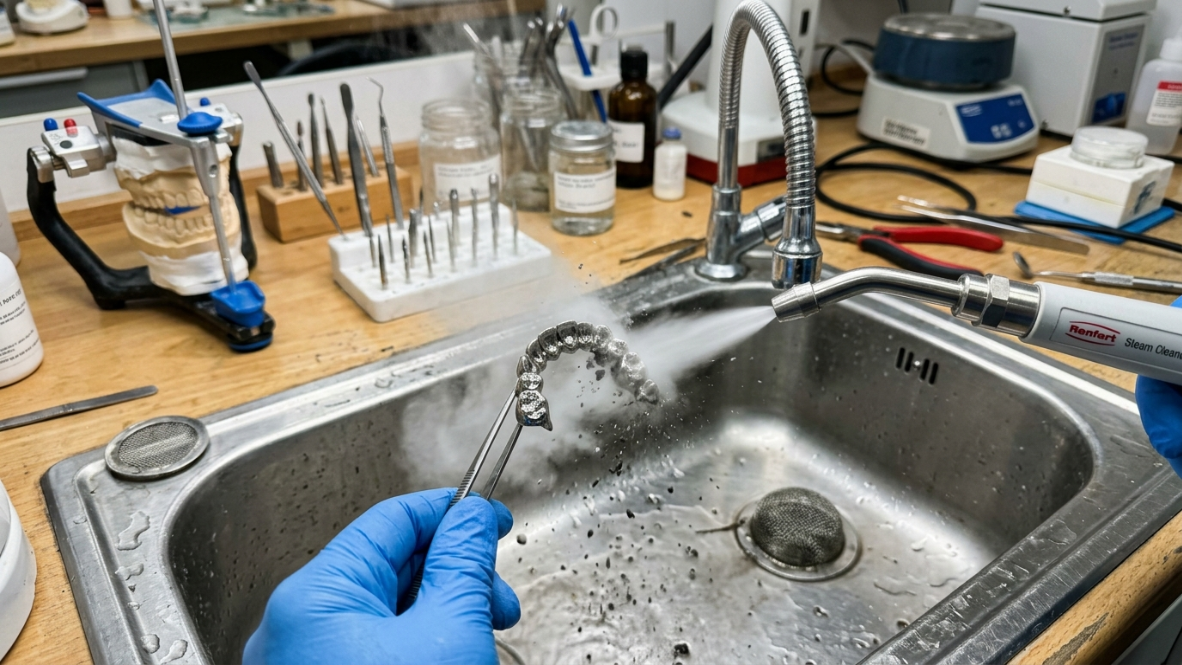
A dental lab steam station is a purpose-built workstation area organized around a commercial steam cleaner. Its job is cleaning dental prosthetics, crowns, bridges, castings, dentures, articulators, and instruments during the fabrication process. Steam cleaners offer a fast, chemical-free way to blast away wax residue, polishing compound, investment material, and other debris that accumulates during prosthesis production.
The station isn’t just the steamer itself. It’s the entire workspace configuration: the boiler unit, the nozzle or steam gun, the containment area that catches debris, the work surface, the drainage path for condensate, and the safety equipment stored within arm’s reach.
Why “Station” and Not Just “Steamer”
A steamer sitting on a random countertop is not a station. A properly designed dental lab steam station setup accounts for moisture management, ergonomic workflow, electrical safety, and proximity to other lab stages like polishing and sterilization. Labs that treat this as a system, rather than a single piece of equipment, report far fewer problems.
Steam Cleaning vs. Autoclave Sterilization vs. Ultrasonic Cleaning
This distinction trips up a surprising number of people. Steam cleaning, autoclave sterilization, and ultrasonic cleaning serve three different purposes, and a well-equipped dental lab needs all three.
Steam Cleaner: Uses pressurized steam (typically 45 to 80 PSI) to blast debris off surfaces. It cleans but does not sterilize. Think of it as the preparation step before sterilization.
Autoclave (Steam Sterilizer): Operates at much lower pressure (15 to 45 PSI) but at sustained temperatures of 121 to 134°C to kill all microorganisms. This is the sterilization step.
Ultrasonic Cleaner: Uses high-frequency sound waves in a liquid bath to create cavitation bubbles that scrub into tiny crevices. No pressure involved. Best for detailed cleaning of small, complex items.
A dental lab steam station handles the first job: removing visible contamination so the autoclave can do its work effectively. Skipping the steam cleaning step means sending contaminated items into the autoclave, which reduces sterilization reliability.
For a deeper dive into how dental steam equipment fits the broader lab workflow, the dental lab steam cleaner glossary covers additional terminology.
Comparison of Dental Cleaning Equipment
Equipment | Removes Debris | Sterilizes | Uses Chemicals | Typical Use |
|---|---|---|---|---|
Steam Cleaner | ✓ | No | No | Wax removal |
Ultrasonic Cleaner | ✓ | No | Usually | Complex parts |
Autoclave | Limited | ✓ | No | Sterilization |
Core Components of a Dental Lab Steam Station Setup
Every functional dental lab steam station setup includes these elements. Missing even one creates problems.
Steam Cleaner / Boiler Unit
The heart of the station. This is the pressurized vessel that heats water into steam and delivers it through a nozzle or gun. Dental lab models typically produce 45 to 80 PSI, which is enough to remove wax, polishing compound, and investment material without damaging porcelain or metal work.
Steam Gun: Hand-Held vs. Fixed Nozzle
Two options exist, and each has trade-offs.
A fixed nozzle is mounted over a sink or containment area, giving the operator both hands free to hold and position the workpiece. It also does a better job containing overspray. For labs that clean dozens of pieces daily, the fixed nozzle reduces fatigue and mess.
A hand-held spray gun provides more freedom of movement and lets the operator direct steam at precise angles. The trade-off is that overspray is harder to control, and one hand is always occupied holding the gun.
Many technicians prefer the fixed nozzle for routine cleaning and keep a hand-held option available for awkward or oversized items.
Containment Station / Steam Tube
This is the enclosure that captures debris and condensate during cleaning. Some manufacturers call it a “steam tube.” The design collects loose dirt particles and impurities, keeping the surrounding workspace clean. Without it, steam cleaning sprays water, wax fragments, and polishing compound across the bench.
Work Surface
Steam stations generate moisture constantly. Standard wood or laminated particle board countertops will warp, swell, and deteriorate quickly. Stainless steel or powder-coated steel surfaces are the standard. One dental lab design guide warns that excess moisture from steam equipment can cause drawers to stick and break, cabinets to delaminate, and countertops to warp.
Drainage Connection
Steam cleaning produces condensate, and that water has to go somewhere. The station should be positioned near a sink or have a dedicated drain line. Condensate discharge from steam equipment can reach temperatures up to 180°F, which may require a tempering tank or cooling system before it enters the building’s drain system, depending on local plumbing codes.
Water Supply
The station needs convenient access to fill water. Distilled water is recommended for most units because it extends boiler life by preventing mineral buildup. Labs that use tap water report more frequent descaling and shorter equipment lifespans.
PPE Storage
Safety glasses and heat-resistant gloves should be stored at the station, not across the room. Steam at 45 to 80 PSI will cause burns on contact. Keeping PPE within reach means it actually gets used.
How to Plan a Dental Lab Steam Station
Planning a steam station is easier when broken into a series of decisions.
Step 1: Determine Daily Cleaning Volume
Estimate how many restorations, appliances, or prosthetics are cleaned each day. Low-volume labs typically need manual-fill systems, while production labs often benefit from auto-fill or direct water feed.
Step 2: Verify Electrical Capacity
Check whether the available electrical service supports 110V, 220V, or three-phase equipment before purchasing a steamer.
Step 3: Plan Water Quality
Decide whether the station will use distilled water, filtered water, or direct plumbing with filtration.
Step 4: Design the Work Area
Leave enough room for containment, drainage, movement, and nearby PPE storage.
Step 5: Plan Maintenance
Schedule routine flushing, descaling, and inspection before the equipment is installed.
Key Specifications Glossary
Understanding these specs prevents purchasing mistakes and helps you compare models accurately.
PSI (Pounds per Square Inch)
The measure of steam pressure output. For dental lab work, 45 to 80 PSI is the effective range. Lower pressure may not remove stubborn wax or investment material. Higher pressure risks damaging delicate porcelain restorations.
Having adjustable pressure is a genuine advantage. Technicians cleaning porcelain veneers can dial down to avoid chipping, then increase pressure for cleaning metal castings or articulators.
For detailed guidance on steamer PSI requirements, that guide breaks down pressure ranges across different applications.
Tank / Reservoir Capacity
Measured in gallons or liters. The goal: fill the tank in the morning and have it last through the workday without refilling. Units with a reservoir capacity of half a gallon or less work well in labs with fewer than six people. Larger labs handling higher volumes need 2-gallon or bigger reservoirs.
Wet Steam vs. Dry Steam
Wet steam contains more moisture and is better for most dental lab tasks: removing wax, polishing residue, and disclosing media. The moisture helps carry debris away from the surface.
Dry steam has less water content and is better for applications where you want minimal moisture on the workpiece. In dental settings, wet steam is the default choice for most daily cleaning.
Heat-Up Time
Most dental lab steam cleaners reach operating pressure in 15 to 20 minutes. This matters for morning startup. A unit with a 20-minute heat-up time needs to be turned on first thing, before the lab starts production work.
Voltage: 110V vs. 220V vs. Three-Phase
Smaller benchtop steamers run on standard 110V outlets. Mid-capacity units (especially those with 3kW heating elements) require 220V circuits. Large floor-standing industrial boilers may need three-phase power.
Before purchasing, verify what electrical service your lab already has. Running a new 220V line costs money and may require an electrician and permit. The guide on 110V vs. 220V steamers explains the practical differences.
Typical Steam Cleaner Specifications
Feature | Small Lab | Medium Lab | Production Lab |
|---|---|---|---|
PSI | 45–60 | 50–70 | 60–80 |
Tank Size | 0.5 gal | 1.5–2 gal | 4–6 gal |
Voltage | 110V | 220V | Three Phase |
Fill Method | Manual | Auto Fill | Direct Feed |
Daily Use | Light | Moderate | Continuous |
Boiler Material: Stainless Steel vs. Low-Carbon Steel
This is a critical and often overlooked factor. Practitioners on the Dental Lab Network forum are vocal about this. One service technician warned: “Check on what the boiler is made of. Most are low carbon steel with a stainless steel shell, and most have heating elements in the boiler, making for steam leaks where the connections go to the elements, with possible ground problems.”
Stainless steel reservoirs resist corrosion far better, especially with imperfect water quality. Labs that invest in stainless steel boilers consistently report longer equipment life.
Heating Element Location: Internal vs. External
Internal elements sit inside the water reservoir. They heat water faster but create mineral deposits around the element connections. These units generally require distilled water and periodic chemical cleaning to prevent corrosion.
External elements wrap around the outside of the reservoir. They require less maintenance and are more forgiving with water quality. If your lab cannot guarantee consistent use of distilled water, an external-element design is the safer choice.
Fill Method: Manual, Auto-Fill, and Direct Water Feed
Manual fill means you pour water in by hand. Simple, inexpensive, and fine for small labs.
Auto-fill (pump system) uses a built-in pump to draw water from a reservoir when levels drop. Reduces interruptions during busy production.
Direct water feed connects the steamer directly to plumbing. One long-time Bego steamer user on the Dental Lab Network forum reported over 20 years of use with water plumbed directly in and a large filter installed before the water enters the unit. For high-volume labs, direct water feed dramatically reduces maintenance time and eliminates the risk of dry-fire from forgetting to refill. The manual vs. auto-fill comparison goes deeper on this decision.
Electrical and Infrastructure Requirements
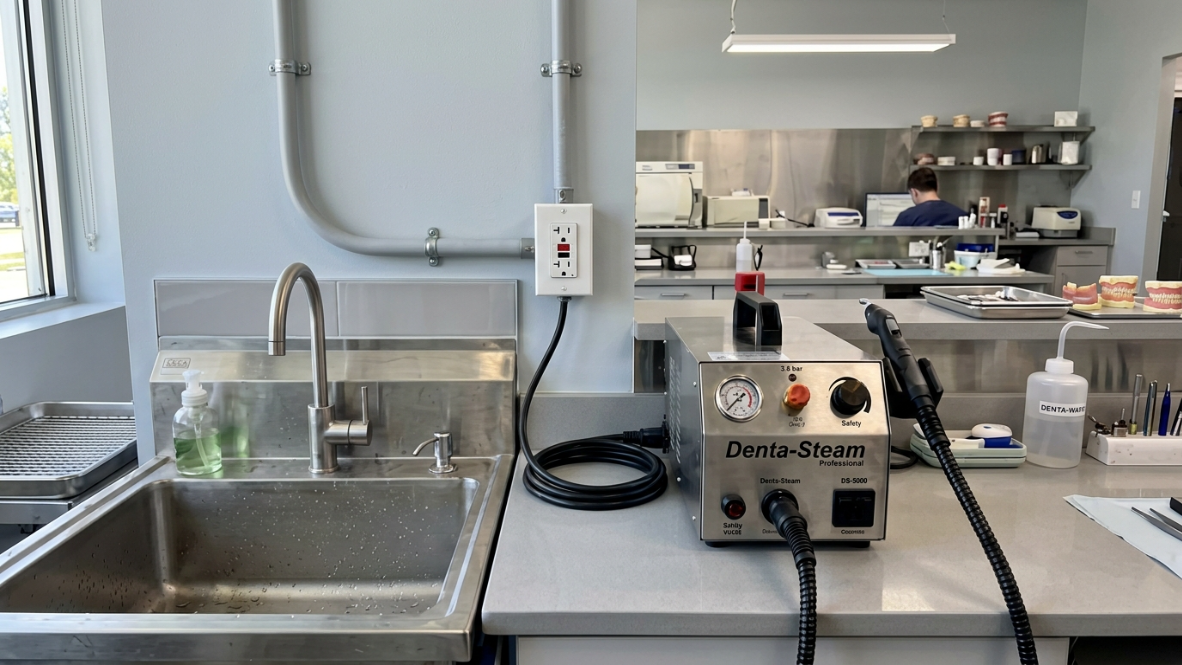
Getting the infrastructure right during your dental lab steam station setup prevents expensive fixes later.
Dedicated Circuit
Steam boilers draw significant power during heat-up. Sharing a circuit with other high-draw equipment (polishing motors, casting machines) can trip breakers. A dedicated circuit for the steam station is worth the small additional cost during initial setup.
GFCI Protection
In any workspace where water and electricity coexist, ground-fault circuit interrupter (GFCI) protection is essential. Most building codes require GFCI outlets within six feet of water sources. A steam station qualifies.
Proximity to Water and Drainage
Ideally, your steam station sits within a few feet of both a water source (for refilling) and a drain (for condensate). Routing condensate across the lab floor or into a bucket is a slip hazard and a code violation waiting to happen.
Workspace Layout and Placement
Station Footprint
For a mid-sized dental lab, one design resource recommends allocating approximately 8 by 10 feet for a complete lab station. That includes room for the steamer, containment area, workspace, and operator movement. Cramming a steam station into a tight corner creates ergonomic issues and limits airflow.
Moisture-Resistant Construction
This point cannot be overstated. Every surface in the steam station area should be moisture-resistant. Stainless steel is the gold standard. Powder-coated steel works as a budget alternative. Wood, MDF, and laminated particle board will fail within months in a steam-heavy environment.
Ventilation
Ventilation matters for two reasons. First, steam itself creates humidity that can affect adjacent equipment and materials. Second, many dental labs handle monomers, solvents, and other volatile substances nearby. OSHA guidance states that ventilation in dental environments is very important because potentially hazardous substances can become airborne. If your steam station is near chemical work areas, a vent hood or dedicated exhaust fan is necessary.
Workflow Integration
The steam station should sit between polishing/finishing and sterilization areas in your lab’s workflow sequence. Work flows from fabrication to polishing to steam cleaning to sterilization. If the steam station is across the room from the autoclave, technicians waste time and are more likely to skip the cleaning step.
Safety and Compliance Terms
ASME Certification
The American Society of Mechanical Engineers sets standards for pressure vessel construction. ASME-certified boilers have been built and tested to specific safety standards for pressurized containers. For commercial dental lab steam equipment, ASME certification means the boiler meets recognized pressure vessel safety requirements. The commercial steam boiler safety guide covers what ASME certification actually involves.
UL/ETL Listing
Underwriters Laboratories (UL) and Intertek (ETL) test electrical equipment for safety. A UL or ETL listing means the steamer’s electrical components have been independently tested and meet national safety standards.
This is not a trivial concern. One practitioner on the Dental Lab Network forum shared a cautionary incident: a Kerr Touchsteam steamer’s rocker switch shorted out and nearly burned down a dental office. The fire was caught just in time and extinguished with a fire extinguisher. Electrical safety certifications exist specifically to reduce the likelihood of failures like this.
Pressure Relief Valve
A mandatory safety device on any pressurized steam boiler. If internal pressure exceeds safe levels, the relief valve opens automatically to vent excess steam rather than allowing the vessel to rupture. Never operate a steam boiler with a missing, damaged, or tampered pressure relief valve.
Low-Water Cutoff
This mechanism shuts down the heating element when the water level drops too low. Without it, the boiler can “dry fire,” which overheats the vessel, damages the heating element, and creates a serious safety hazard. Any commercial-grade dental lab steamer should have this feature.
Boiler Permit Exemptions
Many jurisdictions require permits and periodic inspections for pressurized boilers, but small-capacity units often fall below the threshold. Portable, non-pressurized flash steamers typically require no boiler permit at all, making them attractive for smaller in-office dental labs that want to avoid the permitting process.
OSHA Compliance
In the United States, OSHA sets workplace safety standards that apply to dental laboratories. These cover chemical safety, respiratory protection, ergonomics, and general hazard prevention. Your steam station setup should comply with OSHA requirements for wet-environment safety, burn prevention, and proper ventilation.
Water Quality and Maintenance Glossary
Maintenance is not an afterthought. It’s part of the setup because the choices you make during installation determine your maintenance burden for years.
Distilled Water
Water that has been purified through distillation to remove minerals and impurities. Distilled water is recommended for most steam boilers because it dramatically reduces mineral deposit buildup inside the tank. While any water technically works, cleaner water extends boiler lifetime significantly.
Descaling
The process of removing mineral deposits (scale) from inside the boiler. Even with weekly flushing, deposits accumulate over time. A more intensive cleaning is recommended every one to two months, depending on usage frequency and water quality. Labs using tap water need to descale more often than labs using distilled water.
Solenoid Valve
An electrically controlled valve that opens and closes the steam pathway. These are common replacement parts. Practitioners on the Dental Lab Network forum report replacing the solenoid and electrical contactor every couple of years as normal maintenance. Parts are readily available from industrial suppliers like Grainger or McMaster-Carr.
Pressure Switch
Controls when the heating element turns on and off based on internal boiler pressure. When pressure drops below a set point, the switch activates heating. When pressure reaches the upper limit, it shuts off. A failing pressure switch causes inconsistent steam output or dangerous over-pressurization.
Eco Mode
An energy-saving feature on some commercial steamers that reduces power consumption during idle periods. Some models claim energy savings of up to 33% in eco mode. For labs that run their steamer 8 hours a day but only actively use it intermittently, eco mode reduces operating costs without requiring manual shutdowns.
Daily, Weekly, and Monthly Maintenance Schedule
Frequency | Maintenance |
|---|---|
Daily | Check water level, inspect hose, wipe station |
Weekly | Flush boiler, inspect relief valve |
Monthly | Descale if required, inspect fittings |
Every 6 Months | Replace worn seals and inspect electrical connections |
Annually | Complete boiler inspection and deep cleaning |
Choosing the Right Steam Station for Your Lab
The right dental lab steam station setup depends on lab size, daily volume, and available infrastructure.
Small Lab (1 to 5 People)
A small lab needs an entry-level boiler with manual fill and 110V power. A reservoir of half a gallon is usually sufficient. The focus should be on reliability and ease of maintenance rather than high output capacity. A portable flash steamer can work for very small or in-office setups where boiler permits are a concern.
Medium Lab (6 to 15 People)
A mid-capacity boiler in the 1.5 to 2-gallon range makes sense here. Consider a direct water feed if plumbing allows it, because manual refilling becomes a productivity drain at this scale. A 220V circuit with a 3kW heating element provides faster recovery between uses. ASME and UL certification becomes more important as the equipment runs harder and longer.
Browse dental lab steamer specs for a detailed breakdown of what to look for at this level.
High-Volume Lab (15+ People or Production Lab)
Large production labs need a pump-fill or direct water feed system with a 4 to 6-gallon capacity. Three-phase power may be required. At this scale, equipment uptime is everything. A steamer that goes down for a day disrupts the entire production schedule.
One lab manager on the Dental Lab Network forum described their approach: opening the pressure vessel once a year to clean out accumulated sediment, replacing the solenoid and contactor every couple of years, and getting 12 years before the first significant issue. That kind of longevity comes from buying the right equipment and maintaining it consistently.
Another forum member reported a Reimers steamer running 8 hours a day, 5 days a week, for at least 20 years with only a handpiece replacement. The contrast is sharp. A different poster lamented: “We go through a steamer a year, and would REALLY like to find a reliable steamer.” The difference almost always comes down to boiler material, water quality, and initial investment.
Dental Lab Steam Station Buying Checklist
Before purchasing a steam cleaner, verify:
Boiler material
Heating element design
Pressure output
Tank capacity
Water requirements
Replacement parts availability
Warranty length
ASME certification
UL/ETL listing
Fill method
Voltage requirements
Recovery time
Service availability
Common Mistakes in Dental Lab Steam Station Setup
Avoid these pitfalls that show up repeatedly in practitioner discussions:
Using tap water without a maintenance plan. Hard water destroys boilers. If you cannot commit to distilled water, at minimum install an inline filter and follow an aggressive descaling schedule.
Placing the station on wood or laminate surfaces. The surface will fail. Stainless steel or powder-coated steel is not optional.
Ignoring electrical requirements. Plugging a 220V unit into a 110V circuit (or running a high-draw steamer on a shared circuit) causes immediate problems. Verify your electrical supply before purchasing.
Skipping the containment system. Without a steam tube or containment enclosure, debris and moisture spread across the bench and into adjacent work areas.
Buying on price alone. The cheapest steamer is rarely the cheapest option over three years. Forum practitioners are consistent on this point: quality stainless steel boilers with proper certifications last 10 to 20 years. Budget models with internal heating elements and low-carbon steel tanks often need replacing annually.
Cost of a Dental Lab Steam Station
While exact prices vary by manufacturer, most complete steam station setups fall into three categories.
Lab Size | Typical Equipment | Estimated Investment |
|---|---|---|
Small Lab | Manual Fill | Low |
Medium Lab | Auto Fill | Moderate |
Production Lab | Direct Feed | High |
Dental Lab Steam Station at a Glance
Question | Answer |
|---|---|
Recommended PSI | 45–80 PSI |
Best Water | Distilled |
Best Boiler Material | Stainless Steel |
Typical Voltage | 110V or 220V |
Drain Required | Yes |
GFCI Recommended | Yes |
Boiler Certification | ASME |
Electrical Certification | UL or ETL |
Main Maintenance | Flushing and descaling |
Frequently Asked Questions
What is the difference between a dental lab steam cleaner and an autoclave?
A steam cleaner uses pressurized steam (45 to 80 PSI) to remove debris and contaminants from dental prosthetics. An autoclave uses lower-pressure steam at sustained high temperatures (121 to 134°C) to kill microorganisms and achieve sterilization. Steam cleaning is a preparation step. Autoclaving is the sterilization step. Both are needed, and they’re not interchangeable. For more on this distinction, the wax removal steam guide explains where steam cleaning fits in the fabrication workflow.
Do I need to use distilled water in my dental lab steamer?
It’s strongly recommended. Distilled water prevents mineral buildup inside the boiler, extending equipment life and reducing descaling frequency. Units with internal heating elements particularly require distilled water. External-element designs are more forgiving, but distilled water still provides the best results for any configuration.
What PSI should a dental lab steam cleaner produce?
Most dental lab steam cleaning tasks require 45 to 80 PSI. This range effectively removes wax, polishing compound, and investment material. Adjustable pressure is a valuable feature because delicate items like porcelain veneers benefit from lower pressure settings.
How much space should I allocate for a dental lab steam station?
For a mid-sized lab, approximately 8 by 10 feet is recommended for a complete station that includes the steamer, containment area, work surface, and operator movement space. Smaller labs can work with less, but avoid cramming the station into a tight corner where ventilation and ergonomics suffer.
How often should I descale my dental lab steam boiler?
With heavy daily use, a thorough descaling every one to two months is recommended. Weekly flushing of the reservoir slows buildup but doesn’t eliminate it. Labs using distilled water can stretch descaling intervals further. Labs using tap or hard water should descale monthly.
Do I need a boiler permit for a dental lab steamer?
It depends on your jurisdiction and the unit’s capacity. Small-capacity boilers and non-pressurized flash steamers often fall below local permitting thresholds. Larger ASME-rated pressure vessels may require permits and periodic inspections. Check with your local building authority before installation.
What electrical supply does a dental lab steamer need?
Small units (1-gallon capacity or less) typically run on standard 110V outlets. Mid-range units with higher wattage heating elements often require 220V. Large industrial boilers may need three-phase power. Always verify the electrical requirements of a specific model before purchasing, and plan for a dedicated circuit.
What certifications should I look for in dental lab steam equipment?
ASME certification confirms the boiler meets pressure vessel safety standards. UL or ETL listing confirms the electrical components have been independently tested for safety. Both certifications matter. ASME protects against boiler failures, while UL/ETL protects against electrical fires, a real risk documented by dental lab practitioners.
Ready to build out your dental lab steam station? The dental lab steamer buyers guide walks through specific models, pricing, and configurations matched to lab size and volume.


