

TL;DR
A dental lab steamer case study is a documented evaluation of how steam cleaning equipment performs in a real dental laboratory, measuring factors like contamination removal, equipment downtime, maintenance costs, and total cost of ownership. Published research shows steam cleaning is the most efficient method for removing debris and metallic contamination from dental components. No rigorous, publicly available case studies exist for this equipment category yet, which means lab owners need a clear framework for evaluating steamer performance on their own terms.
If you run a dental lab or manage equipment purchases for one, you already know what a steamer does. The question isn’t whether steam works. It’s whether a specific piece of equipment justifies the investment over months and years of continuous use. That’s what brings people to search for a dental lab steamer case study, and it’s exactly the kind of evidence the industry lacks.
This guide defines the concept, walks through what the science actually shows, and gives you a practical framework for building or evaluating your own case study data.
Considering a steamer upgrade for your dental lab? Browse the dental lab buyer’s guide for specs, sizing, and pressure comparisons by lab size.
Dental Lab Steamer Case Study: Quick Answer
A dental lab steamer case study evaluates whether a steam cleaner improves cleaning quality, reduces downtime, lowers maintenance costs, and delivers a positive return on investment over long-term use. Although few manufacturers publish formal case studies, available scientific research supports steam cleaning for contaminant removal, while practitioner reports suggest equipment lifespan depends primarily on water quality, boiler design, and maintenance practices.
The five metrics that matter most are:
Cleaning effectiveness
Annual maintenance cost
Equipment downtime
Steam pressure consistency
Total cost of ownership
For most laboratories, the long-term operating cost is a more important purchasing factor than the initial purchase price.
Key Takeaways
No comprehensive manufacturer case studies currently exist for dental laboratory steamers.
Scientific evidence supports steam cleaning for debris removal but not sterilization.
Mineral buildup remains the leading cause of equipment failure.
Tracking maintenance costs often reveals greater differences between machines than purchase price alone.
Most laboratories benefit from evaluating equipment over at least 12 months rather than relying on short demonstrations.
What Is a Dental Lab Steamer Case Study?
A dental lab steamer case study is a documented, before-and-after evaluation of steam cleaning equipment in a dental laboratory setting. It tracks measurable outcomes: how effectively the steamer removes contaminants, how often it breaks down, how much maintenance it requires, and what the total cost of ownership looks like over time.
The term exists because lab owners need proof before committing anywhere from $1,000 to $10,000 on equipment that will run all day, every day. Unlike consumer products with thousands of reviews, commercial dental lab steamers operate in a niche where peer validation is scarce. A case study fills that gap with structured evidence rather than anecdotal impressions.
What a credible dental lab steamer case study typically measures:
Cleaning effectiveness on wax, polishing residue, investment material, and other contaminants
Workflow continuity, meaning how often (or rarely) the steamer causes production stoppages
Maintenance burden, including descaling frequency, part replacements, and repair costs
Pressure and temperature consistency under continuous use
Total cost of ownership across the full lifecycle of the equipment
The problem? No manufacturer in the dental steamer space currently publishes rigorous case studies with these metrics. What ranks in search results for this query is a mix of buyer’s guides, product pages, and social media demos. That gap is exactly why understanding what a case study should contain matters more than finding one that already exists.
What Dental Lab Steamers Actually Clean
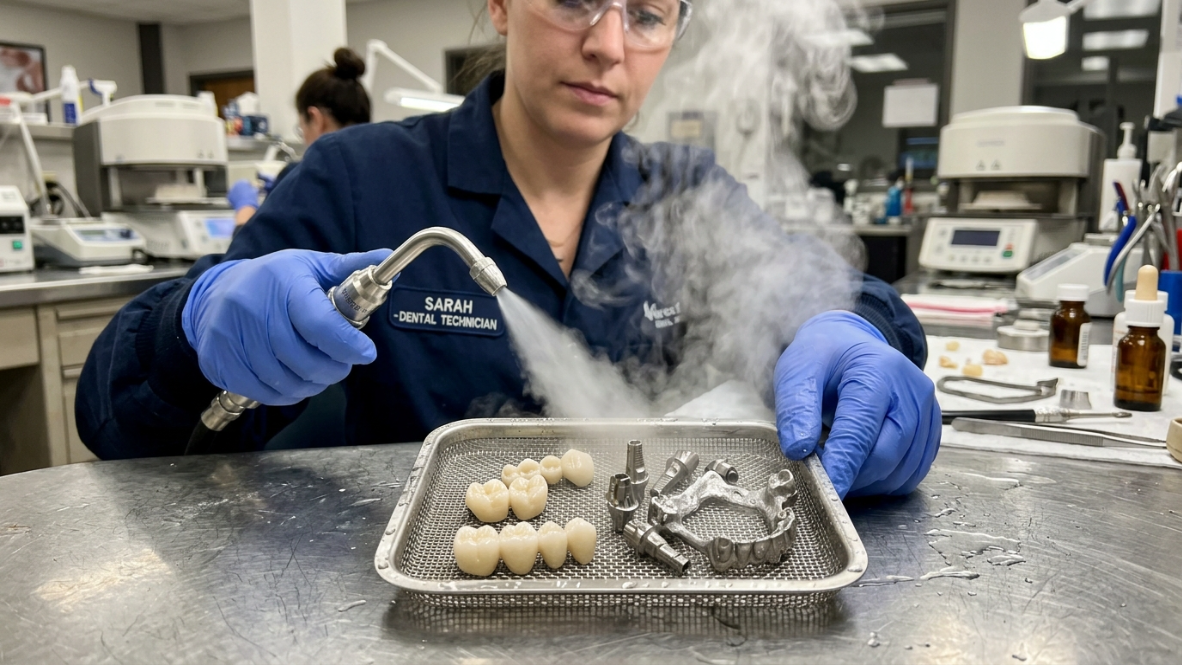
Steam cleaning in dental labs covers far more ground than most people outside the industry realize. Hot steam removes wax residues, polishing agents, and contaminants from impressions, models, and dental prosthetics without leaving chemical residues behind. That last point, no chemical residue, is a significant advantage in a setting where even trace contamination can compromise the fit or biocompatibility of a restoration.
Core cleaning tasks include:
Removing grease, sticky wax, pickling agents, and adhesives from castings
Cleaning crowns, bridges, zirconia frameworks, 3D-printed resins, and CAD/CAM milled appliances
Decontaminating dental impression trays and instruments
Eliminating polishing compound buildup from prosthetics
For a deeper look at wax removal techniques specifically, the guide on steam for dental lab wax removal covers technique, temperature, and equipment considerations.
What the Research Shows About Effectiveness
The strongest published evidence comes from a 2023 study on implant abutment decontamination. Researchers compared multiple cleaning methods and found that steam cleaning was the most efficient method for reducing debris and metallic contamination. This is the closest thing to a formal dental lab steamer case study in the scientific literature, and it strongly supports steam as the preferred cleaning method for precision dental components.
An important caveat: that same study found bacteria on 40% of agar plates after steam cleaning. Most colonies were Bacillus cereus and Staphylococcus warneri. Steam cleaning excels at debris removal, but it is not a sterilization method. Labs still need autoclave protocols for sterilization. Confusing the two is a common and potentially dangerous misunderstanding.
The Surface Degradation Factor
One finding that no competing content covers: prolonged steam exposure can degrade certain dental materials. A PubMed study on dental stone surfaces found that the duration of steam cleaning significantly increased surface roughness values (Ra). Longer steam application also correlated with measurable weight loss from dental stone surfaces.
This matters for any dental lab steamer case study because it introduces a variable most equipment reviews ignore. Pressure and duration need to be matched to the material being cleaned. As one practitioner on the Dental Lab Network forums noted, “anything more than 50 PSI will degrade dies. This unit was designed for jewelry which obviously will take more abuse than a stone die.” Dental labs need moderate pressure with precision, not maximum force on every task.
Key Metrics in a Dental Lab Steamer Case Study
If you’re evaluating equipment or building your own performance data, these five metrics form the foundation of any meaningful dental lab steamer case study.
1. Contamination Reduction
The most basic measure: does the steamer actually clean what it needs to clean? This can be assessed visually for most dental lab tasks, but the abutment study referenced above shows that measured contamination reduction provides much stronger evidence. Before-and-after photography under magnification is a practical approach for labs that want to document results without laboratory-grade analysis.
2. Downtime Hours Per Quarter
This is where the money is. As Renfert’s engineering blog puts it, daily work in a dental laboratory involves constant stress from heat, pressure, and continuous steam usage. A steam cleaner failure can delay entire production lines.
Practitioners on the Dental Lab Network forums confirm this is the single biggest pain point. One lab owner reported going through a steamer every year. Multiple users described dental steamers as “disposable equipment.” But outliers exist: one Reimers owner reported that their steamer was at least 20 years old, still running eight hours a day, five days a week.
The gap between one-year and twenty-year lifespans is enormous, and tracking downtime is how you close that knowledge gap.
3. Maintenance Cost Per Year
Annual maintenance costs vary wildly depending on construction quality and water management. Forum data shows that a rebuild on a 2-gallon Reimers unit was quoted at approximately $800. When you factor in descaling chemicals, replacement heating elements, solenoid valves, and handpieces, maintenance easily becomes the largest ongoing expense category.
Understanding steamer maintenance requirements and terminology helps labs track these costs accurately.
4. Steam Pressure Consistency
Dental lab steam cleaners should produce steam pressure in the range of 45 to 80 PSI for efficient cleaning. But the spec sheet number and the real-world, continuous-use number are often different. Pressure drops under sustained use, especially in units with smaller boilers or lower wattage heating elements.
A useful case study tracks whether the steamer maintains adequate pressure during peak production hours, not just during a five-minute demo.
For detailed pressure and specification benchmarks, dental lab steamer requirements and standards provides a thorough reference.
5. Total Cost of Ownership
Purchase price is just the beginning. A complete dental lab steamer case study calculates:
Initial equipment cost
Annual maintenance and consumables
Energy consumption
Replacement cycle (how many years before you need a new unit)
Lost productivity during downtime
A $2,000 steamer that lasts 15 years with minimal maintenance is dramatically cheaper than a $1,200 unit replaced every 18 months. Yet most buyers focus on the sticker price.
Example ROI Calculation
A simple ROI calculation helps compare two steamers over five years.
Cost Category | Economy Steamer | Premium Steamer |
|---|---|---|
Purchase Price | $1,500 | $3,400 |
Maintenance | $3,200 | $900 |
Downtime Cost | $2,700 | $600 |
Electricity | $580 | $510 |
Five-Year Total | $7,980 | $5,410 |
Although the premium unit costs more initially, its lower maintenance and reduced downtime create a substantially lower total ownership cost over five years.
Example Dental Lab Steamer Case Study
The following fictional example illustrates how a laboratory could document steamer performance over one year.
Metric | Before Replacement | After Replacement |
|---|---|---|
Daily Cleaning Time | 95 minutes | 58 minutes |
Downtime | 22 hours/year | 4 hours/year |
Annual Maintenance | $1,150 | $320 |
Water Consumption | Higher | Lower |
Operator Satisfaction | Moderate | High |
ROI Payback | — | 16 months |
While actual results vary by laboratory size and workload, documenting these measurements allows buyers to compare equipment using objective data rather than marketing claims.
Common Failure Points That Case Studies Reveal
Understanding why steamers fail is just as important as understanding how they perform when working. The pattern across practitioner reports is remarkably consistent.
Mineral Buildup: The Number One Killer
Most steamer failures trace back to water quality. Units with internal heating elements are especially vulnerable. Mineral deposits accumulate on elements, reduce heating efficiency, and eventually cause element failure or steam leaks. Units with a stainless steel water reservoir and the heating element wrapped around the outside require the least maintenance. Units with internal elements generally require distilled water and periodic chemical descaling.
Internal Heating Element Corrosion
Forum users on the Dental Lab Network repeatedly pointed out that most boilers use low carbon steel with a stainless steel shell, and most have heating elements inside the boiler. This design creates the conditions for steam leaks at element penetration points. It’s a structural weakness that becomes inevitable over time without proper water management.
Solenoid Valve Failure
Renfert’s engineering team identified the solenoid valve as the key failure point in dental lab steamers. Their redesign used a larger diameter valve with optimized flow and user-replaceability to reduce downtime. This is a useful data point for any case study: how easily can the most failure-prone component be replaced?
Fire Safety Concerns
This one gets overlooked. One dentist reported on a forum that a Kerr Touchsteam steamer’s rocker switch shorted out and nearly caused a fire. ASME and UL certification exists specifically to mitigate risks like this. In a pressurized system running continuously in a professional setting, safety certification is not optional. The guide on medical lab steam cleaner safety covers compliance considerations in detail.
Pressure, Temperature, and Capacity Requirements
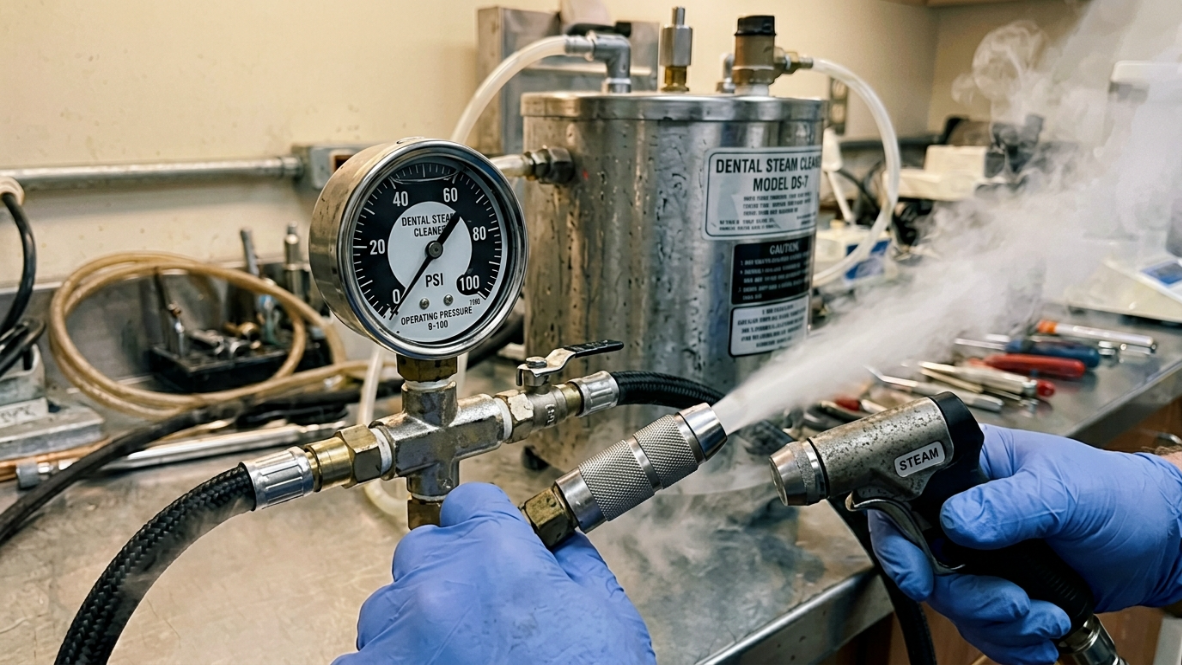
Any dental lab steamer case study needs a baseline understanding of what specs the lab actually requires. Here’s a quick reference.
Pressure Range
The working range for dental applications is 45 to 80 PSI. Most dental-branded steamers fall between 50 and 65 PSI:
Model | PSI | Temperature at Tip |
|---|---|---|
Reliable 5100CD | 50 PSI | 200°F |
Reliable 6000CD | 60 PSI | 221°F |
Renfert POWER Steamer | 65 PSI (4.5 bar) | Not specified |
Reliable 7000CD | 70 PSI | 221°F |
Industrial-grade boilers can reach 70 to 90 PSI, which provides more cleaning power but requires careful technique on delicate materials like dental stone dies. For labs cleaning primarily metal castings, zirconia, and CAD/CAM materials, higher pressure is an advantage. For labs working heavily with gypsum products, moderate pressure with controlled duration is safer.
Capacity by Lab Size
Sizing guidelines are straightforward:
Labs with fewer than 6 technicians: A reservoir of 1/2 gallon or less handles the workload
Larger labs (6+ technicians): Choose a unit with more than 1/2 gallon capacity
High-production labs or military dental facilities: Units with 1.5+ gallon capacity or continuous water-feed systems
Why ASME and UL Certification Matters
Pressurized steam equipment in a professional setting should carry ASME and UL certification. These aren’t marketing badges. They verify that the boiler meets structural, electrical, and safety standards for continuous commercial use. The commercial steam boiler safety guide explains what each certification covers and why it matters for insurance and compliance.
How to Evaluate a Dental Lab Steamer Case Study
Since no manufacturer currently publishes comprehensive dental lab steamer case study data, you’ll need to evaluate whatever evidence you encounter with a critical eye. Here’s what separates useful evidence from marketing.
Red Flags
No before-and-after metrics of any kind
No mention of maintenance requirements or costs
No time frame (a one-week test tells you nothing about reliability)
Vague claims like “cleans everything perfectly” without specifying materials or contaminants
No mention of water quality requirements
Green Flags
Documented pressure readings over time, especially after sustained use
Maintenance logs showing actual costs and frequencies
Cost tracking across the full ownership period
Named lab type and size (a 3-person cosmetic lab has different needs than a 20-person full-service production lab)
Acknowledgment of limitations (for example, that steam does not sterilize)
A Practical Approach
One consistent theme from practitioners on dental lab forums: don’t rely on the manufacturer’s claims alone. Several lab owners reported buying jewelry-grade steamers instead of dental-branded models and getting equivalent or better results at lower cost. As one user bluntly put it, “What’s a good steamer? One that’s not sold by a dental company at an over-inflated price.”
The takeaway isn’t necessarily to buy a jewelry steamer. It’s that construction quality, pressure output, and long-term reliability matter far more than the label on the front. Ask vendors for real customer references. Request maintenance cost data. If they can’t provide it, that tells you something.
The Market Context
The global dental steam cleaners market was valued at approximately USD 150 million in 2023 and is projected to reach around USD 250 million by 2032, growing at a CAGR of 6.0%. That growth reflects both increasing awareness of steam cleaning benefits and the expansion of dental lab services globally.
As the market grows, the need for documented, evidence-based equipment evaluation grows with it. The dental lab steamer case study as a concept will become increasingly important for labs making purchasing decisions in a market with more options and more price points than ever.
Building Your Own Case Study
Since published dental lab steamer case studies are essentially nonexistent, the most useful thing a lab can do is create its own. Start with a simple tracking sheet:
Record baseline performance on day one: pressure at the tip, cleaning results on your most common tasks, time to reach operating temperature
Log every maintenance event: descaling, element replacement, valve issues, anything
Track downtime: every hour your steamer is down, note the date, cause, and duration
Calculate annual costs: add up parts, consumables, energy, and any lost production value
Photograph results: before-and-after images of cleaned components create the most compelling evidence
After 12 months, you’ll have more useful data than any manufacturer or review site currently provides. That’s not a criticism of the industry. It’s an opportunity for labs willing to do the work.
Ready to compare equipment options? See the full dental lab buyer’s guide for side-by-side specs, sizing guidance, and pressure comparisons.
Related Terms
If you’re researching dental lab steamer case studies, these related concepts come up frequently. Understanding them helps you evaluate equipment claims and maintenance requirements more accurately.
Operating pressure (PSI/bar): The force at which steam exits the nozzle. Dental work typically requires 45 to 80 PSI.
Wet steam vs. dry steam: Dry steam contains less moisture and leaves fewer water marks. Important for final cleaning of prosthetics. Learn more about flash steamer vs. boiler differences.
ASME certification: A safety standard for pressurized vessels, verified through third-party inspection.
UL listing: Electrical safety certification confirming the unit meets standards for commercial use.
Continuous-duty rating: Indicates the steamer can run all day without mandatory cool-down periods.
Descaling: The process of removing mineral deposits from the boiler interior. Frequency depends on water quality.
Solenoid valve: The electromagnetic valve controlling steam release. The most common failure point in dental lab steamers.
Dental Lab Steamer Case Study Summary
Category | Key Finding |
|---|---|
Best Cleaning Method | Steam removes debris efficiently but does not sterilize |
Ideal PSI | 45–80 PSI |
Typical Lifespan | 1–20+ years depending on maintenance |
Largest Failure Cause | Mineral buildup |
Biggest Operating Cost | Maintenance and downtime |
Most Important Buying Metric | Total cost of ownership |
Scientific Evidence | Supports contaminant removal effectiveness |
Recommended Water | Distilled water |
Frequently Asked Questions
What does a dental lab steamer case study typically measure?
A well-constructed case study tracks five core metrics: contamination reduction effectiveness, equipment downtime, annual maintenance costs, steam pressure consistency under continuous use, and total cost of ownership over the equipment’s lifespan. Most useful case studies also document the specific materials being cleaned and the lab’s production volume.
Is there published scientific evidence that steam cleaning works in dental labs?
Yes. A 2023 study published in PMC found that steam cleaning was the most efficient method for reducing debris and metallic contamination on implant abutments compared to other cleaning approaches. However, the same study confirmed that steam cleaning does not sterilize, as bacteria were still present on 40% of samples after treatment.
Can steam cleaning damage dental materials?
It can, if applied incorrectly. Research published in PubMed showed that prolonged steam exposure significantly increases surface roughness on type III dental stone. This means technique matters: labs should match pressure levels and exposure duration to the specific material being cleaned. Castings and zirconia tolerate higher pressure than gypsum dies.
How long should a dental lab steamer last?
The range is enormous. Practitioners on dental lab forums report lifespans ranging from one year for poorly maintained units to 20+ years for well-built steamers with proper water quality management and regular maintenance. Construction quality (specifically stainless steel boilers with external heating elements) and consistent use of distilled water are the two biggest factors.
What PSI is best for dental lab steam cleaning?
Most dental applications fall in the 45 to 80 PSI range. Lower pressures (45 to 55 PSI) work well for cleaning gypsum models and dies. Higher pressures (60 to 80 PSI) are better suited for metal castings, zirconia, and removing stubborn investment material. Going above 50 PSI on stone dies risks degrading the surface.
Why do dental lab steamers fail so often?
The primary cause is mineral buildup from using tap water instead of distilled water. This leads to scale accumulation on heating elements, reduced efficiency, and eventual element or seal failure. Solenoid valve wear is the second most common failure point. Units with internal heating elements are more vulnerable than those with external, wraparound element designs.
Should dental labs buy dental-branded steamers or jewelry-grade equipment?
Several dental lab owners on forums report using jewelry-grade steamers with equal or better results at lower prices. The key factors are pressure output, boiler construction quality, and safety certification, not the dental label. Any ASME/UL certified unit with appropriate pressure range and tank capacity can serve a dental lab effectively.
How do I start tracking my own dental lab steamer case study data?
Begin on day one with your new equipment. Record baseline pressure and temperature readings, photograph cleaning results on common tasks, and create a simple log for maintenance events and downtime incidents. After 12 months, calculate your total costs including consumables, repairs, energy, and any lost production time. This data is more valuable than any manufacturer’s marketing materials.


