

TL;DR
Dental lab steamers operate at 50 to 80 PSI to remove wax, polishing compounds, and investment material from crowns, bridges, and prosthetics. Because they exceed the 15 PSI threshold defined by ASME, these units qualify as power boilers and must meet Section I construction standards, carry proper certifications, and comply with state inspection requirements. This guide covers every specification, safety standard, and regulatory obligation dental lab owners need to understand before purchasing or auditing their steam cleaning equipment.
Dental laboratories depend on steam cleaning for dozens of daily tasks, from stripping wax residues off casting patterns to removing polishing compounds from finished zirconia crowns. Yet when it comes to understanding dental lab steamer requirements, most available information is either too generic (written for industrial boiler operators) or too shallow (basic product descriptions with no regulatory context).
This guide fills that gap. It covers the technical specifications, safety certifications, federal and state regulations, and practical maintenance obligations that apply specifically to steam equipment in dental laboratories.
Looking for equipment recommendations alongside these requirements? Check out the dental lab steamer buyer’s guide for model comparisons and sizing advice.
Quick Answer: Dental Lab Steamer Requirements (2026)
Dental lab steamers typically operate at 50–80 PSI and are classified as ASME power boilers because they exceed the 15 PSI threshold. This means they must comply with ASME Section I construction standards, include certified safety systems, and meet state boiler inspection requirements. Most compliant units also require UL/CSA electrical certification, MAWP-rated safety valves, and routine maintenance like descaling every 1–3 months.
Dental Lab Steamer Requirements: Key Specs at a Glance
Category | Requirement | Typical Standard |
|---|---|---|
Operating Pressure | Cleaning efficiency range | 50–80 PSI |
Regulatory Threshold | ASME classification trigger | >15 PSI |
Boiler Standard | Construction code | ASME Section I |
Safety Certification | Electrical safety | UL / CSA Listed |
Material | Tank construction | Stainless steel preferred |
MAWP | Maximum operating pressure | 50–80 PSI stamped |
Maintenance Cycle | Descaling interval | Every 1–3 months |
Inspection | State compliance | Annual (varies by state) |
What Is a Dental Lab Steamer?
A dental lab steamer is a pressurized steam cleaning unit designed to remove wax, investment material, polishing agents, and other contaminants from dental prosthetics, impressions, models, and laboratory tools. Hot steam cleans without leaving chemical residues, which matters when you’re preparing surfaces for porcelain application, casting, or final delivery.
Steamer vs. Autoclave vs. Ultrasonic Cleaner
These three machines serve different purposes, and dental labs often use all of them. Confusing their roles is common, so the distinction is worth making clearly.
Steamers clean. They blast contaminants off surfaces using pressurized steam. They do not sterilize.
Autoclaves sterilize. They use sustained high-pressure steam at specific temperatures (typically 250°F or higher) for defined time periods to kill bacteria, viruses, and spores. Autoclaves are regulated as medical devices.
Ultrasonic cleaners use cavitation (microscopic bubbles created by sound waves) in a liquid bath to dislodge debris. They’re effective for fine detail work but slower than steam for bulk wax removal.
A steamer handles the heavy lifting of daily cleaning. An autoclave handles infection control. They are not interchangeable.
Primary Use Cases in Dental Labs
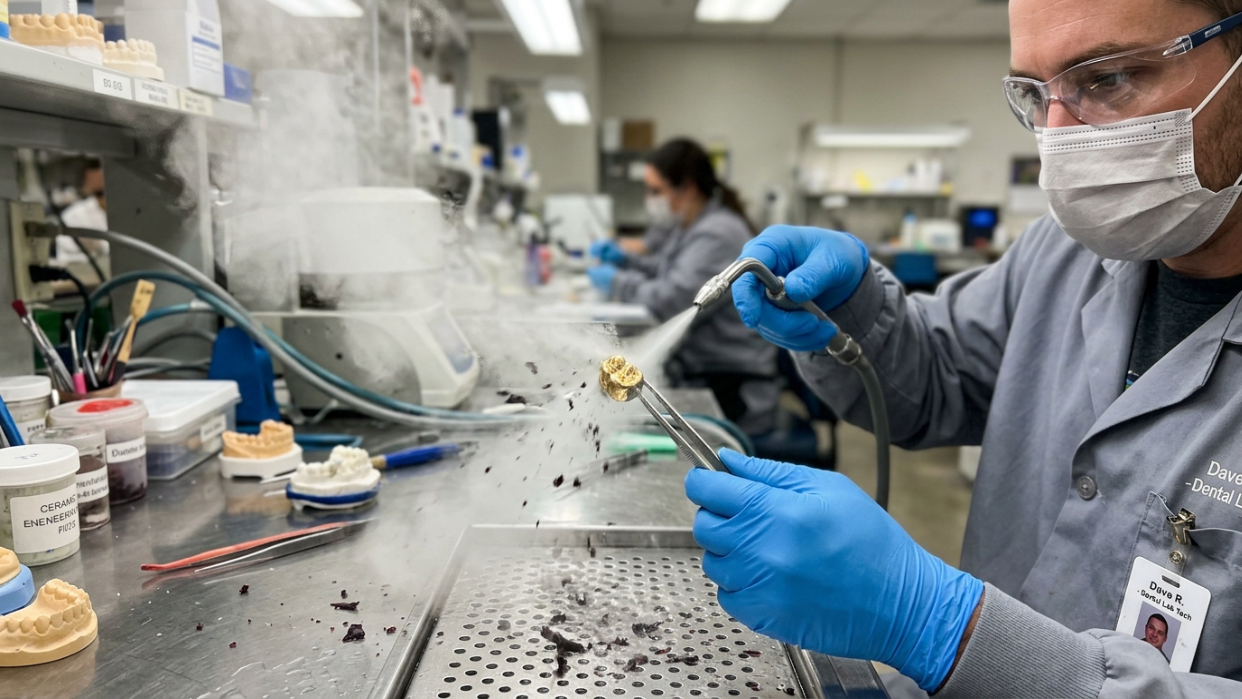
Wax elimination from crowns, bridges, and partial denture frameworks
Polishing compound removal after finishing
Investment material removal after casting
Cleaning CAD/CAM milled appliances and 3D-printed resins
Decontaminating tools and work surfaces between cases
Surface preparation before porcelain or ceramic application
According to a US Air Force dental resource referenced by industry suppliers, wet steam works best for most dental laboratory work, including removing wax, polishing residue, and disclosing media.
PSI Requirements for Dental Lab Steam Cleaners
PSI (pounds per square inch) measures the pressure at which steam exits the nozzle. Higher pressure means more force hitting the workpiece, which translates to faster, more complete cleaning.
The Dental Lab Sweet Spot: 50 to 75 PSI
Dental lab steam cleaners should produce steam pressure in the range of 45 to 80 PSI for effective cleaning, especially on resistant deposits like investment material and baked-on polishing compounds. Industry consensus and manufacturer specifications consistently point to 50 to 75 PSI as the practical sweet spot for dental applications.
Entry-level dental steamers typically start around 40 to 50 PSI. Larger commercial units reach 60 to 80 PSI. For context, the requirements breakdown looks like this:
Cleaning Task | Minimum Effective PSI |
|---|---|
Light wax removal | 40–50 PSI |
Heavy wax and investment | 50–70 PSI |
Polishing compound removal | 50–75 PSI |
Stubborn contaminants | 70–80+ PSI |
Sustained Pressure Matters More Than Peak Specs
A steamer might advertise 80 PSI on the data plate, but what matters is whether it holds that pressure under continuous use. Practitioners on the Dental Lab Network forums consistently emphasize this point. One lab owner using a commercial steamer reported that “the supply of 80 PSI steam is endless. You can stand on the switch all day and it never dips below 80.” That kind of sustained output is what busy labs actually need.
If you’re evaluating steamers, ask about pressure performance under load, not just the maximum rating. For a deeper explanation of how PSI ratings work across commercial steam equipment, see this guide on how much PSI you need.
ASME Certification and the 15 PSI Threshold
This is the single most important regulatory concept in dental lab steamer requirements, and almost no dental-focused content explains it clearly.
The 15 PSI Line
The American Society of Mechanical Engineers (ASME) Boiler and Pressure Vessel Code (BPVC) draws a hard line at 15 PSI. A power boiler is defined as a boiler in which steam or other vapor is generated at a pressure of more than 15 PSI for use external to itself. Equipment operating above this threshold falls under ASME BPVC Section I (Power Boilers), which triggers specific construction, stamping, and inspection requirements.
Since dental lab steamers typically operate at 50 to 80 PSI, they fall squarely into power boiler territory. This is not optional or theoretical. If the MAWP (Maximum Allowable Working Pressure) is greater than 15 PSI, the boiler must be built to the requirements of ASME Section I.
What the ASME “S” Stamp Means
The “S” stamp on a boiler’s data plate indicates it was manufactured under ASME Section I rules, inspected during construction by an authorized inspector, and registered with the National Board of Boiler and Pressure Vessel Inspectors. This stamp matters for three practical reasons:
Insurance. Many commercial property insurers will not cover equipment without ASME certification. If an unregistered pressure vessel fails and causes damage or injury, the lab’s liability exposure increases dramatically.
Inspections. State boiler inspectors check for the ASME stamp. Without it, your steamer may not pass inspection.
Resale and compliance. ASME-stamped equipment has documented provenance. This matters if you sell the unit or if regulators audit your lab.
For a complete walkthrough of what ASME stamps, National Board numbers, and data plates mean, read the commercial steam boiler safety guide.
UL and CSA Electrical Safety Listing
UL (Underwriters Laboratories) and CSA (Canadian Standards Association) certifications verify that a steamer’s electrical components meet safety standards for commercial use. This matters in dental labs because the environment combines water, steam, and electricity in close proximity.
UL listing confirms that the equipment has been tested for electrical safety, including grounding, insulation, and overload protection. OSHA’s Nationally Recognized Testing Laboratory (NRTL) program accepts UL and CSA certifications as evidence that equipment meets workplace safety requirements.
Practitioners on dental lab forums report real-world electrical issues with uncertified equipment, including grounding problems where heating element connections penetrate the boiler shell. Choosing UL/CSA-listed equipment eliminates most of these risks at the source.
MAWP: Maximum Allowable Working Pressure
MAWP is the highest pressure at which a boiler is designed and certified to operate. It’s stamped on the data plate and determines two things: the setting for the safety relief valve and the inspection schedule your state requires.
Every safety relief valve must be set to open at or below the MAWP. If the valve is set higher, or if the boiler is operated above its MAWP, the unit is out of compliance and dangerous.
For dental lab steamers with a MAWP above 15 PSI (which includes virtually all units in the 50 to 80 PSI range), most states require annual inspections. Some states exempt equipment below certain capacity or heat input thresholds, but you need to verify your specific state’s rules.
Understanding the relationship between pressurized and non-pressurized steamers can help clarify where your equipment falls on the regulatory spectrum.
Boiler Tank Construction Materials
The material your steamer’s tank is made from directly affects durability, maintenance burden, and water chemistry requirements.
Stainless Steel
Stainless steel is the top choice for pressurized steam cleaners worldwide. Unlike cast iron, stainless steel does not rust. Units with a stainless steel reservoir and an external heating element (wrapped around the outside of the tank) require the least maintenance and may not require distilled water.
Cast Iron and Low-Carbon Steel
Some lower-cost steamers use cast iron or low-carbon steel tanks. These are prone to corrosion over time, especially in environments with hard water. Forum users on the Dental Lab Network report that many boilers use “low carbon steel with a stainless steel shell, and most have heating elements in the boiler, making for steam leaks where the connections go to the elements, with possible ground problems.”
Internal vs. External Heating Elements
This distinction drives more maintenance decisions than most dental lab operators realize:
External element (wrapped around tank): Less maintenance, fewer leak points, often compatible with regular tap water.
Internal element (immersed in water): Typically requires distilled water, needs periodic chemical cleaning, and creates potential leak points where electrical connections pass through the tank wall.
Water Quality Requirements
Water quality is a genuine point of confusion in dental labs, and the requirements vary by equipment design.
When to Use Distilled Water
Units with internal heating elements generally require distilled water. Mineral deposits from tap water accumulate on the element surface, reducing heating efficiency and eventually causing failure. These units need periodic descaling even with distilled water, though less frequently.
When Tap Water Is Acceptable
Steamers with external heating elements and stainless steel tanks can often run on tap water without problems. The minerals don’t contact the heating element directly, so buildup is slower and less damaging.
The Sensor Exception
Here’s where it gets confusing: some steamers have water-level sensors that rely on the mineral content of the water to function. Their manuals specifically warn against distilled water because the sensor needs minerals to detect the water level. One forum user learned “the hard way that steamers love distilled water,” while others found their sensors stopped working when they switched to it.
The rule: Always follow your specific manufacturer’s manual. If the manual says distilled, use distilled. If it says not to, don’t.
Descaling Schedule
Regardless of water type, descaling is necessary. Hard water accelerates the timeline, but even distilled water leaves trace deposits over months of daily use. Most manufacturers recommend descaling every 1 to 3 months depending on usage intensity and water hardness. For more on maintenance intervals and how they affect equipment lifespan, see this article on how long commercial steam boilers last.
Wet Steam vs. Dry Steam for Dental Applications
Not all steam is the same, and the difference matters for dental lab work.
Wet Steam
Wet steam contains suspended water droplets. It carries more thermal mass and more physical force per blast, making it the preferred choice for heavy cleaning tasks. For wax removal, investment cleanup, and polishing compound elimination, wet steam is what most dental technicians want. The US Air Force dental resource specifically recommends wet steam for the majority of dental laboratory work.
Dry Steam
Dry steam (also called superheated steam) contains little to no liquid water. It’s gentler, evaporates faster, and leaves less moisture on the workpiece. Dry steam is better for final cleaning of delicate ceramics, polished surfaces, or situations where moisture could cause problems.
Most commercial dental lab steamers produce wet steam by default. Some models with spray attachments allow more control over moisture content.
Continuous-Fill vs. Manual-Fill Steamers
How your steamer gets its water supply has a direct impact on productivity, especially in high-volume labs.
Manual-Fill
Manual-fill steamers have a fixed water reservoir that you fill by hand. When the water runs out, you must depressurize the unit, wait for it to cool, refill, and wait for it to heat back up. This cycle can take 15 to 30 minutes depending on the model.
For small labs (six or fewer people), a manual-fill unit with at least half a gallon of capacity is usually sufficient. Mid-size labs should look for 0.5 to 1.5 gallon reservoirs.
Continuous-Fill (Auto-Pump)
Continuous-fill steamers use an automatic pump to draw water from an external source and feed it into the pressurized tank without shutting down. There’s no downtime for refilling.
Busy dental labs run steamers 8 or more hours a day. One forum contributor’s commercial steamer is “at least 20 years old. It’s on 8 hours a day, 5 days a week.” Another reported, “We turn our big steamer on at 6 and turn it off at 6 in the eve.” At that usage level, manual fill is impractical.
For labs processing high volumes, units with 1.5 gallons or more, or those with continuous water feed, are the right choice. For a detailed comparison of these two approaches, read the guide on manual-fill vs. auto-fill steam boilers.
Required Safety Systems
Dental lab steamer requirements include specific safety systems that protect both the operator and the equipment. Any commercial steamer worth buying should include all of the following:
Pressure Switch
Automatically cuts power to the heating element when tank pressure reaches the set limit. Prevents overpressurization.
Thermostat Protection
A secondary temperature cutoff that activates if the pressure switch fails. This is the backup to the backup.
Safety Relief Valve
A mechanical valve that physically opens to vent steam if pressure exceeds the MAWP. This is the last line of defense against catastrophic failure. It must be set at or below the boiler’s rated MAWP and tested periodically.
Low-Water Indicator and Auto-Shutoff
Shuts the heating element off if water drops below a safe level. Running a boiler dry can warp the tank, damage the heating element, or cause a steam explosion. This feature is non-negotiable.
Pressure Gauge
Allows the operator to visually monitor working pressure in real time. Essential for troubleshooting and confirming the unit is operating within spec.
Blowdown Valve
Used during maintenance to flush sediment and scale from the bottom of the tank. Regular blowdown extends boiler life and maintains steam quality.
OSHA Compliance for Dental Laboratories
There are currently no OSHA standards written specifically for dentistry. However, dental labs must comply with applicable general industry standards, and several have direct relevance to steam equipment and lab operations.
General Duty Clause
Even without a dental-specific standard, OSHA’s General Duty Clause (Section 5(a)(1)) requires employers to maintain a workplace “free from recognized hazards that are likely to cause death or serious physical harm.” An uncertified pressure vessel operating at 60+ PSI in a room full of technicians is exactly the kind of recognized hazard this clause addresses.
Hazard Communication Standard
Dental labs use a range of chemicals (alloys, fluxes, investment materials, polishing compounds). The Hazard Communication Standard requires labs to maintain safety data sheets and train employees on chemical hazards. Steam cleaning reduces reliance on some chemical cleaning agents, but it doesn’t eliminate hazcom obligations.
The Beryllium Standard
This one is especially relevant. Beryllium is added to base metal alloys used for crowns, bridges, and partial denture frameworks. Dental technician inhalation of beryllium dusts may cause chronic beryllium disease, a serious and sometimes fatal lung condition. OSHA’s Beryllium Standard sets permissible exposure limits and requires specific controls.
Steam cleaning helps here. Using steam to clean beryllium-contaminated tools and surfaces avoids generating airborne dust, which is the primary exposure route. This makes the steamer not just a cleaning tool but part of the lab’s exposure control strategy.
State Plans
Twenty-eight states have OSHA-approved State Plans that may have different or more stringent requirements than federal OSHA. If your lab is in one of these states, you need to check your state plan for any additional obligations.
Risks of Non-Compliant Dental Lab Steamers
Using a non-certified or improperly rated steamer can result in:
Insurance denial in case of equipment failure
Failed state boiler inspection or shutdown orders
OSHA violations under the General Duty Clause
Increased liability for burns, pressure vessel rupture, or electrical faults
FDA audit findings for undocumented cleaning processes
In practice, non-compliance is not just regulatory—it directly affects lab operability and insurability.
FDA Quality System Regulation (21 CFR 820) Connection
All dental laboratories that manufacture dental appliances must have a Quality System and comply with FDA’s Title 21 Part 820 Quality System Regulation. This regulation covers current Good Manufacturing Practice (cGMP) for medical devices, and dental prosthetics are classified as medical devices.
While the QSR applies to the dental products themselves rather than the steamer directly, the steamer plays a role in GMP-compliant manufacturing workflows. Specifically:
Cleaning processes must be documented and validated
Equipment used in production (including cleaning equipment) should be maintained and calibrated per written procedures
Process controls must ensure that finished devices meet specifications
If an inspector asks how you ensure your crowns are free of wax residue and polishing compound before delivery, your answer involves your steamer, its operating parameters, and your documented cleaning procedures. The steamer is a GMP compliance tool whether you think of it that way or not.
State Boiler Codes and Inspection Requirements
In the United States, boiler safety is handled primarily at the state level, not federally. Each state (and sometimes large cities like Chicago and New York) has its own set of laws mandating periodic safety inspections for pressure vessels.
What Most States Require
For power boilers operating above 15 PSI, most states require:
Initial registration of the boiler
Annual or biennial inspections by a licensed inspector
A valid operating certificate displayed on or near the equipment
Proper ASME construction and National Board registration
Common Exemptions
States typically exempt certain equipment that poses minimal risk. Common exemptions include boilers below a certain size, pressure, or heat input threshold. A small dental steamer with a 1 to 2 gallon tank might qualify for an exemption in some states, but this varies widely. You must check your specific state’s boiler code.
The Fragmented Dental Lab Regulatory Landscape
Adding complexity, only four US states require certification or continuing education for dental technicians or labs. Roughly a dozen states have specific regulatory legislation governing commercial dental laboratory operations. This means dental labs must check both their state dental practice act and their state boiler code, two separate regulatory systems that rarely reference each other.
Maintenance Requirements
Meeting dental lab steamer requirements doesn’t end at purchase. Ongoing maintenance is essential for safety, performance, and regulatory compliance.
Routine Maintenance Schedule
Task | Frequency |
|---|---|
Check pressure gauge accuracy | Weekly |
Inspect hoses and connections for wear | Monthly |
Descale boiler tank | Every 1–3 months |
Test safety relief valve | Quarterly |
Full pressure vessel cleaning | Annually |
Replace solenoid valves | Every 1–2 years (heavy use) |
Replace electrical contactors | Every 1–2 years (heavy use) |
Professional inspection | Per state requirements |
What Practitioners Report
Forum contributors on the Dental Lab Network provide useful benchmarks. One user opens “the pressure vessel once a year to clean the mud out, and the solenoid and electrical contactor seems to need replacing every couple of years.” This aligns with manufacturer recommendations for units running 8+ hours daily.
A recurring theme in forum discussions: labs that buy cheap steamers end up spending more. One technician noted, “We can’t seem to find a steam cleaner with any degree of reliability. We need to replace it almost every year.” Another advised, “I would highly recommend shelling out the extra dough and buying a quality steamer.” The math supports this. If a commercial-grade steamer lasts 15 to 20 years with routine maintenance while a budget unit lasts 12 months, the commercial unit wins on total cost.
Documentation for Compliance
Keep maintenance logs. Record every descaling, part replacement, and inspection. If your state requires boiler inspections, the inspector may ask for maintenance records. If your lab is subject to FDA QSR audits, documented equipment maintenance is an expectation, not a bonus.
Steam Station Setup and Wax Containment
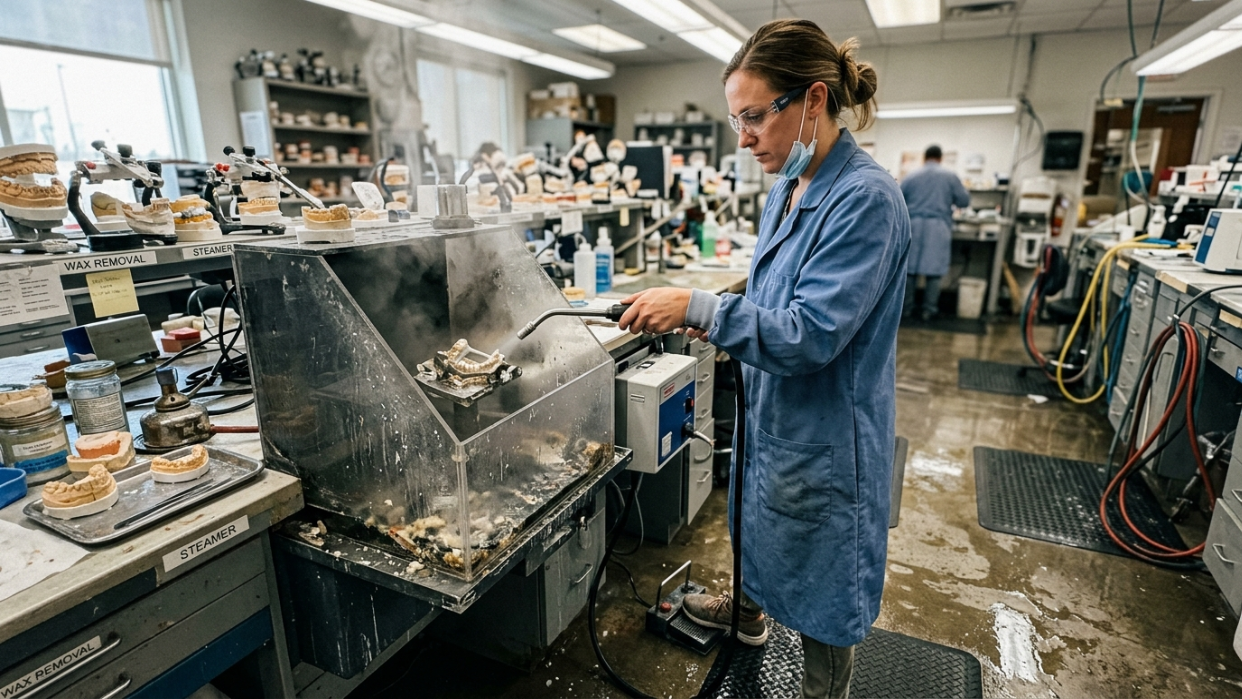
One practical requirement that no spec sheet covers: how to set up your steam station to contain the mess.
When you blast wax off a crown with 60+ PSI steam, that wax goes somewhere. Forum posts show dental technicians improvising cardboard boxes and AC filters to catch wax spray from steam guns. A proper setup includes:
Containment cabinet or box around the steam nozzle area to catch debris
Drainage for collected water and wax residue
Adequate ventilation to manage steam vapor in the work area
Non-slip flooring around the station (wet floors are a slip hazard)
Accessible foot pedal placement so the technician can control steam hands-free while positioning the workpiece
These aren’t optional nice-to-haves. They’re part of meeting your General Duty Clause obligation to maintain a safe workplace.
Buying Considerations: What Dental Lab Owners Actually Care About
Based on extensive forum discussions among dental lab technicians and owners, the practical priorities for steamer selection (in order of importance) are:
Sustained PSI under load. The steamer must hold its rated pressure all day, not just at startup.
All-day operation without downtime. For labs running 8+ hours, continuous-fill systems or large reservoir tanks are essential.
Stainless steel construction. Rust is the enemy. Labs in humid environments or those using tap water need corrosion-resistant tanks.
Easy access to replacement parts. Solenoids, heating elements, caps, and seals wear out. A steamer with proprietary parts that are hard to source becomes a liability.
Cross-industry value. A common sentiment on forums: “Buy one that’s not sold by a dental company at an over-inflated price.” Commercial steamers built for jewelry, garment, or industrial use often deliver the same performance at better value than dental-branded units.
Ready to compare models that meet these requirements? Browse commercial steamers with ASME certification, stainless steel construction, and dental-appropriate PSI ratings.
Frequently Asked Questions
What PSI should a dental lab steamer operate at?
Most dental lab applications require 50 to 75 PSI for effective cleaning. Light wax removal can work at 40 to 50 PSI, but investment material and stubborn polishing compounds need 60+ PSI. The key is sustained pressure under continuous use, not just the peak rating on the spec sheet.
Do dental lab steamers need ASME certification?
Yes, in most cases. Dental lab steamers typically operate at 50 to 80 PSI, well above the 15 PSI threshold that triggers ASME Section I (Power Boiler) requirements. An ASME-stamped boiler has been constructed, inspected, and registered according to the Boiler and Pressure Vessel Code. Your state and your insurer may both require it.
Is a dental steamer the same as an autoclave?
No. A steamer cleans (removes wax, polishing compounds, and debris), while an autoclave sterilizes (kills microorganisms through sustained high-pressure steam at specific temperatures). Dental labs typically need both, but they serve completely different functions.
Should I use distilled water in my dental lab steamer?
It depends on your specific unit. Steamers with internal heating elements generally require distilled water to prevent mineral buildup on the element. Steamers with external elements and stainless steel tanks can often use tap water. Some units have water-level sensors that need minerals to function, and their manuals explicitly warn against distilled water. Always follow the manufacturer’s instructions.
Does OSHA regulate dental lab steamers?
OSHA does not have dentistry-specific standards, but general industry standards apply to dental labs. The General Duty Clause requires employers to maintain safe workplaces, which includes using properly certified pressure vessels. The Beryllium Standard is particularly relevant because steam cleaning helps control beryllium dust exposure from dental alloys.
How often should a dental lab steamer be inspected?
Most states require annual inspections for power boilers operating above 15 PSI. Beyond state-mandated inspections, labs should perform internal maintenance checks (descaling, hose inspection, safety valve testing) on a monthly to quarterly basis. Check your state’s boiler code for specific intervals.
What size steamer does a dental lab need?
Labs with six or fewer technicians can typically work with a manual-fill unit holding at least half a gallon. Mid-size labs should look for 0.5 to 1.5 gallon reservoirs. High-volume production labs running steamers 8+ hours daily need units with 1.5 gallons or more, or continuous-fill (auto-pump) systems that eliminate refill downtime.
Can I use a jewelry steamer in a dental lab?
Yes. Commercial steamers built for jewelry cleaning operate in the same PSI range (50 to 80 PSI) and use the same ASME-certified construction as dental-specific units. Many dental lab owners on forums report that cross-industry commercial steamers offer equivalent performance at better prices than dental-branded equipment. The key requirements (PSI, ASME certification, stainless steel tank, safety systems) are the same regardless of the label.
What PSI is considered dangerous for dental lab steamers?
Any steam system operating above 15 PSI falls under ASME power boiler classification, meaning it requires strict safety, inspection, and certification standards. However, in dental lab use, pressures between 50–80 PSI are normal and safe when properly certified and maintained.


