

TL;DR
Dental steam cleaners use pressurized steam jets (40–80 PSI) to blast away wax, polish residue, and visible debris from prosthetics and lab work. Ultrasonic cleaners submerge instruments in a solution and use sound wave cavitation (25–45 kHz) to remove microscopic bioburden. They serve different purposes and are not interchangeable. Most professional dental settings need both.
Dental professionals face a straightforward but surprisingly confusing equipment question: should you use a steam cleaner or an ultrasonic cleaner? The answer depends entirely on what you’re trying to accomplish, because these two technologies work through completely different mechanisms and solve different problems.
No page in the current search results actually compares these tools head to head in a dental context. Most content covers only ultrasonic cleaners. This guide fixes that gap with clear definitions, clinical evidence, and practical workflow guidance for dental offices and labs alike.
Considering a commercial steam cleaner for your dental lab? See the dental lab steamer buyer’s guide for specs and selection criteria.
Quick Answer: Dental Steamer vs Ultrasonic Cleaner (2026)
Dental steamers and ultrasonic cleaners are not interchangeable:
– A dental steam cleaner uses high-pressure steam (40–80 PSI) to remove visible debris like wax, polishing residue, and surface contamination from dental lab materials.
– An ultrasonic cleaner uses high-frequency sound waves (25–45 kHz) in a liquid bath to remove microscopic bioburden such as blood, saliva, and embedded debris from instruments.
What Is a Dental Steam Cleaner?
A dental steam cleaner is a pressurized boiler unit that heats water in a sealed tank and forces steam through a nozzle or wand at high velocity. Commercial dental models typically operate at 40–80 PSI and reach temperatures above 200°F at the tip. The operator directs the steam jet onto the item being cleaned, using the kinetic energy of the blast to dislodge debris while the heat provides sanitization.
Think of it as a precision power washer that uses steam instead of water.
Primary dental uses
Steam cleaners are workhorses in dental labs. The hot steam removes wax residues, polishing agents, and other contaminants from impressions, models, and prosthetics without leaving chemical residues. Because dental prosthetics are often made from ceramics, plastics, or metal alloys, the gentle but forceful nature of steam cleaning is ideal for protecting delicate surfaces.
For most dental laboratory tasks (wax removal, polishing residue, disclosing media), wet steam works best. The operator uses a foot pedal to control steam flow, keeping both hands free to hold and position the workpiece.
One dental lab technician on the Dental Lab Network forums reported using CD Nelson steamers since 1978, noting “they are made for the strange demands of dental labs as well as the jewelry industry.” The foot pedal control and set nozzle design lets technicians work with both hands, a practical detail that matters during long shifts.
Important distinction: steam cleaner vs. steam autoclave
This trips people up constantly. A dental steam cleaner is a cleaning and sanitizing tool. A steam autoclave is a sterilization device that uses steam, pressure, and sustained high heat to kill all microorganisms. They are completely different machines with different purposes. A steam cleaner does not sterilize instruments to the standard required between patients.
For more on steam cleaner terminology and how these tools fit into lab operations, the dental lab steam cleaner glossary covers the essential vocabulary.
What Is an Ultrasonic Cleaner?
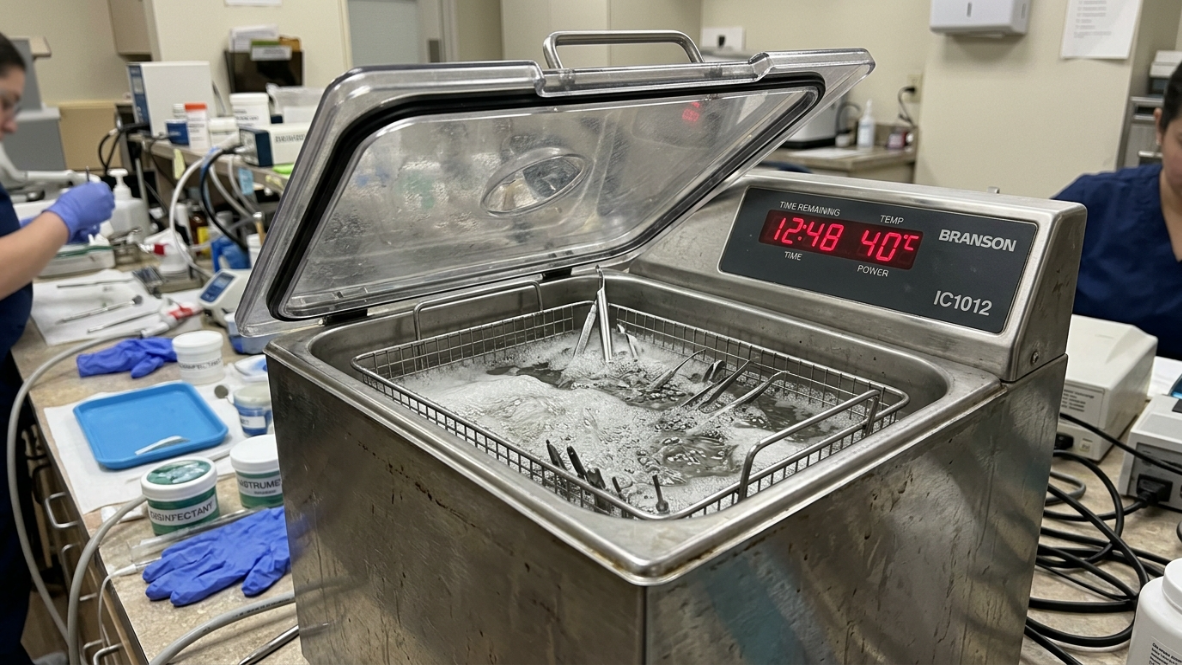
An ultrasonic cleaner is a tank-based device that submerges items in a liquid cleaning solution and bombards them with high-frequency sound waves, typically between 25 and 45 kHz. These sound waves create millions of microscopic cavitation bubbles in the solution. As the bubbles form and collapse, they generate tiny implosions that disrupt the chemical bonds holding contaminants to instrument surfaces.
Higher frequencies (40–45 kHz) are generally recommended for dental cleaning because they provide thorough action while minimizing the risk of damage to delicate instruments.
Primary dental uses
Ultrasonic cleaners are the standard for pre-sterilization instrument cleaning. Over the course of each patient visit, dental instruments accumulate biological residue known as “bioburden,” including blood, saliva, and tissue. Ultrasonic cleaning removes this bioburden from complex instrument geometries (the joints of hemostats, the channels of scalers, the crevices of probes) that manual scrubbing simply cannot reach.
Dental laboratories also use ultrasonic cleaners to remove cements, polishing compounds, and waxes from prostheses. The cleaning solution rushes into hard-to-reach areas of intricately shaped objects, making it highly effective for items with complex surfaces.
How it works in practice
The process is passive. You fill the tank with water and the appropriate cleaning solution (enzymatic cleaners for bioburden, detergent solutions for general cleaning), place the instruments in a basket, set the timer, and walk away. Practitioners on dental forums note they commonly use diluted detergent in ultrasonic baths for routine cleaning cycles.
Key Differences Between Dental Steamers and Ultrasonic Cleaners
Understanding the dental steamer vs ultrasonic comparison starts with recognizing that these tools operate on fundamentally different principles.
Cleaning mechanism
Steam cleaning is active and targeted. The operator directs a high-pressure steam jet at a specific point on the workpiece. The cleaning power comes from the kinetic energy of the steam blast combined with heat.
Ultrasonic cleaning is passive and immersive. Items sit in a bath while cavitation does the work uniformly across all surfaces, including those the operator cannot see or reach.
Surface vs. subsurface cleaning
This is the critical distinction. Steam excels at blasting visible debris off accessible surfaces. Ultrasonic excels at removing microscopic contaminants from hidden crevices and complex geometries.
Side-by-side comparison
Feature | Dental Steam Cleaner | Ultrasonic Cleaner |
|---|---|---|
Operating principle | Pressurized steam jet | Cavitation via sound waves |
Typical output | 40–80+ PSI | 25–45 kHz |
Temperature | 200–300°F+ | Ambient to ~140°F (heated bath) |
Chemicals needed | Water only | Water + enzymatic or detergent solution |
Operator involvement | Active (hand-directed) | Passive (timed cycle) |
Best for in dental | Wax removal, polish residue, prosthetics finishing | Bioburden removal, pre-sterilization cleaning |
Typical price range | $899–$3,000+ (commercial) | $200–$2,000+ (commercial dental) |
Warm-up time | 15–20 minutes | None (immediate) |
For help understanding pressure specifications and what PSI ratings mean for your work, the commercial steamer PSI guide breaks down the numbers.
Why Dental Cleaning Method Matters in Infection Control
Why this matters
Dental cleaning is not just about appearance—it directly affects sterilization success and patient safety.
Clinical importance
Improper cleaning before sterilization can:
Cause biofilm to survive autoclaving
Reduce sterilization effectiveness
Increase risk of cross-contamination
Lead to instrument failure in clinical use
Standard workflow reference (CDC-aligned)
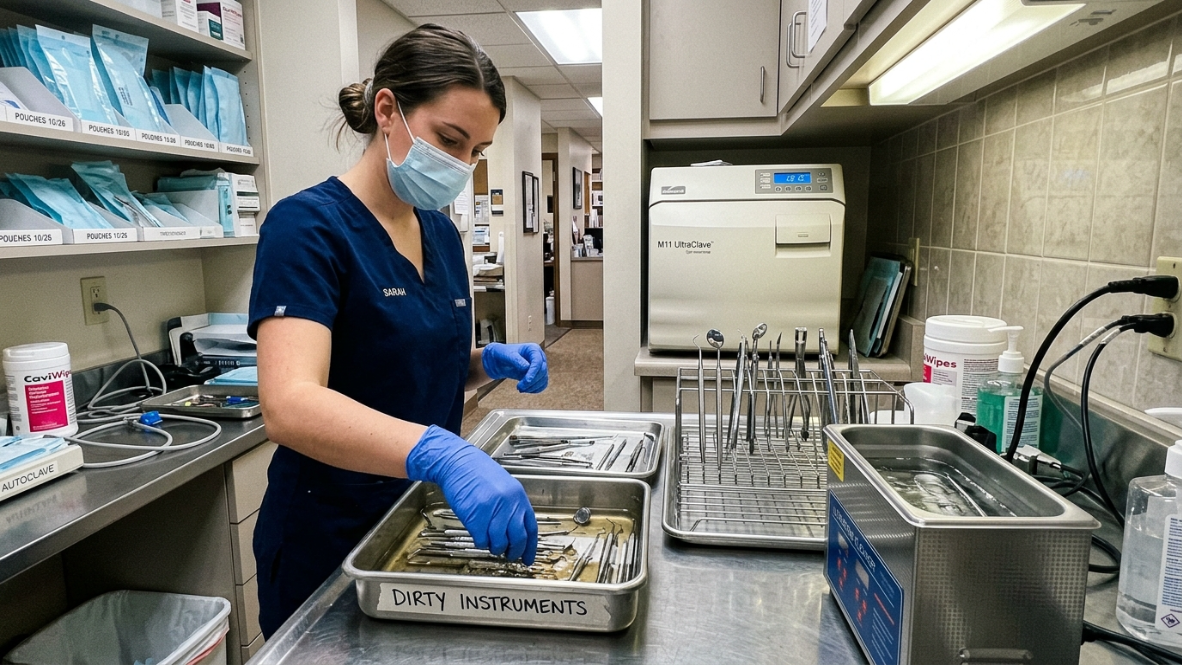
Dental instrument reprocessing typically follows:
Pre-cleaning (gross debris removal)
Ultrasonic cleaning (bioburden removal)
Rinsing & drying
Autoclave sterilization
Storage
When to Use a Dental Steam Cleaner
Steam cleaners are the right tool when you need fast, chemical-free surface cleaning with visible results.
Dental lab work
This is where steam cleaners earn their keep. Wax-ups, impressions, models, castings, and finished prosthetics all accumulate wax residue, polishing compounds, and surface contamination during fabrication. Steam blasts this material away instantly without chemical exposure or surface damage. Compared to aggressive chemical cleaners, steam does not cause discoloration, preserving the quality and appearance of finished work.
The dedicated guide on steam for dental lab wax removal covers techniques and equipment requirements in detail.
Quick point-of-use cleaning
When a technician needs to inspect a workpiece mid-process, a quick steam blast removes debris in seconds. There’s no soak time, no solution to prepare, and no drying step. This speed matters in production-oriented labs where throughput counts.
Environmental and safety advantages
Steam cleaners run on water alone, minimizing chemical use and disposal concerns. For labs already managing multiple chemical agents, reducing one more is a real benefit.
A practical concern worth noting
Lab technicians on the Dental Lab Network forums flag one downside of steam cleaners: small particles can go airborne inside the cleaning enclosure during operation. This is a real pain point that ultrasonic cleaning avoids entirely since items are submerged. Proper ventilation and enclosed steam boxes address this.
Steam Cleaner Pressure (PSI) and Temperature Explained
What PSI means in dental steam cleaning
Higher PSI = stronger mechanical force to remove debris.
PSI Range | Use Case |
|---|---|
20–40 PSI | Light cleaning, delicate prosthetics |
40–60 PSI | Standard dental lab use |
60–80+ PSI | Heavy wax, resin, polishing residue |
Temperature importance
Dental steam cleaners typically operate at:
200°F–300°F+
Higher temperature improves wax and resin removal efficiency
When to Use an Ultrasonic Cleaner
Ultrasonic cleaners are essential when microscopic cleanliness matters and when you’re cleaning instruments with complex shapes.
Pre-sterilization instrument cleaning
This is the primary clinical application. If you fail to remove patient bioburden prior to sterilization, organic matter gets “baked” onto instruments during the autoclave cycle. That’s why ultrasonic cleaners have become a critical part of dental infection control workflows.
A landmark 1995 study found that ultrasonic decontamination of dental instruments achieved greater than a 100-fold reduction in blood contamination compared to manual scrubbing. The safety benefit is significant too: because instruments stay submerged during cleaning, ultrasonic units eliminate the sharps injuries that come with hand scrubbing contaminated tools.
Complex instrument geometries
Hemostats, rongeurs, burs, and similar instruments have joints, channels, and recessed areas where contaminants hide. Cavitation reaches these spaces uniformly. No amount of steam pressure can penetrate a closed hinge joint the way a cavitation bubble can.
Clinical evidence on microscopic cleanliness
A peer-reviewed study in the Journal of Periodontal & Implant Science compared steam cleaning, chlorhexidine scrubbing, and ultrasonic cleaning on titanium abutments. The results were striking: foreign bodies remained on abutment surfaces after steam cleaning, and bacteria were observed on 40% of agar plates following steam cleaning. Only ultrasonic cleaning with a multi-step protocol (chlorhexidine solution, acetone, and ethyl alcohol) successfully removed both foreign bodies and bacteria.
The takeaway is clear: steam cleaning is not a substitute for ultrasonic cleaning when microscopic contamination matters, particularly with implant components.
Ultrasonic Cleaner Frequency, Solutions & Performance Factors
Frequency matters in dental cleaning
Frequency | Cleaning Strength | Best Use Case |
|---|---|---|
25–28 kHz | High aggression | Heavy debris, metal instruments |
35–40 kHz | Balanced | General dental use |
40–45 kHz | Gentle precision | Delicate instruments & implants |
Cleaning solution types
Enzymatic cleaners → break down blood, saliva, tissue
Neutral detergents → waxes, polishing compounds
Disinfectant solutions → added infection control layer (not sterilization)
Can You Use Both? The Recommended Workflow
Yes. Professional consensus across both dental and jewelry communities points to these as complementary tools, not competing ones.
The typical professional sequence is: ultrasonic first for deep cleaning, then steam for a final surface blast. One experienced bench jeweler on the PriceScope forums put it simply: “if a jeweler uses the ultrasonic then steam cleans your jewelry it looks a whole lot better than just those places who use the ultrasonic.” The same principle applies directly to dental lab work.
Where each fits in the instrument processing cycle
The CDC outlines six steps in the instrument processing cycle, with cleaning as the first and most important step. Here’s where each technology belongs:
Step | Equipment |
|---|---|
Pre-cleaning (gross debris removal) | Steam cleaner or hand rinse |
Thorough cleaning (bioburden removal) | Ultrasonic cleaner |
Sterilization | Steam autoclave |
Lab work (wax and polish removal from prosthetics) | Steam cleaner |
In a dental office, the ultrasonic cleaner handles the critical pre-sterilization step. In a dental lab, the steam cleaner handles the bulk of daily cleaning work, with the ultrasonic available for tasks requiring deeper, microscopic-level cleaning.
A jewelry-focused forum thread on Ganoksin captures the occasional overconfidence with steam alone. One practitioner who had just purchased a steam cleaner wrote: “I wonder why I have/need my ultrasonic! I haven’t found anything the steam won’t clean.” But the counter-argument in the same thread was immediate: the only risk is “something so delicate the steam pressure will harm it.” The clinical evidence goes further, showing that steam alone leaves microscopic contaminants that ultrasonic removes.
The bottom line on the dental steamer vs ultrasonic question
Most professional dental settings need both. A lab that only has an ultrasonic cleaner will struggle with fast wax removal and surface finishing. A lab that only has a steam cleaner will miss hidden contaminants on complex or implant-grade components. Owning both covers the full range of cleaning tasks.
Looking for the right commercial steam cleaner for dental lab work? The dental lab steamer specifications guide covers what to look for in pressure ratings, boiler capacity, and safety certifications.
How to Choose Between Dental Steam and Ultrasonic Cleaners
Use a dental steam cleaner if you:
Work in a dental lab
Handle wax-ups, crowns, or prosthetics
Need fast surface cleaning
Want chemical-free residue removal
Use an ultrasonic cleaner if you:
Process surgical or clinical instruments
Require pre-sterilization cleaning
Clean complex instrument geometries
Follow infection control protocols
Use both if you:
Operate a full dental clinic + lab workflow
Want complete coverage of surface + microscopic cleaning needs
Process both prosthetics and patient instruments
Common Mistakes When Choosing Between Steam and Ultrasonic
Confusing a steam cleaner with a steam autoclave
This keeps coming up. A steam cleaner cleans surfaces. A steam autoclave sterilizes instruments. You cannot substitute one for the other. Every dental office needs an autoclave for sterilization regardless of what cleaning equipment it uses.
Assuming ultrasonic cleaning sterilizes instruments
It does not. Ultrasonic cleaning is a pre-sterilization step. Instruments still must go through an autoclave after ultrasonic cleaning. Skipping the autoclave because instruments “look clean” after an ultrasonic cycle is a serious infection control failure.
Buying only one when the workflow needs both
For dental offices focused purely on instrument reprocessing, an ultrasonic cleaner is the higher priority purchase. For dental labs focused on prosthetics fabrication, a steam cleaner comes first. But any setting that handles both types of work will eventually need both tools.
Ignoring steam pressure ratings for heavy wax removal
Not all steam cleaners are equal. A low-PSI unit might struggle with heavy wax buildup or stubborn polishing compounds. Commercial dental lab steamers should produce at least 40–50 PSI. Higher-end models push beyond 60 PSI for demanding tasks. The medical lab steam cleaner safety guide covers compliance and safety considerations for these higher-output units.
Overlooking solution selection for ultrasonic cleaners
Using plain water in an ultrasonic bath reduces cleaning effectiveness significantly. Enzymatic solutions break down protein-based bioburden. General detergent solutions handle waxes and compounds. Match the solution to the task.
Related Terms
Autoclave: A sterilization device that uses steam, pressure, and sustained high heat (typically 250–275°F at 15–30 PSI for 15–30 minutes) to kill all microorganisms, including bacterial spores. The final step in dental instrument reprocessing.
Cavitation: The formation and rapid collapse of microscopic bubbles in a liquid, caused by ultrasonic sound waves. The implosion of these bubbles generates localized energy that dislodges contaminants from surfaces. This is the core cleaning mechanism in ultrasonic cleaners.
Bioburden: The total number of living microorganisms and organic material (blood, saliva, tissue) on a surface prior to sterilization. Removing bioburden is the purpose of pre-sterilization cleaning.
PSI (Pounds Per Square Inch): A unit of pressure measurement. In dental steam cleaners, higher PSI means more forceful steam output, which translates to better cleaning power for stubborn residues like wax and polishing compounds.
kHz (Kilohertz): A unit of frequency measurement (thousands of cycles per second). In ultrasonic cleaners, the kHz rating determines bubble size and cleaning characteristics. Lower frequencies (25 kHz) create larger, more aggressive bubbles. Higher frequencies (40–45 kHz) create smaller, gentler bubbles better suited to delicate dental instruments.
Frequently Asked Questions
Is a dental steam cleaner the same as an autoclave?
No. A steam cleaner uses pressurized steam to blast debris off surfaces. An autoclave uses steam under pressure at sustained high temperatures to sterilize instruments by killing all microorganisms. They are entirely different devices. Every dental practice needs an autoclave for sterilization, regardless of what cleaning equipment it uses.
Can an ultrasonic cleaner replace a steam cleaner in a dental lab?
Not practically. Ultrasonic cleaners excel at removing microscopic bioburden from complex instrument geometries, but they’re slow and cumbersome for the rapid wax removal and surface finishing that dental lab technicians do dozens of times per day. Steam cleaners handle these tasks in seconds. Most professional labs use both.
Does ultrasonic cleaning sterilize dental instruments?
No. Ultrasonic cleaning removes contaminants but does not achieve sterilization. It is a pre-sterilization step. Instruments must still be processed through an autoclave after ultrasonic cleaning.
Which should I buy first for a dental lab?
For a dental lab focused on prosthetics fabrication (wax-ups, castings, crown and bridge work), a steam cleaner is the higher-priority purchase. It handles the most frequent cleaning tasks. An ultrasonic cleaner is a strong second purchase for deeper cleaning of items like implant components.
What cleaning solution should I use in a dental ultrasonic cleaner?
For instrument reprocessing, enzymatic cleaning solutions are recommended because they break down protein-based bioburden. For general lab cleaning (cements, polishing compounds), detergent-based solutions work well. Always follow the ultrasonic cleaner manufacturer’s guidelines for solution concentration and cycle times.
How long does a dental steam cleaner take to warm up?
Most commercial dental steam cleaners require 15–20 minutes of warm-up time before producing consistent, high-pressure steam. This is worth factoring into your daily workflow. The unit should be turned on at the start of the workday and left running.
Can steam cleaning damage dental prosthetics?
When used properly, steam cleaning is gentle enough for ceramics, plastics, and metal alloys. The risk comes from holding the nozzle too close to very thin or fragile structures, or using excessive pressure on heat-sensitive materials. Experienced technicians adjust distance and dwell time based on the material.
What PSI is recommended for dental lab steam cleaning?
Commercial dental lab steamers should produce at least 40–50 PSI for routine wax and residue removal. For heavier-duty tasks or stubborn compounds, models producing 60 PSI or higher provide noticeably better results.
Ready to add a commercial steam cleaner to your dental lab? Explore the full lineup of Hoffman Steam dental lab solutions, built in the USA with ASME/UL certification and backed by lifetime technical support.


