

TL;DR
Strange noises and unexplained leaks from your commercial electric steam boiler almost always point to one of a handful of causes: scale buildup, trapped air, pressure control issues, or component wear. This glossary maps every sound and leak type to its root cause and tells you exactly which problems you can fix yourself and which ones require professional help. It’s written specifically for small commercial electric boiler operators, not residential HVAC or large industrial systems.
Your steam boiler started making a sound it didn’t make last week. Maybe it’s a low rumble, a sharp bang, or a hiss you can’t quite locate. You might also notice water pooling where it shouldn’t be, or your unit keeps shutting itself off. These symptoms are connected more often than people realize. Noise and leaks in steam boilers frequently share the same underlying causes: mineral scale, failing components, or pressure that’s out of spec.
This glossary covers every term you need for diagnosing steam boiler noise leaks in commercial electric units, the kind used in jewelry shops, hat stores, dry cleaners, and upholstery businesses. If you’re running a 1 to 6 gallon electric boiler in your shop, this is for you.
Before diving in, it helps to understand how commercial steamers work at a basic level, including the relationship between the heating element, pressure vessel, and control system.
Quick Answer: How to Diagnose Steam Boiler Noise and Leaks
If your commercial electric steam boiler is making unusual noises or developing leaks, start by matching the symptom to the most likely cause.
Symptom | Most Likely Cause | DIY Fix | Call a Technician? |
|---|---|---|---|
Rumbling or kettling | Mineral scale | Yes | No |
Loud banging | Water hammer | Sometimes | Often |
Hissing | Steam leak | Sometimes | Sometimes |
Gurgling | Trapped air | Yes | Rarely |
Whistling | Restricted flow | Yes | Sometimes |
PRV discharge | Excess pressure | No | Yes |
Water around fittings | Loose connections | Yes | Rarely |
Water leaking from the boiler body | Vessel corrosion | No | Immediately |
The fastest way to diagnose a steam boiler problem is to identify the sound first, then confirm the source with a visual inspection, pressure gauge reading, and leak test.
Steam Boiler Noise and Leak Troubleshooting Flowchart
If you hear:
A rumbling noise:
Check for scale buildup.
Descale the boiler.
Review your water quality.
A loud bang:
Inspect pipe pitch.
Check for condensate buildup.
Verify steam traps and valves.
A hissing sound:
Inspect the PRV.
Check fittings.
Perform the mirror test.
If you see water:
Check the sight glass.
Inspect fittings and valve stems.
Determine whether it’s a water leak or a steam leak.
If the boiler shuts off:
Check the low-water cutoff.
Inspect for hidden leaks.
Verify pressure readings.
Noise Terms: What You Hear and What It Means
Kettling
Kettling is the rumbling, gurgling, or kettle-like boiling sound that gives this problem its name. It happens when mineral scale (primarily calcium and magnesium deposits) builds up on the heating surface, creating an insulating barrier between the metal and the water. Because water can’t make proper contact with the heated surface, localized hot spots form. Water in those spots superheats and flashes into steam, producing that distinctive rumble.
In electric boilers where the heating element sits directly in the water, scale coats the element itself rather than a heat exchanger. The effect is the same: restricted heat transfer, localized boiling, and noise.
The efficiency impact is real. A quarter-inch scale deposit reduces heat transfer by roughly 40%. That means your boiler works harder, takes longer to reach operating pressure, and wears out faster. If you’re hearing kettling, descaling should be your first step. For detailed instructions, see this guide on how to descale a commercial steamer.
Water Hammer
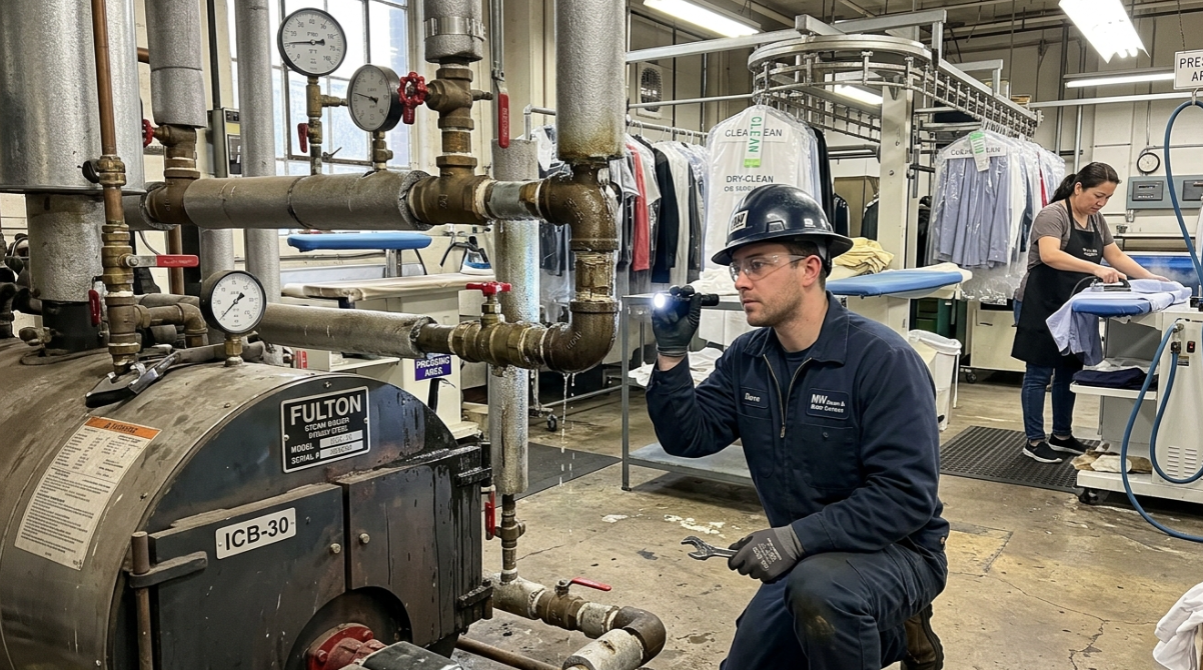
Water hammer is the loud, sharp banging or clanging that can sound like someone striking the pipes with a wrench. It’s one of the most alarming noises in a steam system, and for good reason.
Here’s the mechanics: anytime steam and water occupy the same pipe, the available space shrinks and steam velocity increases. The fast-moving steam picks up pooled water and forms a “slug,” a compact mass of water being pushed through the pipe at high speed. Steam can travel through piping at speeds upward of 100 MPH. When that water slug hits an elbow, valve, or dead end, the impact produces the bang.
Common causes in small commercial setups include improper pipe pitch (pipes that don’t slope back toward the boiler so condensate can drain), failed check valves, and wet steam entering distribution lines. Practitioners on the HeatingHelp forums report that noise persisting throughout an entire heating cycle, sometimes for over an hour, is a strong indicator of incorrect piping pitch or failed valve seats. That kind of sustained water hammer is not normal and needs attention.
For operators whose boilers feed dry cleaning steam systems, proper pipe slope and insulation are critical to preventing water hammer downstream.
Hissing
A hiss almost always means steam is escaping somewhere it shouldn’t. In small commercial electric boilers, the most common sources are:
The pressure relief valve discharging (see below)
Worn valve packing around stems
Loose or degraded fittings
A faulty air vent
Hissing is one of the most straightforward symptoms when diagnosing steam boiler noise leaks because it directly indicates a breach in the pressure boundary. The challenge is locating it, since steam evaporates quickly and the leak may not leave visible evidence.
Gurgling
Gurgling typically means trapped air in the system. In manual-fill electric boilers, this is common after refilling when air isn’t properly purged from the vessel. The air pocket gets displaced as water heats and expands, producing a bubbling or gurgling sound.
The fix is usually simple: follow the manufacturer’s fill procedure carefully and allow the unit to vent air during initial heat-up. If gurgling starts spontaneously (not after a refill), it could indicate a small leak allowing air to enter the system on the condensate return side.
Whistling and Squealing
A high-pitched whistle or squeal usually points to restricted flow. Think of it like pinching a garden hose: the smaller the opening, the higher the pitch. Common culprits include partially closed isolation valves, mineral deposits narrowing a passage, or a failing circulator pump in pump-fill systems.
If you hear whistling from a specific valve, check that it’s fully open. If it’s a steam nozzle or wand, inspect it for scale buildup at the orifice.
Pressure Relief Valve Noise
The pressure relief valve (PRV) is a safety device designed to open and release pressure if the boiler exceeds its rated limit. When it does its job, you’ll hear a sharp hiss or pop followed by a rush of steam. That’s normal, once. If the PRV is cycling repeatedly (opening, closing, opening), you’ll hear rhythmic banging or intermittent hissing, and that’s a problem.
Repeated PRV cycling usually means boiler pressure is running too high, often because the pressurestat or pressuretrol has malfunctioned, been bypassed, or has a blocked sensing line. This is a safety issue. Stop using the boiler and get it inspected. For more on safety controls, refer to this overview of steam boiler safety features.
Surging
Surging is a pulsing or spitting behavior where the boiler intermittently shoots water into the steam discharge line. In new cast-iron boilers, this often happens because residual machining oils float to the surface of the boiler water, disrupting the surface tension and causing plumes of water to erupt upward into the steam outlet. The fix is “skimming,” a process of draining surface water to remove the oil.
This is less common in stainless steel electric units, which don’t have the same casting oil issue. But if you’re experiencing surging in any boiler, it can also indicate overfilling or operating pressure that’s too high for the load.
Humming
A steady hum from a pump-fill boiler usually comes from the feed pump or circulator. It could be a pump running against a closed valve, a bearing starting to fail, or cavitation from insufficient water supply to the pump inlet. Humming that changes pitch or becomes louder over time warrants inspection before the pump fails entirely.
Normal vs. Abnormal: What a Healthy Electric Boiler Sounds Like
A properly operating electric steam boiler is relatively quiet. You’ll hear a low, steady simmer as water heats, and the occasional click of the pressurestat cycling the heating element on and off. The sound is comparable to a quiet electric kettle.
What’s abnormal: sustained banging, repetitive clicking from the PRV, hissing that you can hear from across the room, metallic clanging, or any noise that persists for more than a few minutes without explanation. If a sound is new and you can’t identify it, treat it as something worth investigating.
Steam Boiler Noise Diagnosis Chart
Boiler Noise | Typical Sound | Primary Cause | Severity |
|---|---|---|---|
Kettling | Rumbling | Scale buildup | Moderate |
Water hammer | Banging | Condensate in piping | High |
Hissing | Escaping air | Steam leak | Moderate |
Gurgling | Bubbling | Trapped air | Low |
Whistling | High-pitched | Restricted flow | Moderate |
PRV cycling | Repetitive hissing | Excess pressure | Critical |
Humming | Continuous vibration | Pump problems | Moderate |
Leak Terms: What You See (and What You Don’t)
Steam Leak vs. Water Leak
This distinction matters more than most people realize. A water leak pools on the floor or leaves wet spots on surfaces. It’s visible and relatively easy to trace. A steam leak, on the other hand, occurs at the top of a pipe or at an elevated fitting, and may not be obvious at all. The steam escapes, rises, and dissipates before you ever see it.
Under normal operation, you shouldn’t see steam outside the boiler unless a fitting, pipe, or component has a breach. If you can see a visible plume of steam, the leak is already significant.
Fitting and Joint Leaks
Threaded connections are the most common leak points in small commercial boilers. Vibration, thermal cycling (repeated heating and cooling), and age all conspire to loosen joints over time. Look for moisture, discoloration, or mineral deposits around any threaded fitting, union, or connection point.
White or chalky residue around a fitting is a telltale sign. That’s mineral scale left behind after steam or water evaporated at that spot repeatedly. Forum practitioners specifically advise checking for these “scale spots” at fittings, seams, and the outer boiler surface as indicators of slow leaks.
Valve Packing Leaks
Valves have packing material around the stem to prevent steam from escaping where the handle passes through the valve body. Over time, this packing compresses and wears, allowing steam to seep out. These leaks are particularly hard to find because the small amount of escaping steam often evaporates before becoming visible.
One technique from boiler technicians: hold a tissue near valve stems while the boiler is at operating pressure. If the tissue flutters or gets damp, you’ve found a leak. Tightening the packing nut may solve the problem. If not, the valve needs repacking. A spare parts list helps you identify the right replacement components.
Pin-Hole Leaks
A pin-hole leak is a tiny perforation in the pressure vessel itself, caused by internal corrosion eating through the metal wall. One technician described finding “a pin hole at the crown sheet of the boiler” and immediately told the customer they needed a new boiler. That’s the right call. Pin-hole leaks in a pressure vessel cannot be safely patched or welded. They signal that the vessel wall has thinned beyond repair, and the boiler has reached end of life.
If you find water weeping through the body of the boiler itself (not at a fitting or connection), stop using it.
Pressure Relief Valve Discharge
When the PRV releases steam or water, it’s doing exactly what it was designed to do. But if it discharges regularly or continuously, the boiler is running above its rated pressure, which points to a control failure. Don’t cap, plug, or restrict a PRV discharge line. That creates a bomb.
Review OSHA steam equipment safety considerations if you’re unsure about the compliance implications of PRV issues.
Sight Glass Leaks
Manual-fill boilers have a sight glass (a vertical glass tube) that shows the water level inside the vessel. The gaskets sealing each end of this glass tube degrade over time, especially in hard-water environments. A sight glass leak shows up as moisture or dripping at the top or bottom of the glass fitting. Replacement gaskets are inexpensive and the repair is straightforward.
Low Water as a Leak Indicator
The low-water cutoff (LWCO) is a safety device that shuts off the heating element when water drops below a safe level. If your boiler keeps tripping the LWCO and you haven’t changed your usage pattern, suspect an undetected leak. The boiler is losing water somewhere, and you need to find where.
Track your water consumption. If you’re refilling more often than usual on manual-fill units, or if the pump-fill system is running more frequently, those are clues that water is leaving the system through a path it shouldn’t be.
Detection Tools and Methods for Diagnosing Steam Boiler Noise Leaks
Not every diagnostic requires expensive equipment. Here’s a practical escalation path, from simple to advanced.
Visual Inspection
Start with your eyes. Look for pooling water under and around the boiler. Check for wet spots on piping. Look for white mineral deposits at fittings and seams, the kind described above. Inspect the PRV discharge line for signs of moisture or steam. Check the sight glass for cracks or weeping gaskets.
The Mirror Test
This is the single most useful DIY diagnostic tool for steam leaks, and it’s mentioned constantly in practitioner forums while being almost completely absent from professional guides. Take a small hand mirror and hold it close to suspected leak points: fittings, valve stems, joints, gaskets. If the mirror fogs up, you’ve found a steam leak. This works especially well for what forum members call “ghost leaks,” the ones you can’t see, hear from a distance, or feel with your hand.
A practitioner on the home-barista.com forums described this technique as “especially good for ghost leaks” and reported finding several leaks on various machines this way.
Listen and Feel
With the boiler at operating pressure, move slowly along pipe runs and fittings. Hold a tissue near connections and listen for faint hissing. You can also cup your hand near (not on) fittings to feel for warm air movement. Don’t touch hot surfaces directly.
Flood Test
For suspected leaks in the boiler body itself, one practitioner technique is to overfill the boiler, filling it above the normal maximum water line, and then watch for water appearing on the outside of the vessel. This is crude but effective for localizing body or weld leaks. Only do this with the boiler off and cool enough to handle safely.
Thermal Imaging and IR Cameras
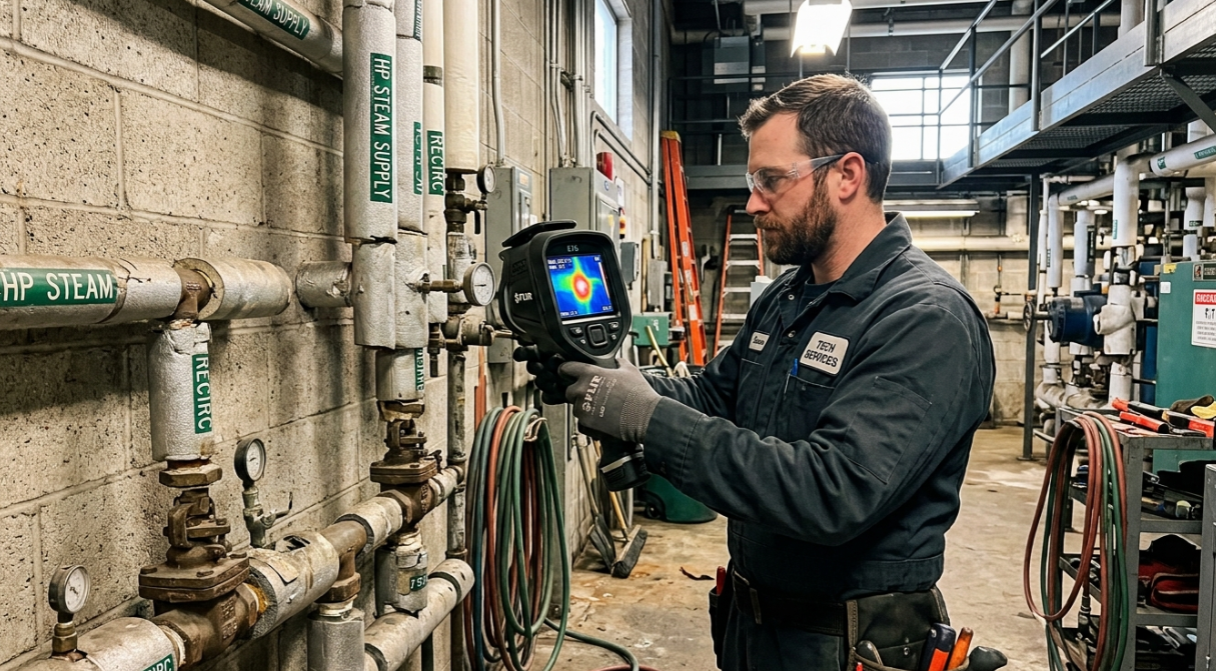
For leaks hidden behind walls, under floors, or in hard-to-reach piping runs, a thermal imaging camera can pinpoint the problem fast. One user on the HeatingHelp forum rented an IR camera, pressurized the system, and found a cracked tee behind a closet wall in about 10 minutes. The thermal signature was visible through half-inch drywall and R-19 insulation.
IR camera rental typically costs $50 to $150 per day from equipment rental shops. For a leak you can’t find any other way, that’s cheap compared to tearing open walls blindly. Fluke notes that thermal imagers can detect leaking bypass valves, tube leaks, and air leaks that reduce system efficiency.
Acoustic Imaging
For shops with complex piping or multiple steam runs, acoustic imaging tools (like Fluke’s sonic industrial imager) can locate air, steam, and vacuum leaks by visualizing sound patterns. This is a higher-end option, more relevant to facilities with extensive distribution systems than to a single-boiler jewelry shop, but worth knowing about if you’re scaling up.
Pressure Gauge Reading
Your boiler’s pressure gauge is a diagnostic instrument, not just an indicator. Record the normal operating pressure during typical use. If pressure drops without explanation, you have a leak somewhere. If pressure climbs above the rated setpoint, the pressurestat may be malfunctioning.
A gauge that reads zero when the boiler is hot and should be pressurized might have a blocked pigtail (the small curved pipe protecting the gauge). For guidance on correct pressure ranges, see this guide on jewelry steamer PSI settings, which covers the principles applicable to any small commercial boiler.
Root-Cause Terms: Why These Problems Happen
Scale and Limescale
Scale is the mineral crust that forms inside boilers when dissolved calcium and magnesium in the water precipitate out during heating. It’s the root cause of kettling, reduced heat transfer, and overheating. It also accelerates corrosion underneath the deposit layer, which eventually leads to pin-hole leaks.
Prevention is straightforward: use the right water. Hard tap water is the enemy of steam boilers. For detailed recommendations, see this water quality guide for steam boilers.
Wet Steam
Wet steam is steam carrying entrained water droplets. It’s caused by operating pressure that’s too low, overfilling the boiler, or improper piping that allows condensate to mix with live steam. Wet steam reduces the effectiveness of any steam-powered process (cleaning, shaping, finishing) and causes water hammer in downstream piping.
Steam Trap Failure
Steam traps separate steam from condensate in distribution systems. They fail in two ways: open (leaking live steam continuously) or closed (blocking condensate return, which causes water hammer and flooding). According to industry data, 15 to 20% of steam traps in a typical system are in failure mode at any given time. A single failed-open trap can waste $40,000 to $50,000 per year in lost energy, and even a single leaking valve can cost $11,000 annually in steam loss.
Most small commercial electric boilers don’t have extensive trap systems, but if your setup includes any distribution piping with traps, periodic testing pays for itself quickly.
Pressurestat and Pressuretrol Malfunction
The pressurestat (or pressuretrol) is the control that cycles the heating element on and off to maintain the correct operating pressure. If the pigtail feeding the pressurestat is blocked, or if the pressurestat itself has failed, the boiler can overshoot its pressure rating. That triggers PRV discharge, creates safety hazards, and accelerates wear on every component.
Blocked pigtails are a common but often overlooked problem. Mineral deposits can partially or fully obstruct the small-bore tube, preventing the pressurestat from sensing actual boiler pressure.
Heating Element Degradation
This is specific to electric boilers and rarely discussed in generic boiler troubleshooting content. Electric heating elements corrode, develop scale coating, and eventually burn through. A degrading element may produce unusual crackling or popping sounds, take longer to reach operating pressure, or trip the circuit breaker. In advanced failure, the element can leak current to ground, tripping a GFCI or causing the boiler to become electrically live, which is extremely dangerous.
Water Quality
Water quality is the upstream factor behind most noise and leak problems. High mineral content causes scale. Low pH (acidic water) accelerates corrosion. Chlorides attack stainless steel. Using distilled or demineralized water, as specified by most commercial boiler manufacturers, prevents the majority of these issues.
Common Steam Boiler Problems by Industry
Jewelry Shops
Most common problems:
Scale buildup
Heating-element deterioration
Pressure fluctuations
Dry Cleaners
Most common problems:
Water hammer
Steam trap failure
Wet steam
Hat Stores
Most common problems:
Scale buildup
Steam nozzle restrictions
Valve packing leaks
Upholstery Businesses
Most common problems:
Condensate accumulation
Steam leaks
Pump-related noise
When to Act: The Decision Framework
Diagnosing steam boiler noise leaks is only useful if you know what to do next. Here’s a clear breakdown.
What You Can Handle Yourself
Descaling: If you’re hearing kettling and there’s no visible damage, descale the boiler following the manufacturer’s instructions.
Tightening packing nuts: If a valve stem is weeping steam, try tightening the packing nut a quarter turn at a time.
The mirror test: Use it to locate ghost leaks before calling anyone.
Blowdowns and water quality: Regular blowdowns to flush sediment, and switching to proper water, are routine maintenance tasks.
Sight glass gasket replacement: A basic repair with inexpensive parts.
Air purging after refill: Follow the correct fill procedure to eliminate gurgling.
For a comprehensive overview of routine tasks, refer to this commercial steam boiler maintenance guide.
When to Call a Technician
PRV discharging repeatedly or continuously
Any crack, weep, or pin-hole in the pressure vessel
LWCO tripping without explanation after you’ve checked water level
Pressure gauge reading above the rated setpoint
Electrical symptoms (breaker trips, tingling sensation near boiler)
Water hammer that persists after checking pipe pitch and valves
Shut Down the Boiler Immediately If You Notice Any of These Signs
The pressure relief valve is releasing steam continuously.
The boiler body is leaking.
The pressure gauge exceeds the rated operating pressure.
The electrical breaker trips repeatedly.
The boiler produces a burning smell.
The low-water cutoff continues to trip after refilling.
You discover a crack in the pressure vessel.
When to Consider Replacement
Pin-hole leaks in the boiler body
Cracked or visibly corroded pressure vessel
Recurring failures across multiple components
Boiler that’s been in service beyond its expected life with no reconditioning
If your boiler is showing end-of-life symptoms, Hoffman Steam offers unlimited lifetime remote technical support to help you evaluate whether repair or replacement makes more sense.
Contact Hoffman Steam support for diagnostic help or to discuss your next steps.
The Cost of Ignoring Steam Boiler Noise and Leaks
For small business operators, downtime is lost revenue. But the costs of ignoring noise and leak symptoms go beyond just the inconvenience.
A quarter-inch of scale means your heating element is working 40% harder than it should, driving up electricity costs every hour the boiler runs. According to the Federal Energy Management Program, roughly 20% of the steam leaving a boiler in a typical system is lost through leaking traps when no proactive maintenance program is in place. The Department of Energy reports that proactive steam system surveys can deliver 10 to 15% annual energy savings.
The good news: with a consistent maintenance program, steam trap failure rates can be reduced from that 15 to 20% average to under 5%. Diagnosing steam boiler noise leaks early, before they become expensive failures, is the most effective way to protect both your equipment and your bottom line.
One HeatingHelp forum user shared that adding Hercules Scout boiler cleaner to a system that hadn’t received any maintenance for 10 years “dramatically reduced both the intensity and duration of the noises.” That’s ten years of neglect partially reversed with a single treatment. Imagine what regular care could do.
Protect your equipment and your uptime with a steam protection plan designed for small commercial operators.
Commercial Steam Boiler Maintenance Schedule
Task | Frequency |
|---|---|
Visual inspection | Before each use |
Check pressure gauge | Weekly |
Inspect fittings | Monthly |
Perform the mirror test | Monthly |
Descale the boiler | Every 3-6 months |
Replace sight glass gaskets | Annually |
Inspect the pressure relief valve | Annually |
Professional inspection | Annually |
Frequently Asked Questions
Why is my steam boiler making a loud banging noise?
Banging is almost always water hammer. Steam traveling at high speed picks up pooled condensate and slams it into pipe fittings, elbows, or valves. Check that all piping slopes back toward the boiler for proper condensate drainage. Verify that check valves are functioning. If the banging happens during PRV cycling, your pressure controls may be malfunctioning.
How do I find a steam leak I can hear but can’t see?
Use the mirror test. Hold a small mirror close to fittings, valve stems, and joints while the boiler is at operating pressure. If the mirror fogs, that’s your leak. For leaks hidden behind walls or insulation, renting a thermal imaging camera can locate the problem in minutes.
Is it normal for a steam boiler to hiss?
A faint hiss during initial pressurization can be normal as air vents from the system. Persistent or loud hissing during operation is not normal and indicates steam escaping from a fitting, valve, PRV, or other component. Locate and address the source.
What does kettling sound like, and is it dangerous?
Kettling sounds like a low rumble or the sound of a kettle approaching boil, but louder and more sustained. It’s caused by scale buildup on the heating surface. It’s not immediately dangerous, but it signals reduced efficiency and accelerated wear. Left untreated, the overheating that causes kettling can eventually damage the heating element or vessel.
How often should I check my steam boiler for leaks?
Do a quick visual inspection before each use, looking for pooling water, steam wisps, and mineral deposits at fittings. Perform a more thorough inspection including the mirror test and pressure gauge check monthly. A comprehensive annual inspection covering all safety devices, the pressure vessel, and all connections is standard practice.
Can I patch a pin-hole leak in my boiler?
No. A pin-hole leak in the pressure vessel means the metal wall has corroded through and the vessel’s structural integrity is compromised. This is an end-of-life condition. The boiler needs to be replaced.
Why does my boiler keep running out of water?
If you’re refilling more often than usual or the low-water cutoff keeps tripping, suspect an undetected leak. Check all fittings, the sight glass, valve stems, and the PRV discharge line. Also check whether the LWCO probe itself is fouled with scale, which can cause false readings.
What’s the difference between a steam leak and a water leak on a boiler?
A water leak pools visibly at the bottom of pipes and fittings. A steam leak occurs at elevated points and may be completely invisible because the steam evaporates before you can see it. Steam leaks are harder to find but equally important to fix, as they represent both energy loss and potential safety concerns.


