

TL;DR
Dry cleaning steam boiler sizing is the process of matching your boiler’s capacity to the total steam demand of your pressing, finishing, and cleaning equipment. The core formula is simple: add up the steam consumption of every piece of equipment in pounds per hour, divide by 34.5, and you get the required Boiler Horsepower (BHP). Single store shops typically need 10 to 15 BHP, while large production plants may require 50 to 150 BHP. Getting this wrong, whether oversized or undersized, wastes fuel, shortens equipment life, and hurts garment quality. Newer approaches like diversity factor analysis, modular boiler configurations, and N+1 redundancy sizing can further refine your calculations and protect against downtime.
Steam is the operational backbone of every dry cleaning business. It powers your pressing stations, drives your finishing equipment, heats your cleaning machines, and produces the hot water you need throughout the day. According to the U.S. Department of Energy, industrial boilers consume roughly 37% of the total energy used in manufacturing, which makes boiler sizing one of the most consequential decisions a dry cleaner will make. Get it wrong, and you pay for it every single month on your utility bill.
Yet most dry cleaners buy boilers based on gut feeling, a dealer’s recommendation, or whatever the previous owner had installed. This guide breaks down exactly what dry cleaning steam boiler sizing means, how the math works, and how to avoid the mistakes that cost thousands over the life of your equipment.
If you’re running a smaller finishing operation and want to understand how electric boilers fit into the picture, the electric vs gas comparison guide is a useful companion to this article.
What Is Dry Cleaning Steam Boiler Sizing?
Dry cleaning steam boiler sizing is the process of calculating exactly how much steam generating capacity your operation requires, then selecting a boiler (or boilers) that can deliver that output reliably and efficiently.
The key unit of measurement is Boiler Horsepower (BHP). One boiler horsepower produces approximately 34.5 pounds of steam per hour, which is equivalent to roughly 33,475 BTUs or 10 kW of thermal energy. That number, 34.5 lbs/hr, is the constant that makes the entire sizing formula work.
Steam serves multiple functions in a dry cleaning plant:
- Pressing and finishing: Utility presses, form finishers, hot head units, and steam irons all require consistent, high pressure steam.
- Dry cleaning machines: Hydrocarbon and solvent machines use steam for drying cycles.
- Washers and dryers: Laundry equipment in combination plants draws significant steam.
- Hot water generation: Many plants use steam to water heat exchangers.
Every one of these applications has a specific steam demand rated by the manufacturer. Your job during boiler sizing is to account for all of them.
The Core Sizing Formula
The formula itself is straightforward:
Total steam demand (lbs/hr) ÷ 34.5 = Required BHP
The real work is in gathering accurate numbers. Here is the step by step process that equipment dealers and plant designers use:
Step 1: List Every Piece of Steam Consuming Equipment
Write down every machine in your plant that uses steam. This includes pressing stations, finishing bays, dry cleaning machines, shirt units, hot head presses, steam irons, and any steam heated auxiliary equipment.
Step 2: Look Up Manufacturer BHP or Steam Ratings
Every pressing equipment manufacturer provides a BHP number or a pounds per hour steam consumption figure for their machines. As one industry dealer explains, “sometimes a little digging might be required, but this is an important number to know when outfitting a new plant or when purchasing a single piece of equipment simply for an upgrade.”
This is where understanding the “from and at” rating becomes critical. Manufacturers often publish steam output using a standardized benchmark called the “from and at 212°F” rating. This figure assumes the boiler receives feedwater already at 212°F and converts it to steam at the same temperature with zero additional heating required. In real world dry cleaning operations, feedwater enters far cooler (often 50°F to 70°F from the municipal supply), which means the boiler must use additional energy to heat that water before generating steam. The practical result: a boiler’s actual steam output can be 20% to 30% lower than its “from and at” nameplate rating. Always ask your dealer or manufacturer whether the published spec is a “from and at” figure or an actual operating output at your expected feedwater temperature. Ignoring this distinction is one of the most common reasons operators end up with less steam than they calculated on paper.
Step 3: Sum All BHP Values
Add up the BHP ratings for every piece of equipment. This gives you your gross steam demand.
Step 4: Apply the Diversity Factor
Here is where experienced plant designers separate themselves from beginners. The gross steam demand assumes every piece of equipment runs at full capacity simultaneously. That almost never happens. The diversity factor (sometimes called the demand factor or coincidence factor) accounts for the reality that not all machines draw peak steam at the same time.
To calculate it, estimate the percentage of your equipment that will realistically operate at peak load simultaneously during your busiest period. In most dry cleaning plants, this falls between 0.60 and 0.80, meaning 60% to 80% of total connected load runs at once during peak hours.
Adjusted demand = Gross steam demand × Diversity factor
For example, if your gross demand totals 40 BHP but your realistic peak simultaneous usage is about 70%, your adjusted demand is 28 BHP. Practitioners on industry forums frequently mention that applying a diversity factor of 0.65 to 0.75 matches what they actually observe on their pressure gauges during the morning rush.
Skipping this step is how shops end up with grossly oversized boilers. That said, be honest about your usage patterns. If your plant truly does run most equipment at once (some high volume production plants do), a diversity factor closer to 0.85 or 0.90 is more appropriate.
Step 5: Add Header Heat Loss
Factor in approximately 5% for heat loss in your steam distribution piping. This accounts for energy lost as steam travels from the boiler through headers and pipes to your equipment.
Step 6: Apply a Safety Factor
Oversize your boiler by a safety factor of 10 to 20% above your calculated demand. This covers startup loads, simultaneous peak usage, and minor calculation variances.
Quick Reference: Typical Equipment BHP Ranges
| Equipment Type | Typical BHP Range |
|---|---|
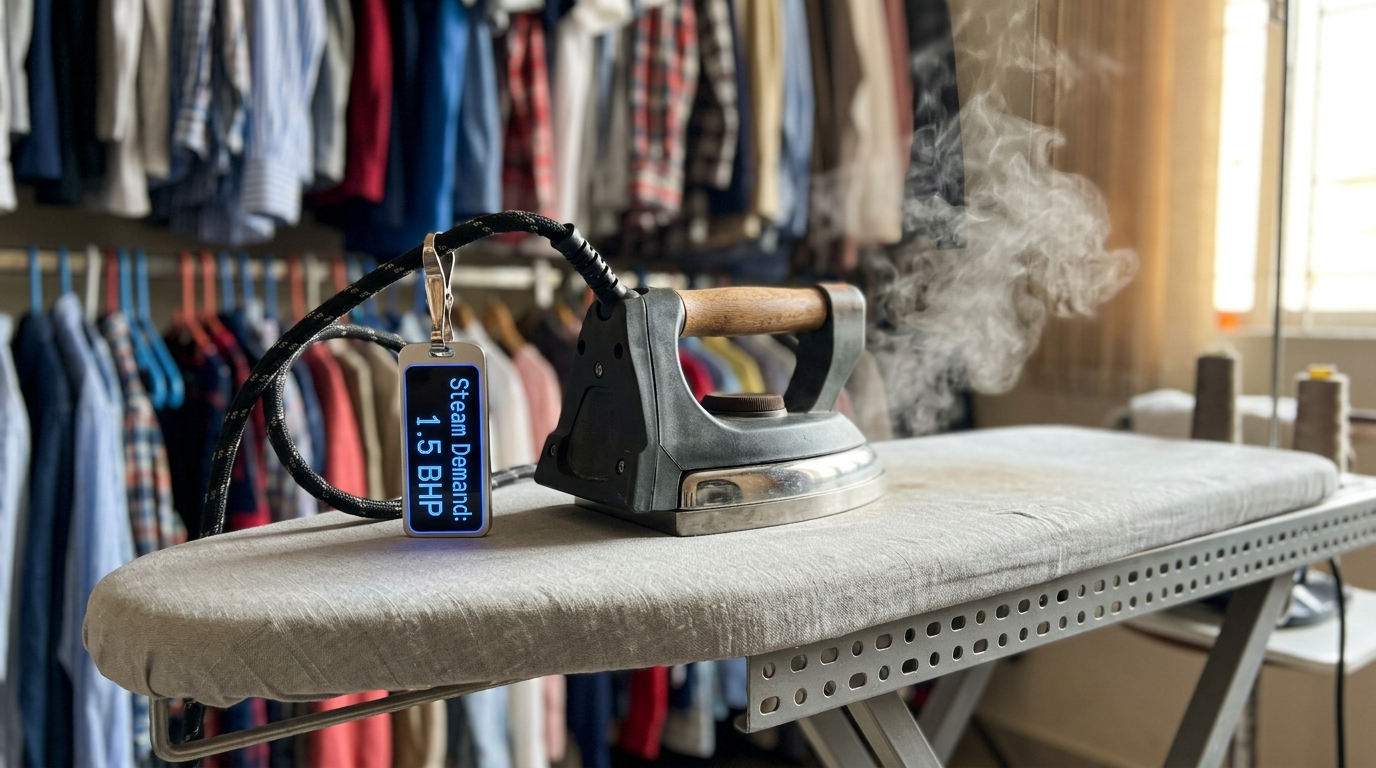
| Single steam iron or finishing station | 0.5 to 2 BHP |
| Utility press (body, pants, or sleeve) | 2 to 5 BHP |
| Double buck shirt unit | 5 to 8 BHP |
| Form finisher bay | 3 to 6 BHP |
| Dry cleaning machine (per unit) | 3 to 8 BHP |
| Commercial washer/extractor | 3 to 7 BHP |
| Commercial dryer | 3 to 8 BHP |
These are general ranges. Always use the manufacturer’s published specifications for your exact models, and remember to check whether those specs use “from and at” ratings.
Sizing by Shop Size
Not every dry cleaner needs the same boiler. The range spans from a single finishing station needing a compact electric unit to a production facility requiring over 100 BHP of gas fired capacity.
Single Station Finishing Shop (1 to 3 BHP)
If you run a small alterations business, a boutique dry cleaner, or a finishing only operation with one or two steam irons and a small press, your total steam demand is minimal. A compact electric boiler in the 1 to 6 gallon range handles this comfortably. These operations represent the sweet spot for electric steam boilers since they need reliable high pressure steam without the infrastructure of a gas system.
For shops in this category, the small industrial steam boiler sizing guide covers the specifics of matching smaller electric units to your equipment.
Package Plant or Single Store Dry Cleaner (10 to 15 BHP)
This is the classic neighborhood dry cleaner. A multi location dry cleaner shared a useful historical benchmark: “When we were all package plants, each store had a 10 to 15 horsepower horizontal boiler.” That range still holds for single store operations running a few presses, a dry cleaning machine, and perhaps a shirt unit.
Mid Size Multi Equipment Plant (20 to 50 BHP)
Once you add multiple finishing bays, a couple of dry cleaning machines, and shirt processing equipment, demand climbs fast. A single location dry cleaner in Atlanta installed a Fulton VSRT 30 (30 BHP) to handle their full operation, running dry cleaning machines at 30 PSI and pressing at 100 PSI. The owner reported 20% utility savings compared to their previous boiler within three months.
Large Production Plant with Laundry (50 to 150 BHP)
For large, multi service operations, the numbers get serious. A well documented case study describes a facility with five 90 pound hydrocarbon dry cleaning machines, six finishing bays, and four double buck shirt units. The total calculated requirement was 75 BHP, and the solution was installing two Parker Boilers: a 70 HP and a 50 HP in a lead/lag configuration.
This brings up two important concepts.
The Lead/Lag Dual Boiler Strategy
If your steam load fluctuates significantly throughout the day or week, two smaller boilers often outperform one large one. The lead boiler handles the base load, and the lag boiler fires only when demand spikes. In that 75 BHP plant, the operators use just the 50 HP boiler on Saturdays to run dry cleaning machines and get a head start on pressing for the week. This prevents the larger boiler from short cycling during low demand periods, which saves fuel and extends equipment life.
Modular Boiler Sizing
The lead/lag concept is actually part of a broader approach called modular boiler sizing. Instead of installing a single large boiler to handle your entire peak load, modular sizing uses multiple smaller boilers arranged in parallel. Each module fires independently based on real time demand.
Why does this matter for dry cleaners? Three reasons.
First, turndown flexibility. A single 60 BHP boiler running at 20% capacity during slow afternoon hours operates inefficiently. Three 20 BHP modules can run one or two units at high efficiency and leave the third off entirely.
Second, maintenance without shutdown. When one module needs service, the others keep producing steam. Your pressing stations never go cold.
Third, staged growth. If you’re expanding your operation over time (adding a shirt unit this year, another finishing bay next year), modular sizing lets you add capacity incrementally rather than buying one oversized boiler on day one and running it at half load for years.
Modular configurations are most common in plants above 30 BHP, but the principle applies at any scale where demand varies significantly throughout the workday.
N+1 Redundancy Sizing
For operations where steam downtime means lost revenue and missed customer deadlines, N+1 redundancy sizing provides a safety net. The concept is straightforward: “N” represents the number of boiler units needed to meet your full operating load, and “+1” adds one extra unit as a backup.
In a dry cleaning context, if your plant requires 40 BHP and you’ve chosen to use two 20 BHP boilers (N=2), an N+1 approach adds a third 20 BHP unit. If any single boiler fails or goes down for maintenance, the remaining two still cover your total demand.
This approach is most relevant for:
- High volume production plants where a full day without steam means thousands in lost output
- Multi shift operations that can’t schedule maintenance during off hours because there are no off hours
- Plants using modular boiler configurations where adding one more module is relatively inexpensive compared to the cost of downtime
For a small single store dry cleaner, full N+1 redundancy may not be economically justified. But even smaller operations benefit from a lighter version of this thinking. Some shops keep a backup electric boiler on hand to run critical pressing stations while the primary boiler is being serviced. The insurance value of avoiding even one or two days of downtime often pays for the backup unit.
When budgeting for redundancy, factor in not just the equipment cost but also the installation cost of piping manifolds that allow quick switchover between units. A redundant boiler sitting in a corner with no piping connected is not actually redundant.
Electric vs. Gas Boilers in Dry Cleaning
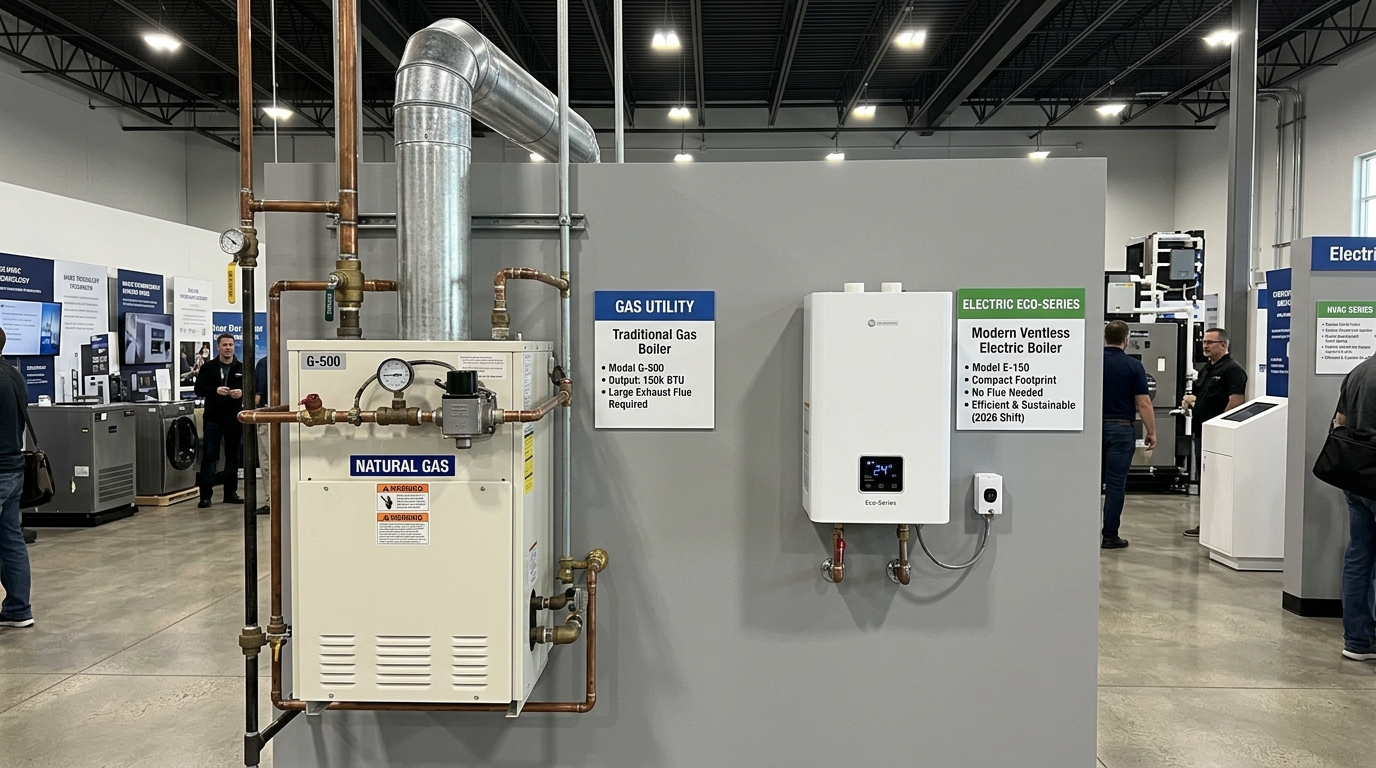
The choice between electric and gas is one of the first decisions in dry cleaning steam boiler sizing, and it depends almost entirely on the scale of your operation.
Gas Boilers
Gas fired boilers are the standard for larger dry cleaning plants. They produce higher steam output relative to their footprint and cost less to operate at scale. But they require ventilation, flue pipes, gas lines, and more complex permitting. For a plant running 20 BHP or more, gas is usually the economical choice.
Practitioners on The Garage Journal forum confirm the economics: one experienced user noted that “running on gas is probably a third of the cost of electricity.” At 50 or 100 BHP, that cost difference adds up to thousands per year.
Electric Boilers
For smaller operations, electric boilers change the equation entirely. They’re compact, require no venting or flue, and installation is dramatically simpler. As one forum contributor put it, “Electric boilers? For the most part they are fairly trouble free.”
Electric boilers make particular sense for:
- Finishing only operations with one to three pressing stations
- Retail locations where gas infrastructure isn’t available or practical
- Small shops that prioritize simplicity and low maintenance over maximum fuel economy
- Businesses in spaces with limited square footage, since electric units have a much smaller footprint
Understanding the specs and power requirements of electric units helps ensure you select the right voltage and amperage for your space.
2026 Operational Cost Comparison
Selecting a boiler based solely on purchase price is a common mistake. The “Total Cost of Ownership” (TCO) is driven by utility rates and maintenance complexity. For a full breakdown of ongoing costs, the boiler maintenance cost guide covers what to budget annually.
| Boiler Type | Avg. Installation Cost | Energy Efficiency | Maintenance Requirement | Best For |
|---|---|---|---|---|
| Electric | Low (No venting) | 98% to 99% | Low (No burner) | Small shops, Retail, LEED builds |
| Natural Gas | High (Venting/Gas lines) | 80% to 85% | High (Annual tuning) | Large plants, 20+ BHP needs |
| Dual Fuel | Very High | 82% to 86% | Very High | Variable fuel cost regions |
Common Dry Cleaning Boiler Sizing Mistakes
Technical Requirements Checklist for 2026 Compliance
Before finalizing your sizing, ensure your equipment meets these specific dry cleaning environment requirements:
- Operating Pressure: Most finishing equipment requires 80 to 100 PSI, while dry cleaning solvent stills typically run at 30 PSI. Ensure your boiler is rated for at least 125 to 150 PSI design pressure.
- Compliance: Verify the unit carries the ASME “H” or “S” stamp and is UL listed. The ASME certification guide explains what each stamp means.
- Steam Quality: Aim for 98% dry saturated steam. Wet steam causes spotting on delicate fabrics like silk or rayon.
- Footprint: For urban retail locations, calculate the “Clearance to Combustibles” required by local 2026 fire codes, which may favor compact vertical or electric units.
Mistake #1: Oversizing
This is the most common error. According to Atlas Copco’s engineering resources, “more often than not, businesses operate with oversized boilers, which causes issues with boiler efficiency.” Engineers and dealers size for the absolute maximum theoretical load without evaluating how often that peak actually occurs.
The result: the boiler spends most of its time operating well below capacity, cycling on and off constantly. Short cycling wastes fuel, increases burner wear, stresses pressure vessels, and shortens the boiler’s lifespan.
This is exactly the problem the diversity factor solves. If you skipped that step in the sizing formula, go back and apply it. A well chosen diversity factor of 0.65 to 0.80 often reveals that the “right” boiler is one or two sizes smaller than naive calculations suggest.
Mistake #2: Undersizing
The opposite problem, while less common, is more immediately painful. An undersized boiler can’t maintain pressure during peak demand. In a dry cleaning plant, that means slow pressing, inconsistent finish quality, and equipment that can’t keep up during the morning rush. Steam hungry machines fight each other for limited supply, and garment quality suffers.
Undersizing also happens when operators rely on “from and at” ratings without adjusting for actual feedwater temperatures. A boiler rated at 15 BHP “from and at 212°F” might only deliver 11 to 12 BHP with cold feedwater, effectively making it undersized for the load it was purchased to serve.
Mistake #3: Ignoring Peak vs. Average Demand
Your boiler doesn’t need to handle every possible piece of equipment running simultaneously unless that actually happens in your operation. But it does need to handle realistic peak loads. This is where the lead/lag dual boiler approach and modular sizing configurations shine for plants with variable demand patterns.
Mistake #4: Neglecting Water Quality
This one sneaks up on operators over time. According to Hartford Steam Boiler, as little as 1/32 of an inch of scale buildup increases fuel consumption by as much as 7%. Scale effectively insulates the heat transfer surfaces inside your boiler, forcing it to work harder to produce the same amount of steam. The water quality standards guide covers testing and treatment protocols.
A Martinizing Metro Milwaukee franchisee with 50 years in the business shared a telling experience with steam trap maintenance: they initially found six or eight bad traps using their own methods, then called in an outside testing company that found 20 more. Bad steam traps bleed capacity and waste energy in ways that mimic undersizing.
Water treatment, regular blowdown, and steam trap maintenance aren’t optional extras. They directly affect whether your boiler delivers the capacity you sized it for.
Efficiency and Maintenance Considerations
Proper dry cleaning steam boiler sizing doesn’t end at purchase. Ongoing efficiency depends on maintenance practices that preserve your boiler’s rated capacity.
According to the Drycleaning & Laundry Institute, high efficiency boilers can save 20 to 25% in gas costs compared to older, less efficient models. That aligns with real world reports: the Atlanta dry cleaner who installed a Fulton VSRT 30 reported saving “at least 20% on utilities” within three months.
Steam Header Design
A detail that affects every plant: steam headers should slope to drain condensate properly. Parker Boiler engineers recommend a 1 inch drop for every 20 feet of pipe run. Without proper slope, condensate pools in the lines, causing water hammer on startup and accelerating corrosion.
Boiler Longevity
Equipment life varies enormously based on conditions and maintenance. That same Martinizing franchisee described replacing two 50 HP boilers that lasted only 8 years, noting: “I don’t know if it is the conditions some of these boilers are exposed to, or just less care being taken with them by us cleaners, but they don’t seem to last as long.” Consistent water treatment, regular blowdown, and functional steam traps are the biggest factors in longevity. A solid maintenance checklist helps establish the routine that extends boiler life.
For smaller electric boilers, maintenance is considerably simpler. Hoffman Steam offers the Workhorse Protection Program, which includes automatic consumable shipments, factory reconditioning, and compliance documentation to keep your equipment performing at rated capacity.
Compliance and Safety Standards
Boiler systems in dry cleaning facilities must meet safety and regulatory standards to operate legally. The two critical certifications are:
- ASME (American Society of Mechanical Engineers): Sets construction and inspection standards for pressure vessels.
- UL (Underwriters Laboratories): Certifies that packaged boiler systems meet electrical and fire safety standards.
Additionally, boilers should comply with CSD 1 code for controls and safety devices. Some jurisdictions require specific permits and inspections before a new boiler can operate. Electric boilers generally face simpler permitting requirements than gas fired units, which is another advantage for smaller shops. The boiler permit requirements guide walks through what most jurisdictions require.
Hoffman Steam’s Pro line boilers carry both ASME and UL certification, which means they meet the strictest safety standards required for commercial operation.
Related Terms
Understanding these terms will help you navigate the boiler sizing process:
- BHP (Boiler Horsepower): The standard unit for rating boiler capacity. 1 BHP = 34.5 lbs/hr of steam = 33,475 BTU/hr.
- PSI (Pounds per Square Inch): Measures steam pressure. Dry cleaning machines typically operate at 30 PSI, while pressing equipment runs at 80 to 100 PSI.
- Lbs/hr (Pounds of Steam per Hour): The rate at which a boiler produces steam, used in the core sizing formula.
- From and At Rating: A standardized benchmark assuming 212°F feedwater, used by manufacturers to publish steam output. Actual output with cold feedwater will be lower.
- Diversity Factor: A multiplier (typically 0.60 to 0.80) applied to gross steam demand to reflect the reality that not all equipment runs at full load simultaneously.
- Lead/Lag Configuration: A dual boiler setup where one boiler handles base load and the second fires only during peak demand.
- Modular Boiler Sizing: An approach using multiple smaller boilers in parallel instead of one large unit, improving efficiency and allowing maintenance without full shutdown.
- N+1 Redundancy: A sizing strategy that adds one extra boiler unit beyond what’s needed for full load, ensuring continuous operation if any single unit fails.
- ASME Certification: Safety standard for pressure vessel construction and inspection.
- Steam Trap: A valve that removes condensate from the steam system without losing live steam. Failed traps waste significant energy.
- Feedwater Tank: Stores and preheats water before it enters the boiler, improving efficiency and reducing the gap between “from and at” ratings and actual output.
- Blowdown: The process of removing dissolved solids and sediment from the boiler to prevent scale buildup.
Choosing the Right Boiler for Your Dry Cleaning Operation
If you’re sizing a boiler for a large production plant, you’ll likely work with a mechanical engineer or equipment dealer to specify a gas fired system in the 50 to 150 BHP range, possibly with a lead/lag or modular configuration and N+1 redundancy for critical operations.
But if you’re running a smaller shop, a finishing only operation, or a retail dry cleaner with one to three pressing stations, the math points toward a compact electric boiler. You get reliable, high pressure steam without the gas infrastructure, complex venting, or heavy permitting requirements.
Hoffman Steam builds electric steam boilers for exactly this segment of the market. From 1 gallon Pro line units to 6 gallon continuous duty industrial models, every Hoffman boiler is manufactured in Pennsylvania, carries ASME and UL certification, and ships with lifetime remote technical support. You can browse the full product range or request a virtual demo to explore which model fits your steam demand.
Frequently Asked Questions
How do I calculate the boiler size I need for my dry cleaning shop?
List every piece of steam consuming equipment, look up the manufacturer’s BHP or lbs/hr rating for each, add them together, apply a diversity factor (typically 0.65 to 0.80), add 5% for header heat loss, then apply a 10 to 20% safety factor. Divide total lbs/hr by 34.5 to get BHP. That’s your target boiler size.
What is the diversity factor and why does it matter?
The diversity factor accounts for the fact that not all your equipment runs at full steam demand simultaneously. It’s a multiplier (usually 0.60 to 0.80 for dry cleaning plants) applied to your gross connected load. Without it, you’ll likely oversize your boiler and waste fuel through short cycling.
What does “from and at” rating mean on a boiler spec sheet?
It’s a standardized output measurement assuming feedwater enters at 212°F. Since real feedwater is much cooler (50°F to 70°F in most plants), actual steam production will be 20% to 30% lower than the “from and at” figure. Always clarify whether a manufacturer’s rating uses this benchmark.
What is modular boiler sizing?
Instead of one large boiler, modular sizing uses multiple smaller units piped in parallel. Each module fires independently based on demand. This improves part load efficiency, allows maintenance without shutting down steam entirely, and lets you add capacity as your business grows.
What is N+1 redundancy in boiler sizing?
N+1 means installing one more boiler unit than you need for peak load. If your operation requires two boilers to meet demand, you install three. The extra unit provides automatic backup if one fails or needs service, preventing costly downtime.
What size boiler does a typical single store dry cleaner need?
Most single store dry cleaners historically operated with 10 to 15 BHP boilers. If you’re running a smaller finishing only operation with just a couple of steam irons or presses, you may need as little as 1 to 3 BHP, which a compact electric boiler handles comfortably.
Is it better to oversize or undersize a dry cleaning boiler?
Neither is ideal, but oversizing is actually more common and more wasteful. An oversized boiler short cycles constantly, burning excess fuel and wearing out components faster. Undersizing causes pressure drops and inconsistent steam delivery. Aim for accurate sizing with a properly applied diversity factor and a 10 to 20% safety margin.
Should I choose an electric or gas boiler for dry cleaning?
It depends on your scale. Gas boilers cost less to run at higher capacities (20+ BHP) but require venting, gas lines, and more complex installation. Electric boilers are simpler, more compact, and require no flue, making them the practical choice for small shops, finishing operations, and locations without gas access.
What is a lead/lag boiler setup?
It’s a dual boiler configuration where one boiler (the lead) handles normal demand while the second (the lag) fires only during peak loads. This prevents a single large boiler from short cycling during low demand periods, saving fuel and extending equipment life.
How does scale buildup affect my boiler’s capacity?
Scale acts as an insulator on heat transfer surfaces. Just 1/32 of an inch of scale can increase fuel consumption by 7%. Over time, untreated water degrades your boiler’s effective capacity, making it perform as if it were undersized even when the nameplate rating is adequate.
What certifications should a dry cleaning boiler have?
Look for ASME certification (pressure vessel safety) and UL certification (electrical and fire safety). Compliance with CSD 1 code for controls is also important. These certifications are required for legal operation in most jurisdictions and are essential for insurance purposes.
How long should a dry cleaning boiler last?
With proper water treatment and maintenance, commercial boilers can last 15 to 25 years. Without consistent care, some operators report replacing boilers in as few as 8 years. Regular blowdown, steam trap testing, and water quality management are the biggest factors in longevity.


