

TL;DR
A dry cleaning steam support system is the entire infrastructure that generates, distributes, and recycles steam throughout a dry cleaning plant. It includes far more than just the boiler: the distribution piping, steam traps, condensate return system, water treatment, and safety controls all work together. Understanding each component is critical because failures in any single part can ruin garment quality, waste energy, and create genuine safety hazards.
What Is a Dry Cleaning Steam Support System?
A dry cleaning steam support system refers to the complete network of equipment and piping that produces steam, delivers it to every machine in a dry cleaning plant, and returns the resulting condensate back to the boiler for reuse. It powers pressing, form finishing, spotting, solvent heating, and garment steaming.
Most dry cleaning operators think of the boiler as the whole system. It’s not. The boiler is one component, the generation stage. A properly functioning steam support system also includes the distribution headers and piping, steam traps at each piece of equipment, condensate return tanks and pumps, water treatment, and safety controls. When any part of this chain underperforms, the entire operation suffers: garments come off presses with water spots, energy bills spike, and equipment degrades faster than it should.
The distinction matters because troubleshooting a “steam problem” often means looking far beyond the boiler. A plant can have a perfectly sized, well-maintained boiler and still deliver terrible steam quality if the traps are failing or the piping lacks proper insulation.
Core Components of a Dry Cleaning Steam Support System
Steam Generator (The Boiler)
The boiler is the heart of any dry cleaning steam support system. Since every steam-dependent process in the plant originates here, selecting the right boiler type and size is the single most consequential equipment decision a dry cleaner makes.
Types of boilers commonly used:
Gas-fired firetube boilers (vertical tubeless or horizontal return tube): The traditional choice for medium to large plants. They deliver high capacity but require gas lines, venting, and a fire-rated enclosure. Practitioners on HVAC forums note that a gas boiler typically needs a one-hour fireproof enclosure with makeup air venting and an exhaust stack.
Electric steam boilers: Compact, require no venting or gas infrastructure, and produce dry steam quickly. They’re ideal for smaller dry cleaning shops with limited space. Hoffman Steam manufactures commercial electric steamers and boilers ranging from 1 to 6-gallon capacities, with ASME and UL certification on Pro models.
Sizing guidance: A small or medium-sized dry cleaning operation typically needs a boiler in the 50 to 150 horsepower range. Larger plants may require dual-boiler configurations. One documented example: a state-of-the-art plant running five 90-lb machines and ten finishing bays required 75 HP of steam, served by a 70 HP primary boiler paired with a 50 HP backup (Tri-State Laundry Equipment).
A dry cleaner featured in a Fulton Boiler case study reported that upgrading to a modern boiler cut startup time in half: “Before, when I’d turn my boiler on, it would take 45 minutes to get to full PSI… while the VSRT takes half the time.” That same owner estimated saving at least 20% on utilities after the upgrade.
Choosing Your Steam Source: Gas vs. Electric (2026 Standards)
Feature | Gas-Fired Firetube | Electric Steam Boiler |
Ideal For | High-volume industrial plants | Small to mid-size boutique shops |
Infrastructure | Requires venting & gas lines | Plug-and-play (No venting) |
Footprint | Large (Requires fire-rated room) | Compact / Point-of-use |
Startup Time | 20–45 Minutes | 10–15 Minutes |
Maintenance | High (Combustion & flues) | Low (No burner assembly) |
Compliance | Strict emission monitoring | High (ASME/UL focused) |
Steam Distribution Network
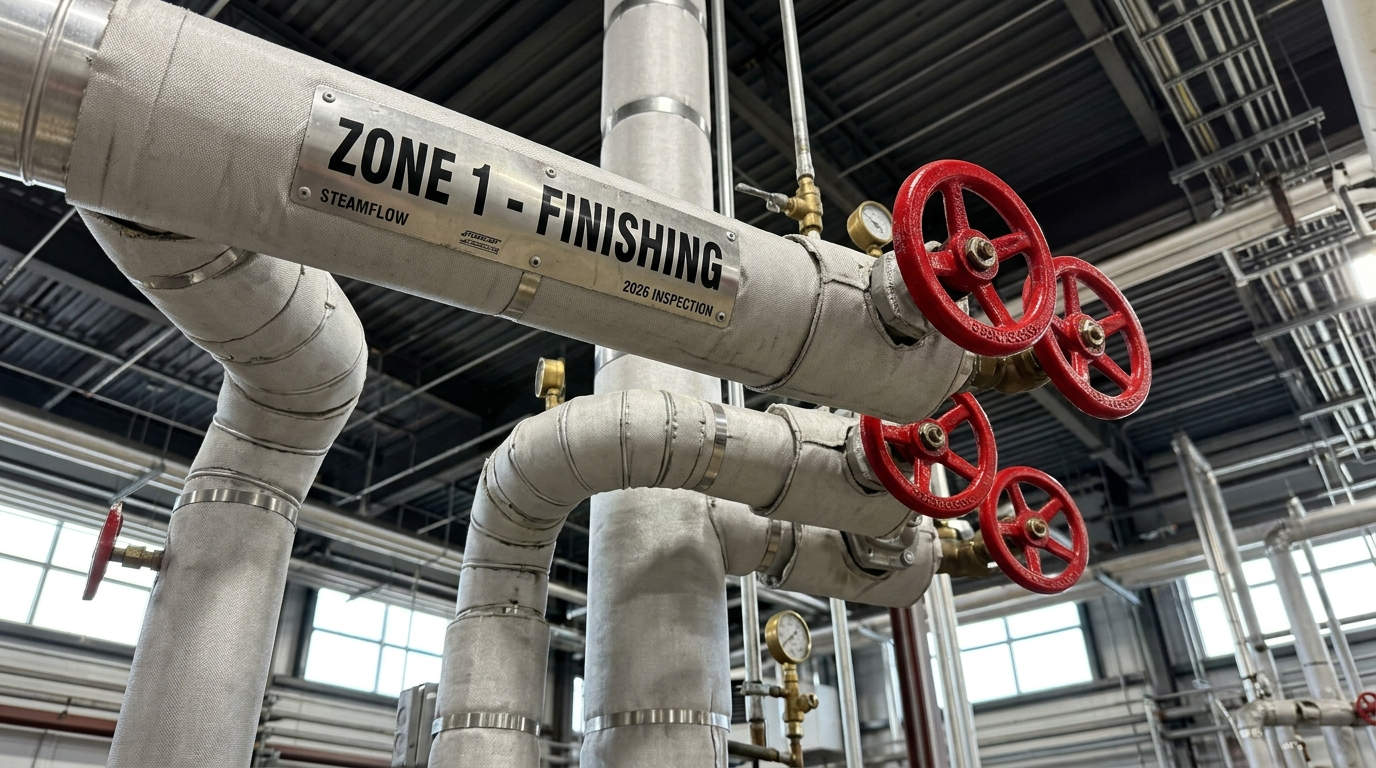
Once steam leaves the boiler, it travels through a network of steam headers, piping, and valves to reach each piece of equipment. This is the circulatory system of your dry cleaning steam support system, and poor design here undermines everything else.
Key design principles:
High/low pressure separation: The steam header should include valves that separate high-pressure and low-pressure sides. This allows operators to close sections when running fewer machines, preventing unnecessary pressure buildup and energy waste across the entire plant.
Proper slope: Supply and return lines must slope so condensate drains naturally. Engineers recommend a slope of 1 inch per 20 feet. Without this slope, condensate pools in the lines, causing corrosion during shutdown and dangerous water hammer on startup.
Insulation: Uninsulated steam piping is one of the most common and costly mistakes in dry cleaning plants. Bare pipes allow steam to cool and become “wet,” which lowers pressing quality, increases fuel consumption, and adds to greenhouse gas emissions.
Some commercial pressing equipment operates at 87 PSI (0.6 MPa) for deep wrinkle removal (Fujistar USA). Maintaining that pressure consistently at the point of use requires well-designed distribution, not just a powerful boiler.
Steam Traps
Steam traps are the most overlooked and most consequential components in a dry cleaning steam support system. Their job is simple: remove condensate and non-condensable gases from the steam line without letting live steam escape. Their impact on operations is enormous.
Without properly functioning steam traps, condensate accumulates inside equipment. This causes reduced heating efficiency, uneven steam distribution, increased energy costs, and physical damage through corrosion and water hammer. Over time, the maintenance costs compound.
Types used in dry cleaning:
Float-thermostatic traps: Common for garment presses
Thermodynamic traps: Durable and suitable for high-pressure applications
Balanced pressure traps: Good for variable-load equipment
Each press in a dry cleaning plant should have its own dedicated trap. Sharing traps between machines is a recipe for uneven performance.
The failure rate is staggering. One story from American Drycleaner illustrates the problem perfectly: a dry cleaner found 6 to 8 bad traps on their own, then hired an outside testing company that found 20 more. That’s typical, not exceptional. Regular trap testing is one of the cheapest, highest-return maintenance activities in any dry cleaning operation.
Condensate Return System
After steam gives up its heat energy at a press or finishing machine, it condenses back into hot water. The condensate return system captures this water and sends it back to the boiler for reuse.
The main components:
Return header: Piping that carries condensate from equipment back to a central collection point
Condensate return tank: A large vented vessel that acts as a reservoir, collecting returned condensate from all steam-heated machinery. It provides the water source for the feed pump that pushes water back into the boiler.
Return pump and check valves: These push condensate from the tank back to the boiler. Industry practitioners consistently identify return pumps and check valves as the most problematic components in the entire steam support system. They fail more often than anything else and deserve close monitoring.
Recovering condensate isn’t optional. It’s already hot (reducing the energy needed to make new steam), it’s already treated (reducing chemical costs), and it’s already clean. Losing it means paying twice: once for fresh water treatment and again for the fuel to heat it.
Water Treatment
Steam boilers are just one part of a quality dry cleaning steam support system. To keep the system reliable and extend its lifespan, some level of water treatment is essential.
Untreated or poorly treated water causes scale accumulation inside the boiler. Scale acts as an insulator on heat transfer surfaces, forcing the boiler to work harder and consume more fuel. In severe cases, scale leads to overheating and dangerous boiler failures.
Proper water treatment includes:
Softening or chemical treatment to prevent scale
Oxygen scavengers to prevent internal corrosion
Regular blowdown to remove accumulated dissolved solids
Monitoring of water chemistry, especially conductivity and pH
For operators running electric boilers in smaller shops, water treatment is still important. Hoffman Steam’s electric boilers for dry cleaning are built for durability, but even the best equipment benefits from clean feedwater.
Safety Controls
The National Board of Boiler and Pressure Vessel Inspectors has documented numerous serious accidents at dry cleaning facilities. Their files contain photographs, news clippings, and official reports. The pattern is consistent: boilers neglected for years, sometimes decades, with no apparent maintenance. The consequences can be catastrophic.
Every dry cleaning steam support system must include:
Low-water cutoffs: Shut down the boiler if water drops below safe levels
Pressure relief valves: Prevent dangerous overpressurization
Gauge glasses: Provide visual confirmation of water level
Inspection certificates: Should be posted on or near each boiler, indicating the maximum safe operating pressure
ASME and UL certification on boiler equipment isn’t bureaucratic overhead. It’s a baseline safety requirement. Hoffman Steam’s Pro line of boilers carries both ASME and UL certification, along with the compliance documentation that inspectors need to see.
Why Steam Quality Matters in Dry Cleaning
The difference between dry steam and wet steam is the difference between professional-quality garment finishing and customer complaints.
Dry steam (steam with minimal moisture content) transfers heat efficiently and evenly. It penetrates fabric, sets creases, and removes wrinkles without leaving water spots or dampness. Wet steam, by contrast, delivers inconsistent heat, can stain delicate fabrics, and forces operators to re-press garments.
A dry cleaner interviewed in a Fulton case study put it plainly: “I can run my dry-cleaning machines at 30 PSI because at 30 PSI it’s full steam, and it’s dry steam… I’m sure I will have a lot less issues with my traps because it’s so dry.”
Steam quality is a system-level outcome. You can’t buy dry steam from a boiler alone. It requires insulated piping (to prevent cooling and condensation in transit), functional steam traps (to remove condensate before it reaches equipment), proper header design, and correct operating pressure. Every component of the dry cleaning steam support system either contributes to or degrades steam quality.
Sizing Your Steam Support System
Getting the sizing right prevents two equally expensive mistakes: undersizing (where equipment can’t maintain pressure during peak loads) and oversizing (where you’ve overspent on capacity you never use).
How to calculate steam requirements:
List every piece of steam-powered equipment in the plant
Note the steam consumption rate (in lbs/hr) from each machine’s specifications
Calculate the total connected load
Apply a diversity factor (not all equipment runs simultaneously at full load)
Add a margin for distribution losses (typically 10 to 15%)
For reference, industrial boilers consume about 37% of total energy used in manufacturing, according to the U.S. Department of Energy. In a dry cleaning plant, that percentage is higher because steam is the primary energy pathway for the majority of processes.
Larger plants often benefit from dual-boiler setups, where a smaller secondary boiler handles light loads and both units run together during peak demand. This approach also provides redundancy: if one boiler goes down, you’re not shut down entirely.
For smaller operations, electric boilers eliminate many of the infrastructure headaches. No gas lines, no venting, no fire-rated enclosures. Hoffman Steam’s RHPG series of industrial boilers provides continuous-duty operation with automatic pump-fill systems, while their smaller JEL models serve shops that need less capacity.
Common Problems and Warning Signs
Pressure Loss Across the Plant
If machines furthest from the boiler aren’t getting adequate steam, the problem is almost always in the distribution network: undersized piping, missing insulation, or leaking joints.
Water Hammer
That banging sound in steam lines is condensate being picked up and hurled through the piping by fast-moving steam. It’s not just annoying. It damages pipes, fittings, and equipment. Proper slope, functional traps, and correct startup procedures prevent it.
Scale Buildup
Neglected water treatment leads to scale on boiler internals. This reduces heat transfer efficiency and, in extreme cases, causes localized overheating and tube failure. The American Drycleaner trade publication has noted that “there are more and more boiler issues than ever,” with ineffective water chemistry among the primary causes.
Steam Trap Failure
Failed traps either leak live steam (wasting energy) or fail to drain condensate (causing water hammer and poor steam quality). Both failure modes are common and both are expensive. Regular testing, ideally quarterly, catches problems before they cascade.
Daily Shutdown Wear
Practitioners on HVAC forums point out that most dry cleaning boilers are designed for daily shutdown, but that doesn’t mean daily cycling is gentle. One experienced technician shared: “The brick work expands and contracts which will cause it to flake and shorten its life. Tube sheets and tubes will expand and contract loosening tubes in time.” The same technician recalled seeing a six-year-old boiler that looked ancient because of the punishment it took in a dry cleaning environment. Cleaners, he noted, are “notorious for lack of maintenance.”
The 2026 Impact Gap: Efficiency and Sustainability
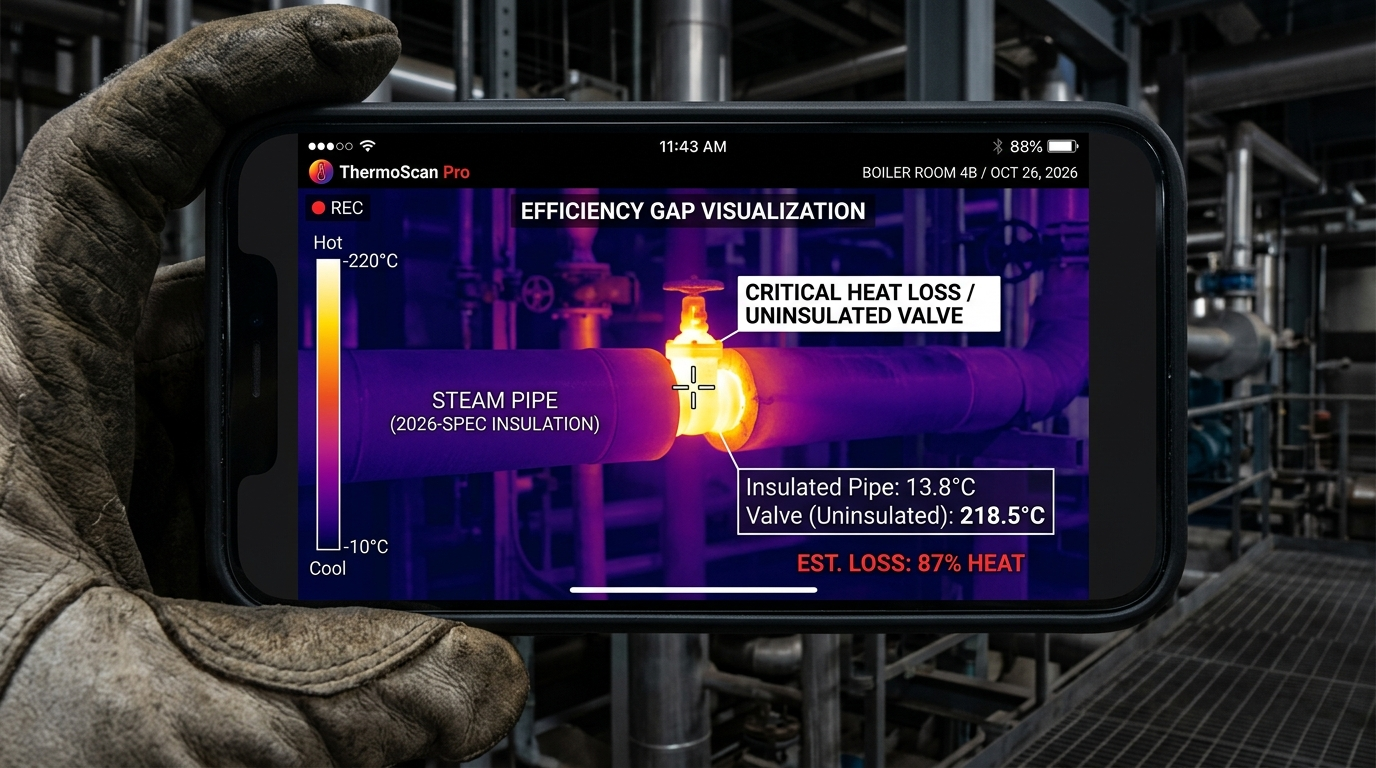
Optimizing your steam support system isn’t just about maintenance; it’s about the bottom line. According to Gartner’s 2026 industrial report, poorly insulated steam lines can lose up to 15% of total BTU output before reaching the press.
Condensate Recovery: Returning hot water to the boiler can reduce fuel consumption by 1% for every 11°F (6°C) increase in feedwater temperature.
Flash Steam Utilization: Modern systems now incorporate high-pressure condensate return to capture “flash steam,” further reducing energy waste.
Thermal Imaging: Routine audits using infrared cameras can identify “invisible” insulation gaps in the distribution network.
Maintenance Best Practices
A well-maintained dry cleaning steam support system lasts years longer, runs more efficiently, and operates safely. Here’s the minimum:
Task | Frequency |
|---|---|
Boiler blowdown | Daily or per manufacturer specs |
Water level and pressure checks | Daily |
Steam trap testing | Quarterly |
Water chemistry analysis | Monthly |
Full boiler inspection | Annually (or per local code) |
Condensate pump and check valve inspection | Quarterly |
Safety valve testing | Annually |
High-efficiency boilers can save 20 to 25% in gas costs, according to the Drycleaning & Laundry Institute (source). But those savings evaporate if maintenance lapses. An economizer that captures waste heat from the boiler flue to preheat makeup water is another proven efficiency upgrade for existing systems.
For operators who lack in-house boiler expertise (which is most small dry cleaners), structured maintenance programs provide a safety net. Hoffman Steam’s Workhorse Protection Program automatically ships consumables, provides factory reconditioning, includes a 47-point inspection, and offers loaner machines during service periods, effectively outsourcing the maintenance expertise that most shops don’t have on staff.
Components at a Glance
Component | Function | Key Concern |
|---|---|---|
Boiler | Generates steam | Sizing, fuel type, certification |
Steam header | Distributes steam to equipment | Pressure separation, valve configuration |
Piping | Carries steam and condensate | Insulation, slope (1″ per 20’) |
Steam traps | Remove condensate from steam lines | Regular testing, one per press |
Condensate return tank | Collects and stores returned water | Venting, level monitoring |
Return pump | Pushes condensate back to boiler | Most failure-prone component |
Water treatment | Prevents scale and corrosion | Chemistry monitoring, blowdown |
Safety controls | Prevent catastrophic failures | Inspection, certification, testing |
Frequently Asked Questions
What is a dry cleaning steam support system?
It is the complete infrastructure that generates, distributes, and recycles steam within a dry cleaning plant. This includes the boiler, steam headers and piping, steam traps, condensate return system, water treatment equipment, and safety controls. Together, these components power pressing, finishing, spotting, and solvent heating processes.
Can I use an electric boiler for a dry cleaning operation?
Yes. Electric steam boilers are a practical choice for small to medium dry cleaning shops. They require no gas lines, no venting, and no fire-rated enclosure. They produce dry, high-pressure steam and have a much smaller footprint than gas-fired alternatives. Hoffman Steam offers ASME/UL certified electric boilers from 1 to 6-gallon capacities specifically suited for commercial use.
How often should steam traps be tested in a dry cleaning plant?
At minimum, quarterly. Steam trap failure is one of the most common and costly problems in dry cleaning operations. One documented case found 26 failed traps in a single plant. Regular testing catches problems before they cause water hammer, energy waste, and garment quality issues.
What causes water hammer in dry cleaning steam lines?
Water hammer occurs when condensate accumulates in steam lines and gets propelled at high speed by moving steam. Common causes include failed steam traps, improperly sloped piping, missing insulation, and incorrect startup procedures. It damages pipes, fittings, and equipment.
How do I know what size boiler my dry cleaning plant needs?
Add up the steam consumption (in lbs/hr) of every piece of steam-powered equipment, apply a diversity factor since not all machines run simultaneously, and add 10 to 15% for distribution losses. A small plant might need 50 HP, while a large plant with multiple machines and finishing bays may require 75 HP or more, potentially in a dual-boiler configuration.
Why does steam quality affect garment finishing?
Dry steam transfers heat evenly and penetrates fabric effectively, producing crisp results without water spots. Wet steam delivers inconsistent heat, can leave moisture on garments, and forces re-pressing. Steam quality depends on the entire system working together: insulated pipes, functional traps, proper pressure, and good boiler operation.
What is the most common maintenance mistake dry cleaners make with their steam systems?
Ignoring the system entirely. The National Board of Boiler and Pressure Vessel Inspectors has documented cases where dry cleaning boilers went years or decades without maintenance, leading to serious accidents. Beyond safety, neglected water treatment causes scale buildup that wastes fuel, and untested steam traps silently drain energy and degrade performance.
Do I need ASME certification on my dry cleaning boiler?
Most jurisdictions require ASME certification for pressure vessels, including steam boilers. Beyond legal compliance, ASME certification confirms the boiler was built to rigorous safety standards. Look for a current certificate of inspection posted on or near the boiler, and verify it lists the maximum safe operating pressure.


