

TL;DR
An electric steam boiler for small business is a compact, electrically powered system that generates steam for tasks like jewelry cleaning, hat shaping, garment finishing, and upholstery work. This glossary covers every technical term you’ll encounter while shopping, from PSI and kW to ASME stamps and low-water cutoffs, all translated into plain English with practical context for shops spending $1,000 to $10,000 on equipment.
Shopping for an electric steam boiler for small business means wading through spec sheets full of abbreviations that seem designed to confuse. PSI, kW, BHP, ASME, UL, LWCO. If you run a jewelry store, hat shop, dry cleaning operation, upholstery business, or tailoring studio, you don’t need an engineering degree. You need a reference that tells you what each term means and whether it should change your buying decision.
That’s what this glossary does. Every entry follows the same format: a plain-English definition, why it matters for your business, and a concrete example or number to anchor it. Bookmark this page. You’ll come back to it.
Considering specific models? See the full buying guide for side-by-side comparisons with pricing.
What Is an Electric Steam Boiler for a Small Business?
An electric steam boiler for a small business is a machine that uses electricity to heat water and produce steam for commercial tasks such as jewelry cleaning, hat shaping, garment pressing, and upholstery work. When choosing one, compare its steam output (pounds per hour), operating pressure (PSI), electrical requirements (voltage, amperage, and phase), duty cycle, and safety certifications. Smaller operations may use compact, lower-power equipment, while continuous or multi-station workflows typically require greater steam capacity. Before purchasing, verify the unit’s specifications and check local boiler, electrical, and inspection requirements.
Electric Steam Boiler Buying Checklist
Use this checklist to compare small commercial electric steam boilers before requesting a quote.
Specification | What It Tells You | What to Check Before Buying |
|---|---|---|
Steam output (lbs/hr or PPH) | How much steam the boiler can produce per hour | Match the rated output to your workload and simultaneous steam demand |
Operating pressure (PSI) | The pressure at which the boiler produces steam | Confirm the required pressure for your application and the equipment’s rated limits |
Electrical power (kW) | The boiler’s rated electrical input | Compare the rating with your available electrical supply |
Voltage and phase | The type of electrical connection required | Confirm single-phase or three-phase compatibility with a licensed electrician |
Amperage | The current the equipment draws | Check the manufacturer’s wiring and circuit requirements |
Duty cycle | Whether the boiler suits intermittent or sustained operation | Choose equipment rated for your expected operating schedule |
Water feed | Whether water is added manually or automatically | Consider how often refilling would interrupt production |
Low-water protection | How the boiler responds if its water level falls too low | Verify the specified safety controls and maintenance requirements |
Certification and registration | Which safety standards and regulatory processes apply | Verify the actual certifications and local jurisdictional requirements |
Maintenance access | How easily the unit can be drained, inspected, and serviced | Check descaling instructions, parts availability, and service support |
Buying tip: Compare complete specifications, not just wattage or advertised pressure. Two boilers with similar power ratings may differ in steam output, recovery time, water-feed design, duty rating, and installation requirements.
How to Choose an Electric Steam Boiler for Your Small Business
Choosing an electric steam boiler starts with your work process, not the largest available pressure or power rating. Use these five steps to narrow your options.
1. Identify the task.
List the work the boiler will perform, such as jewelry cleaning, hat shaping, garment finishing, or upholstery work. Check whether the application requires gentle steam, sustained output, or a specific operating pressure.
2. Estimate your steam demand.
Consider how frequently you use steam, how long each session lasts, and whether multiple stations need steam simultaneously. Use the manufacturer’s rated steam output and recovery specifications to compare models.
3. Check your electrical supply.
Confirm the available voltage, phase, circuit capacity, and panel capacity before selecting a boiler. Have a licensed electrician assess whether the existing installation can support the equipment or requires an upgrade.
4. Verify safety and compliance requirements.
Ask the manufacturer for the boiler’s nameplate details, applicable certifications, operating limits, and installation manual. Contact the relevant local boiler authority to establish which permits, inspections, and registrations apply to your specific model.
5. Compare the total cost of ownership.
Look beyond the purchase price. Include installation, electrical upgrades, water treatment, routine maintenance, replacement parts, and expected electricity consumption. A lower-priced boiler may cost more to install or maintain over its working life.
Final rule: Select a boiler that meets your actual steam demand, fits your electrical infrastructure, and satisfies the applicable safety requirements. If you are unsure about sizing, request a written recommendation from the manufacturer or a qualified boiler professional.
Equipment Types
Electric Steam Boiler
An electric steam boiler uses electricity to heat water and generate steam for commercial or industrial applications. Small-business models vary in water capacity, electrical input, steam output, operating pressure, and duty rating. The appropriate specification depends on the application and how frequently steam is required.
Why it matters: Electric boilers do not require on-site fuel combustion or a combustion flue, which can simplify installation in some commercial spaces. However, they still require suitable electrical infrastructure, water management, safety controls, and any applicable permits or inspections. Although resistance electric heating converts nearly all input electrical energy into heat at the point of use, overall operating cost depends on electricity rates, steam demand, maintenance, and installation requirements. For a deeper comparison of fuel types, the electric vs. gas guide breaks down the real cost differences.
Flash Steamer (Non-Pressurized Steamer)
A non-pressurized steamer that heats a small amount of water very quickly to produce a continuous, gentle flow of steam. It doesn’t build up pressure internally.
Why it matters: Because there’s no pressurized vessel, flash steamers typically don’t fall under ASME boiler certification requirements in most jurisdictions. That means no boiler permits, no annual inspections, and a simpler installation process. The tradeoff is lower steam force, which works for light garment finishing or retail jewelry display cleaning but won’t handle heavy-duty hat shaping or industrial cleaning. For a detailed breakdown, see the flash steamer vs. boiler differences guide.
Compliance note: Do not assume that a product is exempt from boiler regulations simply because it is marketed as a flash steamer or non-pressurized steamer. Confirm the manufacturer’s design specifications and check with your local boiler authority or building department to determine whether registration, inspection, or permitting is required.
Pressurized Boiler
A boiler that generates steam under pressure, typically starting around 40 PSI for small business models and going up to 90 PSI or higher. True professional-grade equipment operates at 50 to 75 PSI, with heavy-duty machines exceeding 125 PSI.
Why it matters: Pressurized steam hits harder and cleans better. If you’re blasting wax off dental castings, shaping stiff felt hats, or deep-cleaning upholstery fabric, you need that pressure. But pressurized boilers fall under stricter regulatory categories and require ASME certification in most states.
Commercial Steamer vs. Boiler: The Naming Confusion
A commercial steamer is a type of boiler. “Boiler” is the general engineering term for any device that heats water in a closed vessel to create steam. “Commercial steamer” usually refers to a smaller, packaged electric boiler system designed for specific business applications rather than heating an entire building.
Why it matters: When manufacturers say “steamer,” they often mean a boiler under a friendlier name. Don’t assume a “steamer” is automatically non-pressurized or permit-free. Check the PSI rating. If it operates above 15 PSI, it’s a pressurized boiler regardless of what the marketing calls it.
Electrode Boiler
An electrode boiler generates heat by passing electric current through conductive water. This differs from the resistance heating elements commonly used in compact commercial electric steam boilers.
Why it matters: Most buyers shopping for a small workshop, retail business, or garment-finishing operation will be comparing resistance-heated units. Confirm the heating technology in the manufacturer’s specifications before comparing models.
Flash Steamer vs. Electric Steam Boiler
Feature | Non-Pressurized Flash Steamer | Pressurized Electric Steam Boiler |
|---|---|---|
Steam generation | Heats small quantities of water rapidly | Generates steam within a pressure-rated system |
Steam delivery | Generally suited to lighter steam applications | Can provide higher-pressure steam when designed and rated for it |
Typical considerations | Portability, simple operation, and application suitability | Steam demand, operating pressure, electrical capacity, and safety controls |
Water supply | Depends on the model; manual or automatic designs may be available | Depends on the model; manual fill and automatic feed are possible |
Compliance | Requirements depend on the design and jurisdiction | May require applicable boiler certification, permits, registration, and inspection |
Best buying approach | Confirm that steam output and delivery meet the task | Compare rated output, operating limits, electrical requirements, and compliance documentation |
Which should you choose? A flash steamer may suit lighter or intermittent applications when its output meets the task. A pressurized electric boiler may be appropriate when the work requires a specified pressure or sustained steam output. Confirm the actual requirements of your application before choosing either type.
Performance and Sizing Terms
PSI (Pounds per Square Inch)
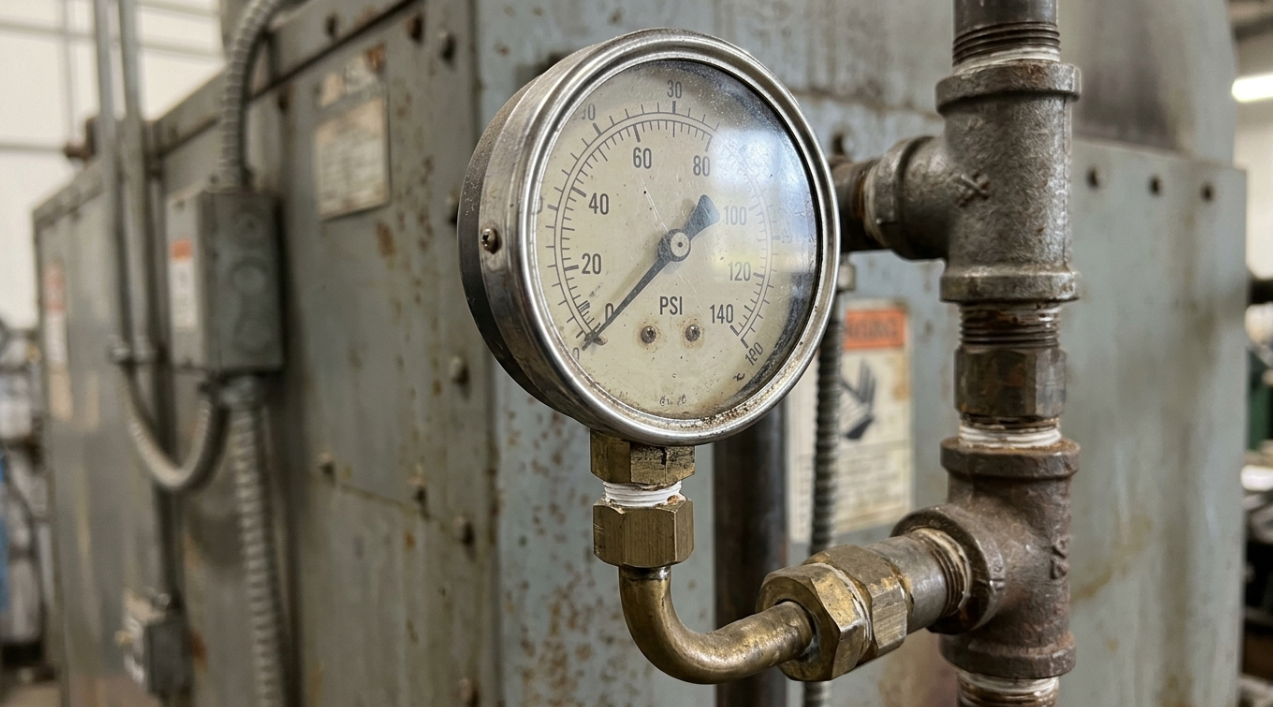
PSI (pounds per square inch) measures pressure. In boiler specifications, you may also see PSIG, which means pounds per square inch gauge—the pressure measured relative to atmospheric pressure.
Why it matters: Operating pressure affects the boiler’s application, design requirements, safety controls, and regulatory classification. A 15 PSIG threshold is important in several U.S. boiler-code contexts, but it does not independently determine every certification or permitting requirement. The applicable code depends on the boiler’s design, capacity, service, and jurisdiction. Always distinguish maximum allowable working pressure from normal operating pressure when comparing specifications. For guidance on how PSI connects to your specific trade, the PSI settings guide is worth reading.
kW (Kilowatt)
Kilowatts (kW) measure electrical power. For an electric steam boiler, the kW rating indicates its electrical input demand and helps determine the required electrical supply.
Key conversion: 1 kW equals approximately 3,412 BTU/hr of power input. A boiler’s actual steam production depends on its design, feedwater temperature, operating pressure, and overall performance.
Why it matters: Higher-power boilers generally require more electrical capacity. Before buying, check the nameplate voltage, phase, rated current, and manufacturer-specified circuit requirements. Do not select a boiler based on kW alone; compare its rated steam output in pounds per hour as well.
BHP (Boiler Horsepower)
The standard measure of a steam boiler’s output capacity. One BHP is defined as the energy required to turn 34.5 pounds of water at 212°F into steam in one hour. That equals roughly 33,475 BTU/hr or about 10 kW of electrical input.
Why it matters for small business: Most small commercial electric boilers operate below 5 BHP. A 3 kW unit is roughly 0.3 BHP. A 36 kW unit is approximately 3.6 BHP. When you see sizing guides recommending “50 BHP minimum,” they’re describing equipment ten times larger than what a typical small business needs. Ignore those guides. They’re written for factories and building HVAC systems, not your shop.
BTU (British Thermal Unit)
The amount of heat required to raise the temperature of one pound of water by 1 degree Fahrenheit. This is the universal unit for comparing heat output across different fuel types.
Key conversion: 1 kW = 3,412 BTU/hr. You’ll encounter BTU ratings when comparing electric boilers against gas options, but for electric-only shopping, kW is the more useful number.
Pounds Per Hour (lbs/hr or PPH)
The rate at which a boiler produces steam. This tells you how much actual steam you get per hour of operation.
Why it matters: A small shop boiler producing 3 to 12 lbs/hr of steam is often plenty for single-station operations like jewelry cleaning or garment finishing. Multi-station shops or continuous-production environments need 15 to 50+ lbs/hr. Match this number to your actual daily workflow, not theoretical capacity.
Electric Steam Boiler Conversion Table
Use these approximate conversions when comparing manufacturer specifications.
Unit | Approximate Equivalent | Practical Use |
|---|---|---|
1 boiler horsepower (BHP) | 33,475 BTU/hr of boiler output | Compare rated boiler capacity |
1 BHP | 34.5 lb/hr of steam, under the conventional definition | Compare steam production ratings |
1 BHP | 9.81 kW of thermal output | Compare heat-output ratings |
1 kW | 3,412 BTU/hr of electrical input energy | Compare electric power ratings |
1 kW | Roughly 3.4–3.5 lb/hr of steam under simplified assumptions | Estimate theoretical steam output |
Important: These figures are not interchangeable without context. Electrical input, thermal output, and rated steam production measure different things. Actual steam output depends on feedwater temperature, operating pressure, boiler design, and performance. Use the manufacturer’s rated pounds per hour when sizing equipment.
Print this table or save it to your phone. It’s the single most useful reference when comparing spec sheets across different manufacturers. To put these numbers into practice for your shop, the boiler sizing guide walks through capacity planning step by step.
Thermal Efficiency
The percentage of input energy that actually becomes useful steam. Electric steam boilers achieve 98 to 99% thermal efficiency at point of use. Gas-fired steam boilers operate at 80 to 85% efficiency (up to 95% with condensing technology).
Why it matters: Higher efficiency means lower operating cost per pound of steam. Electric boilers win this comparison decisively at the point of use, though your local electricity rates vs. gas rates determine total cost. The efficiency advantage also means less wasted heat in your shop, which matters if you’re running a boiler in a small retail space during summer.
Duty Cycle (Intermittent vs. Continuous)
Whether a boiler is designed to run in short bursts or all day long. Intermittent duty means the boiler heats up, you use it for a while, and it rests. Continuous duty means it maintains pressure and produces steam for 8+ hours without interruption.
Why it matters: A jeweler who cleans 20 pieces in the morning and 20 in the afternoon can work with an intermittent-duty, manual-fill boiler. A hat shop shaping hats back to back all day needs continuous duty with an automatic water feed. Continuous production requires much more capacity than occasional steam bursts. Buying an intermittent boiler for a continuous workflow is one of the most common and expensive mistakes small business owners make.
Total Cost of Ownership
The purchase price is only one part of the cost of an electric steam boiler. Small businesses should also consider installation, electricity, water treatment, maintenance, and replacement parts.
Cost Category | What to Include |
|---|---|
Equipment purchase | Boiler, included accessories, and required controls |
Installation | Electrical work, plumbing, mounting, and any required inspection |
Electricity | Rated power, operating hours, electricity tariff, and actual usage |
Water treatment | Filters, softeners, cartridges, and any required treatment supplies |
Routine maintenance | Inspection, descaling, blowdown, and servicing |
Replacement parts | Heating elements, valves, gauges, and controls |
Compliance | Applicable permit, inspection, registration, and insurance costs |
How to estimate electricity cost:
Electricity cost per operating period can be estimated as:
Electricity cost = power consumption (kW) × operating hours × electricity rate per kWh.
For example, a 6 kW boiler operating at its full rated input for 3 hours would consume 18 kWh. Multiply 18 kWh by your electricity tariff to estimate the energy cost for that period.
This is a simplified estimate. Actual consumption may be lower when the boiler cycles off, and operating conditions affect the result. Use measured consumption when available.
Before purchasing, compare the expected cost of ownership across models rather than choosing on purchase price alone.
Short Cycling
When an oversized boiler constantly heats up to pressure, shuts off, loses pressure, then fires again in rapid succession. This wastes electricity and accelerates wear on heating elements and controls.
Why it matters: Oversizing wastes electricity through short cycling, while undersizing causes pressure loss and slows production. The goal is matching boiler capacity to your actual steam demand so the unit runs in longer, steadier cycles rather than constantly toggling on and off.
Electrical Terms
110V vs. 220V vs. Three-Phase Power
These describe the electrical supply your boiler needs.
110V (standard household outlet): Maxes out at about 1.5 kW. Suitable for portable flash steamers and the smallest boilers. Good for light-to-medium steaming in a small boutique where portability matters.
220V (dedicated circuit): Opens up 3 kW or more. Choose this if your business requires constant steam production and faster heat-up recovery times. Requires a dedicated circuit installed by a licensed electrician.
Three-phase power: Supports continuous-duty industrial boilers at 17 kW and above. Typically found in light manufacturing facilities, larger dry cleaners, and multi-station operations. Not available in most standard retail or office spaces without significant electrical upgrades.
For a detailed breakdown of how voltage choice affects daily operations, see the 110V vs. 220V guide.
Dedicated Circuit
A circuit breaker and wiring run that serves only the boiler, with no other equipment sharing the line. Required for any 220V or three-phase boiler installation.
Why it matters: Sharing a circuit with other equipment causes voltage drops, tripped breakers, and inconsistent steam pressure. Your electrician needs to know the boiler’s kW and amperage rating before running the circuit.
Amperage (Amps)
The amount of electrical current flowing through the circuit. Higher kW boilers draw more amps and require heavier wiring and larger breakers.
Why it matters: A 1.5 kW boiler on 110V draws about 13 amps, which fits a standard 15A or 20A household circuit. A 6 kW boiler on 220V draws about 27 amps and needs a dedicated 30A or 40A circuit. Always confirm amperage requirements with your electrician before purchasing. The installation cost for a new circuit typically runs $200 to $800 depending on your building’s electrical panel.
Safety and Certification Terms
ASME Certification (American Society of Mechanical Engineers)
ASME sets the engineering standards for pressure vessels, including boilers. An ASME-certified boiler has been designed, built, and inspected to meet these standards. Three stamp types are relevant to small business buyers:
“S” Stamp (Section I, Power Boilers): Covers boilers generating steam at pressures exceeding 15 PSIG. This is the stamp most small business pressurized boilers carry.
“H” Stamp (Section IV, Heating Boilers): Covers lower-pressure heating applications, capped at 15 PSI steam.
“E” Stamp: Specifically designates electric boilers under the ASME code.
Why it matters: In most states, if your electric boiler operates under pressure, it needs ASME certification. Electric boilers are exempt from combustion-related codes (they don’t burn fuel), but they are not exempt from pressure vessel codes. The ASME “E” stamp exists specifically for this category. For a full walkthrough, see the ASME certified vs. non-certified guide.
UL 834 (Underwriters Laboratories)
UL 834 is the specific safety standard for electric heating, water supply, and power boilers rated at 15,000 volts or less. It covers commercial and industrial applications utilizing hot water or steam. If your electric steam boiler carries UL 834 certification, it has been tested and verified for electrical safety, pressure containment, and control system reliability.
Critical distinction: A UL-listed steamer is not automatically an ASME-certified boiler. For pressurized commercial steam equipment, you typically need both certifications. UL confirms the electrical system is safe. ASME confirms the pressure vessel is safe. They test different things. You need both.
National Board Registration
The National Board of Boiler and Pressure Vessel Inspectors maintains a registry of all ASME-stamped boilers. New boilers must be designed, constructed, inspected, and stamped in accordance with ASME code, then registered with the National Board. The manufacturer’s “NB” number appears on the boiler’s nameplate.
Why it matters: State inspectors will look for this number during your boiler inspection. If it’s missing, you may fail the inspection or face a shutdown order. When buying a boiler, confirm that it carries a National Board registration number, not just an ASME stamp.
Manufacturer’s Data Report (Form P-2A)
The official ASME documentation package for electric boilers. Think of it as the boiler’s birth certificate. It records the manufacturer, serial number, design pressure, materials, and the authorized inspector who witnessed the manufacturing process.
Why it matters: ASME and UL boiler compliance involves three documentation layers: ASME certifies the pressure vessel, UL certifies the electrical assembly, and the National Board registers and tracks everything. The core documents include Form P-2A, the National Board registration number, the UL listing certificate, and your state operating permit. Missing any of these can mean a failed inspection, denied insurance claim, or shutdown order. The compliance documentation checklist walks through every document you need to have on file.
LWCO (Low-Water Cutoff)
A safety device that shuts off power to the heating element if the water level inside the boiler drops too low. Without it, the heating element would fire into an empty or near-empty tank, causing dry-firing, equipment damage, and potential safety hazards.
How it works: The LWCO uses either an electric conductivity probe or a float to detect the water level inside the boiler. When water drops below the safe minimum, the LWCO prevents the heating element from firing.
Why it matters: Practitioners on the HeatingHelp.com forums repeatedly emphasize that automatic water feeders “are not for convenience. They are safety devices.” This is a critical nuance. The LWCO stops the heat. The auto-feeder adds water. They do different jobs. A boiler needs the LWCO even if it also has an auto-feed system.
Safety Relief Valve
A spring-loaded valve required on all pressurized boilers that opens automatically when internal pressure exceeds the set limit. Per ASME code, every power boiler must have at least one safety valve.
Why it matters: This is your last line of defense against catastrophic overpressure. Never plug, modify, or disable a safety relief valve. If it’s leaking or discharging steam during normal operation, that indicates a control problem elsewhere in the system, not a faulty valve.
Pressure Gauge
A dial-type gauge mounted on the boiler that displays the current internal steam pressure in PSI. Allows the operator to verify the boiler is operating within its designed pressure range.
Why it matters: Check this daily. If the pressure reading seems wrong (either too high or stuck at zero), have the gauge tested or replaced before continuing to operate the boiler. An inaccurate pressure gauge makes every other safety device less reliable because you’ve lost your primary monitoring tool.
Maintenance and Operation Terms
Scale / Descaling
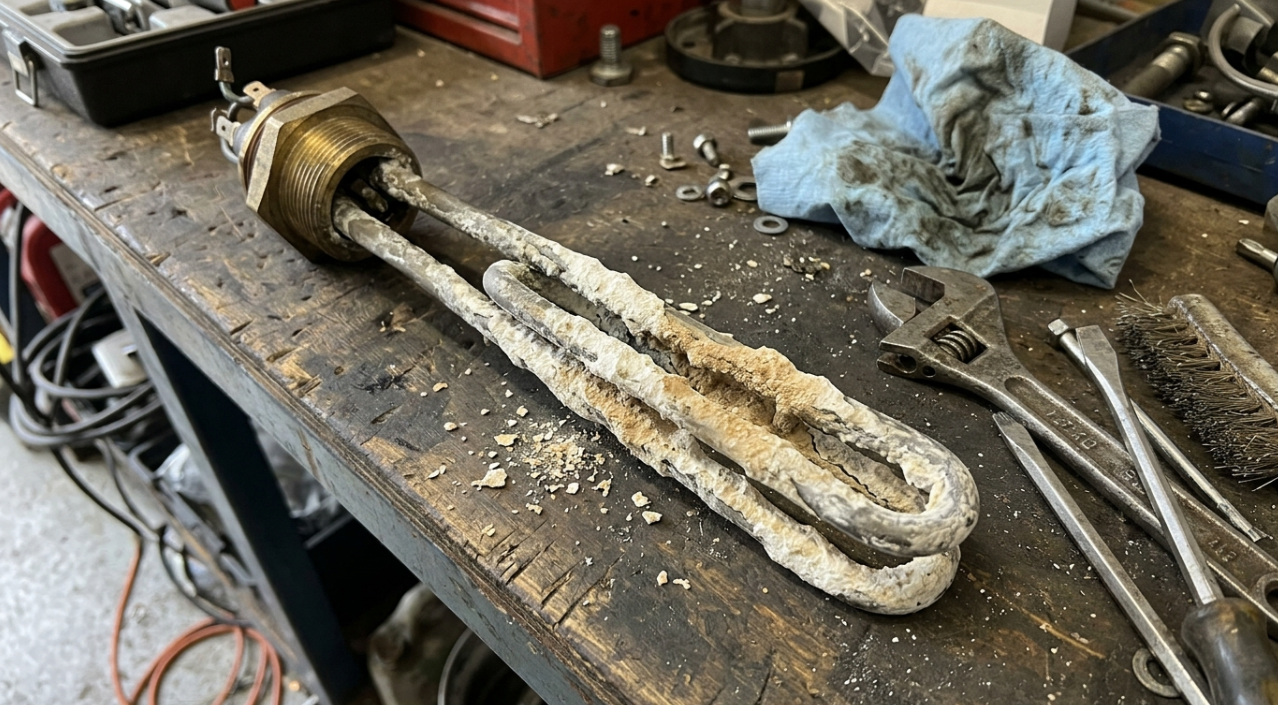
Scale is the mineral buildup that forms inside any device that heats or boils water. Dissolved solids in the water precipitate out and bond to internal surfaces, particularly the heating elements. Over time, scale blocks drains, damages valves, causes heating element failure, and greatly reduces efficiency.
Why it matters: Scale is the biggest maintenance problem for many small electric boilers. Forum users on HeatingHelp.com report that scale causes audible “snap crackle and pop” noises and that heat transfer efficiency drops significantly when surfaces develop mineral buildup. Descaling on a regular schedule (monthly to quarterly, depending on your water hardness) is the single most impactful thing you can do to extend your boiler’s lifespan. One jeweler on the Ganoksin Orchid jewelry forum noted frustration with slow heat-up times, which is often a sign of scale accumulation on the elements. For a step-by-step process, the descaling best practices guide covers what you need.
Blowdown
The periodic release of water from the bottom of the boiler to flush out accumulated sediment and dissolved solids. You open a valve, drain a portion of the water, and refill with fresh water.
Why it matters: Blowdown controls the concentration of minerals in the boiler water and prevents salt precipitation that accelerates scale. Think of it as changing the oil in your car. It’s a five-minute task that prevents expensive repairs.
Manual Fill vs. Pump-Fill (Auto-Feed)
Manual fill means you stop production, open the boiler cap or fill port, and add water by hand when the level drops.
Pump-fill (auto-feed) means an automatic system adds water to the boiler as the water level drops during steam production, without any operator intervention.
Why it matters: Manual-fill boilers work fine for short sessions, but they become impractical when the boiler runs all day. Every manual refill interrupts production. Auto-feed systems are essential for continuous-duty operation. And remember: the auto-feeder adds water, while the LWCO cuts power if the water gets dangerously low. They serve different purposes and a boiler needs both for safe continuous operation.
Sight Glass
A transparent tube mounted on the outside of the boiler that lets you visually check the water level inside the tank.
Why it matters: Essential for manual-fill boilers where the operator must know when to add water. Even on auto-feed boilers, the sight glass gives you a quick visual confirmation that the feed system is working properly. Check it at the start of every shift.
Water Treatment / Water Softener
Any method of treating the incoming water to reduce mineral content (hardness) before it enters the boiler. This can range from a simple inline water softener cartridge to a full chemical treatment program.
Why it matters: Soft water means less scale. Less scale means longer element life, better efficiency, and fewer service calls. If your shop has hard water (common throughout the American Southwest, Midwest, and Florida), a basic water softener filter is one of the cheapest investments you can make to protect your boiler. For broader water quality standards, the water quality guide covers what to test and target.
Heating Element
The electrical resistance component submerged in the boiler water that converts electricity into heat. Small business electric boilers typically use one or more immersion-style elements rated between 1.5 kW and 36 kW.
Why it matters: Heating elements are consumable parts. They corrode, accumulate scale, and eventually burn out. In hard-water areas, elements may need replacement every 2 to 5 years. In soft-water areas with proper descaling, they can last much longer. Reddit users in r/jewelers and r/BenchJewelers report Hoffman equipment lasting 24+ years, with proper maintenance being the key factor in that longevity.
Compliance and Permitting Terms
Boiler Permit
A permit issued by your state or local jurisdiction authorizing you to install and operate a pressurized boiler at your business location. Most states require permits for commercial boilers operating above 15 PSI.
Why it matters: Rules vary widely by state and even by county. Some jurisdictions require permits only for boilers above a certain size or pressure threshold. Others require permits for virtually any pressurized equipment in a commercial setting. The critical threshold is 15 PSI: boilers above that face stricter requirements almost everywhere. Check with your local boiler inspector before you buy, not after. The boiler permit requirements guide maps out what to expect by state.
Certificate of Inspection
The document issued by an authorized boiler inspector (either a state inspector or an insurance company inspector) after examining your boiler and confirming it meets code requirements. This certificate must typically be posted near the boiler.
Why it matters: Operating without a current certificate of inspection can result in fines, insurance claim denials, or a shutdown order. Most jurisdictions require annual or biennial inspections. Mark the renewal date on your calendar.
ASME CSD-1 (Controls and Safety Devices for Automatically Fired Boilers)
An ASME standard that specifies requirements for the controls and safety devices on boilers, including low-water cutoffs, pressure controls, and operating limit switches. While originally written for fuel-fired boilers, many jurisdictions apply portions of CSD-1 to electric boilers as well.
Why it matters: If your state’s boiler code references CSD-1, your electric boiler’s controls must meet these requirements. This affects which LWCO types are acceptable, how pressure controls must be configured, and what redundancy is required. Your boiler manufacturer should be able to confirm CSD-1 compliance.
State Boiler Code
Each state maintains its own set of regulations governing boiler installation, operation, inspection, and permitting. Most states adopt the ASME Boiler and Pressure Vessel Code as the baseline, then add their own requirements on top.
Why it matters: “ASME certified” doesn’t automatically mean “legal in your state.” Some states have additional requirements beyond ASME, such as specific insurance mandates, installer licensing requirements, or registration procedures. Always check your state’s specific code.
Boiler Insurance Requirements
Many states require commercial boiler operators to carry boiler and machinery insurance (sometimes called equipment breakdown insurance). This covers damage from boiler malfunctions, including explosions, cracking, and electrical failures.
Why it matters: Even if your state doesn’t legally require boiler insurance, your landlord or general liability insurer probably does. More importantly, if you operate an uncertified or uninspected boiler and something goes wrong, your general business liability policy may deny the claim entirely. Boiler insurance typically costs $200 to $500 per year for small commercial electric units, which is trivial compared to the cost of an uninsured equipment failure.
Frequently Asked Questions
Do I need an ASME-certified boiler for my small business?
If your boiler operates above 15 PSI (and most commercial electric steam boilers do), then yes, most states require ASME certification. Non-pressurized flash steamers are generally exempt. The distinction between flash steamers and pressurized boilers is the single biggest factor in determining your compliance obligations.
What size electric steam boiler does a small business need?
Most single-station operations (one jewelry bench, one hat block, one pressing station) work well with boilers in the 1.5 to 6 kW range, producing roughly 5 to 20 lbs/hr of steam. Multi-station shops or continuous-production environments should look at 6 to 36 kW models. Use the conversion table above to translate between kW, BHP, and lbs/hr when comparing spec sheets.
Can I plug a commercial steamer into a regular wall outlet?
Only if it’s a 110V model rated at 1.5 kW or less. Anything larger requires a dedicated 220V or three-phase circuit installed by a licensed electrician. Plugging a high-draw boiler into a shared household circuit will trip breakers and risk electrical damage.
What’s the difference between a flash steamer and an electric steam boiler?
A flash steamer is non-pressurized and produces a gentle, continuous flow of steam by rapidly heating small amounts of water. An electric steam boiler builds pressure in a sealed vessel (typically 40 to 90 PSI for small business models) and delivers more forceful steam. Flash steamers are simpler and permit-free in most areas. Pressurized boilers are more powerful but require ASME certification and boiler permits.
How often should I descale my electric steam boiler?
Monthly to quarterly, depending on your water hardness. Hard water areas may require monthly descaling. Soft water areas with a water softener inline can stretch to quarterly. Scale buildup is the number one cause of heating element failure and efficiency loss in small electric boilers.
Do I need both ASME and UL certification?
For a pressurized commercial electric steam boiler, yes. ASME certifies the pressure vessel. UL 834 certifies the electrical system. They test different things and neither replaces the other. A boiler with only one certification is missing half the safety verification.
How long does an electric steam boiler last?
Electric steam boilers typically last 15 to 25 years with proper maintenance, compared to 10 to 15 years for gas-fired units. Regular descaling, blowdown, and water treatment are the main factors that determine whether your boiler hits the low or high end of that range.
What permits do I need to operate a commercial steam boiler?
Requirements vary by state, but most jurisdictions require a boiler installation permit, an initial inspection by an authorized inspector, and an annual or biennial certificate of inspection renewal. Some states also require boiler and machinery insurance. Check with your local boiler inspector before purchasing.
Next Steps
This glossary gives you the vocabulary to read spec sheets, ask informed questions, and avoid the most common purchasing mistakes. The next step is matching these concepts to specific equipment.
Ready to compare models and pricing? The electric steam boiler buying guide puts these terms into action with side-by-side model comparisons built specifically for small business buyers.


