

TL;DR
Electric steam boilers convert electricity directly into steam at 98-99% thermal efficiency, require no gas lines or flue systems, and produce zero on-site emissions. Gas-fired steam boilers burn natural gas or propane at 80-85% efficiency but benefit from cheaper fuel costs at scale. For small and mid-size businesses with intermittent steam needs, electric boilers win on installation simplicity, maintenance costs, safety compliance, and total cost of ownership. Gas makes sense only when you need massive continuous steam output and already have gas infrastructure in place.
If your business needs steam only a few hours per day, an electric steam boiler is usually the better choice because it installs faster, requires less maintenance, produces no on-site emissions, and avoids gas permits or venting requirements. A gas steam boiler becomes the better option only when steam demand is continuous, fuel costs dominate operating expenses, and existing gas infrastructure is already available.
Quick Buying Recommendation: Electric vs Gas Steam Boiler
For most small businesses, an electric steam boiler is the better choice because installation is simpler, safety requirements are easier to manage, and the total ownership cost is often lower when steam is used intermittently. Businesses such as jewelry stores, hat shops, garment retailers, dry cleaners, upholstery shops, and small manufacturing operations usually benefit from electric steam because they do not need continuous industrial steam production.
A natural gas steam boiler becomes the better choice when steam demand is constant, the facility already has gas infrastructure, and fuel savings outweigh the additional installation, maintenance, and compliance requirements.
Choose electric when:
Steam is used less than 8 hours per day
The building does not already have gas service
You operate in a leased retail or commercial space
You need quiet, clean operation
You want minimal maintenance
Choose gas when:
Steam runs continuously throughout the day
Production depends on high steam output
Your facility already has industrial gas infrastructure
Fuel cost savings justify higher installation complexity
Electric vs Gas Steam Boiler at a Glance
Business Situation | Better Choice | Why |
|---|---|---|
Retail stores | Electric | No flue or gas line |
Jewelry shops | Electric | Fast startup and intermittent use |
Hat shops | Electric | Compact installation |
Garment boutiques | Electric | Lower maintenance |
Restaurants | Depends | Based on daily steam demand |
Large factories | Gas | Lower fuel cost at high output |
Existing gas infrastructure | Gas | Lower operating fuel costs |
Rental commercial spaces | Electric | Easier installation |
What Is an Electric Steam Boiler?
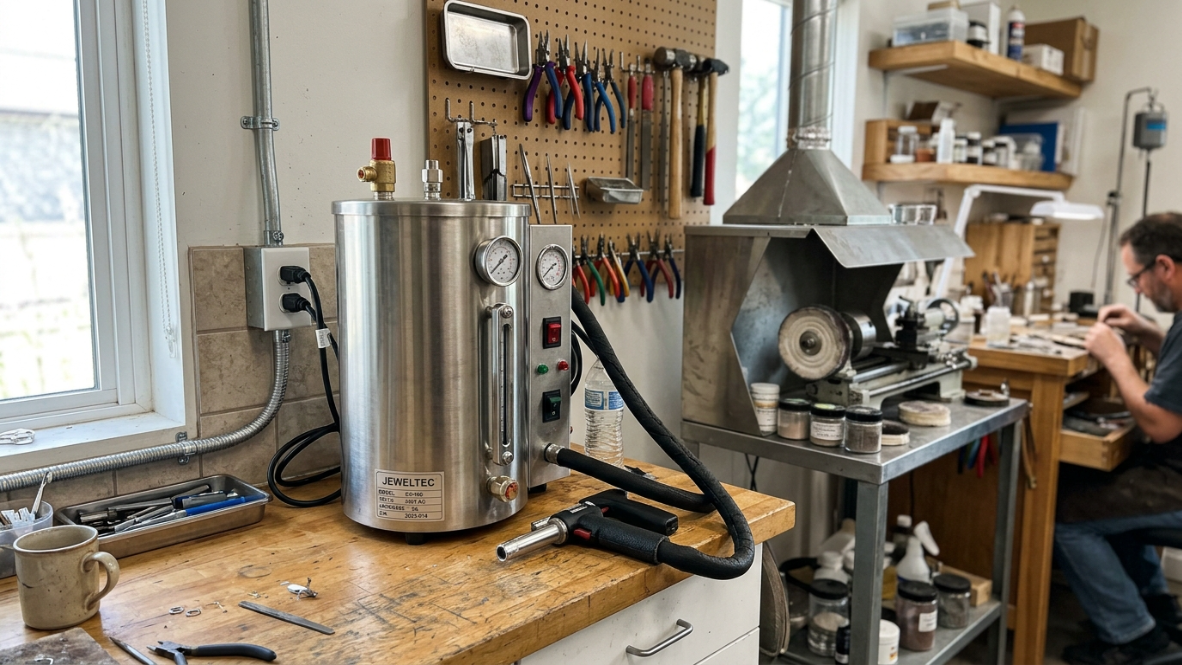
An electric steam boiler uses electric heating elements (resistance type) or electrode technology to heat water and produce steam. There is no combustion involved. No flame, no flue, no fuel line. The unit plugs into an electrical supply, heats water directly, and delivers steam on demand.
Because electricity converts to heat with almost no energy wasted in the process, these boilers achieve thermal efficiencies of 98-99% at point of use. They are compact, quiet, and can be installed in nearly any location, including retail stores, mall kiosks, and rented commercial spaces where gas equipment is either prohibited or impractical.
For small businesses exploring electric steam options, Hoffman Steam manufactures commercial electric steamers ranging from portable flash steamers to ASME-certified boilers with up to 6-gallon capacity.
What Is a Gas-Fired Steam Boiler?
A gas-fired steam boiler (sometimes called a gas steam boiler) burns natural gas or propane in a combustion chamber. The heat generated transfers through exchange surfaces to water, converting it to steam. This process requires a gas supply line, an exhaust flue or chimney, a combustion air system, and various safety controls.
Gas boilers typically operate at 80-85% efficiency under standard conditions, though modern condensing designs can push into the 90-95% range. They excel at high-volume, continuous steam production for large industrial facilities.
The core difference between electric and gas steam boilers comes down to the energy source: electricity versus combustion. Everything else, from installation complexity to regulatory burden, follows from that distinction.
Side-by-Side Comparison: Electric Steam Boiler vs Gas
Factor | Electric Steam Boiler | Gas-Fired Steam Boiler |
|---|---|---|
Energy Source | Electricity | Natural gas or propane |
Thermal Efficiency | 98-99% | 80-85% (up to 95% condensing) |
Installation Complexity | Low, no flue or gas line needed | High, requires gas line, flue, ventilation |
On-Site Emissions | Zero | CO₂, NOx from combustion |
Maintenance Burden | Low, fewer moving parts | Higher, annual combustion tuning required |
Safety Compliance | Simpler, no combustion codes | Requires ASME CSD-1, NFPA 85 compliance |
Typical Capacity | Best for small to mid-scale | Scales to very large output |
Equipment Lifespan | 15-25 years | 10-15 years |
Fuel Cost per BTU | Higher | Lower |
Best For | Intermittent use, small/mid business | Large-scale continuous operation |
Electric Steam Boiler vs Gas: Pros and Cons
Electric Steam Boiler Advantages
98–99% point-of-use efficiency
No combustion
No chimney or venting
No gas connection required
Lower maintenance
Quieter operation
Zero on-site emissions
Easier permitting
Longer average lifespan
Electric Steam Boiler Disadvantages
Higher electricity cost in many regions
Limited maximum output compared to industrial gas boilers
Requires adequate electrical service
May require electrical panel upgrades
Gas Steam Boiler Advantages
Lower fuel cost per BTU
Better for continuous industrial production
Extremely high steam capacities available
Existing gas infrastructure reduces operating costs
Gas Steam Boiler Disadvantages
More maintenance
Combustion safety requirements
Flue installation required
Gas permits
Carbon emissions
More complex installation
Efficiency: What the Numbers Actually Mean
The efficiency gap between electric and gas steam boilers is significant at point of use. Electric boilers convert nearly all input energy into steam, with minimal heat escaping the system. The U.S. Department of Energy confirms that oil- and gas-fired boiler efficiency typically falls in the 80-85% range.
That 15-point difference matters. For every dollar of energy you feed a gas boiler, roughly 15-20 cents escapes as waste heat through the flue, the combustion exhaust, and radiation losses. An electric boiler loses almost nothing.
There is a legitimate counterargument: the efficiency of electricity generation at the power plant level is lower than 100%, so the “well-to-steam” efficiency of electric boilers depends partly on how the grid produces power. This matters for environmental accounting at a macro level. But for a small business owner comparing monthly utility bills, point-of-use efficiency is what shows up on the invoice. If you want to understand how commercial steamers work at a technical level, the conversion process is straightforward.
Electric vs Gas Steam Boiler Cost: What Small Businesses Actually Pay
The purchase price is only one part of boiler ownership. Small businesses should compare four costs:
Equipment purchase
Installation
Operating expenses
Maintenance and downtime
Typical Cost Factors
Cost Category | Electric Steam Boiler | Natural Gas Steam Boiler |
|---|---|---|
Equipment | Moderate | Moderate to high |
Gas line installation | None | $1,000-$5,000+ |
Venting/flue | None | Required |
Electrical upgrades | Possible | Usually lower |
Permits | Usually simpler | More complex |
Annual maintenance | Lower | Higher |
Fuel cost | Higher per BTU | Lower per BTU |
Downtime risk | Lower | Higher due to combustion components |
For a factory operating 24 hours per day, natural gas usually wins because fuel savings accumulate continuously.
For a boutique, jewelry store, or garment business using steam only a few hours daily, installation and maintenance savings often make electric the more economical choice.
Estimated Five-Year Ownership Comparison
Expense | Electric | Gas |
|---|---|---|
Boiler Purchase | Moderate | Moderate |
Gas Line Installation | None | High |
Flue Installation | None | High |
Annual Maintenance | Low | Moderate |
Permits | Low | Moderate |
Fuel Cost | Higher | Lower |
Downtime Risk | Lower | Moderate |
Typical Total Ownership (Small Business) | Lower | Higher |
Installation and Infrastructure
Electric boilers have a clear installation advantage. They are compact, require no flue, and can be placed in almost any location with adequate electrical service.
This is not a small detail. It is often the deciding factor.
Many small businesses operate in spaces where gas simply is not an option. Mall locations, strip center retail units, historic downtown buildings, and rented commercial spaces frequently lack gas access or explicitly prohibit combustion equipment. In these settings, the electric steam boiler vs gas comparison is moot before it starts.
Hoffman’s GEM-III portable steamer, for example, operates on standard electrical power and requires no boiler permits, making it suitable for mall and retail environments where gas equipment would never be approved.
Even where gas is available, the installation timeline difference is striking. An electric boiler can be operational within hours of delivery. A gas installation involves coordinating gas line work, flue installation, ventilation engineering, and permit inspections, a process that can take weeks or months.
Practitioners on Reddit and trade forums frequently note that the simplicity of electric boiler installation was the primary reason they chose electric over gas, even before considering operating costs.
Manual Fill vs Auto Fill: Which Boiler Feature Do You Need?
Small businesses should also consider whether they need manual fill or automatic water filling.
Manual Fill Boilers
Best for:
Low-volume businesses
Occasional steam use
Smaller retail applications
Advantages:
Lower upfront cost
Simple operation
Fewer components
Automatic Fill Boilers
Best for:
Daily commercial use
Higher steam demand
Businesses operating multiple hours per day
Advantages:
Less operator involvement
More consistent steam production
Better for continuous workflows
Businesses comparing boiler configurations should understand the difference between manual vs auto fill systems before purchasing.
Electric vs Gas Steam Boiler Safety Comparison
Safety Factor | Electric Boiler | Gas Boiler |
|---|---|---|
Open flame | No | Yes |
Gas leak risk | No | Yes |
Carbon monoxide risk | No | Possible |
Combustion monitoring | No | Required |
Ventilation requirements | Minimal | Required |
Pressure safety controls | Required | Required |
Boiler certification | Required | Required |
Electric boilers remove combustion-related risks, but they still operate under pressure and require proper installation, maintenance, and safety controls.
For businesses without a dedicated maintenance team, reducing combustion complexity can significantly simplify daily operation.
Safety and Compliance
Both electric and gas steam boilers that operate under pressure must meet ASME boiler and pressure vessel codes. All 50 U.S. states have adopted the ASME code, and only certified organizations may manufacture boilers carrying the ASME stamp.
Beyond that shared requirement, the compliance burden diverges sharply.
Gas boilers require:
Compliance with ASME CSD-1 (Controls and Safety Devices for Automatically Fired Boilers)
Compliance with NFPA 85 (Boiler and Combustion Systems Hazards Code)
Combustion equipment operating permits
Flame safeguard controls, fuel shutoff valves, and purge cycle systems
Regular combustion safety inspections
Electric boilers skip all of this. Because they do not burn fuel, electric steam boilers are not subject to complex combustion safety codes. For a small business owner without engineering staff, this simplification is significant. No flame sensors to calibrate, no gas leak risks to manage, no combustion air calculations to satisfy.
Hoffman’s Pro-line models carry both ASME and UL certification, providing the safety documentation that commercial operations need without the combustion-related regulatory complexity.
Maintenance and Lifespan
Electric boilers require less maintenance than gas alternatives. The reason is straightforward: fewer components. No burners to clean, no heat transfer tubes exposed to combustion byproducts, no flue to inspect for carbon buildup.
Gas boilers need annual combustion tuning at minimum. Burner assemblies require cleaning and adjustment. Flue systems must be inspected for blockages and corrosion. Heat exchangers accumulate soot and scale that degrades efficiency over time.
The lifespan difference reflects this maintenance reality. Electric boilers commonly last 15-25 years, while gas boilers typically last 10-15 years. The absence of combustion-related wear on heating surfaces, gaskets, and exhaust components gives electric units a meaningful durability advantage.
Real-world evidence supports these numbers. One user in Reddit’s r/jewelers community reported using Hoffman steamers for over 30 years in a commercial jewelry business, with the first unit lasting 24 years before replacement. That kind of longevity is common with electric steam equipment when properly maintained. A regular maintenance checklist can help extend equipment life even further.
For businesses that want to compare how long different types of commercial steam equipment last in practice, there is a detailed guide on boiler lifespan covering the variables that affect durability.
Typical Applications for Electric Steam Boilers
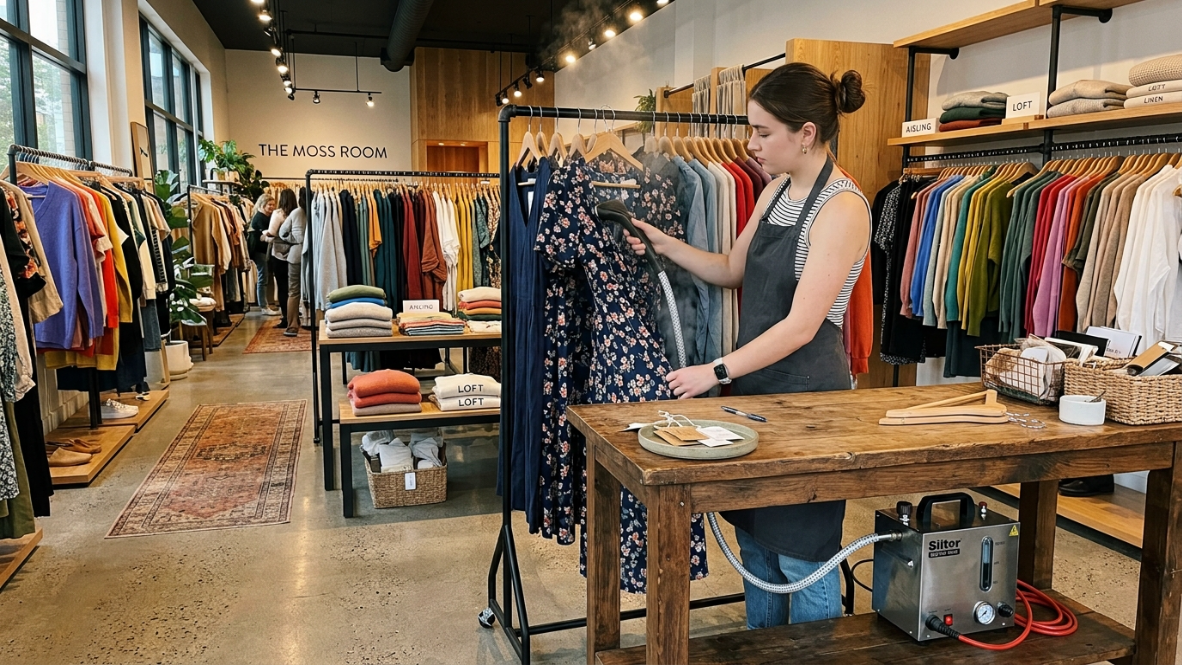
Electric steam boilers are commonly used in businesses where steam demand is moderate and installation simplicity is important.
Industry | Typical Use |
|---|---|
Jewelry stores | Cleaning and polishing |
Hat shops | Hat shaping |
Garment stores | Wrinkle removal |
Dry cleaners | Finishing garments |
Upholstery shops | Fabric steaming |
Museums | Textile preservation |
Taxidermy | Skin preparation |
Laboratories | Small-scale sterilization |
Food processing | Batch steaming |
Medical clinics | Equipment sterilization |
Emissions and Environmental Impact
Electric steam boilers produce zero on-site emissions. No CO₂, no NOx, no particulates, no combustion byproducts of any kind. Gas-fired boilers generate all of these during normal operation.
For businesses in areas with strict air quality regulations, this distinction affects both permitting requirements and ongoing compliance costs. Some municipalities require emissions monitoring and reporting for gas combustion equipment, adding administrative burden.
The full environmental picture is more complex. The overall carbon footprint of an electric boiler depends on how the electricity feeding it was generated. Grid power from coal plants carries a significant carbon load. Power from renewables carries almost none. As the U.S. grid continues shifting toward cleaner generation, the environmental advantage of electric boilers grows stronger over time.
For businesses that prioritize sustainability messaging to their customers, or operate in jurisdictions with aggressive emissions targets, electric boilers offer a cleaner story with fewer compliance headaches.
How to Choose Between an Electric and Gas Steam Boiler
When choosing a commercial steam boiler, ask yourself these questions.
How many hours per day will the boiler operate?
If steam is needed only occasionally throughout the day, electric boilers generally provide lower total ownership costs despite higher electricity prices.
Does your building already have natural gas?
Installing a new commercial gas connection can significantly increase project costs.
Will the boiler be installed in a leased building?
Many landlords prohibit combustion equipment or modifications to venting systems, making electric boilers the easier option.
Do local regulations require emissions permits?
Gas-fired equipment may require additional inspections and permits depending on state and municipal regulations.
What is your available electrical capacity?
Some larger electric boilers require 208V or 480V three-phase power.
Best Hoffman Electric Steam Boiler Models for Different Businesses
The right electric steam boiler depends on your steam volume, operating schedule, and workspace limitations. Hoffman Steam offers several electric boiler options designed for commercial applications ranging from portable retail steaming to continuous industrial use.
Business Type | Recommended Hoffman Model | Best For |
|---|---|---|
Jewelry stores, small boutiques, mobile operations | Hoffman GEM-III | Portable steaming, quick startup, low-volume applications |
Hat shops and garment retailers | Hoffman Pro-Line models | Daily garment finishing and professional steaming |
Dry cleaners and textile businesses | Hoffman RHPG series | Higher steam demand and continuous operation |
Small manufacturing operations | Larger ASME-certified Hoffman boilers | Production environments requiring consistent steam output |
Hoffman GEM-III Portable Electric Steamer
Best for:
Jewelry cleaning
Retail garment steaming
Hat shaping
Small workshops
Advantages:
No gas connection required
Compact footprint
Fast startup
Easy installation
Ideal for businesses without dedicated boiler rooms
Hoffman RHPG Electric Steam Boilers
Best for:
Continuous commercial operation
Higher-volume steaming
Manufacturing applications
Advantages:
Larger steam capacity
ASME-certified construction
Designed for demanding commercial environments
Businesses looking for a broader range of commercial steam boilers should compare capacity, operating pressure, electrical requirements, and automation features before selecting a model.
Which Is Right for Your Business?
After comparing electric steam boiler vs gas across every meaningful dimension, the decision usually comes down to scale, infrastructure, and usage pattern.
Choose electric if:
You run a small or mid-size operation (jewelry store, hat shop, garment boutique, upholstery business, dry cleaner, taxidermy studio)
Your steam demand is intermittent rather than continuous
Your location has no gas access or prohibits combustion equipment
You want minimal installation time and complexity
You lack engineering staff for combustion safety compliance
Low maintenance and long equipment life are priorities
Zero on-site emissions matter to you or your customers
Choose gas if:
You need massive, continuous steam output (large industrial facility)
You have cheap local natural gas and existing gas infrastructure
Your operation runs steam around the clock at high volume
You have dedicated boiler operators and maintenance staff
The per-BTU fuel cost advantage justifies the infrastructure investment
For most small businesses, the practical reality is that electric is not just competitive, it is the clear winner. The fuel cost advantage of gas only materializes at scales far beyond what a retail store, boutique, or small workshop requires.
Hoffman Steam builds electric steam boilers specifically for these small commercial applications, from the $995 GEM-III portable flash steamer to the $9,499 RHPG-36 continuous-duty industrial boiler. Every unit ships with free shipping in the contiguous U.S., a 30-day return policy, and unlimited lifetime remote technical support.
Browse Hoffman’s full product line to find the right electric steam boiler for your business, with transparent pricing and no sales calls required.
Common Mistakes When Buying a Steam Boiler
Many businesses choose the wrong boiler because they focus only on fuel costs.
Common mistakes include:
Ignoring installation costs
Buying more capacity than needed
Forgetting electrical service upgrades
Not checking local permitting requirements
Comparing only purchase price instead of lifetime ownership cost
Assuming gas is always cheaper
Ignoring maintenance expenses
Which Steam Boiler Should Your Business Buy?
The best boiler depends less on fuel type and more on how your business uses steam.
Buy an Electric Steam Boiler If You Own:
Jewelry Store
Recommended:
Hoffman GEM-III or small electric boiler
Why:
Low steam demand
Limited operating hours
Space restrictions
No need for gas infrastructure
Hat Shop
Recommended:
Hoffman Pro-Line
Why:
Frequent steam use
Fast recovery
Compact installation
Garment Boutique
Recommended:
Electric boiler
Why:
Quiet operation
Customer-facing environment
No exhaust or combustion concerns
Dry Cleaner
Recommended:
Larger electric boiler or gas depending on volume
Consider gas if:
Steam operates all day
Multiple presses run simultaneously
Manufacturing Facility
Recommended:
Gas or large electric commercial steam boiler
Gas usually wins when:
Steam demand is continuous
Fuel cost is the primary concern
Frequently Asked Questions
What is the efficiency difference between electric and gas steam boilers?
Electric steam boilers operate at 98-99% thermal efficiency at point of use, converting nearly all input energy into steam. Gas boilers typically achieve 80-85% efficiency, with modern condensing models reaching 90-95%. The gap exists because combustion inherently wastes energy through exhaust gases and radiant heat loss.
Are electric steam boilers more expensive to run than gas?
On a per-BTU basis, electricity costs roughly 3.5 times more than natural gas in the U.S. However, total operating cost includes installation, maintenance, permits, and standby losses. For small businesses with intermittent steam needs, electric boilers often cost less overall because they eliminate gas line installation, combustion maintenance, and standby fuel waste.
Do electric steam boilers need a gas line?
No. Electric steam boilers connect to electrical power only. They require no gas line, no flue, no chimney, and no combustion air supply. This makes them suitable for locations where gas infrastructure is unavailable or prohibited.
Do electric boilers require ASME certification?
Pressurized electric steam boilers must meet ASME boiler and pressure vessel codes, which all 50 U.S. states have adopted. However, non-pressurized flash steamers (like the Hoffman GEM-III) may be exempt from boiler permit requirements depending on local jurisdiction. The key distinction is operating pressure, not energy source.
Can I use an electric steam boiler in a mall or retail store?
Yes. Electric steam boilers are commonly used in mall and retail environments because they produce no combustion byproducts and require no venting. Many mall lease agreements prohibit gas-fired equipment entirely, making electric the only option. Portable electric steamers that require no boiler permits are particularly popular for these settings.
How long do electric steam boilers last compared to gas?
Electric steam boilers typically last 15-25 years, while gas boilers last 10-15 years. Electric units benefit from having fewer components subject to wear. Without burners, flue systems, or combustion-related parts, there are simply fewer things that degrade over time.
What size electric steam boiler does a small business need?
It depends on your application and how many steam tools you run simultaneously. A jewelry store might need a 1-2 gallon boiler, while a hat shop or garment finishing operation might require a 6-gallon unit. Understanding the basics of steam boiler sizing will help you match capacity to your actual demand.
Is an electric steam boiler safer than gas?
Electric boilers eliminate all combustion-related hazards: no gas leaks, no carbon monoxide risk, no open flame. Both types carry pressure-related risks that require proper safety controls and certification. But removing combustion from the equation simplifies safety compliance significantly, especially for businesses without dedicated boiler operators.


