

TL;DR
For high pressure steam car interior cleaning at commercial volume, consumer and prosumer steamers fall short. They lose pressure after a minute of continuous use, require cooldown between refills, and carry no safety certifications. Professional detailing and reconditioning shops need sustained 65+ PSI output, continuous-duty operation, and (increasingly) ASME/UL compliance documentation for insurance and building code requirements. Commercial electric boilers built for all-day use, like Hoffman Steam’s 70-90 PSI lineup, solve these problems by design. If your shop cleans two cars a day or more, consumer-tier steamers are already costing you money in downtime and inconsistent results.
What Is the Best High Pressure Steam Cleaner for Car Interiors?
For commercial car interior detailing, the best high-pressure steam cleaner is one that delivers at least 65 PSI sustained pressure, supports continuous-duty operation, and maintains consistent heat output throughout the workday.
Professional detailing shops typically prioritize:
– Sustained pressure rather than peak advertised PSI
– Continuous-fill operation to eliminate downtime
– Commercial-grade construction
– Safety certifications for business compliance
– Long-term reliability and serviceability
For occasional use, consumer steamers may be sufficient. For shops cleaning multiple vehicles daily, commercial electric boilers and continuous-fill steam systems generally provide better productivity, lower downtime, and lower long-term operating costs.
Quick Recommendation by Volume
Shop Volume | Recommended Equipment Type |
|---|---|
1-2 cars/day | Prosumer steam cleaner |
3-5 cars/day | Commercial manual-fill boiler |
5-10 cars/day | Commercial auto-fill boiler |
10+ cars/day | Continuous-duty industrial boiler |
Commercial Steam Equipment at a Glance
Consideration | Consumer/Prosumer Steamers | Commercial Electric Boilers (Hoffman) |
|---|---|---|
Sustained PSI | 30-58 (drops under continuous use) | 70-90 PSI sustained |
Runtime | 30-120 min, then cooldown | Continuous-duty (RHPG series, auto pump-fill) |
Certification | None | ASME and UL certified (Pro line and above) |
Warranty | 2 years typical | 3-year tank, 1-year components, lifetime remote tech support |
Refill | Batch fill, 15-20 min downtime | Manual or automatic pump-fill depending on model |
Price Range | $112-$1,949 | $1,199-$9,499 |
Built For | Occasional or light-duty use | All-day commercial operation |
Manufacturing | Overseas | Made in USA (Dushore, Pennsylvania) |
For shops needing continuous-duty, certified steam equipment, explore Hoffman’s commercial lineup built for all-day operation at sustained high pressure.
Why PSI Matters More Than Temperature for Car Interiors
Most steam cleaner marketing focuses on temperature. For commercial car interior work, that’s the wrong priority.
Steam cools rapidly as it travels from the nozzle tip to the cleaning surface. Higher PSI doesn’t mean you’re blasting harder. It means the steam maintains its effective temperature over a greater distance, so it’s still hot enough to break down grime when it contacts the surface. A unit rated at 275°F but delivering only 30 PSI produces lukewarm mist by the time it reaches a door panel six inches away.
Professional detailing sources recommend sustaining 55-75 PSI with boiler temperatures of 290-320°F and nozzle-tip delivery of 240-280°F for production-level car interior work. That sustained output is exactly what separates commercial boilers from consumer steamers.
Here’s the number that matters: practitioners on Reddit and AutoGeek forums report that many consumer models drop to roughly 50% of their advertised pressure after just one minute of continuous use. A consumer steamer rated at 58 PSI that drops to 29 PSI under load is functionally useless for commercial throughput.
Understanding how much PSI matters for commercial work is the first step in choosing equipment that won’t bottleneck your operation.
Why Consumer Steamers Fail in Commercial Environments
Shop owners sometimes start with consumer or prosumer steamers because the upfront cost looks attractive. It rarely works out. Here’s what actually happens in production use.
Pressure drop under load. Consumer models like the McCulloch MC1385 (58 PSI advertised) or the Dupray Neat (50 PSI) deliver reasonable pressure for the first minute. Under continuous use, pressure drops significantly. For a hobbyist cleaning one car on a Saturday, that’s tolerable. For a shop running four or five interiors a day, it means inconsistent results and wasted labor time.
Refill downtime kills productivity. Batch-fill consumer steamers require a full cooldown before refilling, typically 15-20 minutes. A Dupray Tosca owner on the Autopia forum noted that real-world runtime is only 30-40 minutes before a refill cycle that eats 15-20 minutes. Over a full workday of interior details, that adds up to more than an hour of dead time. One practitioner upgrading to a continuous-fill system explained that “zero downtime while in use pays for itself in more efficient labor.”
No safety certifications. No consumer or prosumer steamer carries ASME or UL certification. For shops operating under commercial leases, carrying business insurance, or navigating building code inspections, this creates a compliance gap. More landlords and insurers are asking for documentation on pressurized equipment, and consumer steamers simply don’t have it.
Short service life under commercial use. Equipment designed for occasional household cleaning wears out fast when run 6-8 hours daily. Forum practitioners running prosumer units in commercial settings report hose replacements and heating element failures within 12-18 months, at which point the “savings” from buying cheaper equipment have evaporated.
Even mid-range commercial detailing steamers like the Vapor Systems VX5000 ($795, 65 PSI) or the Dupray Tosca ($996, 72.5 PSI) hit ceilings quickly. The VX5000 still uses batch fill. The Tosca draws criticism for customer service issues. One forum user stated plainly: “While I love the machine, their customer service is terrible.”
Higher-end options like the Fortador Volt Mini ($1,949, 100 PSI) and the Optima Steamer ($5,600-7,200+) solve some pressure and runtime problems but introduce others, from external water bucket setups to diesel noise and inconsistent tech support. One Autopia forum member shared a candid owner experience of the Optima: “$7,200 OTD. There’s a few bugs.”
The pattern is consistent: consumer and prosumer steamers cost less upfront but cost more in downtime, repairs, and replacement cycles. Commercial electric boilers cost more initially but are built for the duty cycle a professional shop actually demands.
Steam vs. Carpet Extractor: Know This Before You Invest
This is the single biggest point of confusion in car interior cleaning, and it directly affects equipment purchasing decisions for commercial shops.
Steam cleaning and carpet extraction are different tools for different jobs. Steam excels at sanitization and hard-surface detail work: vents, cup holders, leather seats, door panels, console crevices. It melts grime and kills bacteria. But steam pushes moisture around. It does not vacuum it up.
For deep-seated stains in carpet and cloth upholstery, you need a carpet extractor, which combines water injection with vacuum suction to pull contaminants out of fabric fibers. One production detailer explained it plainly: an extractor at 58 PSI cleans and dry-vacuums in one pass, completing a car interior in 20-30 minutes. Steam would take 45-60 minutes on the same car plus a separate wipe-down.
The best-equipped shops pair both tools. Steam handles hard surfaces and sanitization. An extractor handles deep fabric cleaning. If a salesperson tells you a steam cleaner alone will remove a coffee stain from beige carpet, look elsewhere. For a deeper breakdown, see the steamer vs. carpet extractor comparison.
High Pressure Steam Cleaner vs Hot Water Extractor vs Tornador
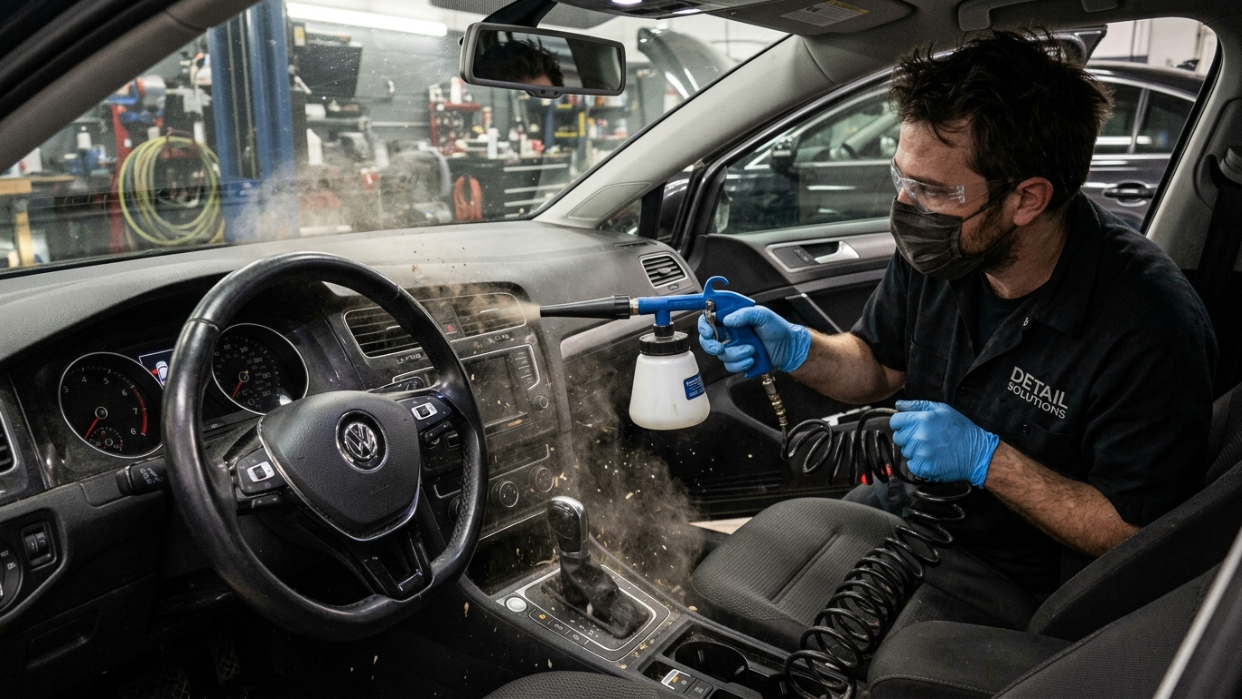
Many detailers compare steam cleaners against extractors, but a third tool often enters the conversation: the Tornador air cleaning system.
Feature | Steam Cleaner | Carpet Extractor | Tornador |
|---|---|---|---|
Sanitizes surfaces | Yes | Limited | No |
Removes deep carpet stains | Limited | Excellent | Limited |
Cleans vents and crevices | Excellent | Poor | Excellent |
Uses chemicals | Minimal | Often required | Often required |
Moisture left behind | Low | Moderate | Low |
Upholstery recovery | Moderate | Excellent | Moderate |
Drying time | Fast | Moderate | Fast |
Which Tool Produces the Best Results?
Professional detailing shops often use all three tools together:
Tornador for debris removal
Steam for sanitization and grime breakdown
Extractor for deep fabric cleaning
Using the right tool for each task improves efficiency and customer results.
What High-Pressure Steam Actually Cleans in a Car Interior
Knowing where steam excels (and where it doesn’t) determines whether the equipment investment makes sense for your shop’s service menu.
Where steam dominates:
Air vents and HVAC openings. Steam penetrates the narrow slats that brushes and wipes can’t reach, loosening dust and killing bacteria that cause musty odors. This is a high-value upsell for reconditioning and used-car prep.
Cup holders and console crevices. Sticky residue from drinks melts instantly under high-pressure steam. A quick wipe with a microfiber cloth finishes the job.
Leather seats. Steam lifts embedded dirt from leather pores without the chemical residue that spray cleaners leave behind. For shops offering leather reconditioning services, this capability pays for itself quickly.
Door panels and hard trim. Textured plastic panels trap grime in their grain pattern. Steam at 60+ PSI forces it out where a brush alone would just push it around.
Floor mats. Steam sanitizes rubber and all-weather mats effectively. For fabric mats with deep stains, pair steam with an extractor for best results.
Where steam falls short:
Carpet stains. Coffee, juice, pet accidents. Steam will sanitize and loosen the surface layer, but it won’t extract the liquid contamination embedded deep in carpet fibers. That’s extractor territory. Understanding the difference between steamers and extractors is essential before committing to equipment.
Does Steam Actually Sanitize Car Interiors?
One of the biggest advantages of steam cleaning is its ability to reduce bacteria, mold spores, and odor-causing contaminants without relying heavily on chemical cleaners.
Steam is commonly used on:
Steering wheels
Door handles
Gear shifters
Center consoles
Child car seats
Seat belts
HVAC vents
What Steam Cannot Do
Steam sanitizes surfaces but does not:
Permanently prevent bacteria growth
Remove deeply embedded biological contamination
Replace professional mold remediation
For heavily contaminated vehicles, steam should be part of a larger restoration process rather than the only cleaning method.
What High-Pressure Steam Can Damage (Real Warnings from Production Shops)
The risks of high pressure steam car interior work are underreported. Here’s what shop operators and professional detailers have learned the hard way.
Leather and vinyl adhesive failure. When steam contacts leather and vinyl surfaces, heat and moisture penetrate through to the adhesive layer underneath. Most automotive adhesives tolerate some heat, but not the intense, prolonged exposure that comes from parking a steam nozzle in one spot. Train your technicians to keep the nozzle moving at all times.
Cloth seat fiber melting. One detailer on a popular forum shared this cautionary tale: “The first time I used a steam cleaner, I left the round brush on a cloth seat for just a little too long and it melted the fibers and left a circle impression on the face of the seat.” This is not a fringe risk. It happens to untrained technicians regularly. Shops running multiple techs need clear protocols.
Window seals and rubber trim. Multiple practitioners warn against steaming window sills and rubber seals. The moisture gets trapped inside door panels, causing windows to streak and fog for the rest of the detail. One experienced detailer put it bluntly: “Don’t steam the window sills/rubber seals! You’ll screw up your windows for that detail.”
Headliners. The professional community is genuinely split on this. Headliner fabric is glued to the roof panel, and too much heat or agitation can loosen that adhesive. Some detailers avoid headliners entirely with steam. Others swear by a careful technique using steam, all-purpose cleaner, and microfiber towels, reporting great results across hundreds of vehicles. The difference comes down to training, pressure control, and knowing when to stop.
Electronics and infotainment screens. High-pressure steam near touchscreens, button clusters, and exposed wiring is a gamble. Moisture intrusion into electronic components causes intermittent failures that may not appear until days later. Mask off electronics or use a lower-pressure attachment.
These risks apply regardless of equipment quality. Learning how to avoid common steaming mistakes transfers directly from upholstery work to automotive interiors, and investing in proper training protects your shop from costly claims.
Hoffman Steam’s Commercial Boiler Lineup for Interior Work
Hoffman Steam builds commercial electric boilers in Dushore, Pennsylvania, for small businesses and light industrial operations. While the product line serves garment finishing, upholstery restoration, jewelry cleaning, and other trade applications, the same sustained high-pressure output makes these boilers a strong fit for professional auto detailing and reconditioning shops, particularly those running multiple services.
Entry-Level: EVD-1 ($1,199)
The EVD-1 is a 1-gallon, 110V boiler producing 40 PSI. It ships with a steam nozzle, foot pedal, and fill funnel. At 40 PSI, it handles lighter interior cleaning tasks like vent sanitization and leather surface work. It’s compatible with steam irons, brushes, and spray guns, making it a viable starting point for shops adding steam to their service menu without major upfront investment.
Mid-Range: JEL3 / JEL3S ($1,999-$2,599)
The JEL3 is a 2-gallon manual-fill boiler with an optional 220V/3kW upgrade. The JEL3S variant adds an electronic spray gun for combined steam-and-spray applications, useful for interior reconditioning where chemical application and steam cleaning happen in sequence. ASME/UL certified, these models meet compliance requirements that consumer steamers simply cannot.
For shops evaluating whether a commercial boiler or a flash steamer better fits their workflow, the fundamental design differences are worth understanding before purchasing.
Professional: ELG4 ($1,899-$2,099)
The ELG4 is an ASME/UL certified entry-level boiler with manual fill and 1.5kW heating. Optional upgrades include a steam wand, equipment cart, and 220V/3kW power. This model bridges the gap between portable steamers and heavy-duty boilers for shops that need certified equipment but don’t yet require continuous-duty capacity.
Large Capacity: JEL11 Series ($4,495-$7,895)
The JEL11M is a 6-gallon manual-fill boiler available in 220V single or three-phase configurations. The JEL11M-S adds a spray wand. The JEL11 upgrades to an automatic pump system, eliminating manual refills entirely. For shops running interior details alongside upholstery or reconditioning work throughout the day, the 6-gallon capacity dramatically reduces interruptions.
Industrial: RHPG Series ($6,999-$9,499)
The RHPG series is built for continuous-duty operation with automatic pump-fill systems. The RHPG-17 ($6,999), RHPG-24 ($7,999), and RHPG-36 ($9,499) scale in power and capacity across the range. These are the models for high-volume shops where steam equipment runs all day across multiple service bays or applications. The automatic pump-fill design means zero downtime, the single biggest operational advantage over every consumer and most commercial detailing-specific steamers on the market.
Upholstery Shop Bundle ($2,329)
Hoffman offers a purpose-built bundle for upholstery shops that includes relevant accessories and attachments. For shops handling both automotive upholstery and interior detailing, this bundle provides a ready-to-work setup without sourcing components separately.
Why ASME/UL Certification Matters for Your Shop
No consumer steamer carries ASME or UL certification. For commercial operations, these certifications verify that a boiler meets specific safety and construction standards. They’re increasingly relevant as commercial landlords and insurance providers tighten compliance requirements for pressurized equipment. Hoffman’s Pro line and above carry both certifications, with documentation available for inspections and insurance submissions.
Warranty and Support
Hoffman provides a 3-year tank warranty, 1-year component warranty, and unlimited lifetime remote technical support. The 30-day money-back return policy functions as a practical equipment trial. The Workhorse Protection Program ($216-$280/year) adds automatic consumable shipments, factory reconditioning, loaner machines, and VIP support, addressing the maintenance burden that often catches small shop owners off guard.
Reddit’s r/jewelers and r/BenchJewelers communities include users who report decades of service life from Hoffman equipment. One user mentioned running two Hoffman steamers over 30 years, with the first lasting 24 years. That kind of longevity changes the cost-of-ownership math entirely.
Request a virtual demo from Hoffman Steam to see how commercial boiler performance compares to the consumer detailing steamers your shop may be outgrowing.
The Continuous-Fill Factor: Why It Drives the Buying Decision
One spec that doesn’t get enough attention in steam equipment comparisons is whether the unit supports continuous refill or requires a full cooldown between tanks.
For a shop doing one or two cars a day, batch fill with manual refill is workable. The tank lasts long enough per vehicle, and the downtime between cars may overlap with other prep tasks.
For production environments, the math changes fast. When each refill cycle costs 15-20 minutes of dead time, and your shop is running 4-5 interiors in a day, that’s over an hour of lost productivity, lost revenue, and idle labor cost.
Hoffman Steam’s RHPG series industrial boilers feature automatic pump-fill systems designed for exactly this scenario. They run continuous-duty without cooldown, which is the fundamental operational difference between consumer steamers and commercial boiler systems. For shops running multiple services throughout a full workday (interior details plus upholstery, reconditioning, or garment finishing), that distinction drives the buying decision.
Compare manual-fill vs. auto-fill boilers to understand which design fits your shop’s workflow.
Total Cost of Ownership: The Real Equipment Decision
Purchase price is just the starting point. Here’s what shop owners should factor into the real cost of a high pressure steam car interior setup.
Distilled water. At roughly $1 per gallon and 1-2 gallons per vehicle, this adds $20-60 per month for a busy shop. Not huge, but not zero.
Descaling and maintenance. Consumer units without accessible boiler drains become clogged with mineral deposits over time (even with distilled water, trace minerals accumulate). Commercial boilers with drain valves and maintenance access last dramatically longer. Hoffman’s Workhorse Protection Program includes factory reconditioning every 24 months, a 47-point inspection, parts and labor coverage, and ASME/UL recertification, covering maintenance costs that would otherwise be unpredictable.
Replacement parts. Hoses, gaskets, and nozzle tips wear out. Hoffman offers a 20% parts discount through its protection plans and maintains factory stock for all current and legacy models.
Chemical savings. Steam reduces or eliminates the need for multiple interior cleaning products. For shops spending $200-400 per month on interior chemicals, a quality commercial steamer can offset $150-300 of that monthly.
Revenue upside. Adding a premium interior sanitization service with steam allows shops to charge $50-150 more per vehicle. Across 20-30 cars per month, that’s $1,000-4,500 in additional monthly revenue from a single equipment investment, often covering the cost of a mid-range Hoffman boiler within a few months.
Equipment lifespan. Consumer steamers typically last 1-3 years under commercial use. Hoffman boilers, backed by ASME/UL construction standards and factory maintenance programs, routinely last a decade or more. The per-year cost difference is substantial.
Financing. Hoffman offers financing options including 0% APR promotions, which smooth the cash flow impact for small businesses. Consumer steamers don’t offer commercial financing.
Understanding proper maintenance practices protects your investment regardless of which model you choose.
Typical Annual Operating Costs
Expense Category | Consumer Steamer | Commercial Boiler |
|---|---|---|
Distilled Water | $240-$720 | $240-$720 |
Replacement Hoses | $50-$200 | $50-$150 |
Repairs | $100-$500 | $50-$300 |
Downtime Cost | High | Low |
Replacement Cycle | 1-3 Years | 10+ Years |
Pro Techniques from Production Detailers
These recommendations come from practitioners on Reddit, AutoGeek, and Autopia who run interior details at commercial volume.
Always vacuum first. Steam loosens dirt, but if the surface is covered in loose debris, you’re just making mud. A thorough vacuum pass before steaming cuts total time per vehicle and improves results dramatically.
Use distilled water only. Tap water contains minerals that deposit inside the boiler during the heating process, eventually making the unit inoperable. This isn’t optional. Every manufacturer recommends distilled water, and ignoring this will void your warranty and shorten your equipment’s life.
Wrap triangle attachments with microfiber. This gives you simultaneous steam application and wiping action. The microfiber catches the loosened grime immediately, preventing it from resettling on the surface. For shops running multiple technicians, standardizing this technique ensures consistent output quality.
Keep the nozzle moving. Never park the steam head in one spot. Two to three seconds of contact is sufficient for most surfaces. Lingering causes adhesive failure, fiber melting, and moisture saturation.
Condition leather immediately after steaming. Steam opens leather pores and strips natural oils. If you don’t apply conditioner right after cleaning, the leather will dry out and crack faster than if you’d never cleaned it at all.
Budget 60-90 minutes per sedan. A standard sedan takes about an hour for a full high pressure steam car interior detail. Heavily soiled vehicles can push that to two hours. Plan your scheduling accordingly, especially if your steamer needs refill downtime between vehicles.
How Much Pressure Do You Really Need for Car Interior Detailing?
Many buyers assume higher PSI automatically means better cleaning. In reality, the ideal pressure depends on the surface being cleaned.
Surface | Recommended PSI |
|---|---|
Leather seats | 40-60 PSI |
Plastic trim | 50-70 PSI |
Air vents | 60-90 PSI |
Rubber floor mats | 60-90 PSI |
Upholstery | 40-65 PSI |
Heavy grime buildup | 70+ PSI |
Is 100 PSI Too Much?
Not necessarily. High-pressure steam systems can be effective when paired with proper technique and attachments. The key is controlling exposure time and keeping the nozzle moving to avoid heat damage.
Choosing the Right Hoffman Model for Your Shop
The right model depends on your daily volume, service mix, and power availability.
Adding steam to an existing service menu (1-3 cars per day): The EVD-1 at $1,199 or the JEL3 at $1,999 provides a certified, commercial-grade entry point. These manual-fill models handle the duty cycle of a small shop adding interior steam cleaning to their offerings. The JEL3S ($2,399-$2,599) adds a spray gun for combined steam-and-chemical work.
Dedicated interior detailing or reconditioning (4-8 cars per day): The JEL11 series ($4,495-$7,895) offers 6-gallon capacity with the option for automatic pump-fill. At this volume, refill downtime from smaller boilers starts eating into your daily revenue. The automatic pump system on the JEL11 eliminates that bottleneck entirely.
Multi-service commercial operation (full-day continuous use): The RHPG series ($6,999-$9,499) is built for shops where steam runs all day, whether for vehicle interiors, upholstery restoration, reconditioning, or other applications. Automatic pump-fill, continuous-duty construction, and the highest pressure output in Hoffman’s lineup (70-90 PSI sustained) make these the workhorses for serious commercial operations.
Multi-use shops (detailing + upholstery + garment finishing): Hoffman’s equipment serves multiple trade applications from a single boiler. A shop running interior details in the morning and upholstery restoration in the afternoon gets full utilization from one piece of equipment, something detailing-specific steamers can’t offer.
The commercial steam equipment guide explains how boiler types differ and which applications each design handles best.
All Hoffman models ship with free delivery within the contiguous United States, transparent published pricing, and a 30-day return policy. Request a virtual demo to evaluate the right fit for your shop before committing.
Frequently Asked Questions
What PSI do I need for commercial high pressure steam car interior cleaning?
For production-level car interior work, look for a minimum of 55 PSI sustained output. Professional detailers recommend 65-90 PSI for consistent results at commercial throughput, with boiler temperatures reaching 290-320°F. Consumer models that advertise 50+ PSI but can’t sustain it during continuous use will bottleneck your operation.
Can high pressure steam damage car interior surfaces?
Yes. Holding the steam nozzle in one spot too long can melt cloth seat fibers, loosen adhesive under leather and vinyl, and damage rubber window seals. Electronics and infotainment screens are also vulnerable to moisture intrusion. Proper technician training on technique (keeping the nozzle moving, understanding material tolerances) is essential for any shop offering steam cleaning services. See our guide on avoiding common steaming mistakes.
Do I need a steam cleaner or a carpet extractor for car interiors?
Both, ideally. Steam excels at sanitizing hard surfaces like vents, cup holders, leather, and door panels. Carpet extractors are better for deep fabric stains because they inject water and vacuum it back out in one pass. Steam alone won’t remove a deep carpet stain. Most production shops use both tools. Read the full steamer vs. carpet extractor comparison.
Why does ASME/UL certification matter for a shop steamer?
ASME (American Society of Mechanical Engineers) and UL (Underwriters Laboratories) certifications verify that a boiler meets specific safety and construction standards. For commercial operations, these certifications may be required by building codes, insurance providers, or landlords. No consumer or prosumer steam cleaner carries these certifications. Hoffman’s Pro line and above are ASME/UL certified with documentation available for compliance purposes.
Why do steam cleaners require distilled water?
Tap water contains minerals that deposit inside the boiler as water converts to steam. Over time, these mineral deposits restrict water flow and damage heating elements, eventually making the unit inoperable. Using distilled water is a universal manufacturer requirement, not a suggestion. Proper maintenance practices extend equipment life significantly.
How long does it take to steam clean a car interior?
A standard sedan takes 60-90 minutes for a full high pressure steam car interior detail. Heavily soiled vehicles can take up to 2 hours. This time estimate assumes vacuuming first and does not include carpet extraction for deep stains. Plan scheduling accordingly, and factor in whether your equipment supports continuous operation or requires refill downtime.
Is continuous refill important for a commercial detailing steamer?
For shops doing more than 2-3 interiors per day, absolutely. Batch-fill steamers require 15-20 minutes of cooldown and reheat between fills. If your steamer only runs 30-50 minutes per fill and you’re doing multiple cars daily, that downtime adds up to over an hour of lost productivity. Hoffman’s RHPG series and the JEL11 with automatic pump-fill eliminate this bottleneck entirely. Compare manual-fill vs. auto-fill boilers.
Can I use a Hoffman boiler for applications beyond car interiors?
Yes. Hoffman’s commercial electric boilers serve garment finishing, upholstery restoration, jewelry cleaning, hat shaping, shrink packaging, and other trade applications. For multi-service shops, a single boiler can handle interior detailing, upholstery work, and other steam-based services, maximizing equipment utilization across your full service menu.


