

Getting that perfect, sparkling finish on a piece of jewelry isn’t just about skill, it’s about having the right tools. A professional steam cleaner is a jeweler’s best friend for blasting away polishing compounds, grime, and oils. But to get those brilliant results safely, you need to understand one of the most important factors: your jewelry steamer psi settings.
Quick Summary: Recommended Jewelry Steamer PSI
What is the best PSI for jewelry steaming?
For professional jewelry cleaning, the ideal pressure is 50 to 65 PSI. This range provides a “dry” steam at approximately 155°C (311°F), which effectively removes polishing compounds and oils without the risk of stone displacement or thermal shock common at higher pressures.
Cleaning Task | Recommended PSI | Steam Quality |
Delicate/Daily Clean | 40 – 50 PSI | Gentle, wet steam |
Professional/Standard | 50 – 65 PSI | Optimal dry vapor |
Heavy Polishing Removal | 70 – 80 PSI | High-heat, high-force |
PSI, or pounds per square inch, determines the power, temperature, and dryness of the steam. While the ideal pressure can vary, most jewelers find the sweet spot for general cleaning to be between 50 and 65 PSI. This range is powerful enough to get a deep clean without risking damage to delicate pieces. Let’s break down what those numbers on your gauge mean so you can master your jewelry steamer psi settings for any task. If you’re new to bar vs. PSI and other jargon, see Top 10 Steamer Terms Explained.
Understanding the “Sweet Spot”: Typical Pressure Ranges
Most commercial steam cleaners, including those perfect for a jewelry workshop, operate within a typical range. In more familiar terms, that’s approximately 58 to 102 PSI. This is a critical concept for ideal jewelry steamer psi settings because it offers a fantastic balance of high temperature cleaning power and manageable safety.
At the lower end (around 4 bar or 58 PSI), the steam is hot enough (about 152°C)), to effectively sanitize and remove grease without being overly aggressive.
At the higher end (around 7 bar or 102 PSI), the temperature climbs to about 170.5°C, providing the power needed for heavy duty industrial tasks.
For a jeweler, having a machine that operates comfortably within this range gives you the versatility to handle everything from routine cleaning to tackling tough, built up grime.
Nominal Operating Pressure: The Number That Really Matters
You might see a “max PSI” advertised, but the more important figure is the nominal operating pressure. Think of this as the steady, sustainable pressure your machine maintains during continuous use. A steamer with a nominal operating pressure of 65 PSI, for example, is designed to consistently deliver steam at that level.
Why is this so important for your jewelry steamer psi settings? At 65 PSI (around 4.5 bar), steam reaches a temperature of approximately 155°C or 311°F. This creates a very “dry” vapor. For jewelers, this is perfect because it cleans thoroughly without soaking surfaces or leaving behind water spots. A reliable machine that holds its operating pressure ensures you get consistent, professional results every time—for example, a pro shop boiler like the Hoffman Pro JEL3. In fact, some industry leading steamer models have operated at 60–70 PSI as far back as 1980, proving its effectiveness.
How Your Steamer Maintains Pressure: The Control Range (70 to 80 psig)
So how does a machine stay around its nominal pressure? It uses a pressure control range. A common range, for instance, is 0–85 PSI. This means the steamer’s internal pressure switch will cycle the heating element on and off to keep the pressure within that window.
It works like this: the boiler heats up until the pressure hits the upper limit (80 PSI), then the heater cuts off. As you use the steam, the pressure drops. Once it hits the lower limit (70 psig), the heater kicks back on to build pressure again. This cycling ensures the machine provides powerful steam without constantly running at its absolute peak, which reduces strain on its components. Having an adjustable control range gives you the ultimate flexibility with your jewelry steamer psi settings, allowing you to dial the power up or down for different jobs. Models like the ELG4 include adjustable thermostatic controls to fine-tune output.
The Professional Setting: What 80 PSI is For
When you see a “professional steamer” advertised with an 80 PSI setting, it signifies a very powerful machine built for demanding applications, representing the higher end of jewelry steamer psi settings. At 80 PSI (about 5.5 bar), steam is extremely hot, reaching around 162°C or 324°F.
This level of power is excellent for tasks that require deep, penetrating steam, like shaping thick felt hats (see the JEL11M Hat Shaper Bundle) or blasting grease off industrial parts. While it’s more power than you’d need for a delicate diamond ring, having a machine capable of reaching 80 PSI means it’s built to commercial standards with a robust tank and safety features. High-end electric boilers like the Hoffman Pro RHPG-17 (70 to 90 PSI) ensure professional users always have plenty of power on tap.
Pressure Safety by Gemstone Type
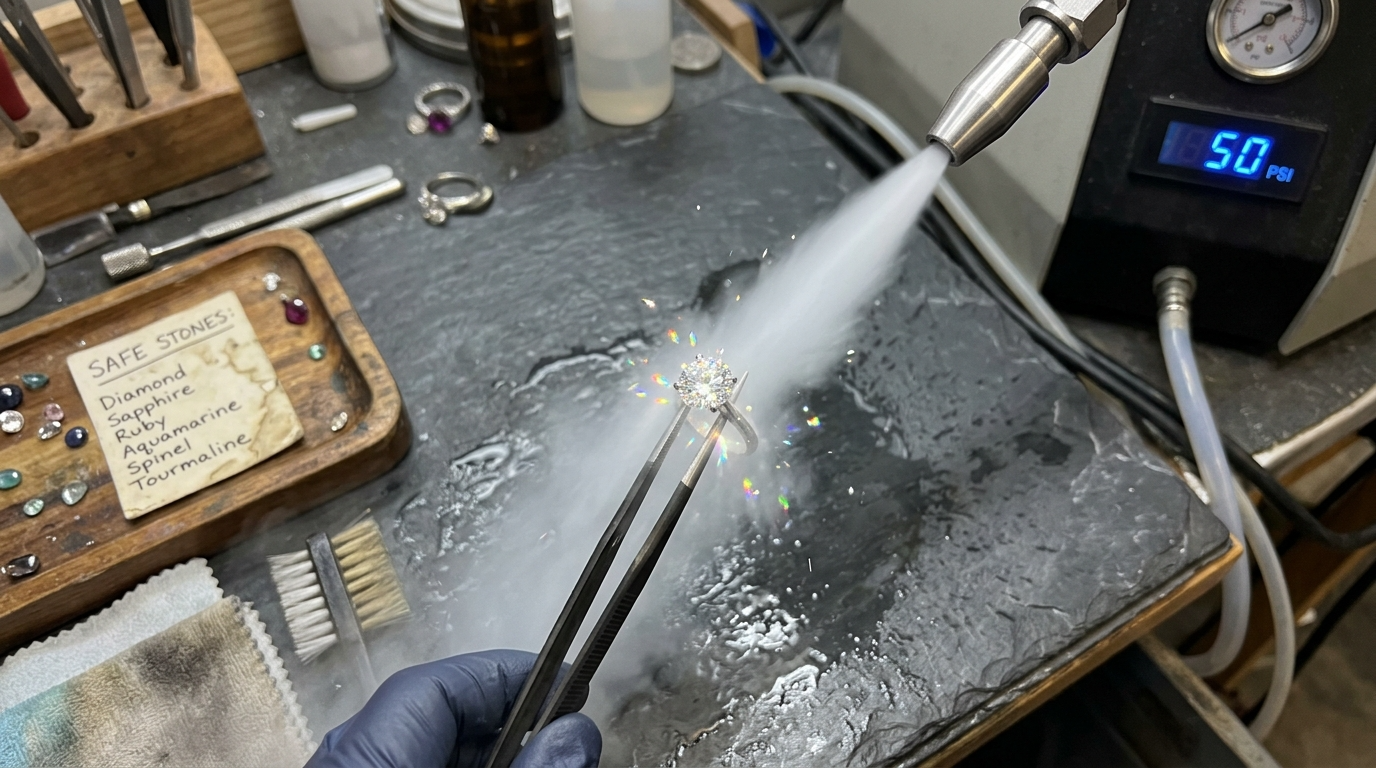
Not all jewelry can handle high-pressure steam. Use this guide to adjust your settings based on the material:
Hard Stones (Diamonds, Sapphires, Rubies): Can safely handle 60+ PSI, provided there are no significant inclusions.
Porous/Organic (Pearls, Opals, Turquoise): DO NOT STEAM. These are heat and pressure-sensitive; use ultrasonic or manual cleaning instead.
Treated Stones: Use caution. High PSI can strip “oiled” treatments from emeralds or coatings from topaz.
Filigree & Pavé Settings: Stick to 40 – 50 PSI to prevent dislodging small stones from their prongs.
Safety and Best Practices for Your Steamer
Understanding the numbers is only half the battle. Using your steamer correctly and safely is crucial for getting great results and ensuring your equipment lasts.
Always Verify the Pressure Gauge Before Cleaning
Checking your pressure gauge before you start working is a simple habit that impacts both performance and safety when managing your jewelry steamer psi settings.
For Performance: Using a steamer before it has reached its target pressure can cause it to spit hot water instead of producing a steady, dry steam. This can soak the piece you are working on and is far less effective for cleaning. Wait for the gauge to reach its recommended operating pressure (for example, 4 bar or 58 PSI) to ensure you are working with stable, dry vapor.
For Safety: The pressure gauge is your most important safety indicator. Never attempt to open the boiler’s fill cap or perform maintenance until the gauge reads exactly zero. Opening a system under pressure can cause a dangerous eruption of scalding steam.
Troubleshooting: A Pressure Drop During Use
If you notice your steam pressure dropping while you work, the most common culprit is low water. Steam is just boiled water, so if the tank is running empty, the machine can no longer produce enough vapor to maintain pressure.
Many commercial steamers have a low water cutoff sensor that automatically shuts off the heater to prevent the boiler from running dry and overheating. If you see the pressure falling, it’s a sign that it’s time to safely depressurize the unit and refill the tank. For businesses that can’t afford downtime, some industrial models like Hoffman Steam’s RHPG series offer continuous-feed pumps that automatically refill the boiler, keeping pressure rock steady all day long. For example, the Hoffman Pro JEL11 includes an automatic water pump for continuous operation.
How to Calibrate Your Steamer PSI for Cleaning
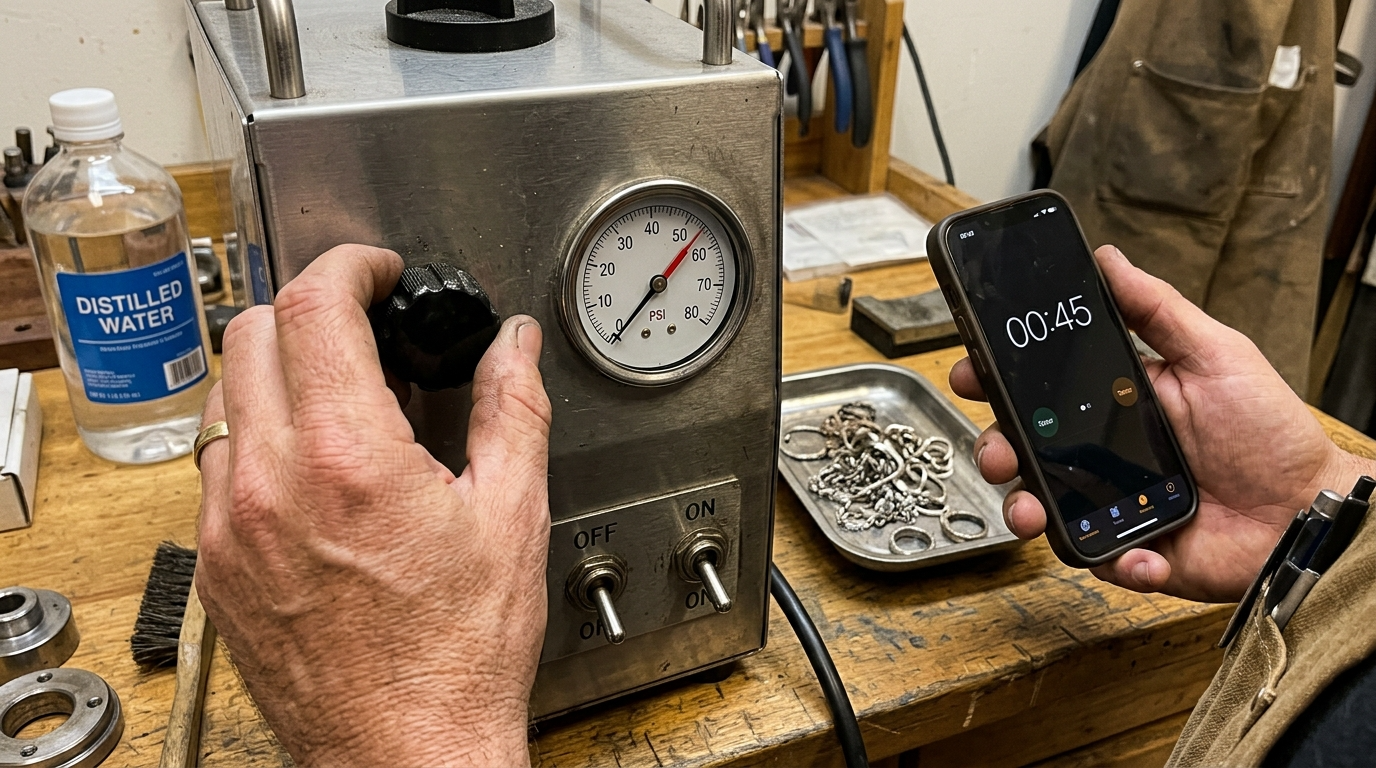
Fill and Seal: Ensure the boiler is filled with distilled water and the cap is finger-tight.
Preheat Cycle: Switch the unit on and wait for the gauge to hit the 60 PSI mark (usually 15–20 minutes).
The “Purge” Blast: Point the nozzle into a sink and tap the foot pedal for 2 seconds to clear condensed water.
Check the Vapor: Ensure the steam is invisible near the nozzle (dry steam) rather than a wet white mist.
Adjust Output: Use the pressure regulator to dial down to 45 PSI for delicate prongs or up to 65 PSI for heavy grease.
Frequently Asked Questions About Jewelry Steamer PSI Settings
What is the best PSI for a jewelry steamer?
A good range for general jewelry cleaning is 40–50 psi. This provides enough power to remove polishing compounds and grime without being too aggressive for most gemstones and metals.
Can high PSI damage my jewelry?
Yes, extremely high pressure can potentially damage delicate settings or soft stones. It’s best to start with a lower pressure setting and increase it only if necessary. Never use high pressure steam on porous gems like pearls, opals, or emeralds.
Why is my jewelry steamer spitting water?
Spitting water is usually caused by using the steamer before it has fully heated up and reached its operating pressure. Always check the pressure gauge to confirm the machine is ready before you begin cleaning.
How do I know what my jewelry steamer psi settings should be?
Start with your steamer manufacturer’s recommended setting, often around 4 bar or 58 PSI. For routine cleaning, a moderate pressure of 50 PSI is effective. For tougher grime, you may increase it, but always exercise caution with delicate pieces. If you’re still unsure, use the Which Steamer is Right for Me? tool to match a model to your use case.
Is 60 PSI good for a steam cleaner?
Yes, 60 PSI is an excellent pressure for many commercial cleaning tasks, including jewelry. It provides a great balance of cleaning power and control, producing hot, dry steam that is effective for sanitizing and degreasing.
What’s the difference between operating pressure and max pressure?
Max pressure is the highest pressure a machine can briefly hit, while nominal operating pressure is the stable, consistent pressure it maintains during normal use. Operating pressure is a much better indicator of real world performance.


