

For professional jewelers, providing a brilliant, showroom-quality clean isn’t just a courtesy—it’s a critical part of the customer experience. The debate over using a jewelry steamer vs. an ultrasonic cleaner comes down to understanding the right tool for each stage of your workflow. While both are essential, they perform different functions. Ultrasonic cleaners provide a deep, initial cleaning, while high-pressure steam delivers the final, high-impact sparkle and sanitization that clients expect. Let’s break down how each technology works in a professional shop environment.
At a Glance: Jewelry Steamer vs. Ultrasonic Cleaner
In a professional jewelry workflow, the ultrasonic cleaner is used for deep-cleaning to remove embedded grime, oils, and polishing compounds via cavitation. The jewelry steamer is used for the final stage to sanitize, remove residue, and provide a high-pressure, “showroom” finish. For best results, professional jewelers use both in sequence: ultrasonic first for debris removal, followed by steam for a streak-free brilliance.
Feature | Ultrasonic Cleaner | High-Pressure Steamer |
Primary Function | Deep-cleaning & debris removal | Finishing, sanitizing & polishing |
Technology | Cavitation (Sound Waves) | Pressurized Steam (70-90 PSI) |
Best For | Complex settings, pavé, filigree | Final sparkle, sanitization, drying |
Chemicals | Requires cleaning solution | Chemical-free (Distilled water) |
Risk Factor | Loose stones, porous gems | Thermal shock, glue/adhesives |
The Role of Ultrasonic Cleaners in a Jewelry Shop
An ultrasonic jewelry cleaner is a workshop staple, using high-frequency sound waves to remove tough, embedded contaminants from pieces that come into your shop.
The Science Behind It: Cavitation for Deep Cleaning
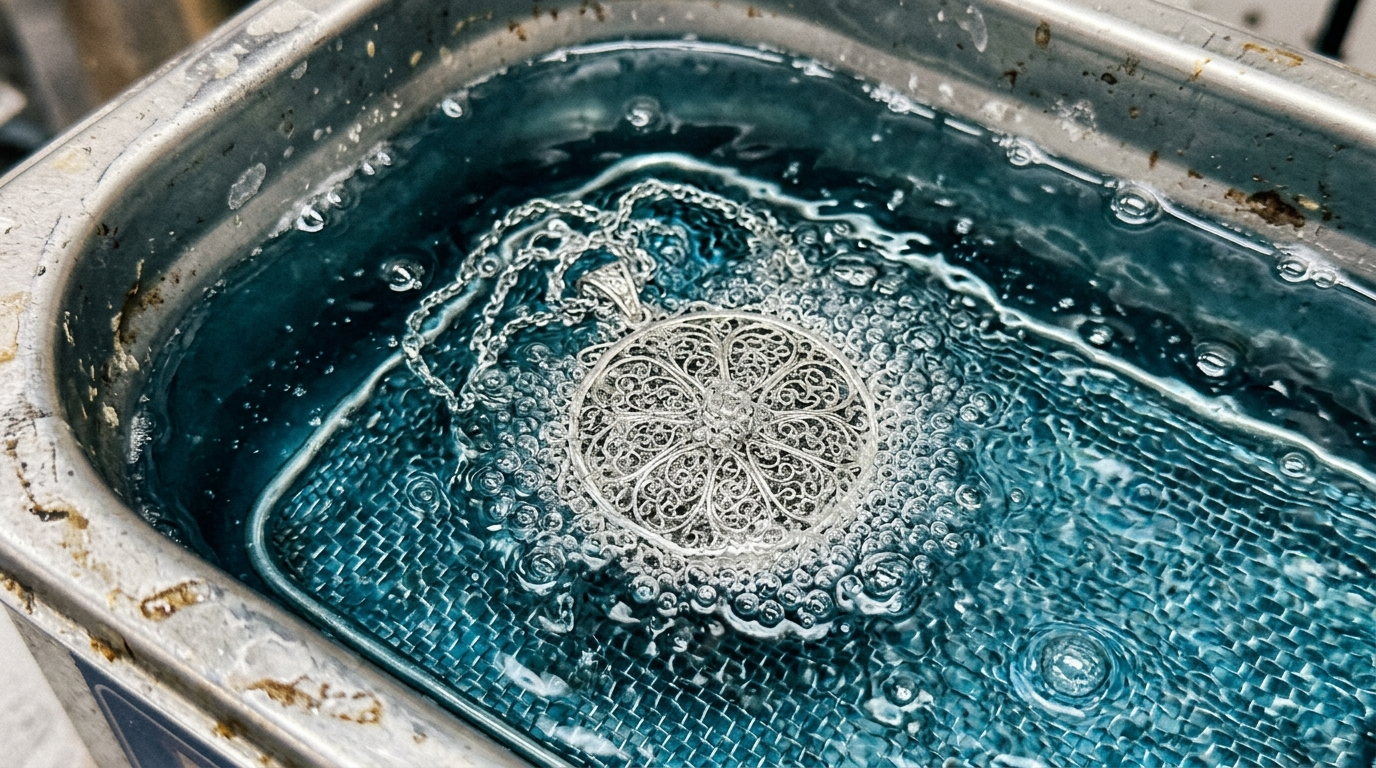
An ultrasonic cleaner operates through a process called cavitation. The unit generates high-frequency sound waves (typically 20 to 400 kHz) through a tank of cleaning solution. These waves create and violently collapse millions of microscopic bubbles.
This implosion creates powerful, tiny jets of liquid that act as a micro-scrub brush, blasting away dirt, oils, grime, and stubborn materials like polishing compounds and investment powder from every surface. It’s an indispensable, hands-off process for preparing jewelry for further work or final presentation.
Key Application: Deep Crevice & Pre-Polish Cleaning
The primary advantage of ultrasonics in a professional setting is their unmatched ability to penetrate and clean complex pieces. The cavitation process reaches deep into pavé settings, filigree work, and chain links where manual brushing can’t.
This makes it the go-to tool for the initial cleaning of customer repairs, estate pieces, and newly cast items needing removal of polishing compounds. However, the powerful vibrations mean that a thorough stone check is mandatory before cleaning; any pre-existing loose settings can be exacerbated by the process.
The Power of High-Pressure Steam Finishers
A professional steam cleaner provides the critical finishing touch, using high-pressure steam to deliver a brilliant, sanitized, and residue-free piece back to the customer.
How it Works: High-Pressure, High-Temperature Finishing
A commercial steam cleaner heats water in a certified boiler to create high-pressure steam, often reaching 70-90 PSI. This pressurized steam is directed through a precision nozzle.
The combination of intense heat and pressure instantly melts away oils and lotions while blasting any remaining grime or ultrasonic solution residue from the piece. Because steam is a gas, it penetrates small spaces to flush out surface debris, leaving jewelry sparkling, sanitized, and immediately dry to the touch.
Key Benefits: Brilliance, Sanitization, and Workflow Efficiency
For a busy shop, a commercial steam cleaner offers distinct operational advantages. First, it delivers instant results, transforming a piece from clean to “showroom brilliant” in seconds. This speed is essential for on-the-spot customer service. Second, it is a chemical-free process, relying solely on distilled water.
Finally, the high heat thoroughly sanitizes jewelry, a crucial step for items like earrings and a key value-add for health-conscious clients. A reliable, continuous-duty steamer, like a Hoffman Steam JEL-3 boiler, is a cornerstone tool for any jeweler committed to providing a truly professional finish.
Material and Gemstone Safety: Professional Best Practices
The most critical factor in the jewelry steamer vs. ultrasonic decision is material safety. Using the wrong method can result in damaged customer property and harm your reputation.
What to Put in an Ultrasonic Cleaner (And What to Avoid)
Ultrasonic cleaners are ideal for hard, durable materials.
Safe for Ultrasonic Cleaning:
Hard Metals: Gold, platinum, sterling silver, and palladium.
Hard Gemstones: Diamonds, sapphires, and rubies can withstand the vibrations. Most lab-grown versions of these stones are also safe.
Other Hard Materials: Stainless steel, ceramic, and glass.
Do NOT put these in an ultrasonic cleaner:
Organic Gems: Pearls, coral, amber, ivory, and shell will be damaged or destroyed.
Soft or Porous Stones: Opal, turquoise, lapis lazuli, malachite, and tanzanite should never be cleaned ultrasonically. Opals are particularly vulnerable to crazing (forming micro-cracks).
Treated Gemstones: Many emeralds are oil-treated, and some diamonds are fracture-filled. Ultrasonic cleaning can remove or damage these treatments, diminishing the stone’s appearance.
Plated Jewelry: The intense scrubbing action can chip or erode thin plating.
What to Clean with a Steamer (And What to Keep Far Away)
With steam, thermal shock is the primary risk.
Safe for Steam Cleaning:
Hard Metals: Gold and platinum handle the heat without issue.
The “Big Three” Gemstones: Diamonds, rubies, and sapphires were formed under extreme heat and pressure, making them perfectly safe to steam.
Metal-Only Pieces: A plain gold chain or platinum wedding band will achieve maximum brilliance.
Do NOT put these in a steam cleaner:
Organic Gems: Pearls, coral, and amber will suffer irreversible damage from the heat.
Soft or Treated Gems: Opals can crack from thermal shock. Emeralds can also crack, or their oil treatments can “sweat out.” Porous stones like turquoise can be damaged.
Glued Items: Any piece with epoxied or glued components will fail, as the heat weakens the adhesive.
Delicate or Antique Pieces: The high pressure from a commercial steamer could dislodge small stones from delicate pavé or filigree settings, especially on antique pieces with fragile prongs.
Professional Intake Checklist
Before placing any piece of jewelry into cleaning equipment, follow these three steps:
Magnified Inspection: Use a loupe to check for loose prongs or fractured stones.
Treatment Identification: Determine if stones are oil-treated (Emeralds) or fracture-filled.
Adhesive Check: Verify if stones are tension-set or held by epoxy (common in pearls and costume jewelry).
Making the Right Investment: Professional Considerations
Beyond material safety, a business must evaluate workflow integration, shop safety, and the total cost of ownership when choosing between a jewelry steamer vs. an ultrasonic cleaner. Still not sure which model fits your shop? Take the Which Steamer is Right for Me? quiz.
Workflow Integration & Shop Safety
In a professional workflow, the ultrasonic cleaner is typically the first step, while the steamer is the last. An ultrasonic cleaner runs on a timer, allowing staff to multitask.
A steam cleaner requires active, focused use. Operator safety is paramount, as the high-pressure steam can cause severe burns. Proper training and features like foot-pedal operation are essential. For compliance and safety, many jewelers invest in ASME/UL-certified boilers, which meet stringent safety standards required by building codes and insurance policies.
Investment, ROI, and Total Cost of Ownership
While entry-level ultrasonic cleaners are relatively inexpensive, a commercial-grade steam boiler represents a more significant capital investment. However, evaluating the total cost of ownership is key. A durable, American-made boiler is built for continuous daily use and can last for decades, delivering a strong return on investment.
Look for suppliers that offer transparent pricing, robust warranties, and financing options. Hoffman Steam, for example, provides financing programs to help businesses manage the upfront cost. Furthermore, maintenance plans like the Workhorse Protection Program reduce downtime and protect your investment for years to come.
Maximizing Your Equipment Lifespan
To ensure your Hoffman Steam JEL-3 or ultrasonic unit performs for decades, follow these maintenance protocols:
Blow-Down Daily: For steam boilers, perform a daily blow-down to remove sediment and prevent scale buildup.
Solution Refresh: Change ultrasonic fluids daily; dirty solution acts as an abrasive and reduces cavitation efficiency.
Gasket Inspection: Check steamer nozzle gaskets and safety valves monthly for wear.
Enhancing the Customer Experience

The true difference between amateur and professional cleaning lies in the equipment and expertise. A jeweler’s first step is always inspection—checking for loose stones and identifying materials. Owning professional-grade equipment allows you to deliver a superior service that builds customer trust and loyalty.
Offering a quick, complimentary steam clean with a powerful commercial steamer when a customer drops off or picks up a piece is a simple, high-impact way to elevate their experience and showcase your commitment to quality.
Better Together: The Professional Cleaning Standard
For premier results, professionals don’t choose jewelry steamer vs. ultrasonic—they use both in sequence. Clean each piece using a heated ultrasonic, then steam clean it.
This two-step process delivers a level of clean that is impossible to achieve with one method alone. The ultrasonic does the heavy lifting, and the steamer provides the final, dazzling touch. This combination is essential for cleaning everything from customer repairs to your own showcase inventory.
If your business aims to meet this professional standard, investing in commercial-grade equipment is non-negotiable. Contact Hoffman Steam to discuss their range of jewelry steamers, designed for the demands of a busy shop, or schedule a live virtual demo to see them in action.
Frequently Asked Questions for Jewelry Professionals
1. Which is better for engagement rings, a jewelry steamer or ultrasonic cleaner?
For a standard diamond ring in a platinum or gold setting, using both is best practice. The ultrasonic cleaner removes lotions, soaps, and dirt from behind the setting, while the steamer provides the final, brilliant sparkle that makes the diamond pop. Always inspect prongs before cleaning.
2. Is using tap water in commercial cleaning equipment acceptable?
No, distilled water is the industry standard. For steam boilers, tap water introduces mineral deposits (scale) that clog components, reduce performance, and can void warranties. For ultrasonics, distilled water ensures consistent and effective performance of the cleaning solution.
3. Will an ultrasonic cleaner loosen diamonds in a customer’s ring?
An ultrasonic cleaner will not loosen a properly secured stone. However, if a prong is already damaged or a stone is loose, the vibrations can dislodge it. This is why a thorough intake inspection of all customer jewelry is a critical, non-negotiable first step to limit liability.
4. What’s the difference between a consumer steamer and a commercial boiler?
The difference is pressure, capacity, and durability. Consumer-grade “steamers” often produce weak, low-pressure steam and are not designed for continuous, all-day use. A commercial boiler from a brand like Hoffman Steam produces high-pressure (70-90 PSI) steam, is built with industrial-grade components, and often carries ASME/UL certification for safety and compliance in a business environment.
5. Why is ASME/UL certification important for my jewelry business?
ASME (American Society of Mechanical Engineers) and UL (Underwriters Laboratories) certifications indicate that a boiler has been built and tested to meet rigorous safety standards for pressurized vessels. In many jurisdictions, this certification is required by law for commercial insurance policies and building inspections. It ensures the safety of your employees, your customers, and your business.


