

TL;DR
Medical lab steam cleaner safety covers the certifications, equipment features, and operator protocols that prevent injuries and keep labs compliant with federal standards. Steam cleaning is not the same as steam sterilization, and confusing the two can create serious regulatory problems. Key safety considerations include ASME and UL certification, proper PPE, distilled water use, pressure relief systems, and ventilation. This guide defines every term a dental or medical lab operator needs to understand when purchasing and using steam cleaning equipment safely.
Quick Answer: Medical Lab Steam Cleaner Safety (2026)
Medical lab steam cleaner safety refers to the standards, certifications, and operating procedures required to safely use pressurized steam equipment in regulated medical and dental environments. It ensures that steam cleaners are used for high-level disinfection only—not sterilization, and that equipment meets safety requirements such as ASME boiler certification, UL/ETL electrical listing, proper pressure controls, and OSHA-compliant PPE protocols.
Key safety requirements include:
– ASME BPVC-certified pressure vessel
– UL or ETL electrical safety listing
– Pressure relief valve and low-water cutoff systems
– Use of distilled water to prevent scale buildup
– PPE including heat-resistant gloves and eye protection
Compliance with OSHA Bloodborne Pathogens Standard (29 CFR 1910.1030)
Steam cleaning is a pre-cleaning and disinfection method, while sterilization must be performed using an autoclave.
Why Medical Lab Steam Cleaner Safety Deserves Its Own Guide
Burns, electrical shocks, and pressure valve blowouts are not hypothetical risks. The CPSC documented 48 burn injuries from a single product line of defective consumer-grade steamers. In professional medical and dental labs, where staff work with pressurized steam daily, the stakes are higher and the regulatory requirements stricter.
Yet no single resource connects the dots between the certifications, equipment features, and operating practices that define medical lab steam cleaner safety. Government sources like OSHA and the CDC cover broad sterilization and lab safety guidance, but they don’t address the specific concerns of someone operating a commercial steam cleaner in a dental prosthetics lab or a small diagnostic facility.
This guide fixes that. It’s written for dental lab technicians, medical lab managers, small practice staff, and anyone evaluating or operating steam cleaning equipment in a regulated environment.
If you’re evaluating equipment for a dental lab specifically, the dental lab steam cleaner guide is a useful companion to this page.
Steam Cleaning vs. Steam Sterilization: The Most Important Distinction
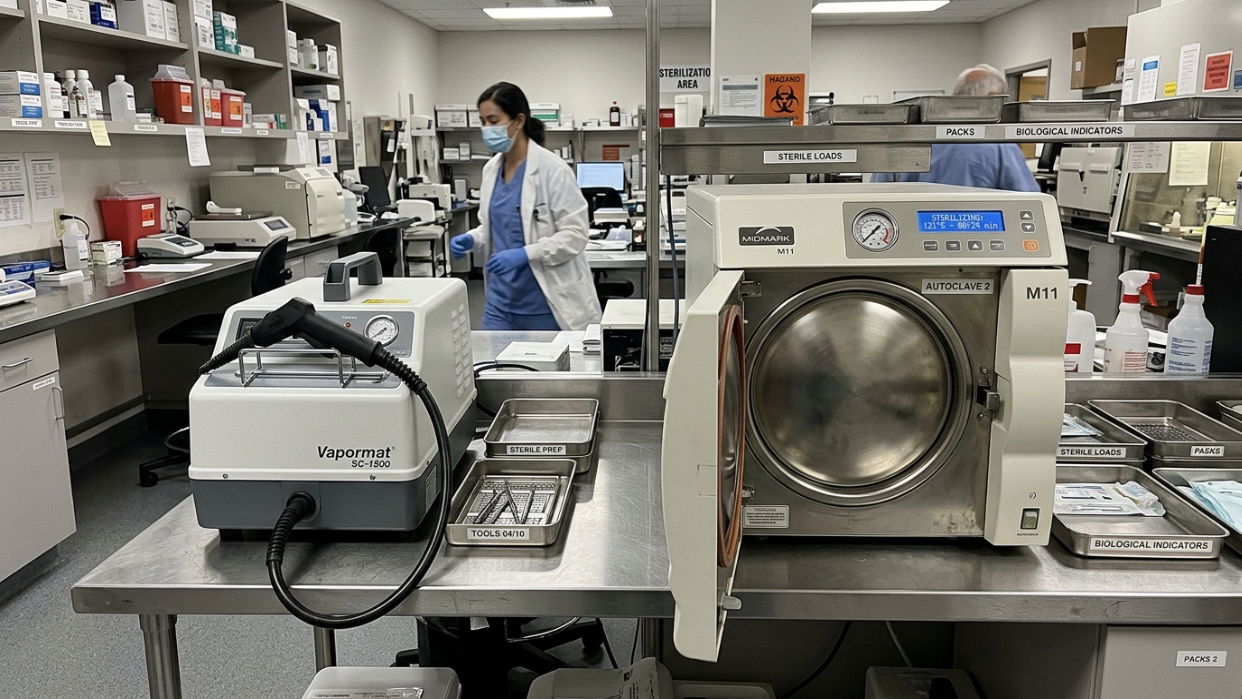
Getting this wrong can fail an inspection or, worse, put patients at risk. These two processes sound similar but operate under completely different principles.
Steam Cleaning (Open-Nozzle Disinfection)
A commercial steam cleaner uses a boiler to generate high-temperature pressurized steam, which is directed through a nozzle or gun onto surfaces, instruments, or lab items. This process removes up to 99.99% of bacteria, protozoa, fungi, and other microbes. It qualifies as high-level disinfection but not sterilization.
In medical and dental labs, open-nozzle steam cleaners are best suited for pre-cleaning tasks: removing wax from dental prosthetics, blasting debris from castings, cleaning work surfaces, and general surface disinfection. They are not autoclaves and should never be used as a substitute for sterilization of critical instruments.
Steam Sterilization (Autoclaving)
Steam sterilization happens inside a sealed chamber (autoclave) under precisely controlled conditions. The CDC states that moist heat in the form of saturated steam under pressure is the most widely used and most dependable sterilization method. The four parameters that must be validated are steam, pressure, temperature, and time.
Standard sterilization temperatures are 121°C (250°F) with a minimum 30-minute exposure in a gravity displacement sterilizer, or 132°C (270°F) with a minimum 4-minute exposure in a prevacuum sterilizer. Steam dryness must reach at least 97% for effective sterilization.
Why This Matters for Your Lab
If your lab handles instruments classified as “critical” or “semi-critical” under the Spaulding Classification system (anything that contacts sterile tissue, mucous membranes, or broken skin), those instruments require sterilization, not just steam cleaning. A commercial steam cleaner handles the pre-cleaning step. An autoclave handles sterilization. Both have a role. Neither replaces the other.
Understanding the difference between these equipment types is fundamental. For a deeper comparison, see the guide on flash steamers vs. boilers.
Regulatory and Certification Terms Every Lab Operator Should Know
ASME BPVC (Boiler and Pressure Vessel Code)
The ASME Boiler and Pressure Vessel Code governs the design, fabrication, assembly, and inspection of boiler and pressure vessel components. Over 6,800 certificate holders participate in the program worldwide. For small commercial steam boilers like those found in dental and medical labs, ASME Section IV (heating boilers) is the most relevant section, covering vessels operating at or below 15 PSI for steam.
Why it matters: An ASME-stamped boiler has been independently inspected and verified to meet national pressure vessel safety standards. Many state and local jurisdictions require ASME certification for any pressurized steam equipment in commercial settings. This is not a marketing badge. It’s a legal and insurance requirement in many locations.
For a detailed breakdown of reading an ASME stamp, see the guide on how to read a boiler data plate.
UL Listing and ETL Certification
UL (Underwriters Laboratories) and ETL (Intertek) both test and certify electrical safety. A UL or ETL listing confirms that the electrical components (heating elements, wiring, switches, controls) in a steam boiler won’t create fire or shock hazards under normal operating conditions. For medical and dental labs, this certification is typically required by building codes and insurance carriers.
The difference between UL and ETL is the testing body, not the standard. Both test to the same UL and CSA safety standards. What matters is that your equipment carries one of these marks.
OSHA Bloodborne Pathogens Standard (29 CFR 1910.1030)
OSHA’s Bloodborne Pathogens Standard requires training and protective measures for any staff potentially exposed to infectious materials. Any surface contaminated with blood or bodily fluids must be cleaned and decontaminated with an appropriate disinfectant immediately or as soon as feasible.
In a medical or dental lab, steam cleaning can serve as one component of a bloodborne pathogen compliance program, but the standard requires documented SOPs, PPE provision, and staff training regardless of which cleaning method you use. Simply owning a steam cleaner does not make a lab compliant.
OSHA Laboratory Standard (29 CFR 1910.1450)
This standard applies more broadly to chemical and biological hazards in laboratory settings. It requires a written Chemical Hygiene Plan and addresses ventilation, PPE, and hazard communication. Labs using steam equipment near chemicals or biological specimens need to account for this standard in their safety documentation.
AAMI ST108:2023 (Water Quality for Medical Device Processing)
This is the newest major standard affecting anyone using steam in a medical or dental environment. Published by the Association for the Advancement of Medical Instrumentation and approved in August 2023, AAMI ST108 was developed by nearly 120 subject matter experts.
The standard establishes three categories of water quality:
Utility Water: Tap water acceptable for initial washing and flushing
Critical Water: Extensively treated water required for final rinsing or steam generation
Steam: Vaporized water produced by a centralized boiler or generator, with specific purity requirements
The practical implication is significant: the water you put in your boiler directly affects both safety and cleaning effectiveness. Poor water quality can damage medical devices by causing staining, corrosion, pitting, malfunction, blocked lumens, and discoloration. Many small lab operators are unaware this standard even exists.
EN 13060 (Small Steam Sterilizer Standard)
Primarily a European standard, but increasingly referenced in the U.S. dental and small-lab market. EN 13060 defines performance tiers for small steam sterilizers: Class N (non-wrapped, solid instruments only), Class S (specified loads as defined by the manufacturer), and Class B (the highest tier, capable of sterilizing all load types including wrapped goods, porous materials, and hollow instruments).
Spaulding Classification System
Developed by E.H. Spaulding, this system categorizes medical devices by infection risk:
Critical: Items that contact sterile tissue (surgical instruments). Require sterilization.
Semi-critical: Items that contact mucous membranes or non-intact skin (dental mirrors, laryngoscope blades). Require high-level disinfection at minimum.
Non-critical: Items that contact intact skin only (blood pressure cuffs, stethoscopes). Require low-level disinfection.
Steam cleaning with an open-nozzle unit handles non-critical and some semi-critical disinfection tasks. Critical items demand autoclave sterilization.
Medical Lab Steam Cleaner Compliance Checklist
Requirement | Standard | Why It Matters | Mandatory? |
|---|---|---|---|
Boiler safety certification | ASME BPVC | Prevents pressure vessel failure | Yes (most jurisdictions) |
Electrical safety | UL / ETL | Prevents shock and fire hazards | Yes (insurance/building code) |
Water quality | AAMI ST108:2023 | Prevents corrosion and contamination | Strongly recommended |
PPE compliance | OSHA 29 CFR 1910.1030 | Protects against burns & exposure | Yes |
Pressure safety systems | Internal engineering standard | Prevents explosion risk | Yes |
Maintenance logs | OSHA + insurance requirements | Required for audits & liability | Yes |
Equipment Safety Features: What to Look For
A well-built commercial steam cleaner includes multiple overlapping safety systems. Understanding what each one does helps you evaluate equipment and catch problems before they become emergencies.
Pressure Relief Valve (Safety Valve)
This valve automatically vents excess steam if pressure inside the boiler exceeds the rated maximum. It’s the last line of defense against catastrophic overpressure. One dental lab technician on the Dental Lab Network forums described what happens when other safety systems fail and the relief valve activates: the manual relief valve dumped 80 PSI through a 1.5-inch opening, filling the entire room with steam instantly. The valve did its job, but the event underscores why every safety layer matters.
Pressure Switch
Cuts power to the heating element when the boiler reaches its maximum operating pressure. This prevents the boiler from continuously building pressure beyond its rated capacity. It works in tandem with the relief valve: the pressure switch is the first line of defense, the relief valve is the backup.
Thermostat Protection
Prevents the boiler from overheating. If the temperature exceeds safe limits (due to a failed pressure switch or other malfunction), the thermostat kills the heating element independently.
Safety Cap (Pressure-Lock Cap)
Prevents the operator from opening the boiler while it’s under pressure. This is a critical burn-prevention feature. Without it, removing a boiler cap on a pressurized tank would release superheated steam directly at the operator. A proper safety cap physically locks until pressure drops to safe levels.
Low-Water Cutoff
Automatically shuts down the heating element if the water level drops too low. Running a boiler dry destroys the heating element and can cause dangerous overheating of the empty tank. This feature protects both the equipment and the operator.
Blowdown Valve
Allows periodic draining of sediment and mineral buildup from the bottom of the boiler. Regular blowdown maintains boiler efficiency and prevents scale accumulation that can lead to hotspots and premature tank failure.
Foot Pedal Control
Allows hands-free activation of the steam flow. In a medical or dental lab, this means operators can keep both hands on the workpiece and control steam delivery with their foot, reducing the risk of burns from fumbling with manual triggers while handling small, intricate items.
For a broader overview of how these safety systems work together, see the guide on commercial steam boiler safety requirements.
Operational Safety Terms
PSI (Pounds Per Square Inch)
The unit measuring steam pressure. Higher PSI means more forceful steam output. Most commercial lab steam cleaners operate between 40 and 90 PSI. Understanding your equipment’s rated PSI matters because it determines both cleaning power and the level of safety certification required. For a detailed breakdown of how PSI affects performance, refer to the PSI guide for commercial steamers.
Dry Steam vs. Wet Steam
Dry steam has a dryness fraction of 97% or higher, meaning it contains very little liquid water. Wet steam carries more moisture droplets. For sterilization, dry steam is essential because moisture interferes with heat transfer to instrument surfaces. For steam cleaning tasks (surface disinfection, debris removal), some moisture is acceptable and can even aid in loosening contaminants.
Flash Steamer (Non-Pressurized)
A flash steamer generates steam on demand by dripping water onto a superheated element. It’s non-pressurized, meaning it doesn’t build and store steam pressure in a tank. Flash steamers are simpler, require no boiler permits, and work well for light-duty tasks. They produce lower-pressure steam compared to pressurized boilers.
Gravity Displacement Sterilizer
An autoclave type where steam enters the chamber and pushes cooler air down and out through a drain at the bottom. Slower air removal means longer cycle times. Standard cycle: 121°C for 30 minutes.
Prevacuum Sterilizer
An autoclave type that uses a vacuum pump to remove air from the chamber before steam injection. Faster and more thorough steam penetration, especially for porous loads. Standard cycle: 132°C for 4 minutes.
Biological Indicators (BIs)
These are the only process indicators that directly monitor the lethality of a sterilization process. A BI contains a known population of highly resistant bacterial spores. After a sterilization cycle, the BI is incubated. If the spores are killed, the cycle was effective. Required for routine sterilization monitoring in most medical settings.
Chemical Indicators (CIs)
Strips or tapes that change color when exposed to specific sterilization conditions (temperature, time, steam presence). They confirm that conditions were reached but do not prove sterilization was achieved. Think of them as a quick pass/fail screen, not a definitive test.
Bowie-Dick Test
A specific test for prevacuum sterilizers that verifies the vacuum pump is removing air effectively. Incomplete air removal creates cold spots where steam can’t reach, causing sterilization failures. Run daily as the first cycle in any prevacuum autoclave.
ATP (Adenosine Triphosphate) Testing
A rapid surface cleanliness test that detects biological residue (living cells and organic material) on surfaces or instruments. An ATP swab test gives results in seconds and is increasingly used in labs to verify that pre-cleaning (including steam cleaning) was effective before items move to sterilization.
Dwell Time (Exposure Time)
The duration that steam must remain in contact with a surface or load to achieve the desired level of disinfection or sterilization. For steam cleaning (disinfection), dwell time varies by organism and temperature. For autoclave sterilization, dwell time is precisely specified: 30 minutes at 121°C or 4 minutes at 132°C in standard cycles.
Operator Safety Practices
PPE Requirements
OSHA mandates appropriate use of personal protective equipment including gloves, gowns, and respirators for staff exposed to hazardous agents. For steam equipment operators specifically, PPE should include:
Heat-resistant gloves (not standard latex or nitrile exam gloves)
Face and eye protection (steam burns to the face and eyes are a documented hazard)
Closed-toe shoes (to protect feet from hot water drips or spills)
Lab coat or gown (standard in most medical lab settings already)
Burn Prevention Protocols
Burns are the number one operational hazard with steam equipment. The CPSC documented 52 reports of hot water incidents from one consumer-grade product line alone, resulting in at least 48 burn injuries. In a professional setting, burn prevention comes down to:
Never attempt to open a boiler under pressure. Use equipment with a pressure-lock safety cap.
Keep hands and face away from the nozzle during operation.
Allow adequate cool-down time before refilling manual-fill boilers.
Train every operator, not just the person who unboxed the equipment.
Ventilation Requirements
Steam cleaning produces heat and moisture. In enclosed lab spaces, this raises humidity levels and can affect both air quality and sensitive electronics. Proper ventilation is essential, particularly in areas where patients or staff may have respiratory sensitivities. At minimum, ensure the work area has mechanical ventilation (an exhaust fan) or is located near an air handling unit.
Operators should also maintain a safe distance from sensitive medical devices like ventilators, monitors, or analytical instruments to prevent moisture-related electrical damage.
Distilled Water Use and Descaling
This is where medical lab steam cleaner safety intersects with equipment longevity. Practitioners on Dental Lab Network forums consistently emphasize distilled water, with one user stating they “found out the hard way that steamers love distilled water.” Tap water introduces minerals that form scale inside the boiler, reducing efficiency and eventually causing overheating or element failure.
Under AAMI ST108:2023, water used for steam generation in medical device processing should meet “Critical Water” quality standards. Even for general lab steam cleaning where AAMI compliance isn’t strictly required, using distilled water is the single easiest thing an operator can do to extend boiler life and maintain consistent steam quality. Regular descaling on a documented schedule is equally important.
For a detailed maintenance framework, the steam equipment maintenance glossary covers scheduling, descaling, and documentation practices.
Electrical Grounding and Shock Prevention
Electrical shock from poorly built or poorly maintained steam equipment is a real concern. Practitioners on the Dental Lab Network have reported receiving electrical shocks from certain steam cleaner brands. One lab operator reported their steamer “lost pressure quick and our techs were getting electrical shocks.” Another user confirmed experiencing static electricity shocks, acknowledging “it’s not normal.”
The common thread in these reports is equipment construction quality. Users of stainless-steel-bodied units with proper welds reported no such issues, with one stating, “They have stainless steel with stainless welds, never see rusty mud in them. None of the machines has given me electrical shots.”
The takeaway: grounding, stainless steel construction, and proper weld integrity are not just durability features. They are safety features that prevent shock hazards. Always verify that your steam cleaner is properly grounded, connected to an appropriate outlet (matching the voltage rating), and that no visible corrosion or wiring damage exists.
Maintenance Schedules and Documentation
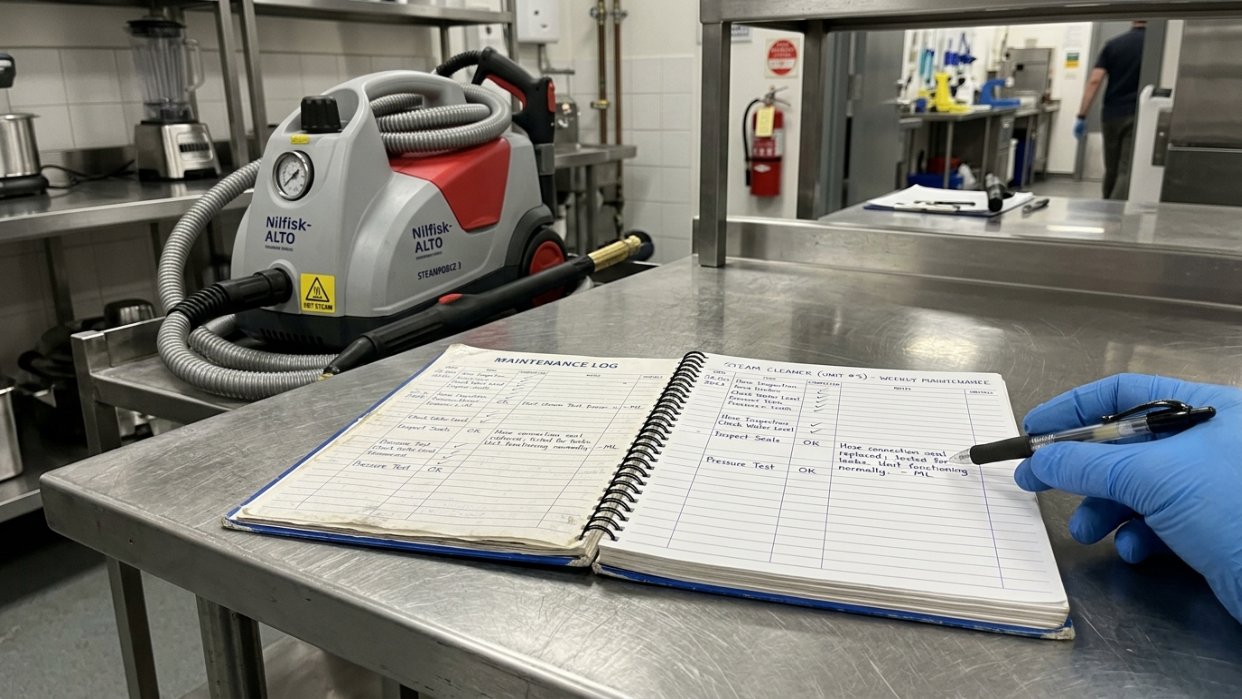
In regulated medical and dental environments, “I’ll get to it later” is not a maintenance strategy. Documentation matters for three reasons:
OSHA compliance requires written safety procedures and training records.
Insurance carriers may deny claims related to equipment that wasn’t maintained per manufacturer specifications.
Equipment failure from deferred maintenance creates safety hazards (pressure buildup, element failure, loss of safety switch function).
Keep a log of descaling dates, element inspections, safety valve tests, and any repairs. This documentation also protects the lab during inspections and audits.
Common Safety Mistakes in Medical Labs
Many steam cleaner incidents in medical and dental labs are caused by preventable operational errors rather than equipment failure.
1. Using non-certified consumer equipment
Equipment without ASME or UL/ETL certification may lack critical safety systems like pressure switches or proper grounding.
2. Confusing steam cleaning with sterilization
This leads to instruments being improperly processed, violating CDC sterilization guidelines.
3. Using tap water instead of distilled water
Mineral buildup causes boiler scaling, overheating, and eventual system failure.
4. Skipping pressure relief valve testing
A failed safety valve can lead to dangerous overpressure events.
5. No documentation of maintenance
This is a frequent audit failure under OSHA and insurance inspections.
Common Confusion Points
“Steam Cleaner” vs. “Autoclave”
A steam cleaner uses an open nozzle to direct pressurized steam at surfaces. An autoclave is a sealed pressure chamber that achieves sterilization. They are fundamentally different tools for different stages of the decontamination process. In a medical lab, steam cleaning handles pre-cleaning and surface disinfection. Autoclaving handles instrument sterilization. Google’s own search results often conflate these categories, which makes this distinction especially important for lab operators researching equipment.
“Disinfection” vs. “Sterilization”
Disinfection eliminates most pathogenic microorganisms on a surface. Sterilization eliminates all forms of microbial life, including bacterial spores. The difference is not academic. Using a process labeled “disinfection” when “sterilization” is required (based on Spaulding classification) can violate CDC guidelines and put patients at risk. Steam cleaning achieves disinfection. Only validated autoclave cycles achieve sterilization.
“Medical-Grade” Claims
There is no official “medical-grade” certification for steam cleaners. The term is marketing language. What actually validates a steam cleaner for medical or dental lab use is a combination of ASME certification (pressure vessel safety), UL or ETL listing (electrical safety), and compliance with applicable OSHA and CDC guidelines. When evaluating equipment, look for specific certification marks rather than vague “medical-grade” claims. The commercial steam vendor checklist provides a framework for asking the right questions before purchasing.
Pressurized vs. Non-Pressurized Steamers
Non-pressurized flash steamers generate steam on demand at atmospheric pressure. They’re lighter, simpler, and don’t require boiler permits. Pressurized boilers build and store steam under pressure (typically 40 to 90 PSI), delivering more forceful steam output for demanding cleaning tasks. Both have legitimate uses in medical lab settings, but they carry different safety profiles and certification requirements.
Choosing Equipment That Meets Medical Lab Steam Cleaner Safety Standards
When selecting a steam cleaner for a medical or dental lab, prioritize these features in this order:
ASME certification on the boiler tank (required by many jurisdictions)
UL or ETL listing on all electrical components
Pressure relief valve, pressure switch, thermostat protection, and low-water cutoff (all four, not just one or two)
Safety cap that locks under pressure
Stainless steel construction with proper welds (prevents corrosion and electrical hazard)
Foot pedal control for hands-free operation
Manufacturer support for maintenance, documentation, and parts availability
Hoffman Steam’s Pro Line boilers carry both ASME and UL certification and are manufactured in the United States, which simplifies compliance documentation for labs that need it.
Explore the Pro Line steam boilers to compare certified models for lab use.
Regulatory Authorities Referenced in This Guide
To ensure compliance accuracy, this guide aligns with the following organizations:
Occupational Safety and Health Administration (OSHA)
Centers for Disease Control and Prevention (CDC)
Association for the Advancement of Medical Instrumentation (AAMI)
American Society of Mechanical Engineers (ASME)
Underwriters Laboratories (UL)
Frequently Asked Questions
Is a steam cleaner the same as an autoclave?
No. A steam cleaner uses an open nozzle to direct pressurized steam at surfaces for disinfection and debris removal. An autoclave is a sealed pressure chamber that achieves sterilization under validated conditions (specific temperature, pressure, and time). Both are useful in medical labs, but they serve different purposes and are not interchangeable.
What certifications should a medical lab steam cleaner have?
At minimum, look for ASME certification on the pressure vessel (boiler tank) and UL or ETL listing on the electrical components. Many states require ASME certification by law for commercial pressurized steam equipment, and most insurance carriers require UL or ETL listing.
Can I use tap water in my lab steam cleaner?
You can, but you shouldn’t. Tap water contains minerals that cause scale buildup inside the boiler, reducing efficiency and potentially causing overheating. AAMI ST108:2023 specifies water quality standards for steam used in medical device processing. Distilled water is the standard recommendation for any commercial steam boiler in a lab environment.
What PPE do I need when operating a steam cleaner?
Heat-resistant gloves, face and eye protection, closed-toe shoes, and a lab coat or gown. Standard latex or nitrile exam gloves do not provide adequate burn protection. Steam burns are the most common injury associated with steam cleaning equipment.
How often should I maintain my lab steam cleaner?
Follow the manufacturer’s recommended schedule, but at minimum: descale the boiler regularly (frequency depends on water hardness and usage volume), test the pressure relief valve periodically, inspect electrical connections for corrosion or damage, and document everything. In a regulated lab environment, undocumented maintenance is essentially the same as no maintenance during an audit.
Does OSHA regulate steam cleaner use in medical labs?
OSHA does not have a standard specifically for steam cleaners, but the Bloodborne Pathogens Standard (29 CFR 1910.1030) and Laboratory Standard (29 CFR 1910.1450) both apply to the environments where steam cleaners are used. These require documented procedures, PPE, training, and hazard controls regardless of which cleaning method the lab employs.
What is AAMI ST108, and does it apply to my lab?
AAMI ST108:2023 is the newest standard governing water quality for medical device processing. It applies to any facility that uses water or steam in cleaning, disinfecting, or sterilizing medical devices. Even if your lab only uses a steam cleaner for pre-cleaning (not sterilization), the water quality principles in this standard are worth following to prevent equipment damage and ensure consistent results.
Are cheaper steam cleaners safe for medical lab use?
Price alone doesn’t determine safety, but certification does. Consumer-grade and low-cost steam cleaners frequently lack ASME certification, UL listing, and basic safety features like pressure-lock caps and low-water cutoffs. The CPSC’s documentation of 48 burn injuries from one inexpensive consumer brand illustrates the real consequences of choosing uncertified equipment for professional use.


