

TL;DR
Passing an ASME boiler inspection comes down to three things: owning properly certified equipment, maintaining it regularly, and having your paperwork ready when the inspector arrives. This guide defines every term you’ll encounter during the process, from ASME stamps to red tags, and gives you a concrete checklist so your small business passes without surprises. If your boiler is ASME-stamped and National Board registered, you’re already ahead of most operators.
Direct Answer: How Do You Pass an ASME Boiler Inspection?
To pass an ASME boiler inspection, make sure your boiler has a valid ASME code stamp and National Board registration, verify that every required safety device works correctly, complete routine maintenance before the inspection, and organize all required documentation. Most inspectors focus on four areas:
– ASME certification and identification
– Safety devices (relief valve, low-water cutoff, pressure gauge)
– Physical condition of the boiler
– Maintenance and inspection records
If all four areas are in order, most inspections become straightforward and routine.
What Inspectors Look For at a Glance
Inspection Area | Inspector Checks | Common Failure |
|---|---|---|
Certification | ASME Stamp, NB Number | Missing or unreadable nameplate |
Safety Devices | Relief valve, LWCO, controls | Disabled or improperly adjusted safety devices |
Boiler Condition | Leaks, corrosion, scale | Heavy corrosion or unauthorized repairs |
Documentation | MDR, inspection certificate, maintenance logs | Missing paperwork |
Operating Conditions | Pressure below MAWP | Operating above rated pressure |
What “Pass Boiler Inspection ASME” Actually Means
Let’s clear up a common confusion right away. The phrase “pass boiler inspection ASME” blends two related but distinct things:
ASME governs how your boiler was built. The American Society of Mechanical Engineers created the Boiler and Pressure Vessel Code (BPVC), a set of engineering standards that manufacturers must follow when constructing pressure equipment. The BPVC is adopted by law in all 50 U.S. states, most Canadian provinces, and regulatory bodies worldwide.
State inspectors verify that your boiler continues to operate safely. They check that the equipment still meets code, that safety devices work, and that you have the right documentation.
When people search for how to pass a boiler inspection ASME, they’re really asking: “What does the inspector want to see, and how do I make sure my equipment meets the standard?” This guide answers both questions through a glossary of every key term you’ll encounter, paired with practical preparation advice.
Whether you run a jewelry store, a dry cleaning shop, or a hat shaping business, understanding these terms turns inspection day from an anxiety-producing event into a routine formality.
Starting with certified equipment? Hoffman’s Pro line boilers ship with ASME/UL certification and National Board registration, so your compliance documentation is handled before the inspector ever walks in. Learn more about ASME certified boiler basics.
Understanding the Typical ASME Boiler Inspection Process
Many first-time operators don’t know what actually happens during an inspection. While procedures vary by jurisdiction, most inspections follow the same sequence.
Step 1: Review Documentation
The inspector reviews:
Certificate of Inspection
Manufacturer’s Data Report
Maintenance records
Previous inspection reports
Step 2: Verify Boiler Identification
They compare:
ASME Stamp
National Board number
Serial number
MAWP
Manufacturer information
Step 3: Inspect Safety Devices
The inspector checks:
Safety relief valve
Low-water cutoff
Pressure gauge
Operating controls
Emergency shutoffs
Step 4: Examine Physical Condition
The inspector looks for:
Corrosion
Water leaks
Scale buildup
Cracks
Improper repairs
Clearance around the boiler
Step 5: Determine Compliance
If everything complies with code, the inspector issues or renews the inspection certificate. If serious hazards are found, the boiler may be red-tagged until repairs are completed.
Construction and Certification Terms You Need to Know
These are the terms related to how your boiler was built and certified. They form the foundation of every inspection because the inspector’s first job is confirming your equipment was manufactured to code.
ASME BPVC (Boiler and Pressure Vessel Code)
The BPVC is the master rulebook. It covers the design, fabrication, testing, and certification of boilers and pressure vessels. Think of it as the building code for pressure equipment. There are currently more than 6,800 certificate holders in the ASME BPVC Certification Program worldwide.
Why it matters for your inspection: Every inspector checks your equipment against BPVC standards. If your boiler was built to code, you start with a clean slate.
ASME Stamp (Code Symbol Stamp)
An ASME stamp is a certification mark issued to manufacturers that have demonstrated compliance with the BPVC. The stamp appears on a metal nameplate permanently attached to your boiler. It’s backed by a Manufacturer’s Data Report filed with both the jurisdiction and the National Board.
When an inspector shows up, one of the first things they look for is this stamp. No stamp, no shortcut. There are several stamp types, and each certifies a different category of work:
H Stamp certifies heating boilers and cast iron sectional heating boilers. If you operate a low-pressure steam or hot water heating boiler, this is the stamp you’ll see.
S Stamp certifies power boilers built under Section I of the BPVC. These are higher-pressure units used in industrial and process applications.
U Stamp certifies unfired pressure vessels built under Section VIII. If your equipment includes a separate pressure vessel (like an air receiver), it should carry this stamp.
R Stamp is issued by the National Board, not ASME directly. It certifies that a contractor is authorized to perform repairs or alterations in compliance with NBIC standards. This becomes relevant if your boiler fails inspection and needs repair.
For small commercial electric boilers in the 1 to 6 gallon range, you’ll typically see an H stamp or a combination of certifications. The key point: your boiler should have the appropriate ASME stamp for its classification. For a deeper breakdown of what these stamps mean on your specific equipment, see this guide on how to read a boiler data plate.
National Board (NB) Registration
The National Board of Boiler and Pressure Vessel Inspectors maintains a registry of boilers and pressure vessels. When a manufacturer builds a boiler to ASME code, it gets assigned a National Board number and registered in the system. This creates a traceability chain from factory to installation site.
Many states require both an ASME stamp and National Board registration. Maryland, for example, requires that any boiler installed in the state be built to ASME code and registered with the National Board. Your inspector will check for this number on your nameplate.
Manufacturer’s Data Report (MDR)
This is the detailed birth certificate for your boiler. Sometimes called a Form U-1 (for pressure vessels) or similar designation depending on the BPVC section, it documents the materials used, the construction methods, test results, and the ASME stamp number. The manufacturer files this with the National Board and your state jurisdiction.
Inspectors expect this documentation to be available. If you bought your boiler from a reputable manufacturer that provides compliance documentation, you should already have a copy. If you don’t have one, contact your manufacturer or the National Board to obtain it before your inspection.
MAWP (Maximum Allowable Working Pressure)
This is the number stamped on your nameplate that tells the inspector the maximum steam pressure your boiler can legally operate at. It’s determined during design and construction, based on the weakest component in the system.
Here’s why it matters practically: your safety relief valve must be set at or below MAWP. Your operating pressure must stay below MAWP. If the inspector finds evidence that you’ve been running above this number, that’s a serious violation.
Nameplate
The metal plate permanently attached to your boiler that displays the ASME stamp, NB registration number, MAWP, manufacturer name, serial number, and year built. It must be visible and legible. If your nameplate is obscured by paint, dirt, or is positioned where no one can read it, clean it or reposition your equipment before inspection day.
Inspection and Compliance Terms
These terms describe the inspection process itself, the people who conduct it, and the documents that prove you’re legal.
Certificate of Inspection
This is your permission slip to operate. After a boiler passes inspection, the inspector issues a Certificate of Inspection that’s valid until the next inspection comes due. Most states require this certificate to be posted near the boiler or at least readily available on the premises.
Operating without a valid Certificate of Inspection is a violation in every jurisdiction that regulates boilers. Under Illinois law, for instance, “the operation of a boiler or pressure vessel without an Inspection Certificate shall constitute a petty offense” with each day of unlawful operation counted as a separate offense.
Types of Boiler Inspections
There are several distinct inspection types, and the terminology can be confusing:
Certificate Inspection is the formal inspection conducted to renew your Certificate of Inspection. This is the one most small business owners think of when they hear “boiler inspection.”
External Inspection involves examining the boiler’s exterior, controls, safety devices, and operating conditions while the unit may still be in service or recently shut down. The inspector looks at the pressure gauge, safety valve, low-water cutoff, and the general condition of the boiler and its surroundings.
Internal Inspection is more involved. The boiler must be taken out of service, cooled down, drained, and opened for access. The inspector examines the waterside surfaces for scale, corrosion, pitting, and any signs of overheating or material degradation. For small electric boilers, internal inspections may be less frequent than for large industrial units, but your state sets the schedule.
Authorized Inspector (AI) vs. Inservice Inspector (IS)
These are the two commissions granted by the National Board. An Authorized Inspector typically works for an insurance company and inspects new construction and installation. An Inservice Inspector handles ongoing periodic inspections of operating equipment.
For most small business owners, the inspector who shows up is working on behalf of your state or your insurance carrier. You don’t get to choose, but you should confirm they hold a valid commission.
Installation Permit
Before installing a new or relocated boiler, most states require an installation permit. This must be obtained before the boiler is connected and fired up. The permit process verifies that your equipment is ASME-stamped, NB-registered, and suitable for the location. Skipping this step can result in a failed first inspection or fines.
Red Tag (Suspension of Operation)
This is the outcome every operator wants to avoid. If an inspector finds an unsafe condition that poses an immediate threat, like a crack, a disabled safety valve, or severe corrosion, they have the authority to suspend operation on the spot. They “red tag” the equipment, and you cannot legally operate it until the defect is repaired by an R stamp holder and the boiler passes a re-inspection.
Understanding what triggers a red tag is essential to passing your ASME boiler inspection. More on that below.
Safety Devices and Maintenance Terms
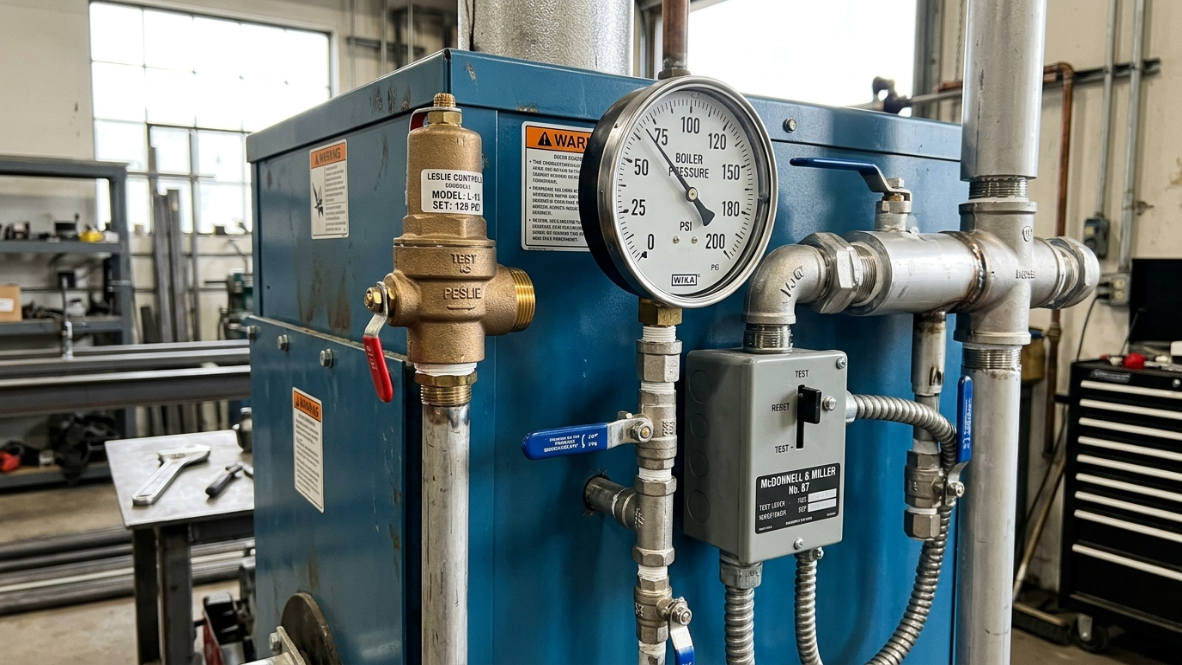
Inspectors focus heavily on safety devices because these are the components that prevent catastrophic failures. If you maintain nothing else, maintain these.
Safety Relief Valve (SRV)
This is the pressure release mechanism that prevents your boiler from exceeding MAWP. The inspector will verify that it’s properly rated, correctly set, not corroded or painted over, and that it can actually lift (open) when needed. A seized or improperly set safety valve is one of the fastest paths to a red tag.
Safety valves have a limited service life and should be replaced or recertified on a schedule. Check your manufacturer’s recommendations.
Low-Water Cutoff (LWCO)
This device automatically shuts down the heating elements if the water level drops too low. Without it, the boiler can overheat and potentially rupture. Inspectors test this device during their examination. A non-functional LWCO is a common cause of failed inspections.
For electric boilers, the LWCO is especially critical because electric heating elements exposed to air can burn out rapidly or cause localized overheating of the vessel.
Pressure Gauge
It must be accurate, readable, and properly connected. The inspector will compare its reading against known standards. If your gauge reads significantly differently from reality, it means you’ve been operating blind, and the inspector will note it.
Blowdown
This is a regular maintenance procedure where water is drained from the bottom of the boiler to remove accumulated sediment, sludge, and dissolved solids. Consistent blowdown reduces scale buildup, which is one of the most common and preventable findings during internal inspections. Keep a log of your blowdown schedule. Inspectors appreciate documented maintenance.
For more on routine boiler care, see this steam boiler maintenance glossary.
ASME CSD-1 (Controls and Safety Devices for Automatically Fired Boilers)
This standard specifies the minimum safety requirements for controls and safety devices on boilers that operate automatically. It covers things like operating controls, high-limit controls, low-water cutoffs, and flame safeguard systems (though flame safeguards apply to gas units, not electric boilers). If your electric boiler has automatic fill, automatic pressure controls, and automatic shutdown features, CSD-1 governs those systems.
Hydrostatic Testing
Practitioners on engineering forums (Eng-Tips, specifically) draw an important distinction that most guides miss. Hydrostatic testing for new construction under ASME code is conducted at pressures between 1.3 to 1.5 times MAWP. Once a boiler is in service, the National Board Inspection Code (NBIC) governs any subsequent pressure testing, and the requirements differ.
For small business owners, the practical takeaway is this: your new ASME-stamped boiler was already hydrostatically tested at the factory before it shipped. You don’t need to worry about this for your initial inspection. It may come up during in-service inspections only if the inspector suspects wall thinning or other structural concerns.
Inspection Intervals: What to Expect
How often your boiler gets inspected depends on two factors: the pressure rating and your state’s laws.
High-pressure boilers (above 15 PSI) generally require annual internal and external inspections. Pennsylvania mandates annual inspections for high-pressure process and power boilers. Illinois follows the same pattern, with high-pressure boilers requiring annual internal inspections.
Low-pressure boilers (15 PSI and below) are typically inspected every two years. Pennsylvania, for example, requires low-pressure boilers to be tested every two years. Illinois follows a similar biennial schedule for low-pressure units used for heating and potable hot water.
These intervals vary by state. The National Board maintains a jurisdiction synopsis covering every U.S. state and Canadian province. Check your specific state before assuming any schedule applies to you.
What does this mean for your shop? If you’re running a small electric boiler at 40 PSI for jewelry cleaning or hat shaping, that’s a high-pressure unit requiring annual inspection in most states. A boiler operating at or below 15 PSI falls into the less frequent schedule. Knowing your operating pressure determines your inspection calendar.
Boiler Inspection Requirements by Boiler Type
Boiler Type | Typical Pressure | Typical Inspection Frequency |
|---|---|---|
Low-pressure steam | 15 PSI or less | Every 2 years (varies by state) |
High-pressure steam | Above 15 PSI | Annual |
Hot water boiler | Varies | Depends on state |
Electric boiler | Depends on pressure | Annual if high pressure |
Non-pressurized steam generator | None | Often exempt |
12-Step Boiler Inspection Preparation Checklist
This should become the centerpiece of the article because the title promises a checklist.
Two Weeks Before Inspection
□ Review previous inspection report
□ Verify inspection date
□ Schedule maintenance if needed
□ Test all safety devices
One Week Before
□ Clean around the boiler
□ Verify nameplate is readable
□ Check pressure gauge
□ Review maintenance logs
Day Before
□ Gather paperwork
□ Verify blowdown records
□ Check for leaks
□ Ensure inspector has access
What Inspectors Actually Check: Your Preparation Checklist
Passing an ASME boiler inspection is not mysterious. Inspectors follow a standardized process, and what they look for is well documented. Here’s what to have ready:
Documentation:
ASME nameplate visible and legible (stamp, NB number, MAWP, serial number)
Current Certificate of Inspection posted
Manufacturer’s Data Report accessible
Maintenance logs, including blowdown records
Water treatment records, if applicable
Safety Devices:
Safety relief valve properly set to MAWP or below, not corroded, not painted shut
Low-water cutoff functional (test it before inspection day)
Pressure gauge accurate and readable
All controls and automatic shutoffs operational
Physical Condition:
No visible corrosion, leaks, or material degradation on external surfaces
No evidence of scale, sludge, or pitting on waterside surfaces (if internal inspection)
No unauthorized modifications or repairs (any repairs must be done by an R stamp holder)
Clear access around the boiler for the inspector to work
Operating Conditions:
Boiler operating at or below MAWP
No bypassed safety interlocks
Proper water level maintained
The National Board notes that inspectors document any evidence of internal corrosion, scale, leaks, overheating, and flame impingement. Having a water treatment routine and maintaining logs shows the inspector you’re proactive, not reactive.
For a broader look at compliance obligations, read this commercial steam boiler safety guide.
Common Reasons Boilers Fail Inspection
According to state inspection agencies and National Board guidance, the most common failures include:
Missing ASME nameplate
Missing National Board registration
Defective relief valve
Low-water cutoff not functioning
Corrosion
Excessive scale
Missing maintenance records
Leaking boiler
Operating above MAWP
Unauthorized repairs
Knowing these issues beforehand dramatically improves your chances of passing the inspection.
Small Boiler Exemptions: When Inspection May Not Apply
Not every piece of steam equipment requires a boiler inspection. Many states have exemptions based on size, pressure, and intended use.
Washington State provides one of the clearest examples. Their legislature explicitly found that “small low-pressure boilers are found in devices such as espresso coffee machines and cleaning equipment common throughout Washington state. Such systems present little threat to public health and safety.” Under RCW 70.79, these devices are exempt from boiler regulation.
Common exemption thresholds across states include:
Boilers below a specified pressure threshold (often 15 PSI for steam)
Unfired pressure vessels under 5 cubic feet at less than 250 PSI
Vessels under 6 inches inside diameter
Non-pressurized steam generators
What this means for small businesses: A non-pressurized flash steamer, like Hoffman’s GEM-III, generates steam on demand without maintaining a pressurized vessel. This type of equipment typically falls outside jurisdictional scope entirely, meaning no boiler permits and no inspections required. That’s a significant advantage for mall locations, retail environments, and businesses that want to avoid the compliance overhead.
However, exemptions vary by state, and “small” means different things in different jurisdictions. Always verify with your state’s chief boiler inspector before assuming your equipment is exempt. If you’re deciding between pressurized and non-pressurized steamers, the inspection question should be part of that decision.
Boiler Inspection Requirements by State
Although ASME standards apply nationwide, inspection laws are established by each state.
Areas that commonly differ include:
Inspection frequency
Permit requirements
Exemption thresholds
Registration procedures
Inspection fees
Always verify requirements with your state’s boiler authority before assuming an exemption applies.
What Happens If You Fail
Failing an ASME boiler inspection isn’t just an inconvenience. The consequences are financial, operational, and in some cases criminal.
Immediate shutdown. A red-tagged boiler cannot operate until repairs are made and the unit passes re-inspection. For a jewelry store that depends on steam cleaning or a dry cleaner that needs steam for finishing, this means lost revenue every day the equipment is down.
Fines that add up fast. Penalties for operating without a valid inspection certificate vary by state, but they’re consistently steep. In Missouri, it’s a Class A misdemeanor with fines reaching $10,000 per day, per object in unlawful use. Virginia starts at $100 per day. Federal code allows civil penalties up to $15,625 per violation per day. Missouri alone issues approximately 3,000 violations annually for code infractions or unsafe conditions.
Insurance implications. Operating without proper ASME certification or a current inspection certificate can result in insurance claim denials. If something goes wrong with an uninspected boiler, your insurer has grounds to reject the claim.
Repair requirements. If your boiler needs repairs to pass re-inspection, those repairs must be performed by a contractor holding an R stamp from the National Board. You can’t just have your handyman weld a patch.
The bottom line: the cost of preparation is always less than the cost of failure.
How Buying ASME-Certified Equipment Makes Passing Easy
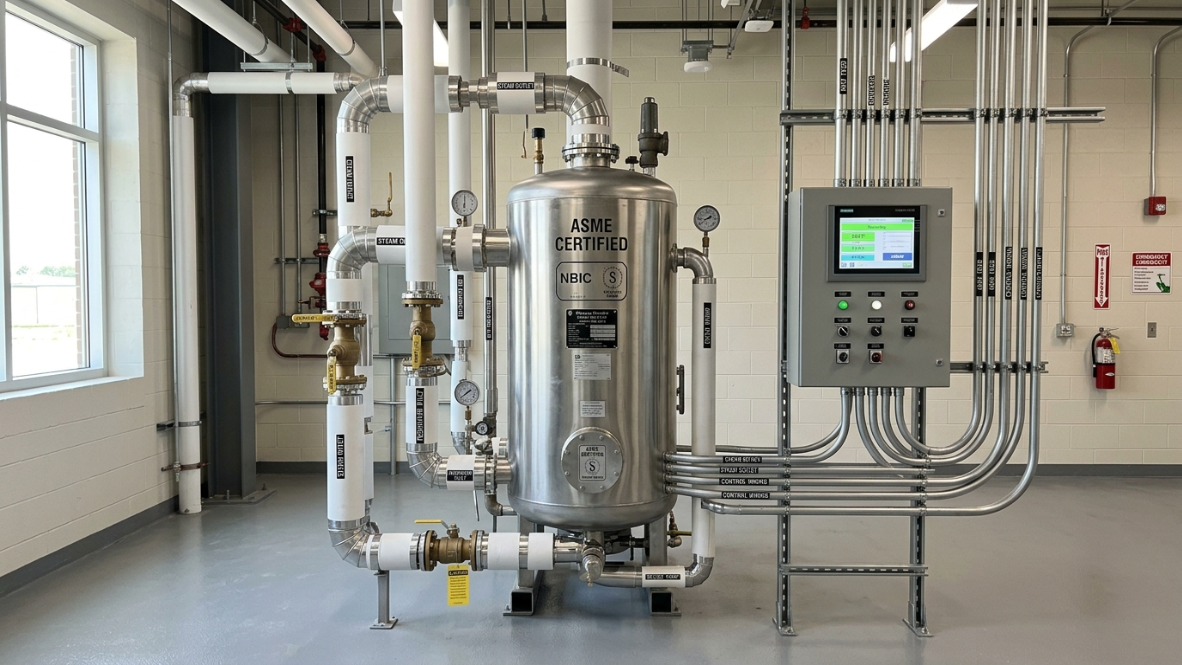
Here’s the good news for small business owners who haven’t bought their boiler yet, or who are considering an upgrade. Purchasing ASME-stamped, NB-registered equipment from a manufacturer that provides compliance documentation turns your first inspection into a paperwork exercise, not an engineering surprise.
When your boiler arrives with the ASME stamp already on the nameplate, the NB registration number already filed, and the Manufacturer’s Data Report already completed, you’ve cleared the hardest hurdles before the inspector ever arrives. The inspection then focuses on verifying that the installation is correct, the safety devices work, and the documentation matches the equipment. That’s a much simpler proposition than trying to prove compliance after the fact.
This is the practical difference between buying from a manufacturer that understands compliance and buying equipment that may or may not meet code. For a comparison of what certification means for your specific situation, see this guide on ASME certified vs. non-certified boilers.
Ready to buy equipment that’s inspection-ready from day one? Hoffman’s Pro line boilers (ELG4, JEL3, and JEL11 series) ship with ASME/UL certification, National Board registration, and full compliance documentation. The Workhorse Essential protection plan adds factory reconditioning, a 47-point inspection, and ASME/UL recertification every 24 months, so you stay inspection-ready year after year.
Typical Boiler Inspection Timeline
Time | What Happens |
|---|---|
2 Weeks Before | Maintenance review |
1 Week Before | Safety checks |
1 Day Before | Gather paperwork |
Inspection Day | External/internal inspection |
Same Day | Pass or deficiency report |
After Repairs | Reinspection if required |
Key Takeaways
Passing an ASME boiler inspection begins with ASME-certified, National Board-registered equipment.
Inspectors focus on documentation, safety devices, physical condition, and operating pressure.
Annual or biennial inspections depend on boiler pressure and state regulations.
Routine maintenance and complete records prevent most inspection failures.
State laws vary, so always confirm inspection schedules and exemption rules with your local authority.
Frequently Asked Questions
What is the first thing an inspector checks during an ASME boiler inspection?
The ASME nameplate. The inspector confirms that the boiler carries a valid ASME code symbol stamp, that the National Board registration number is present, and that the nameplate is legible. Without this stamp, the inspection starts on the wrong foot entirely.
How often do I need a boiler inspection?
It depends on your boiler’s pressure rating and your state. High-pressure boilers (above 15 PSI) typically require annual inspections. Low-pressure boilers are usually inspected every two years. Check the National Board’s jurisdiction synopsis for your state’s specific requirements.
Does my small electric boiler need an inspection?
Possibly not. Many states exempt small, low-pressure boilers below certain size and pressure thresholds. Non-pressurized flash steamers (like Hoffman’s GEM-III) generally fall outside boiler regulation entirely. But exemptions vary by state, so confirm with your local jurisdiction before assuming you’re exempt.
What causes a boiler to fail inspection?
The most common failures involve disabled or improperly set safety relief valves, non-functional low-water cutoffs, visible corrosion or cracking, excessive scale buildup on waterside surfaces, missing or illegible nameplates, and lack of required documentation.
What happens if my boiler gets red-tagged?
You must immediately cease operating the equipment. Repairs must be performed by a contractor holding an R stamp from the National Board. After repairs, the boiler must pass a re-inspection before it can return to service. Operating a red-tagged boiler is a violation that carries daily fines in most states.
What paperwork do I need for a boiler inspection?
Have the Manufacturer’s Data Report available, your current Certificate of Inspection posted, maintenance logs (especially blowdown records and water treatment documentation), and the boiler nameplate visible. The inspector needs to verify that the documentation matches the physical equipment.
Can I do boiler repairs myself to pass an ASME inspection?
Not if they involve welding, structural modifications, or alterations to pressure-bearing components. Such work must be done by an organization holding a valid R stamp from the National Board. Unauthorized repairs are themselves a violation and can result in the boiler being condemned.
How do I pass a boiler inspection ASME if this is my first one?
Buy ASME-stamped, NB-registered equipment from a manufacturer that supplies compliance documentation. Obtain your installation permit before firing the boiler. Verify all safety devices are functional. Have your Manufacturer’s Data Report ready. The first inspection for properly certified equipment is straightforward because the heavy lifting happened at the factory.


