
TL;DR
A small commercial steam boiler is a compact, business-use boiler or steam generator that produces steam for work tasks like jewelry cleaning, hat shaping, garment finishing, and light manufacturing. The term is ambiguous because government energy programs use “small commercial boiler” to describe building heating equipment, while shop owners typically mean a compact electric process-steam unit. The most important concept to understand is the 15 PSI pressure threshold, which separates low-pressure from high-pressure boilers and can change your inspection, insurance, and permit obligations. This glossary covers every term a small business buyer needs before choosing equipment.
Small Commercial Steam Boiler: Glossary for Business Buyers
The phrase “small commercial steam boiler” sounds straightforward. It is not. Depending on who is using the term, it can refer to a gas-fired building heating system, a compact electric steam generator on a jewelry counter, or a pump-fed boiler powering a garment finishing line. That confusion creates real problems for business buyers who end up comparing the wrong categories, buying underpowered equipment, or getting surprised by compliance requirements they did not expect.
This glossary cuts through the noise. It defines every term a small business owner is likely to encounter while shopping for commercial steam equipment, from PSI and kW to ASME stamps and blowdown valves. The goal is to give you a working vocabulary so you can ask better questions, read spec sheets with confidence, and avoid expensive mistakes.
What Is a Small Commercial Steam Boiler?
A small commercial steam boiler is a compact steam-producing unit used by businesses for tasks such as jewelry cleaning, hat shaping, garment finishing, and light manufacturing. Depending on its design, it may generate steam in a pressurized boiler or through an on-demand steam generator. Buyers should compare operating pressure, sustained steam output, electrical requirements, duty cycle, safety controls, and applicable certifications before choosing a unit.
The term can also refer to building-heating equipment, so buyers should confirm that a product is designed for their specific process-steam application. Boiler inspection and permit requirements depend on the equipment’s specifications and the rules adopted by the relevant jurisdiction.
Interested in comparing actual equipment? See the commercial steamer price guide for current pricing by category.
Small Commercial Steam Boiler Terms at a Glance
Term | What It Means | Why Buyers Should Care |
|---|---|---|
PSI | Pounds per square inch, a measure of pressure | Helps determine the required operating pressure and applicable equipment classification |
MAWP | Maximum allowable working pressure | Identifies the vessel’s rated pressure limit |
kW | Kilowatts, a measure of electrical power | Helps assess heating capacity and recovery performance |
Steam output | Amount of steam produced over time | Indicates whether the unit can support sustained workloads |
Gallon capacity | Amount of water the boiler holds | Helps estimate water capacity and operating intervals |
Duty cycle | Intended pattern and duration of operation | Helps determine whether the unit suits intermittent or continuous work |
ASME stamp | Mark associated with construction under an applicable ASME code | Helps verify pressure-vessel construction requirements |
UL/ETL listing | Evidence of evaluation to applicable safety standards | Helps verify electrical and product safety compliance |
Auto-fill | System that automatically replenishes boiler water | Can reduce refill interruptions during frequent use |
Blowdown | Draining boiler water to remove accumulated solids | Helps manage water quality and deposits when required by the manufacturer |
Buying rule: Do not select a commercial steam boiler based on PSI or tank capacity alone. Match pressure, sustained output, electrical supply, duty cycle, maintenance needs, and compliance documentation to the actual job.
What a Small Commercial Steam Boiler Actually Is
A small commercial steam boiler is a compact boiler or steam generator used by a business to produce steam for work tasks such as cleaning, shaping, finishing, pressing, sanitizing, or light production. Unlike a consumer handheld steamer or steam mop, a pressurized commercial boiler may be treated as regulated pressure equipment. That means it may require ASME construction, electrical listing, inspection, and operating documentation.
The word “small” usually means physically compact, something that fits on a counter, a rolling cart, or a small floor footprint in a workroom. It does not automatically mean exempt from boiler codes or safety requirements. Size and exemption status depend on specifications like pressure, volume, and shell diameter, which vary by jurisdiction.
What “Small Commercial” Means (and Does Not Mean)
This is the first point of confusion for most buyers, and it matters more than people realize.
In federal energy purchasing programs, “small commercial boiler” describes building heating equipment. The DOE’s Federal Energy Management Program covers commercial packaged boilers in the range of roughly 300,000 to 2,500,000 Btu/hr, focused on space conditioning and service water heating source. These are gas-fired or oil-fired units tied to HVAC systems. They are not what a jeweler, hat shop, or tailor is looking for.
In the trades and light industrial world, “small commercial steam boiler” almost always means a compact electric steam unit designed for process work. Think of the boiler sitting under a jeweler’s bench, beside a hat shaping station, or in a dry cleaning back room. It produces steam for the work itself, not for heating a building.
In this glossary, “small commercial steam boiler” refers to compact electric steam equipment for business tasks, not building heat boilers, gas-fired systems, or consumer-grade devices.
Steam Boiler vs Commercial Steamer vs Flash Steamer
These three terms get used interchangeably in product listings and casual conversation. They are not the same thing.
Steam boiler
A steam boiler heats water in a vessel to produce steam. If the vessel operates under pressure, pressure equipment rules may apply. The term carries specific implications about construction, safety controls, and potential regulatory oversight.
Commercial steamer
“Commercial steamer” is a marketing term more than a technical one. It can refer to a garment steamer, a jewelry steam cleaner, a hat steamer, or a full pressurized steam boiler. When a product page says “commercial steamer,” you need to look at the specs to know what you are actually getting.
Flash steamer
A flash steamer produces steam on demand without storing it in a pressurized vessel. Some jewelry and garment steam products use this approach. Stuller’s product videos, for example, describe atmospheric jewelry steamers that convert distilled water to dry steam on demand and “require no boiler.” The steam generation method is different, which changes the compliance path, maintenance profile, and output behavior.
The takeaway: “No boiler” does not mean “not commercial.” It means the equipment generates steam differently, and the regulatory and performance implications follow from that difference.
Pressure Terms Every Buyer Should Know
Pressure is the single most important compliance concept in small commercial steam boiler purchasing. Getting this wrong can mean buying equipment you cannot legally operate, or missing out on equipment that would serve you better.
PSI (Pounds Per Square Inch)
PSI measures steam pressure. Higher PSI generally means more forceful steam at the nozzle or tool, but PSI alone does not tell you how much steam the boiler can sustain during continuous work.
Practitioners on Reddit confirm this. Jewelers discussing professional steam cleaners emphasize that pressure specs on paper can mislead. A high-PSI unit with weak recovery may disappoint during a busy day at the bench source. For delicate work, controllability often matters more than raw maximum pressure.
The 15 PSI Threshold
This is the compliance cliff. Under UL 834’s classification, a high-pressure steam boiler furnishes steam at pressures above 15 PSI, while a low-pressure steam boiler operates at not more than 15 PSI source. Crossing this line can change the applicable ASME code section, inspection expectations, permit requirements, and insurer questions.
Think of 15 PSI not as a minor spec detail but as a regulatory boundary. Many small commercial steam boilers operate above 15 PSI (some Hoffman models reach 70 to 90 PSI), so understanding where your equipment falls relative to this threshold matters.
MAWP (Maximum Allowable Working Pressure)
MAWP is the maximum pressure the boiler is designed to safely withstand. Your normal operating pressure should always be below MAWP. If a safety valve opens during normal work, that is not a nuisance, it is a signal to stop and diagnose the cause.
Miniature Boiler
UL 834 defines miniature boilers as units not exceeding 16 inches inside shell diameter, 5 cubic feet gross volume, and 100 PSI MAWP source. Some jurisdictions treat miniature boilers differently for inspection purposes. The classification is worth knowing because many small commercial electric steam boilers fall into this range.
For a deeper look at how boiler permit requirements affect small businesses, that guide covers the state-by-state variation in detail.
The 15 PSI Threshold: What Buyers Need to Know
The 15 pounds per square inch (PSI) threshold is an important distinction in common boiler classifications, but its regulatory effect depends on the applicable code, equipment design, and jurisdiction.
In the United States, low-pressure steam heating boilers are commonly associated with operating pressures at or below 15 PSIG, while high-pressure steam boilers operate above that threshold under the applicable classification. However, a product’s pressure rating alone does not establish whether it is exempt from inspection or permitting.
Before purchasing a steam boiler, verify:
Operating pressure: The pressure range the unit is designed to maintain during normal use.
Maximum allowable working pressure (MAWP): The maximum pressure permitted by the vessel’s design and documentation.
Applicable construction standard: The ASME Boiler and Pressure Vessel Code section or other standard relevant to the equipment.
Jurisdictional requirements: Local definitions, exemptions, inspection requirements, and operating permits.
Installation and insurance requirements: Additional conditions imposed by the property owner, authority having jurisdiction, or insurer.
Do not assume that a boiler operating at or below 15 PSI is automatically exempt from inspection or permitting. Confirm the requirements for the specific equipment and installation before ordering.
Certification and Compliance Terms
Certification terms are not interchangeable. Each one covers a different aspect of the equipment, and confusing them can create problems with inspectors, insurers, and landlords.
ASME (American Society of Mechanical Engineers)
ASME is the organization behind the Boiler and Pressure Vessel Code (BPVC). When someone says a boiler is “ASME certified,” they mean the pressure vessel was constructed under a code-governed quality and inspection system.
ASME certification marks and code designators identify particular types of equipment and the applicable construction requirements. Common designators associated with boiler equipment include:
S: Associated with power boilers under the applicable ASME certification scope.
E: Associated with electric boilers within the applicable ASME certification scope.
M: Associated with miniature boilers.
H: Associated with heating boilers.
These designators are not interchangeable, and the appropriate certification depends on the equipment’s design and intended classification. Do not assume that every compact electric steam generator requires the same stamp. Ask the manufacturer for the applicable code section, nameplate information, and supporting documentation, and confirm acceptance with the relevant jurisdiction.
Each designator corresponds to a specific BPVC section and equipment type. Understanding which stamp applies to your boiler helps when dealing with inspectors or insurers. For a full walkthrough, see this guide to ASME certification explained.
UL Listing (and ETL/cETL)
ASME covers the pressure vessel. UL or another Nationally Recognized Testing Laboratory (like ETL) covers the electrical safety system. UL 834 specifically covers electric boilers for commercial and industrial hot-water or steam applications, including ASME-stamped vessels, safety valves, pressure and temperature controls, wiring, and auxiliary equipment assembled as a unit.
A small business buying an electric pressurized steam boiler needs both: ASME for the pressure side, UL/ETL for the electrical side.
National Board Registration
The National Board of Boiler and Pressure Vessel Inspectors maintains permanent records of registered pressure-retaining items. Registration indicates that the item was constructed in accordance with the ASME Code and inspected by a qualified NBBI Commissioned Inspector source.
The National Board number is the boiler’s permanent traceability record. It helps inspectors, insurers, and service providers verify what the equipment is and how it was built. Think of it like a VIN number for a pressure vessel.
Certificate of Inspection and Operating Permit
A certificate of inspection is the document a jurisdiction may require to prove a boiler has been inspected and is allowed to operate. The key word is “may.” Requirements vary by state, equipment type, pressure rating, use, and local exemptions. The National Board’s jurisdiction synopsis shows that many states require annual certificate inspections for power and high-pressure boilers, with biennial cycles common for low-pressure steam boilers, but there is no single national rule source.
Practical step: Before installing a pressurized boiler, check with your state boiler office, local fire marshal, landlord or mall property manager, and insurer. Do this before you buy, not after delivery.
Sizing and Performance Terms
Most buyers default to comparing PSI because it is the easiest number to find on a product page. That is a mistake. Here is a better framework for reading specs.
kW (Kilowatt Rating)
The kW rating tells you how much electrical power the boiler consumes, and it is one of the best proxies for steam recovery speed. Gallons tell you how much water the tank holds. kW tells you how fast the boiler can turn that water into steam.
A bigger tank with weak wattage can run longer between fills but recovers slowly after heavy use. A smaller tank with higher wattage recovers faster but may need more frequent refills. Neither is inherently better; the right balance depends on your workflow.
The shorthand: Gallons affect runtime. kW affects recovery. PSI affects force. Duty cycle affects survival.
For a breakdown of power requirements by model, that guide covers voltage, amperage, and phase in practical terms.
PSI vs. kW vs. Steam Output: What Is the Difference?
PSI, kW, and steam output describe different aspects of a commercial steam boiler. They should be evaluated together rather than used interchangeably.
Specification | What It Measures | What It Helps You Evaluate |
|---|---|---|
PSI | Steam pressure | Whether the operating pressure suits the application |
kW | Electrical power input | The heating capacity available to produce steam |
Steam output | Quantity of steam produced over time | Whether the unit can sustain the workload |
Tank capacity | Water held in the boiler | Water capacity and operating intervals |
Recovery time | Time required to rebuild pressure or steam availability after demand | How well the unit handles repeated or sustained use |
Example: Two boilers may have similar pressure ratings but perform differently during a busy workday. If one can sustain the required steam output and recover more effectively under the same workload, it may be better suited to continuous production.
Do not assume that a higher kW rating guarantees a particular steam output or that a larger tank guarantees faster recovery. Compare manufacturer-rated output, operating conditions, recovery data, and electrical requirements before making a purchase.
Buyer tip: If the manufacturer does not publish sustained output or recovery information, ask how the unit performs during repeated use and whether it is rated for your intended duty cycle.
Voltage and Phase
Small commercial electric steam boilers typically come in 110/120V (standard outlet) or 220/240V configurations. Some larger units require three-phase power, which is common in industrial spaces but not always available in retail or small commercial locations.
Check your electrical service before ordering. A 220V boiler connected to a 110V circuit will not work, and upgrading electrical service adds time and cost to installation.
Gallon Capacity vs Steam Output
Gallon capacity is the amount of water the boiler holds. It is frequently confused with power. A 2-gallon boiler is not automatically twice as productive as a 1-gallon boiler; it simply holds more water. Output depends on wattage, heating surface area, controls, operating pressure, and duty cycle.
Steam output, often expressed as pounds per hour in industrial contexts, tells you how much steam the boiler can actually produce over time. If two boilers have the same PSI but one cannot maintain pressure during continuous work, the unit with higher sustained output is the better commercial choice.
Duty Cycle
Duty cycle describes whether a boiler is built for intermittent use, frequent daily use, or continuous operation. This is the term most buyers ignore, and it is the one that predicts whether the equipment will survive real-world workloads.
A jeweler who steams a few pieces per hour has a different duty cycle requirement than a hat bar shaping hats all day or a production line needing steady steam. One practitioner on LinkedIn put it bluntly: a unit sized only for average load can fail when production ramps, and load profile plus water quality should come before a quote source.
Do not choose by gallons alone. Choose by workflow: steam force, recovery speed, water capacity, fill method, and daily duty cycle.
Spec | What buyers think it means | What it actually tells you |
|---|---|---|
PSI | Power | Steam force and pressure, not sustained output |
Gallons | Power | Water capacity and runtime, not recovery |
kW | Electrical size | Heat input and recovery speed |
Duty cycle | Often ignored | Whether the unit can survive the real workload |
Fill method | Convenience | Downtime profile and labor burden |
Certification | Fine print | Inspection, insurance, and legal acceptance |
Looking for equipment matched to your workload? The electric steam boiler guide walks through model selection by trade and use case.
Fill Method: Manual vs Auto-Fill
How water gets into the boiler affects daily workflow more than most buyers expect.
Manual Fill
The operator depressurizes and cools the boiler as required, opens it, adds water, and waits for pressure to rebuild. Manual fill keeps upfront cost and system complexity low. It works well for intermittent use, but the downtime adds up fast in higher-volume shops.
Auto-Fill and Pump-Fill
A pump and water supply maintain water level automatically. The boiler can keep producing steam without operator intervention for refills. Auto-fill or pump-fill systems cost more but dramatically reduce labor and downtime in continuous or high-volume workflows.
For a side-by-side comparison, the guide on manual vs auto-fill boilers breaks down the trade-offs by use case.
Safety Control Terms
Every pressurized steam boiler should have several safety controls. Understanding what they do helps you operate the equipment safely and recognize when something needs attention.
Low-Water Cutoff
A low-water cutoff shuts down the boiler or heating element when water falls below a safe level. Running a boiler with insufficient water can damage heating elements and create a serious safety hazard. Sussman’s small electric steam generator literature describes this as a controller that maintains proper water level and shuts the unit off when boiler water drops below safe operating level.
Practitioners on Reddit reinforce this point. One user with shop experience advises never running a steamer close to empty and turning units off overnight to prevent damage source.
Safety Valve (Pressure Relief Valve)
A safety valve opens to reduce pressure if it rises too high. UL 834 requires that covered electric boilers include one or more safety valves or safety relief valves conforming to ASME requirements. Never plug, bypass, or modify a safety valve. If it opens or leaks during normal operation, treat it as a maintenance and safety issue, not an annoyance.
Sight Glass
A sight glass is a transparent tube or window that lets the operator see the water level inside the boiler. If the sight glass is dirty, cloudy, or unreadable, the operator loses a simple but critical check against low-water problems. Clean it regularly.
Pressure Gauge and Pressure Control
The pressure gauge shows current boiler pressure. The pressure control turns heating elements on and off to maintain the target pressure range. Some boilers also include a manual-reset high-limit control that requires the operator to physically reset the unit after a high-limit safety event, preventing automatic restart after an abnormal condition.
Water and Maintenance Terms
Water quality is not a footnote. It is the single biggest factor in the long-term reliability of a small commercial steam boiler. Practitioners and manufacturers agree on this, even when they disagree on the specifics.
Feedwater, Hard Water, and TDS
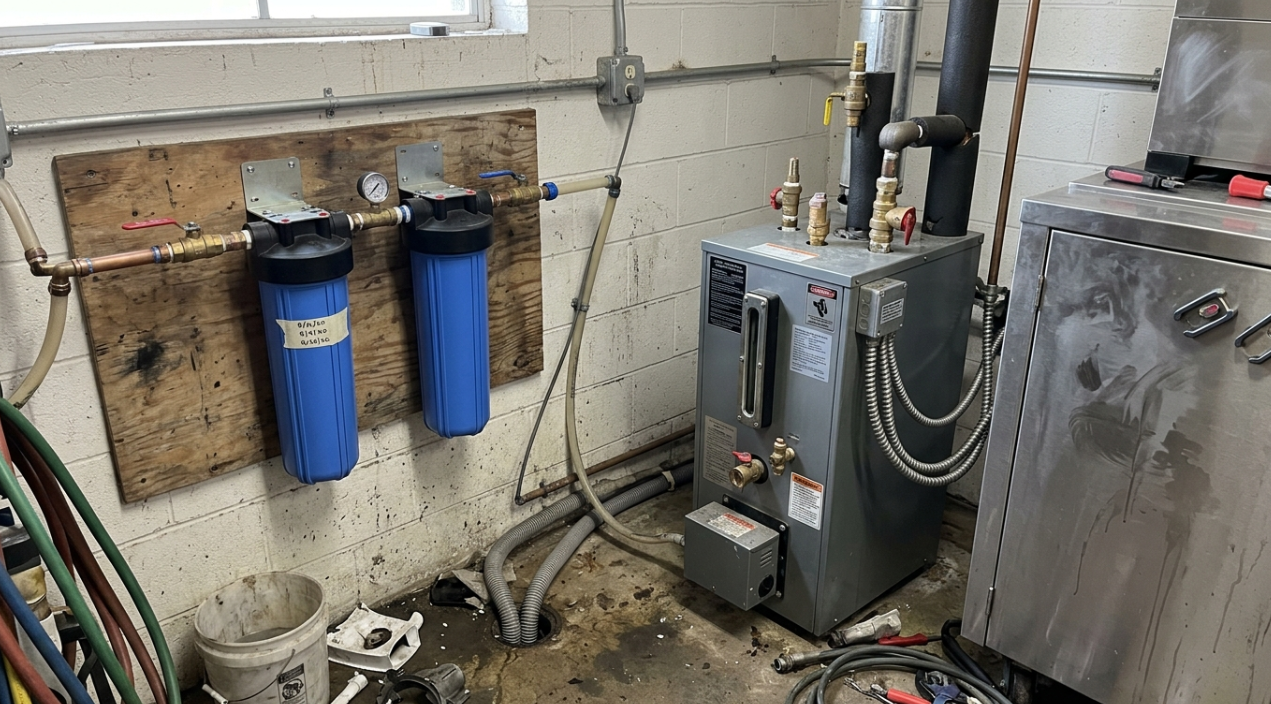
Feedwater is the water supplied to the boiler. Hard water is water high in dissolved minerals like calcium and magnesium. TDS (total dissolved solids) is the measurement of all dissolved substances in the water.
As water turns into steam, dissolved solids stay behind and concentrate in the boiler. The EPA explains that if TDS gets too high, the result is scale buildup, corrosion, or both source. EPA recommends pre-treating boiler make-up water using options like water softeners, reverse osmosis, or demineralization.
Scale
Scale is mineral buildup on heating surfaces. It acts as insulation, reducing heat transfer and slowing steam production. In electric boilers, scale on heating elements forces them to work harder and run hotter, which shortens their life. A LinkedIn commenter on electric boiler technology called advanced water treatment “the real backbone” of electric boiler reliability, noting that zero tolerance for scaling is essential to protect heating elements.
Blowdown
Blowdown is the periodic draining of water from a boiler to remove accumulated dissolved solids and sludge. The DOE defines it plainly: insufficient blowdown leads to deposits or carryover, while excessive blowdown wastes water, energy, and chemicals source. For small manual-fill shop boilers, the process is simpler than in a large industrial plant, but the underlying reason is identical.
Descaling and Water Treatment
Descaling means removing mineral buildup that has already formed. Water treatment means managing water quality before it enters the boiler to prevent scale and corrosion from forming in the first place.
Here is where manufacturer instructions matter. Ganoksin’s Orchid jewelry forum has a long-running debate about distilled versus tap water. One Gesswein representative said Reimers recommended ordinary tap water plus regular cleaning, while a technical-service participant argued distilled water avoids mineral scale and costly rebuilds. Both had evidence on their side because the right answer depends on the manufacturer’s design, materials, and warranty terms.
Best practice: Use the water your manufacturer specifies. If your local water is hard, treat water quality as a maintenance issue, not an afterthought. For detailed guidance, the water quality standards guide covers testing, treatment, and manufacturer recommendations.
Wear Parts and Service Life
Caps, gaskets, valves, heating elements, hoses, nozzles, and seals all wear out over time. This is normal. Practitioners on the r/jewelers subreddit discuss this openly. One user reported going through two Reliable units in about 10 years, replacing caps and gaskets along the way. Another reported using two Hoffman steamers over 30 years, with the first lasting 24 years source. The difference between frustration and long service life often comes down to maintenance habits, not brand alone.
Professional steam equipment is not “set and forget.” Turn units off overnight. Flush them regularly. Replace wear parts on schedule. Keep maintenance logs.
Common Applications for Small Commercial Steam Boilers
The terms in this glossary show up differently depending on the trade. Here is how they translate to real-world use cases.
Jewelry Cleaning
Jewelers need controlled, forceful steam to remove polishing compounds, oils, and residue from finished pieces. Not all stones and treatments can tolerate steam, so controllability matters alongside pressure. A jeweler using steam a few times an hour needs different duty cycle capacity than a production bench running all day.
Hat Shaping
Hat shops need heat, directed steam, moisture control, and typically hand or foot control. Practitioners on r/CowboyHats debate equipment choices intensely. One user preferred a Jiffy J-4000H for its lower moisture and lower price, while another insisted that a real shop steamer classified as a boiler produced a much hotter plume and worked better for straw hats. Steam quality, heat, and moisture level matter alongside PSI for this work.
Garment Finishing and Tailoring
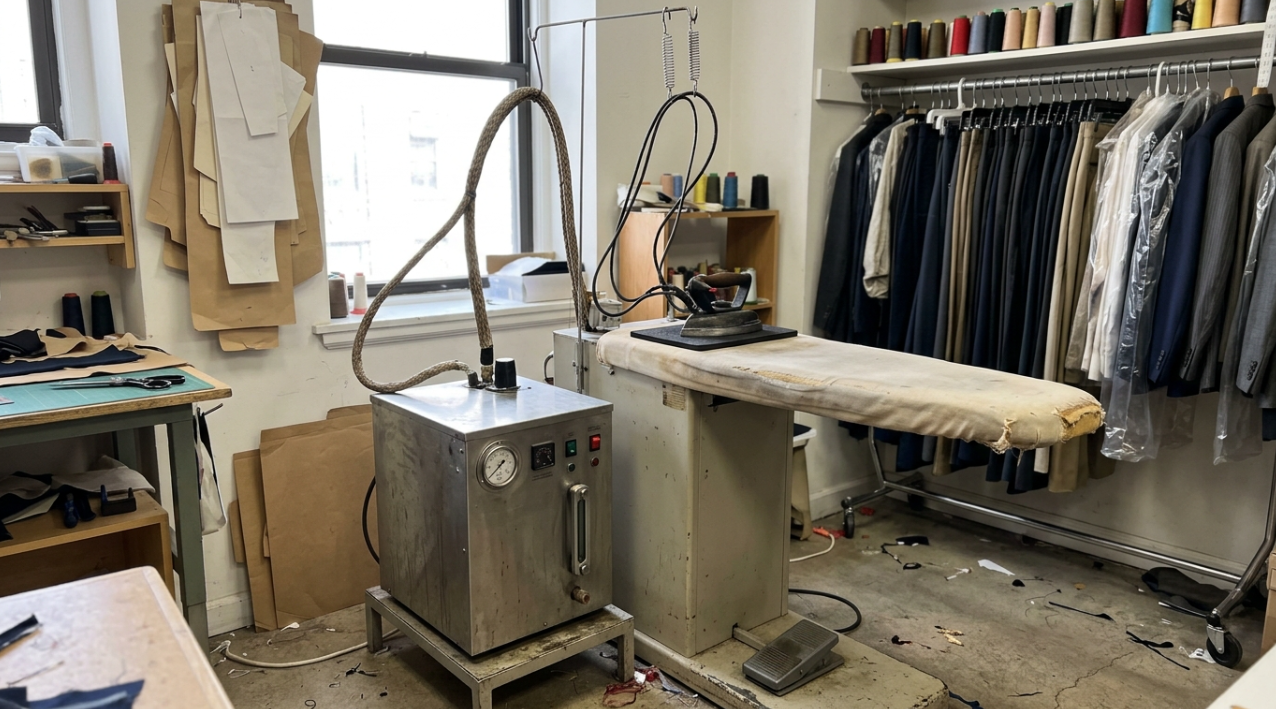
Steady steam for irons, brushes, finishing tables, or spot work. Recovery speed and duty cycle are critical for shops doing continuous pressing throughout the day.
Upholstery Restoration
Controlled steam with appropriate accessories to avoid over-wetting fabric and padding. Water quality matters here too because mineral-laden steam can leave marks on fabric.
Dental and Lab Work, Shrink Packaging, Light Manufacturing
These applications share a common theme: they need reliable, consistent steam output and equipment that can handle the duty cycle the work demands. A dental lab cleaning wax patterns and a shrink-packaging line wrapping product all day have different volume needs but the same underlying requirement for uptime and predictable performance.
Which Steam Boiler Specifications Matter for Each Application?
Application | Main Buying Priority | Specifications to Check |
|---|---|---|
Jewelry cleaning | Controlled steam delivery for delicate work | Pressure control, nozzle options, recovery, and manufacturer-approved use |
Hat shaping | Directed steam with suitable moisture and heat characteristics | Steam delivery, shaping accessories, output consistency, and controls |
Garment finishing | Consistent steam during repeated pressing tasks | Sustained output, recovery, iron compatibility, and duty cycle |
Upholstery restoration | Appropriate moisture control for the material | Steam regulation, accessories, and manufacturer guidance for the surface |
Dental and laboratory work | Consistent output and compatibility with the intended process | Required steam conditions, cleanliness requirements, output, and documented suitability |
Shrink packaging and light manufacturing | Reliable supply during repeated or sustained production | Output rate, recovery, duty cycle, electrical service, and integration requirements |
These are starting points, not universal equipment specifications. Requirements vary by application and by the specific tool or process being supplied. Confirm compatibility with the equipment manufacturer before selecting a boiler.
How to Choose the Right Equipment Class
Before comparing models, figure out your equipment class. This table helps match your situation to the right starting point.
If your situation is… | Consider… |
|---|---|
Occasional retail steaming or permit-sensitive space | Flash steamer or non-pressurized commercial steamer |
Jewelry counter or bench work | Small pressurized boiler or jewelry steam cleaner |
Hat shop with daily shaping | Boiler with shaping accessories and strong steam control |
Boutique or tailor with light finishing work | 110/120V small commercial steam boiler |
Production or light industrial use | Higher-capacity or pump-fill boiler |
Continuous daily steam demand | Auto-fill, continuous-duty boiler |
The 5-Question Test
Before choosing a small commercial steam boiler, answer these questions:
What work will the steam do? Jewelry cleaning, hat shaping, garment finishing, shrink packaging, upholstery, lab work, or something else.
How often will it run? Occasional bursts, daily counter use, or continuous production.
What pressure range is needed? Non-pressurized steam may be enough for some tasks; higher-pressure work may require a regulated boiler.
What electrical service is available? Standard 110/120V, 220/240V, or three-phase power.
What documentation will an inspector, landlord, mall, or insurer require? ASME stamp, UL/ETL listing, National Board number, certificate of inspection, maintenance records.
Need help matching equipment to your workflow? The best commercial steamers guide covers recommendations by trade.
How to Read a Small Commercial Steam Boiler Spec Sheet
Spec sheets pack a lot of information into a small space. Here is what to look for and verify before purchasing.
Performance specs:
Operating pressure range (PSI)
MAWP
Tank capacity (gallons)
kW rating
Voltage, amperage, and phase
Heat-up time
Recovery behavior under load
Duty cycle rating (intermittent, frequent, or continuous)
Compliance documentation:
ASME stamp and designator (S, E, M, or H)
UL, ETL, or cETL electrical listing
National Board registration number
Safety controls:
Safety valve set pressure
Low-water cutoff
Pressure gauge
Sight glass
Manual-reset high-limit control
Operational details:
Manual fill or auto-fill
Water quality requirements
Required clearance, ventilation, and drainage
Blowdown and drain valve
Ownership details:
Warranty coverage and duration
Replacement parts availability
Service and technical support terms
Questions to Ask Before Buying a Small Commercial Steam Boiler
Before ordering a small commercial steam boiler, ask the supplier questions that go beyond the headline PSI and tank capacity.
1. Performance and Capacity
What is the rated steam output, and under what operating conditions was it measured?
How quickly does the unit recover after repeated steam use?
Is it designed for intermittent, frequent, or continuous operation?
Can it support the tools and accessories I intend to connect?
2. Electrical and Installation Requirements
What voltage, amperage, and phase does the unit require?
Will my existing electrical service support it?
Does installation require a dedicated circuit, additional plumbing, drainage, or other site modifications?
What clearances and environmental conditions are required?
3. Certification and Compliance
Which construction code or standard applies to this model?
What ASME documentation, if any, is supplied?
Is the complete electrical assembly listed by UL, ETL, or another recognized testing laboratory?
Does the relevant jurisdiction require an inspection, operating permit, or other documentation?
Can the supplier provide the nameplate information and records needed for verification?
4. Maintenance and Ownership Costs
What water quality does the manufacturer specify?
How often must the boiler be flushed, descaled, inspected, or serviced?
Which components are considered routine wear parts?
Are replacement valves, gaskets, heating elements, and other parts readily available?
What does the warranty cover, and who provides technical support?
5. Final Fit for Your Business
Will the equipment handle the busiest part of my working day?
How much downtime will refilling or routine maintenance create?
What happens if the boiler needs service during a production shift?
Is a pressurized boiler necessary, or would an appropriate on-demand steamer meet my needs?
Before you commit: Obtain the manufacturer’s technical documentation, confirm site and electrical compatibility, and verify regulatory requirements with the relevant authority. A supplier’s recommendation alone does not establish that the equipment is suitable or legally acceptable for your installation.
Total Cost of Ownership: Beyond the Boiler’s Purchase Price
The purchase price of a small commercial steam boiler is only one part of its total cost of ownership. Installation, electrical upgrades, water treatment, maintenance, and downtime can affect the actual cost of operating the equipment over time.
Cost Category | What to Include | Why It Matters |
|---|---|---|
Equipment purchase | Boiler, standard accessories, and required controls | Establishes the initial equipment cost |
Installation | Electrical work, plumbing, drainage, and site preparation | May add significant upfront expense |
Utilities | Electricity and water | Depends on operating hours, load, and local utility rates |
Water treatment | Filters, treatment equipment, or approved treatment supplies | Helps manage water-related maintenance risks |
Routine maintenance | Cleaning, descaling, inspections, and servicing | Helps maintain performance and reliability |
Replacement parts | Gaskets, valves, hoses, heating elements, and seals | Affects long-term repair costs |
Downtime | Lost production or interrupted service during maintenance and repairs | Can be especially important in busy shops |
Compliance | Required inspections, permits, and related documentation | Depends on the equipment and jurisdiction |
How to Compare Two Boilers Fairly
Estimate the costs over the same ownership period for each model. Use the manufacturer’s operating data, your expected workload, actual utility rates, quoted installation costs, and published maintenance requirements.
Do not assume that the lowest purchase price produces the lowest long-term cost. A model with easier servicing, accessible replacement parts, and adequate capacity for your workload may provide better overall value.
For a realistic comparison, request an itemized quote covering the boiler, accessories, installation requirements, documentation, warranty, and ongoing service needs.
When a Small Commercial Boiler Is More Than You Need
A pressurized steam boiler may be unnecessary if you only need occasional garment steaming, light hat touchups, or non-pressurized steam in a permit-sensitive retail space. A flash steamer or commercial garment and hat steamer may be enough.
Jiffy’s J-4000H, for example, is positioned as a commercial hat steamer with a 1500-watt heating element and a stainless internal boiler tank, designed for quickly shaping and blocking hats. For a small retail store doing light touch-up work, that kind of equipment might be the right fit.
A pressurized small commercial steam boiler becomes the better choice when you need higher pressure, sustained output for longer work sessions, multiple accessories (irons, spray guns, shaping heads), higher-volume production, or documented compliance for inspectors and insurers. The equipment class should match the work, not the other way around.
Documents to Keep With Your Small Commercial Steam Boiler
Inspectors, insurers, landlords, and future buyers may all ask for documentation. Keep these records organized and accessible:
Owner’s manual
ASME documentation or data report (if applicable)
National Board registration number (if applicable)
UL/ETL/cETL electrical listing documentation
State or local inspection certificate (if applicable)
Installation records (date, location, electrical hookup details)
Maintenance log (descaling, blowdown, element replacement, valve service)
Water treatment and descaling records
Safety valve service records
Warranty and support records
Documentation is not busywork. It protects you during inspections, insurance claims, equipment resale, and any dispute about whether the boiler was properly maintained.
Frequently Asked Questions
What is a small commercial steam boiler?
A small commercial steam boiler is a compact, business-use boiler or steam generator that heats water to produce steam for tasks like cleaning, shaping, finishing, pressing, or light production. In the trades, it usually refers to an electric steam unit designed for process work, not a gas-fired building heat boiler.
Is a commercial steamer the same as a steam boiler?
Not necessarily. “Commercial steamer” is a broad market term that can describe everything from a garment steamer to a pressurized electric boiler. A steam boiler specifically implies a vessel that heats water to produce steam, often under pressure, which may trigger regulatory requirements. The distinction matters for compliance and performance.
What does the 15 PSI threshold mean for small business buyers?
Under UL 834 classifications, steam above 15 PSI is considered high-pressure and steam at or below 15 PSI is low-pressure. Crossing this line can change the applicable ASME code section, inspection schedule, permit requirements, and insurer expectations. It is a regulatory boundary, not just a performance spec.
What water should I use in a small commercial steam boiler?
Use whatever the manufacturer specifies. Some recommend distilled water, others recommend treated tap water, and others have different requirements depending on the model and materials. If your local water is hard (high in dissolved minerals), treat water quality as a priority maintenance concern. Scale buildup from poor water quality is one of the top causes of heating element failure and reduced performance.
How do ASME, UL, and National Board certification differ?
ASME certification covers the pressure vessel’s construction under the Boiler and Pressure Vessel Code. UL (or ETL) listing covers the electrical safety system. National Board registration provides permanent traceability, confirming the equipment was built to ASME Code and inspected by a qualified commissioned inspector. A properly certified small commercial electric steam boiler should have all three where applicable.
Do I need a permit to operate a small commercial steam boiler?
It depends on your jurisdiction. Requirements vary by state, equipment type, pressure rating, volume, and use. Some jurisdictions exempt miniature boilers or low-pressure units from certain inspection requirements, while others do not. Check with your state boiler office, local fire marshal, property manager, and insurer before installation.
How often does a small commercial steam boiler need maintenance?
At minimum, operators should follow the manufacturer’s recommended schedule for descaling, blowdown, element inspection, gasket and valve checks, and sight glass cleaning. Daily habits matter too: turn the boiler off overnight, do not run it close to empty, and flush it regularly. Consistent maintenance is the biggest predictor of long equipment life.
What is the difference between PSI and steam output?
PSI measures the pressure of the steam. Steam output measures how much steam the boiler can produce over time (often in pounds per hour). A boiler with high PSI but weak recovery may not keep up during continuous work. Both specs matter, but sustained steam output is often more important for production workflows than peak PSI.
What is the difference between boiler capacity and steam output?
Boiler capacity describes how much water the unit holds, while steam output describes how much steam it produces over a specified period. A larger tank does not necessarily produce steam faster. Compare rated output, heating power, recovery performance, and duty cycle when choosing equipment for frequent or continuous use.
Does every small commercial steam boiler need an ASME stamp?
Not necessarily. Applicable construction requirements depend on the equipment’s design, classification, intended use, and the rules adopted by the relevant jurisdiction. Ask the manufacturer which construction code applies and what documentation is provided. Confirm any requirements with the authority responsible for the installation before purchasing.
Can I install a commercial electric steam boiler using a standard outlet?
Some smaller models are designed for standard electrical supplies, while others require a dedicated circuit, a higher voltage, or three-phase power. Check the manufacturer’s voltage, amperage, phase, and circuit requirements against the building’s electrical service before ordering. Have a qualified electrician assess any installation or upgrade requirements.
If you are comparing small commercial electric steam equipment for jewelry cleaning, hat shaping, garment finishing, upholstery, or light production, the commercial steamer buyer’s guide can help match the right equipment class to your specific workflow and compliance needs.


