

TL;DR
Small industrial steam boiler sizing means matching your boiler’s steam output to your actual daily workload, not buying the biggest unit you can afford. For small shops running electric boilers between 1.5 kW and 36 kW, the key sizing factors are your electrical service (110V vs. 220V vs. 3-phase), your required operating pressure (40 to 90 PSI), and whether you need intermittent or continuous steam. Oversizing causes short cycling and wasted electricity. Undersizing creates weak steam and production bottlenecks.
Direct Answer: How Do You Size a Small Industrial Steam Boiler?
For most small commercial shops, the correct boiler is the smallest model capable of maintaining your required PSI throughout your busiest production period. Oversizing wastes electricity through short cycling, while undersizing causes pressure loss and slows production.
If you need a quick answer, size a small industrial steam boiler using these five factors:
Step | What to Check | Why It Matters |
|---|---|---|
1 | Steam application | Jewelry cleaning, garment finishing, hat shaping, shrink packaging, etc. all require different steam output. |
2 | Required PSI | Most commercial applications require 40–90 PSI. |
3 | Electrical service | Your available voltage (110V, 220V, or 3-phase) limits the maximum boiler size you can install. |
4 | Duty cycle | Continuous production requires much more capacity than occasional steam bursts. |
5 | Safety margin | Add approximately 10–20% additional capacity to handle peak demand without oversizing. |
Why Sizing Matters, Even for Small Boilers
Every guide on the internet about steam boiler sizing assumes you’re running a factory with hundreds of boiler horsepower. That’s not helpful if you’re a jeweler trying to blast residue off a ring, a hatter shaping felt crowns, or a tailor pressing suits in a 400-square-foot shop.
But the physics don’t care about the size of your operation. An oversized boiler short cycles, burning through heating elements and wasting electricity. An undersized boiler can’t keep up, leaving you with weak, wet steam that slows production. Small industrial steam boiler sizing is the process of finding the sweet spot between those two problems.
The goal is straightforward: match your boiler’s steam output to what your tasks actually demand, factoring in your electrical service, your duty cycle, and the pressure your work requires.
Browse Hoffman’s commercial steamers to see how different models map to different shop sizes and applications.
What Is Steam Boiler Sizing?
Steam boiler sizing is the calculation of how much steam a boiler needs to produce, at what pressure, and for how long to meet the demands of a specific operation. In large industrial settings, this involves complex load analyses across dozens of process lines. For small shops and light industrial users, it’s simpler but no less important.
Correct sizing means your boiler produces enough steam at the right pressure to complete your tasks efficiently, without long recovery waits between uses and without the waste that comes from running equipment far below its capacity.
Core Sizing Terms Explained
Understanding a few key terms will make every spec sheet and product listing instantly more readable. Here’s what each one means and why it matters for small operations.
Boiler Horsepower (BHP)
Boiler horsepower is the standard measure of a steam boiler’s output capacity. One BHP is defined as the energy required to turn 34.5 pounds of water at 212°F into steam in one hour. That equals roughly 33,475 BTU/hr or about 10 kW of electrical input.
Why this matters for small shops: most small commercial electric boilers operate below 5 BHP. A 3 kW unit is roughly 0.3 BHP. A 36 kW unit is approximately 3.6 BHP. When sizing guides talk about “50 BHP minimum,” they’re describing equipment ten times larger than what a typical small business needs.
BTU (British Thermal Unit)
A BTU is the amount of heat needed to raise one pound of water by 1°F. It’s the universal currency for measuring heat energy. The conversion that matters: 1 BHP equals approximately 33,475 BTU/hr.
For small electric boilers, BTU ratings help you compare output across different manufacturers who may list specs in different units.
Pounds Per Hour (PPH or lbs/hr)
This is the rate at which a boiler produces steam. One BHP produces about 34.5 lbs/hr of steam at atmospheric pressure. A small shop boiler producing 3 to 12 lbs/hr of steam is often plenty for single-station operations like jewelry cleaning or garment finishing.
kW Rating
For electric boilers, the kilowatt rating is the most practical sizing number because it tells you exactly how much electrical power the boiler draws and, since electric boilers are nearly 100% efficient, how much heat goes into making steam. Roughly 1 kW produces about 3.4 lbs/hr of steam.
The critical connection: your available electrical service determines your maximum kW. A standard 110V/15A circuit maxes out around 1.5 kW. A 220V circuit opens up 3 kW or more. Three-phase power supports continuous-duty industrial boilers at 17 kW and above.
For a deeper breakdown of how voltage affects your options, see this 110V vs. 220V steamer guide.
Steam Pressure (PSI)
Steam pressure, measured in pounds per square inch, determines steam temperature and dryness. A fundamental relationship exists between pressure and temperature: as pressure increases, the boiling point rises, and the resulting steam gets hotter and drier.
At 40 PSI, steam reaches about 287°F. At 65 PSI, it hits roughly 311°F, producing dry vapor ideal for cleaning without water spots. At 90 PSI, steam temperature climbs past 330°F, delivering the force needed for stubborn residue and heavy-duty shaping work.
For more on matching pressure to specific tasks, the PSI settings guide for jewelry steamers covers this in detail.
The 15 PSI ASME Threshold
This is a regulatory line that every commercial boiler buyer needs to understand. Any boiler operating above 15 PSI falls under ASME Boiler and Pressure Vessel Code (Section I) jurisdiction. That means ASME certification is required for legal commercial operation.
Since most small industrial tasks require 40 PSI or higher, virtually every commercial steam boiler used in a professional setting needs ASME certification. Hobby steamers and consumer units that operate below 15 PSI simply can’t deliver the pressure required for professional results.
Operating Pressure Range and Pressure Switch Cycling
Every pressurized boiler has a pressure switch that controls a cut-in point (when the heating element turns on) and a cut-out point (when it shuts off). For example, a boiler set to operate between 55 and 70 PSI will heat until it reaches 70, shut off, and restart when pressure drops to 55.
This cycling is normal. Problems start when the boiler is so oversized that it hits the cut-out point almost immediately after firing, which is called short cycling.
Tank / Gallon Capacity
Small boiler spec sheets often list capacity in gallons (1 gallon, 2 gallons, 6 gallons). This number describes the water reservoir, not the steam output rate. A 6-gallon tank doesn’t mean 6 gallons of steam per hour. Tank volume determines how long you can operate between refills, especially on manual-fill systems. The actual steam production rate depends on the wattage of the heating elements.
Think of it this way: gallon capacity is your fuel tank, kW is your engine.
Safety Margin
Standard practice is to add a 10 to 20% buffer above your calculated steam demand. This accounts for unexpected peaks, simultaneous tool use, or slightly degraded performance as heating elements age. For small shops with variable demand, practitioners on forums like DoItYourself.com push back against sizing too tightly, arguing that real-world conditions (recovery time, concurrent use, cold-start mornings) matter more than hitting an exact number.
Fuel-to-Steam Efficiency
Gas-fired boilers typically convert 80 to 85% of fuel energy into steam, losing the rest to combustion exhaust and radiant heat. Electric boilers approach 98 to 100% efficiency because there’s no combustion loss. Every watt goes into heating water.
This changes the sizing math significantly. A 3 kW electric boiler delivers more usable steam than gas-boiler sizing formulas would predict at the same input rating. Every ranking page on the SERP assumes gas-fired boilers. For small shops running electric, the efficiency advantage means you can often size smaller than those guides suggest.
Turndown Ratio
Turndown ratio describes a boiler’s ability to operate efficiently across a range of outputs, from its maximum capacity down to some minimum. A boiler with a 4:1 turndown ratio can fire at 25% of its rated capacity without shutting off entirely. Higher turndown ratios mean greater flexibility during low-demand periods and fewer short-cycling events.
For small electric boilers, turndown is less of a factor since most use simple on/off heating elements rather than modulating burners. But the concept still matters when evaluating whether a boiler can handle your lightest and heaviest demand days without problems.
Latent Heat of Vaporization
This is the energy required to convert water at 212°F into steam at 212°F, without any further temperature increase. At atmospheric pressure, that figure is about 970 BTU per pound. It takes a surprising amount of energy just to change the state from liquid to vapor, which is why steam carries so much cleaning and shaping power.
Small Industrial Steam Boiler Sizing Chart
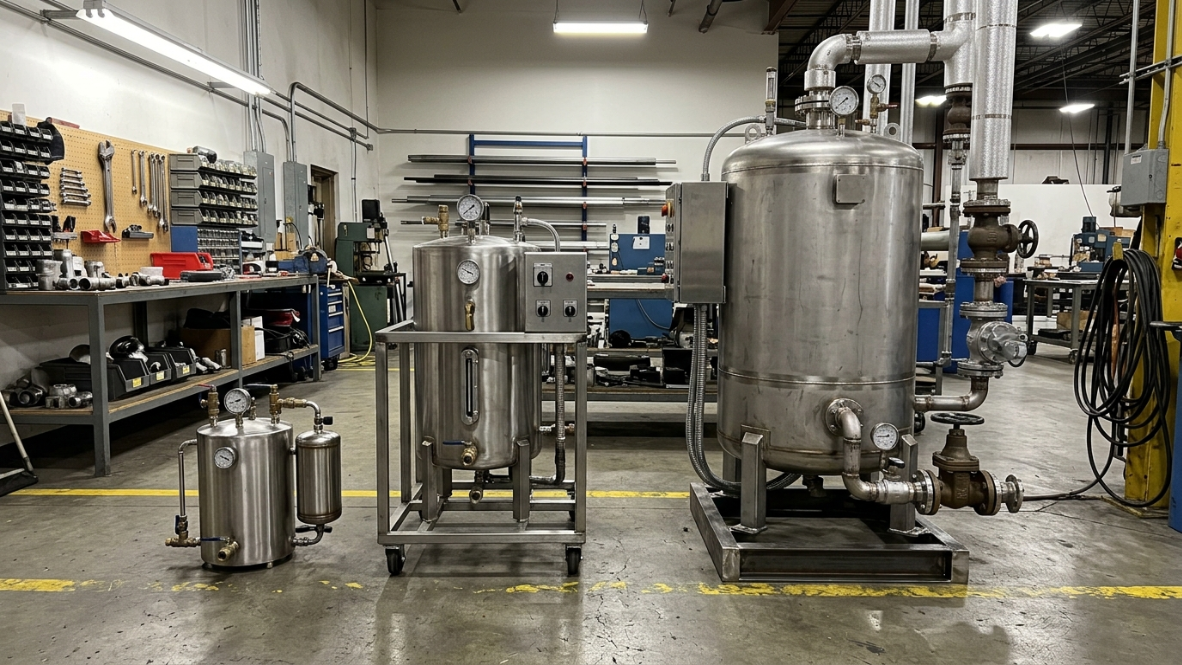
Most buyers can narrow their boiler size by matching their application, electrical service, and expected daily workload.
Business Type | Typical Pressure | Typical Boiler Size | Recommended Electrical Service |
|---|---|---|---|
Jewelry Shop | 60–80 PSI | 1.5–3 kW | 110V or 220V |
Hat Shop | 50–70 PSI | 3–6 kW | 220V |
Tailor / Garment Shop | 40–65 PSI | 3–6 kW | 220V |
Dental Lab | 50–70 PSI | 3–6 kW | 220V |
Bakery Equipment Cleaning | 60–90 PSI | 6–12 kW | 220V |
Small Manufacturing Line | 60–90 PSI | 17–36 kW | 3-Phase |
Key Sizing Factors for Small Operations
Task-Based Steam Demand
Small business owners don’t think in BHP or pounds per hour. They think in terms of the work: “Can this steamer clean 50 rings before lunch?” or “Will it shape felt hats all day without running out?” The right approach to small industrial steam boiler sizing starts with your tasks.
Jewelry cleaning typically requires short, high-pressure bursts at 60 to 80 PSI. A single jeweler working one nozzle may need only 1.5 kW of steam generation. A busy shop with multiple stations or back-to-back customers needs more capacity and likely an auto-pump system for continuous duty.
Hat shaping demands sustained steam flow at moderate to high pressure (50 to 70 PSI) to soften and mold felt or straw. Sessions can last several minutes per hat, so recovery time between uses matters. A manual-fill 2-gallon boiler may be fine for occasional shaping, while a shop doing 20+ hats per day needs a larger tank or auto-fill system.
Garment finishing and tailoring use steam irons and pressing tools that draw steam steadily. The question isn’t peak pressure so much as sustained availability. If you’re deciding between a standalone iron and a boiler-fed system, the steam iron vs. steam boiler guide breaks down that decision.
Shrink packaging and light manufacturing applications tend to require continuous steam, sometimes over full shifts. These operations almost always need auto-pump boilers in the 17 to 36 kW range.
Example Boiler Sizing Calculations
Example 1: Jewelry Repair Shop
A jeweler uses one steam gun throughout the day for cleaning rings and watches.
Operating pressure: 70 PSI
Steam use: short bursts
Electrical service: 110V
Duty cycle: intermittent
Recommended size:
1.5–3 kW electric boiler
Manual-fill system is usually sufficient
Example 2: Hat Manufacturer
A custom hat shop shapes 25 hats per day.
Operating pressure: 60 PSI
Steam demand: moderate
Electrical service: 220V
Duty cycle: several hours daily
Recommended size:
3–6 kW boiler
Auto-fill preferred
Example 3: Small Production Facility
A packaging line requires continuous steam.
Operating pressure: 80 PSI
Steam demand: continuous
Electrical service: 3-phase
Recommended size:
17–36 kW
Automatic feed system
Continuous-duty design
Electrical Service: Your First Hard Constraint
Before calculating BTU or BHP, check what power you have. Your electrical service is the ceiling on your boiler size.
A standard 110V/15A outlet supports roughly 1.5 kW. That’s enough for a compact entry-level boiler suitable for light, intermittent use. A 220V single-phase circuit opens up 3 kW or more, which suits most single-operator shops. Three-phase 220V or 480V power is required for continuous-duty industrial boilers in the 17 to 36 kW range.
If you’re in a retail space, strip mall, or small storefront, you likely have 110V or possibly 220V. Upgrading electrical service is possible but adds cost and requires an electrician. Factor this into your sizing decision early.
Manual Fill vs. Automatic Pump
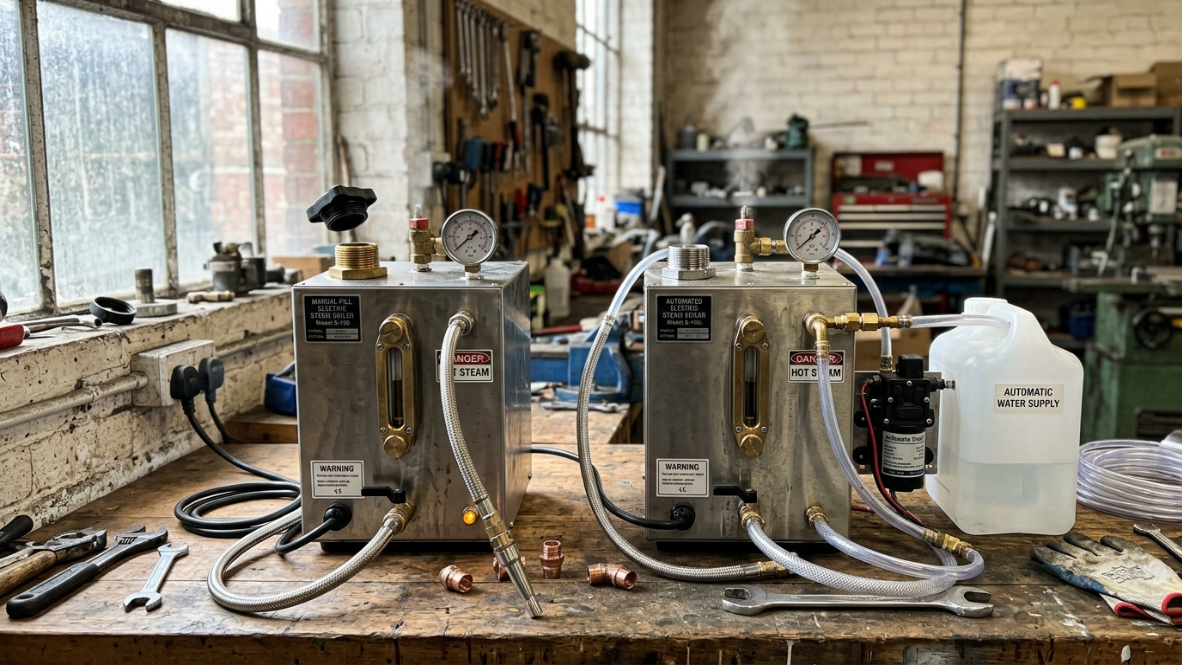
This is a sizing factor that no large-boiler guide mentions, but it fundamentally affects small shop operations. A manual-fill boiler requires you to stop work and add water when the tank runs low. That interruption limits your effective duty cycle.
An automatic pump-fill system pulls from a reservoir and keeps the boiler topped off during operation, enabling true continuous duty. For a thorough comparison, see the manual fill vs. auto fill guide.
If your work involves occasional bursts of steam (cleaning a few pieces of jewelry, pressing a garment), manual fill is fine. If you’re running steam for hours at a stretch, auto-pump isn’t optional, it’s a sizing requirement.
Physical Footprint
Space constraints hit small shops hardest. As Miura’s sizing guide notes, even a perfectly sized boiler is useless if it can’t fit in the building. Large fire-tube boilers need dedicated boiler rooms with ventilation and gas lines.
Compact electric boilers, by contrast, need no combustion air, no flue, and no gas piping. Many sit on a workbench, roll on a cart, or tuck under a counter. This makes small industrial steam boiler sizing partly a question of physical dimensions, not just thermal output.
Duty Cycle
How many hours per day will the boiler run? A jeweler who steams for 15-minute intervals throughout the day has a very different demand profile than a dry cleaner running a boiler for 8 consecutive hours. Duty cycle determines whether you need a boiler built for intermittent or continuous operation, and which fill system (manual or auto-pump) makes sense.
Common Sizing Mistakes
Oversizing and Short Cycling
The Department of Energy identifies oversizing as the leading cause of boiler short cycling in commercial and industrial settings. When a boiler’s capacity far exceeds actual demand, it quickly hits its pressure setpoint, shuts off, cools down, and restarts, sometimes cycling every few minutes.
One user on HeatingHelp.com described having a 117,000 BTU boiler for a system needing only 24,000 BTU/hr at design temperature, nearly 5 times oversized. As they put it, “This setup would be perfect if my design temperature were -160°F, but as I live in New York and not Mars, it winds up being an exercise in inefficiency and short-cycling.”
Short cycling isn’t just a problem for massive plant boilers. In small electric boilers, it accelerates wear on heating elements, stresses pressure switches, and wastes electricity through repeated heat-up losses.
Undersizing
The opposite problem. An undersized boiler can’t maintain pressure under load. Steam comes out weak and wet, recovery between uses takes too long, and production grinds to a halt during busy periods. Undersizing is particularly common when small business owners buy hobby-grade steamers thinking they’ll perform like commercial equipment.
Confusing Hobby Steamers with Commercial Boilers
Consumer and hobby steamers typically operate below 15 PSI, lack ASME certification, and produce steam too weak for professional applications. They may seem cheaper, but they can’t deliver the 40 to 90 PSI that commercial tasks demand. Buying a hobby unit for professional work isn’t saving money; it’s buying the wrong tool.
A refurbished commercial boiler is a better path to properly sized commercial equipment on a budget.
Ignoring PSI Requirements
Different tasks need different pressures. A garment steamer might work at 40 PSI, but jewelry cleaning often needs 60+ PSI for effective residue removal. Sizing isn’t just about volume; it’s about whether the boiler reaches and sustains the pressure your specific application requires.
Signs Your Steam Boiler Is the Wrong Size
Your boiler may be oversized or undersized if you notice any of these symptoms.
Symptom | Possible Cause |
|---|---|
Boiler cycles on and off every few minutes | Oversized boiler |
Steam pressure drops during use | Undersized boiler |
Long recovery times | Boiler too small |
Frequent heating element replacement | Excessive short cycling |
Wet steam at the nozzle | Insufficient pressure or poor sizing |
High electric bills with light workload | Oversized system |
ASME and Safety Certification
Any boiler operating above 15 PSI requires ASME Boiler and Pressure Vessel Code certification. Since commercial steam tasks typically require 40 PSI or more, this applies to virtually every professional steam boiler.
ASME certification means the boiler was designed, built, and inspected to meet rigorous safety and construction standards. UL (Underwriters Laboratories) certification adds independent product safety testing.
Why does this matter beyond safety? Insurance companies often require ASME certification for commercial equipment. Building inspectors may ask for it. And if something goes wrong with an uncertified boiler in a commercial space, liability exposure increases dramatically.
Hoffman’s Pro line and industrial RHPG series carry both ASME and UL certification, manufactured in Pennsylvania by factory technicians. For more on reading and understanding boiler safety documentation, see this guide to boiler data plates.
Quick-Reference Conversion Table
Unit | Equivalent |
|---|---|
1 BHP | 33,475 BTU/hr |
1 BHP | ~10 kW |
1 BHP | 34.5 lbs/hr steam |
1 kW | ~3.4 lbs/hr steam |
1 kW | ~3,412 BTU/hr |
Latent heat (atmospheric) | 970 BTU/lb |
Latent heat (100 PSI) | ~900 BTU/lb |
These conversions let you translate between spec sheet formats. If one manufacturer lists output in lbs/hr and another in kW, you can compare directly.
How Electric Boilers Change the Sizing Math
Almost everything written about small industrial steam boiler sizing online assumes gas-fired equipment with 80 to 85% combustion efficiency. Electric boilers operate at nearly 100% efficiency because there is no combustion, no exhaust stack, and no radiant heat loss from a burner.
This means a 3 kW electric boiler delivers roughly 10,200 BTU/hr of usable steam energy. A gas boiler rated at the same input would deliver only about 8,200 to 8,700 BTU/hr after efficiency losses. Put differently, the electric boiler gives you about 20% more usable steam per unit of rated input.
For small shops, this efficiency advantage means you can size more conservatively than gas-boiler calculators suggest. Combine that with zero ventilation requirements, no gas line installation, and a smaller physical footprint, and electric boilers are often the only practical choice for small commercial spaces.
Electric vs Gas Boiler Sizing
Factor | Electric Boiler | Gas Boiler |
|---|---|---|
Typical Efficiency | 98–100% | 80–85% |
Ventilation Required | No | Yes |
Flue Required | No | Yes |
Installation Complexity | Lower | Higher |
Small Shop Suitability | Excellent | Moderate |
Startup Time | Fast | Moderate |
Typical Maintenance | Lower | Higher |
Putting It All Together: A Sizing Approach for Small Shops
Identify your tasks and pressure needs. What are you steaming, at what PSI, and for how long per session?
Check your electrical service. 110V, 220V single-phase, or 3-phase? This sets your maximum kW.
Estimate your duty cycle. Intermittent bursts or continuous all-day use?
Choose manual fill or auto-pump based on how long you run between breaks.
Add 10 to 20% safety margin above your calculated needs.
Verify ASME/UL certification for any boiler operating above 15 PSI.
If this process raises more questions than it answers for your specific situation, contact Hoffman’s steam experts for personalized sizing advice.
Steam Boiler Sizing Checklist
Before buying a boiler, confirm the following:
Required operating PSI
Daily hours of operation
Number of steam tools used simultaneously
Electrical service available
Available installation space
Manual-fill or automatic-fill preference
Required certifications (ASME/UL)
Desired safety margin
Expected future production growth
This checklist helps prevent buying a boiler that is either too small or unnecessarily large.
Frequently Asked Questions
How do I know what size steam boiler I need for my shop?
Start with your tasks: what pressure do you need (40, 65, or 90 PSI), how often do you use steam, and for how long per session? Then check your electrical service to determine your maximum kW. A jeweler with one cleaning station on a 110V outlet needs roughly 1.5 kW. A hat shop running multiple shaping sessions per day on 220V typically needs 3 to 6 kW. Continuous industrial operations need 17 kW or more on 3-phase power.
What’s the difference between gallon capacity and steam output?
Gallon capacity is the size of the water tank. Steam output (measured in lbs/hr or kW) is how fast that water converts to steam. A 6-gallon tank with a 1.5 kW element produces steam slowly but runs a long time between refills. A 1-gallon tank with 3 kW produces steam faster but empties sooner. Tank size affects run time; wattage affects steam production rate.
Do I need ASME certification for a small boiler?
If the boiler operates above 15 PSI, yes. Since most commercial applications (jewelry cleaning, hat shaping, garment finishing) require 40+ PSI, you should assume ASME certification is required. Operating an uncertified boiler above 15 PSI in a commercial space creates regulatory, insurance, and liability risks.
What happens if my boiler is too big for my needs?
An oversized boiler short cycles, rapidly reaching its pressure setpoint and shutting off, only to restart minutes later. This cycling pattern wears out heating elements, stresses pressure controls, and wastes electricity. The DOE confirms that oversizing is the most common cause of cycling-related efficiency losses.
Can I run a commercial boiler on 110V?
Yes, but with limitations. A 110V/15A circuit supports roughly 1.5 kW, which is enough for light, intermittent use like occasional jewelry cleaning. For sustained or higher-volume work, you’ll need 220V service. Continuous industrial duty requires 3-phase power.
How does manual fill vs. auto-pump affect sizing?
Manual fill limits your effective duty cycle because you must stop and refill the tank periodically. If your work requires continuous steam, a manual-fill system effectively undersizes your operation by introducing forced downtime. An auto-pump system maintains water level during operation, allowing truly continuous duty at rated output.
Why do electric boilers size differently than gas boilers?
Gas boilers lose 15 to 20% of input energy to combustion exhaust and radiant heat. Electric boilers convert nearly all input energy directly to steam. This means a 3 kW electric boiler delivers roughly the same usable steam as a 3.6 kW gas unit. Online sizing calculators built for gas boilers will overestimate what you need if you’re buying electric.
What’s the right safety margin for a small steam boiler?
Industry standard is 10 to 20% above your calculated peak demand. For small shops with highly variable workloads (busy mornings, slow afternoons), lean toward the higher end. For consistent, predictable operations, 10% is typically sufficient.


