

TL;DR
A steam boiler for shrink packaging supplies controlled steam to a shrink tunnel, where heat causes film or labels to contract tightly around products. Steam tunnels operate at lower temperatures (180 to 200°F) than hot air systems, producing more uniform shrinkage on complex shapes and filled containers. Electric boilers in the 1 to 3 BHP range are the practical choice for small and mid-size packaging operations because they require no venting, no gas lines, and often fall under low-pressure exemptions that simplify compliance. This guide defines every term you will encounter when researching, sizing, and buying steam boiler equipment for shrink packaging.
If you’re buying a steam boiler for shrink packaging, start by matching the boiler’s steam output (lbs/hr) and operating pressure (PSI) to your shrink tunnel’s specifications rather than choosing the largest boiler available.
For most small and medium packaging lines:
– 1–3 BHP electric boilers are sufficient.
– Size the boiler for at least 20% more steam capacity than your tunnel’s peak demand.
– Low-pressure systems (15 PSI or below) may reduce inspection and licensing requirements.
– Water treatment is one of the biggest factors affecting boiler lifespan.
– Steam tunnels provide more uniform shrinking than hot-air tunnels for shrink sleeves, tamper bands, and complex containers.
Choosing a properly sized boiler improves label quality, reduces operating costs, and prevents production bottlenecks.
What Is a Steam Boiler for Shrink Packaging?
A steam boiler for shrink packaging is a pressurized vessel that heats water to produce steam, which is then piped into a shrink tunnel. Inside the tunnel, products wrapped in perforated shrink film travel along a conveyor while steam contacts the film from all sides. The heat causes the film to contract rapidly, conforming tightly to each item and producing a secure, professional wrap.
This equipment sits at the intersection of two industries. Packaging professionals understand films, conveyors, and line speeds but may have never purchased a boiler. Boiler buyers understand pressure ratings and ASME codes but may know nothing about shrink ratios or sleeve types. The result is a confusing purchasing process where people don’t know what questions to ask.
Industries that rely on steam shrink packaging include beverage bottling, food packaging, pharmaceuticals, cosmetics, consumer goods, and light manufacturing. Whether you are applying full-body shrink sleeves to craft beer bottles or tamper-evident bands to supplement containers, the boiler is the heart of the operation.
If you are comparing flash steamers and boilers, understanding the distinction is critical before investing in shrink packaging equipment.
How a Steam Boiler Works in a Shrink Packaging Line
Water enters the boiler.
Heating elements generate steam.
Steam travels through insulated piping.
Pressure regulators reduce steam to tunnel operating pressure.
Steam enters the shrink tunnel.
Film shrinks around the product.
Condensate returns to the boiler.
Every component in this process affects shrink quality. A failure in water treatment, steam regulation, or condensate removal can reduce label appearance and increase operating costs.
Shrink Packaging Terms (Packaging-Side Glossary)
Shrink Tunnel / Steam Tunnel
An enclosed chamber through which products pass on a conveyor belt while being exposed to heat. A steam tunnel specifically uses piped steam as its heat source, as opposed to hot air or infrared radiation. Steam tunnels shrink-wrap products quickly and effectively, saving time and reducing waste because steam transfers heat more efficiently than circulated air.
Shrink Wrapping vs. Shrink Labeling
These terms get confused constantly. Shrink wrapping encloses an entire product (or group of products) in film for protection, bundling, or tamper evidence. Shrink labeling applies a printed film sleeve to a container for branding and decoration. Both use the same heat-shrink principle, but the boiler specs, tunnel design, and film types can differ. A shrink wrapping operation might bundle six bottles together, while a shrink labeling line applies individual branded sleeves to each bottle.
Shrink Sleeve / Shrink Label
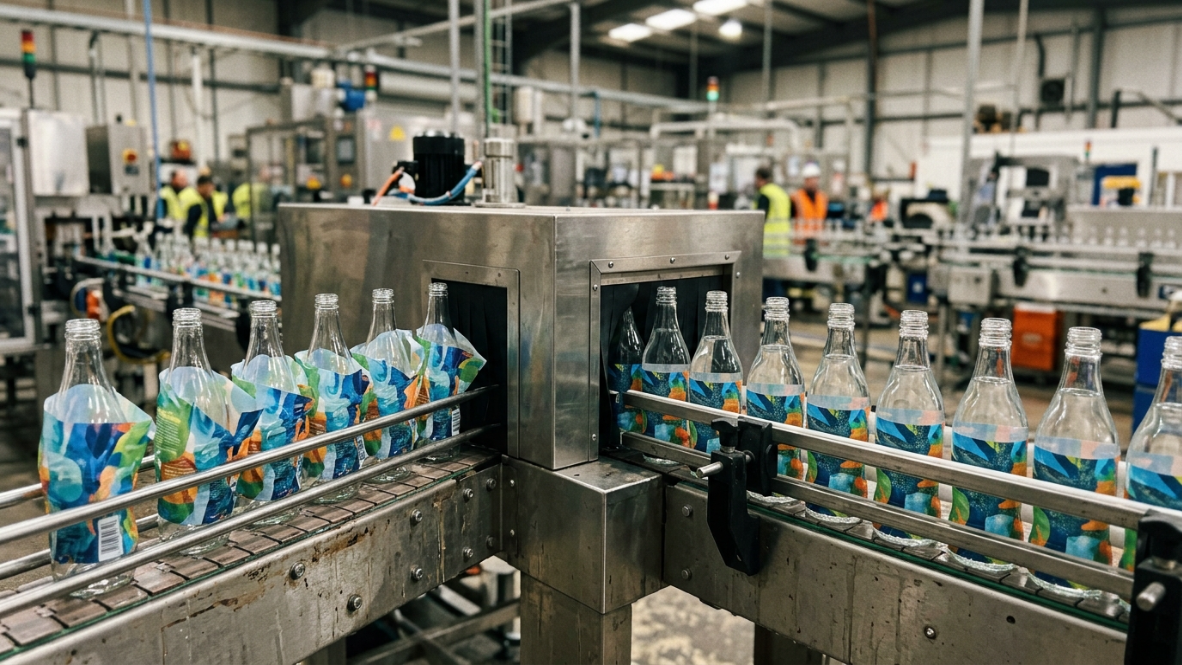
A tubular piece of printed film that slides over a container and then shrinks to conform to its shape when exposed to heat. Sleeves allow 360-degree graphics coverage, which is why brands prefer them for complex or contoured containers.
Full-Body Sleeve vs. Neck Band vs. Tamper-Evident Band
A full-body sleeve covers the entire container from top to bottom. A neck band wraps only the cap and neck area. A tamper-evident band is a narrow ring, usually around the cap, that breaks when the product is opened. Each type requires different shrink percentages and may demand different tunnel settings.
Shrink Ratio
Expressed as a ratio like 2:1 or 3:1, this describes how much the film can reduce in size. A 2:1 ratio means the film can shrink to half its original diameter. Higher ratios are needed for containers with dramatic curves or tapers. Steam tunnels are particularly effective for applications requiring over 50% shrink on shaped containers.
Film Types: PVC, PETG, OPS, PLA, Polyolefin
Different films shrink at different temperatures and rates.
PVC (Polyvinyl Chloride): Most common and affordable. Shrinks at lower temperatures. Some materials like PVC may require higher steam pressure to shrink correctly on certain container shapes.
PETG (Polyethylene Terephthalate Glycol): Higher clarity, recyclable, increasingly popular for sustainability-conscious brands. Requires precise temperature control.
OPS (Oriented Polystyrene): Lightweight with good clarity. Lower shrink force makes it suitable for thin-walled containers.
PLA (Polylactic Acid): Bio-based, compostable option. Narrower temperature window demands excellent steam regulation.
Polyolefin: Common for shrink wrapping (not labeling). Versatile, food-safe, and works well in both steam and hot air tunnels.
Steam tunnels generate high-quality shrink for all these film types, producing even, consistent heat that creates a premium finish on shaped containers.
Pre-Shrink Zone
A section at the tunnel entrance where products receive initial, gentle heat exposure before entering the main steam zone. This helps the sleeve begin contracting evenly and prevents film from shifting or wrinkling before full shrinkage occurs.
Multi-Zone Steam Control
Some advanced tunnels divide the steam chamber into multiple independently controlled zones. Each zone can deliver different amounts of steam, allowing operators to fine-tune the shrink profile. This matters most for complex container shapes where different sections of the sleeve need different heat exposure.
Conveyor Speed
The rate at which products move through the tunnel, typically measured in feet per minute. Conveyor speed must be balanced against steam output: too fast and the film won’t fully shrink, too slow and products can overheat or labels can distort. The PMMI packaging association recommends engineering 20% higher throughput than your fastest upstream machine to prevent bottlenecks.
Steam Boiler Terms (Boiler-Side Glossary)
Steam Boiler vs. Steam Generator (Flash Steamer)
A steam boiler is a pressurized vessel that holds a reserve of heated water and produces steam on demand from that stored volume. A steam generator (sometimes called a flash steamer) heats water in a small coil with no significant water storage, producing steam almost instantly but in smaller volumes.
For shrink packaging, boilers are generally preferred because they provide consistent steam pressure over sustained production runs. Flash steamers can work for very small operations or intermittent use. Understanding the key differences between these two technologies prevents costly mismatches.
BHP (Boiler Horsepower)
A unit measuring a boiler’s steam-generating capacity. One BHP equals the ability to evaporate 34.5 pounds of water per hour at 212°F. Typical shrink tunnel boilers range from 1 to 3 BHP. A small single-tunnel operation might need just 1 BHP, while a multi-lane or high-speed line could need 3 BHP or more.
PSI / PSIG
Pounds per square inch, the standard measurement for steam pressure. PSIG means “pounds per square inch gauge,” which measures pressure above atmospheric pressure. Shrink tunnel boilers typically operate at 0 to 85 PSIG, though some systems are rated up to 100 PSIG. For context on how PSI affects different commercial applications, this guide to PSI for commercial steamers explains the practical differences.
Steam Capacity (lbs/hr)
The amount of steam a boiler can produce per hour, measured in pounds. This is arguably the most important spec when sizing a boiler for your tunnel. Typical shrink-packaging boilers produce 34 to 102 lbs/hr. If your tunnel demands more steam than the boiler can generate, shrink quality drops immediately.
Operating Pressure Range
The pressure window within which the boiler is designed to function. For shrink packaging, you want a boiler whose operating range matches the tunnel manufacturer’s steam pressure requirements. Running outside this range, either too low or too high, causes inconsistent shrinkage.
Saturated Steam vs. Superheated Steam vs. Wet Steam
Saturated steam exists at the exact temperature where water transitions to vapor at a given pressure. This is what shrink tunnels need. It carries maximum heat energy for its temperature and condenses evenly on film surfaces.
Superheated steam has been heated beyond saturation temperature. It behaves more like hot air, transfers heat less efficiently through condensation, and is generally undesirable for shrink packaging.
Wet steam contains entrained water droplets. It causes water spots on labels, uneven shrinkage, and poor finish quality. A properly functioning steam generator creates 99.5% dry heat needed for effective shrink sleeve labeling.
Steam Dryness / Steam Quality
Expressed as a percentage, steam quality indicates how much of the steam is actual vapor versus liquid water. A steam quality of 99.5% means only 0.5% of the steam is liquid droplets. For shrink labeling, anything below about 95% quality will produce visible defects on printed sleeves. This is why water treatment and proper boiler maintenance matter so much.
Low-Pressure vs. High-Pressure Boiler
The dividing line is 15 PSI. Boilers operating at or below 15 PSI are classified as low-pressure. Those above 15 PSI are high-pressure. This distinction has massive practical implications: high-pressure boilers typically require annual inspections, while low-pressure boilers usually need inspection only every two years. Some jurisdictions exempt low-pressure systems from boiler operator licensing requirements entirely.
For small packaging operations, low-pressure steam generation systems can avoid the certification requirements associated with larger, high-pressure systems. Some integrated shrink tunnels deliberately use low-pressure generators for exactly this reason.
Electric Boiler vs. Gas-Fired Boiler
Electric boilers use heating elements submerged in water. Gas-fired boilers burn natural gas or propane to heat a water-filled vessel. For shrink packaging, electric boilers hold significant advantages. They produce no flames, soot, or corrosive combustion byproducts. They require no venting or gas line installation. They are compact enough to sit beside the tunnel. And they often last 20 to 25 years or more, compared to 10 to 15 years for gas units.
Electric boilers also eliminate fire risk around heat-sensitive packaging films. In a facility handling large rolls of PVC or polyolefin, an open flame is an unnecessary hazard.
Explore Hoffman Steam’s RHPG-36 industrial boiler, which lists shrink wrap packaging as a primary application.
Integrated Boiler vs. Remote/Standalone Boiler
An integrated boiler is built directly into the shrink tunnel as a single unit. A remote (standalone) boiler is a separate piece of equipment connected to the tunnel via steam piping. Integrated systems simplify installation and reduce floor space requirements. Standalone boilers offer more flexibility, can serve multiple tunnels, and are easier to service independently. Some manufacturers like PDC International now include compact integrated boilers to eliminate the cost of a separate steam source.
Condensate Return
After steam releases its heat energy in the tunnel and condenses back into hot water, a condensate return system captures that water and feeds it back to the boiler. This saves energy (the water is already hot) and reduces water consumption. For continuous-duty packaging operations, condensate return pays for itself quickly. The concept is explained further in this steam support system guide, which covers piping, traps, and condensate management in detail.
Blowdown
The process of periodically draining water from the bottom of the boiler to remove accumulated sediment, minerals, and dissolved solids. Without regular blowdown, scale builds up on heating elements, reducing efficiency and shortening boiler life. For packaging operations running shifts, blowdown should happen at least daily.
MAWP (Maximum Allowable Working Pressure)
The highest pressure at which a boiler can safely operate, as determined by its design and stamped on its data plate. Never exceed the MAWP. Always ensure your shrink tunnel’s pressure demands fall well below the boiler’s MAWP.
Safety and Compliance Glossary
ASME Boiler and Pressure Vessel Code (BPVC)
The engineering standard governing the design, construction, and inspection of boilers and pressure vessels in the United States. Published by the American Society of Mechanical Engineers, this code is adopted (with variations) by every U.S. state. A boiler that meets ASME BPVC has been designed and manufactured to documented safety standards.
ASME Stamp
A stamp on the boiler’s nameplate indicating it was built under ASME code. Different designators apply: “S” for power boilers, “H” for heating boilers, and “E” for electric boilers. For shrink packaging applications, you will most commonly encounter the “H” or “E” stamp. Only manufacturers holding a valid ASME Certificate of Authorization can apply this stamp.
National Board Registration
After a boiler is manufactured to ASME standards, it can be registered with the National Board of Boiler and Pressure Vessel Inspectors. Registration provides a unique serial number and creates a permanent record. Many jurisdictions require National Board registration before a boiler can be installed and operated.
UL Listing
Underwriters Laboratories (UL) certification indicates that the boiler’s electrical components have been independently tested for safety. For electric boilers used in packaging facilities, UL listing is often required by building codes and insurance carriers. It covers the wiring, controls, heating elements, and safety interlocks.
Certificate of Inspection / Operating Permit
Most states require a valid Certificate of Inspection (or Operating Permit) to be publicly displayed near the boiler. This certificate is issued after a commissioned inspector examines the boiler and confirms it meets code requirements. The most common requirements include having an ASME-stamped and National Board-registered boiler, undergoing periodic inspections, and maintaining a valid, publicly displayed certificate.
Low-Pressure Exemption
Here is where small packaging businesses catch a break. Many states exempt boilers operating at or below 15 PSI from some or all inspection and operator licensing requirements. If your shrink tunnel can function at low pressure, selecting a low-pressure boiler or integrated steam generator can eliminate significant regulatory overhead. Always verify your state’s specific exemptions before relying on this.
Sizing and Selection: Key Concepts for Your Steam Boiler for Shrink Packaging
Choosing the right boiler is not about buying the biggest one you can afford. It is about matching capacity to demand.
Matching Boiler Capacity to Tunnel Demand
Start with your tunnel manufacturer’s steam consumption specification, usually stated in lbs/hr. Then select a boiler that can deliver at least that amount at the required pressure. A tunnel rated for 80 lbs/hr at 50 PSI needs a boiler that comfortably produces 80+ lbs/hr at 50+ PSI. Equipment suppliers on Alibaba and other platforms note that if several shrink-labeling machines are in use, it may be better to have a larger boiler or even several boilers working together.
Steam Boiler Sizing Chart for Shrink Packaging
Packaging Line | Typical Tunnel Demand | Recommended Boiler |
|---|---|---|
Small tabletop tunnel | 20–35 lbs/hr | 1 BHP |
Small production line | 35–55 lbs/hr | 1.5 BHP |
Medium production | 55–80 lbs/hr | 2 BHP |
Large single tunnel | 80–100 lbs/hr | 3 BHP |
Multiple tunnels | 100+ lbs/hr | 5+ BHP |
Actual sizing should always follow the tunnel manufacturer’s published steam consumption.
The 20% Throughput Buffer Rule
The PMMI packaging association recommends engineering your shrink-label process to have 20% higher throughput than the fastest machine upstream. Apply the same logic to your boiler: size it to produce 20% more steam than your tunnel’s peak demand. This buffer accounts for startup, fluctuating line speeds, and the inevitable efficiency losses from scale buildup over time.
Electrical Requirements
Electric boilers for shrink packaging come in several configurations:
110V/120V, single phase: Suitable only for the smallest flash steamers or very low-capacity boilers. Limited to roughly 1.5 kW.
220V/240V, single phase: The sweet spot for small operations. Supports heating elements up to about 6 kW.
220V/480V, three phase: Required for larger boilers in the 10 to 30 kW range. If your facility does not have three-phase power, installation can cost thousands of dollars.
Confirm your facility’s electrical service before selecting a boiler. The 110V vs 220V steamer guide explains the practical trade-offs in more detail.
Steam Boiler Installation Checklist
Before purchasing verify:
Available voltage
Single vs three phase power
Water supply
Drain connection
Floor space
Steam piping distance
Condensate return
Ventilation (gas units)
Water treatment
Local inspection requirements
Water Quality and Its Effect on Boiler Life
This is the hidden factor that no one talks about enough. Hard water (high mineral content) causes scale deposits on heating elements and interior surfaces. Scale acts as insulation, forcing elements to work harder, overheat, and fail prematurely. Untreated water can reduce boiler lifespan by up to 50%.
For packaging operations running continuous shifts, invest in a water softener or reverse-osmosis system. Use distilled or deionized water if your boiler manufacturer recommends it. Test water hardness quarterly. This single precaution protects your investment more than any other maintenance practice.
Common Boiler Sizing Mistakes
Buying too much boiler
Oversized boilers short-cycle.
Buying too little boiler
Steam pressure falls during production.
Ignoring water quality
Scale destroys heating elements.
Ignoring electrical service
Facilities often require expensive electrical upgrades.
Forgetting future expansion
Plan for another tunnel if growth is expected.
Steam Regulation in Shrink Tunnels
Consistent shrink quality depends on consistent steam delivery. PDC International, a major tunnel manufacturer, describes regulating steam flow in five distinct ways: step-down regulators (reducing boiler pressure to tunnel pressure), condensate traps (removing liquid water from steam lines), steam filtering (catching particulates), a proprietary steam valve (modulating flow to match demand), and optional electronic regulation for automated control. If your tunnel lacks built-in regulation, you will need to install external regulators between the boiler and tunnel.
When You Should NOT Buy a Steam Boiler
Avoid steam if:
Packaging electronics
Moisture-sensitive products
Small intermittent hobby production
Low production volume
No water supply available
Instead consider hot air or infrared.
Steam vs. Hot Air vs. Radiant Heat: When to Choose What
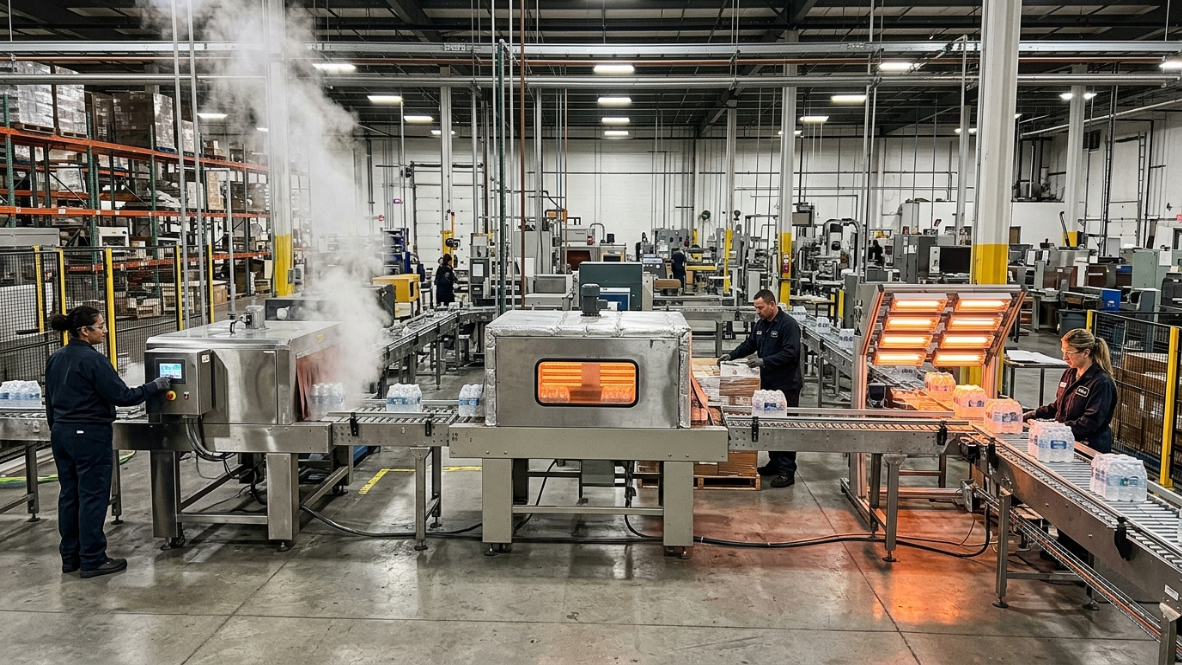
Understanding the three main heat sources for shrink packaging prevents you from buying the wrong system entirely.
Factor | Steam Tunnel | Hot Air Tunnel | Radiant (Infrared) Tunnel |
|---|---|---|---|
Operating Temperature | 180 to 200°F (80 to 95°C) | 200 to 400°C | Varies by emitter type |
Heat Transfer Method | Condensation on film surface | Convection (circulated air) | Direct radiation |
Shrink Uniformity | Excellent, especially on complex shapes | Good for simple shapes | Targeted, can be uneven |
Moisture Contact | Yes (steam condenses on product) | None | None |
Best For | Filled containers, 360° sleeves, high shrink ratios, premium label quality | Moisture-sensitive products, simple shapes, moderate shrink | Spot shrinking, tamper bands, specific zones |
Energy Efficiency | Moderate (requires boiler infrastructure) | Generally lower energy consumption | Highest efficiency for targeted applications |
Maintenance | Boiler descaling, water treatment, element checks | Heating element and fan inspection | Emitter replacement |
Infrastructure Needs | Boiler, steam piping, water supply, condensate return | Electrical connection, ventilation | Electrical connection |
Initial Cost | Higher (boiler adds cost) | Lower | Moderate |
When Steam Is the Clear Winner
Steam dominates when you need to shrink sleeves on filled containers. In electric (hot air) shrink tunnels, the internal contents of filled containers act as a thermal sink, absorbing much of the heat intended for the label. Steam transfers heat through condensation, which is far more efficient and overcomes the thermal-sink problem.
Steam is also the right choice for containers with complex curves, recessed panels, or aggressive tapers where the film must shrink more than 50%. The even heat distribution prevents thin spots, wrinkles, and fish-eyes that plague hot-air systems on difficult shapes.
When Hot Air Makes More Sense
If your products cannot tolerate any moisture (certain paper labels, electronics packaging, dry powder containers), hot air tunnels avoid the condensation issue entirely. They also carry lower upfront costs because no boiler is needed. For simple cylindrical containers with modest shrink requirements, hot air performs well enough and simplifies your equipment footprint.
Maintenance Terms for Packaging Boilers
A steam boiler for shrink packaging that runs daily will fail prematurely without consistent maintenance. Here are the terms you will encounter.
Descaling
Removing mineral deposits (scale) from the boiler’s interior surfaces and heating elements. Scale buildup reduces heat transfer efficiency, increases energy consumption, and can cause element burnout. Descaling frequency depends on water hardness and daily run hours. Some operations descale monthly, others quarterly.
Element Replacement
Electric boiler heating elements are consumable parts. They corrode over time, especially in hard water. When an element fails, steam output drops. Keeping spare elements on hand prevents unplanned downtime. Electric boilers experience much less daily wear and tear than gas boilers thanks to fewer moving parts and a cleaner process.
Blowdown Schedule
A planned routine for draining accumulated sediment and dissolved solids. Bottom blowdown removes sludge from the lowest point in the boiler. Surface blowdown skims dissolved solids from near the water line. For packaging operations with continuous run times, daily blowdown at the end of each shift is standard practice.
Water Treatment
Chemical or mechanical treatment of feedwater to reduce hardness, control pH, and prevent corrosion. Options range from simple inline water softeners to full chemical treatment programs. The cost is small compared to the cost of replacing elements or an entire boiler vessel.
Inspection Intervals
High-pressure boilers (above 15 PSI) typically require an inspection every year. Low-pressure boilers (15 PSI and below) usually need inspection every two years, though this varies by state. These inspections include both internal examination (looking at the vessel interior, elements, and fittings) and external examination (piping, valves, safety devices, and controls). Following upkeep tips for steam boilers helps them work well and reduces downtime.
Choosing the Right Boiler for Your Shrink Packaging Operation
With all these terms defined, the actual selection process becomes straightforward. Here is the decision framework.
Step 1: Determine your tunnel’s steam requirements. Get the exact lbs/hr and PSI specifications from the tunnel manufacturer. If you are buying a new tunnel, ask for these numbers before committing.
Step 2: Add the 20% buffer. Multiply the tunnel’s steam demand by 1.2. This is your minimum boiler capacity.
Step 3: Decide integrated vs. standalone. If you are running a single tunnel at modest speeds, an integrated system simplifies everything. If you need to serve multiple tunnels, plan for growth, or want independent maintenance access, go standalone.
Step 4: Confirm your electrical service. Check your facility’s voltage, phase, and amperage capacity. Upgrading electrical service is expensive and time-consuming.
Step 5: Evaluate compliance requirements. Check your state’s boiler regulations. If you can operate below 15 PSI, a low-pressure system saves regulatory headaches. If you need higher pressure, budget for ASME/UL-certified equipment and annual inspections.
Step 6: Plan for water quality. Test your water. Install appropriate treatment. Build descaling and blowdown into your maintenance schedule from day one.
For small and mid-size packaging operations, electric boilers in the 1 to 3 BHP range, with ASME and UL certification, cover the vast majority of shrink packaging applications. They are compact, safe around packaging materials, and built for decades of service.
See the Hoffman RHPG-36 industrial boiler for continuous-duty shrink wrap packaging with automatic pump-fill and ASME/UL certification.
Key Takeaways
Steam boilers provide the most consistent shrink quality for complex containers.
Match boiler capacity to tunnel demand instead of oversizing.
Add a 20% steam capacity buffer.
Electric boilers dominate small and medium packaging operations.
Water treatment dramatically increases boiler life.
Low-pressure systems can reduce regulatory requirements.
Frequently Asked Questions
What size steam boiler do I need for a shrink tunnel?
Most shrink tunnels for small to mid-size operations require boilers in the 1 to 3 BHP range, producing 34 to 102 lbs/hr of steam at 0 to 85 PSIG. Start with your tunnel manufacturer’s steam consumption specification, then add a 20% buffer to account for startup, fluctuating line speeds, and efficiency losses over time.
Is steam or hot air better for shrink packaging?
Steam is better for filled containers, complex shapes, and applications requiring over 50% shrink. It operates at lower temperatures (180 to 200°F) and transfers heat more uniformly through condensation. Hot air is better for moisture-sensitive products and simple shapes where lower upfront cost matters more than shrink quality.
Do I need an ASME-certified boiler for shrink packaging?
In most U.S. states, yes. Commercial boilers generally require ASME certification, National Board registration, and periodic inspections. However, some low-pressure systems (at or below 15 PSI) may be exempt from certain requirements depending on your state. Always check local regulations before purchasing.
What does steam quality mean for shrink labeling?
Steam quality measures the percentage of actual vapor versus liquid water droplets. Effective shrink sleeve labeling requires approximately 99.5% dry steam. Wet steam (lower quality) causes water spots on labels, uneven shrinkage, and poor finish. Proper boiler maintenance, water treatment, and condensate management maintain high steam quality.
Can I use one boiler for multiple shrink tunnels?
Yes, if the boiler’s capacity exceeds the combined steam demand of all tunnels plus a 20% buffer. A standalone boiler connected via steam piping to multiple tunnels is the standard approach for multi-line operations. Ensure your steam regulation equipment can balance pressure across all tunnels simultaneously.
How often does a shrink packaging boiler need maintenance?
Daily blowdown at shift end is standard. Descaling frequency depends on water hardness but typically ranges from monthly to quarterly. Heating elements should be inspected quarterly and replaced as needed. High-pressure boilers require annual professional inspection, while low-pressure systems typically need inspection every two years.
Why do electric boilers last longer than gas boilers?
Electric boilers have no combustion, meaning no flames, soot, or corrosive exhaust gases degrading internal components. Fewer moving parts reduce mechanical wear. With proper water treatment, electric boilers routinely last 20 to 25 years. Gas-fired boilers, exposed to combustion byproducts and thermal cycling stress, typically last 10 to 15 years.
What happens if I use hard water in my shrink packaging boiler?
Mineral deposits (scale) accumulate on heating elements and vessel walls. Scale insulates elements from water, causing them to overheat and fail. It restricts water flow, reduces steam output, and degrades steam quality. Untreated hard water can cut boiler lifespan roughly in half. A water softener or reverse-osmosis system is the simplest protection.


