

TL;DR
Steam boiler performance logging is the practice of recording operating conditions like steam pressure, water level, temperature, and power draw at regular intervals. These records help operators spot problems early, prevent unplanned downtime, satisfy safety regulations, and extend equipment life. For small commercial electric boilers, the process is simpler than for gas-fired systems because there’s no combustion data to track. A basic log can be as simple as five columns on a clipboard.
Running a commercial steam boiler without a performance log is like driving without a dashboard. Everything might feel fine until the moment it isn’t, and by then the repair bill, the lost workday, or the failed inspection has already arrived. Steam boiler performance logging gives operators a structured way to track what their equipment is doing over time, turning routine observations into actionable data.
Whether you operate a jewelry store steamer at 90 PSI or a continuous-duty boiler in a light manufacturing shop, consistent logging is one of the simplest things you can do to protect your investment.
Explore Hoffman’s ASME-certified Pro Line boilers built with built-in gauges that make performance logging straightforward.
Quick Answer: What Should You Record in a Steam Boiler Performance Log?
For most small commercial electric steam boilers, record these six measurements every time the boiler operates:
Measurement | Recommended Frequency | Why It Matters |
|---|---|---|
Steam pressure | Every operating session | Identifies pressure loss |
Water level | Every operating session | Prevents low-water damage |
Heat-up time | Every operating session | Detects scale buildup |
Heating element status | Weekly | Identifies failed elements |
Blowdown events | After maintenance | Tracks water quality |
Electrical consumption | Monthly | Monitors energy efficiency |
A boiler performance log should be completed:
Daily for low-pressure boilers
Once every 8-hour shift for high-pressure boilers
Before every operating session for small commercial electric boilers
The simplest logging system is a five-column worksheet that records pressure, water level, heat-up time, maintenance events, and operator notes.
What Is Steam Boiler Performance Logging?
Steam boiler performance logging is the systematic recording of a boiler’s operating conditions over time. According to the National Board of Boiler and Pressure Vessel Inspectors, a boiler maintenance log provides a written record that can be used for hot water as well as low- and high-pressure steam boilers. When consistently maintained, these logs help identify operating trends, enabling early diagnosis of potential issues.
The concept is straightforward: at regular intervals, the operator writes down (or digitally records) key readings from the boiler’s gauges and controls. Over weeks and months, those entries create a picture of how the boiler is performing, whether conditions are stable, and when something starts drifting outside normal range.
Performance logging applies to all boiler types, but the specific parameters recorded vary significantly depending on whether the system is gas-fired, oil-fired, or electric. For small commercial electric steam boilers (the kind used in jewelry shops, hat stores, garment businesses, and upholstery operations), the logging process is considerably simpler because there’s no combustion involved.
What Gets Recorded in a Boiler Performance Log
A typical boiler log includes spaces to record the time, pressure, temperature, water levels, operation of heating elements or burners, and any remarks. More detailed operations track additional variables like flow rates, sight glass readings, blowdown events, and exhaust temperatures.
For electric boilers specifically, the parameter list shrinks because there are no flames, no flue gases, and no combustion air to worry about. Electric boilers are flameless, eliminating the risks of flareback, firebox explosions, and the entire category of combustion monitoring.
Core Parameters for Electric Steam Boilers
Steam pressure (PSI): The primary operating metric. Record the pressure reading at the start of each session and at regular intervals during operation.
Water level: Check the sight glass or water level indicator. Low water is the leading cause of boiler damage.
Heating element status: Note whether all elements are energizing properly. A failed element means slower heat-up and reduced capacity.
Heat-up time: Minutes from cold start to operating pressure. This number creeping upward over time signals scale buildup or element degradation.
Electrical draw (kW): Relevant for tracking energy costs and spotting anomalies. If your boiler suddenly draws more or less power than usual, something has changed.
Blowdown performed: Record when you drain sediment to manage mineral buildup. This ties directly into water quality management.
Notes/remarks: Anything unusual, including sounds, leaks, error indicators, or maintenance performed.
Electric vs. Gas-Fired Boiler Logging: What’s Different
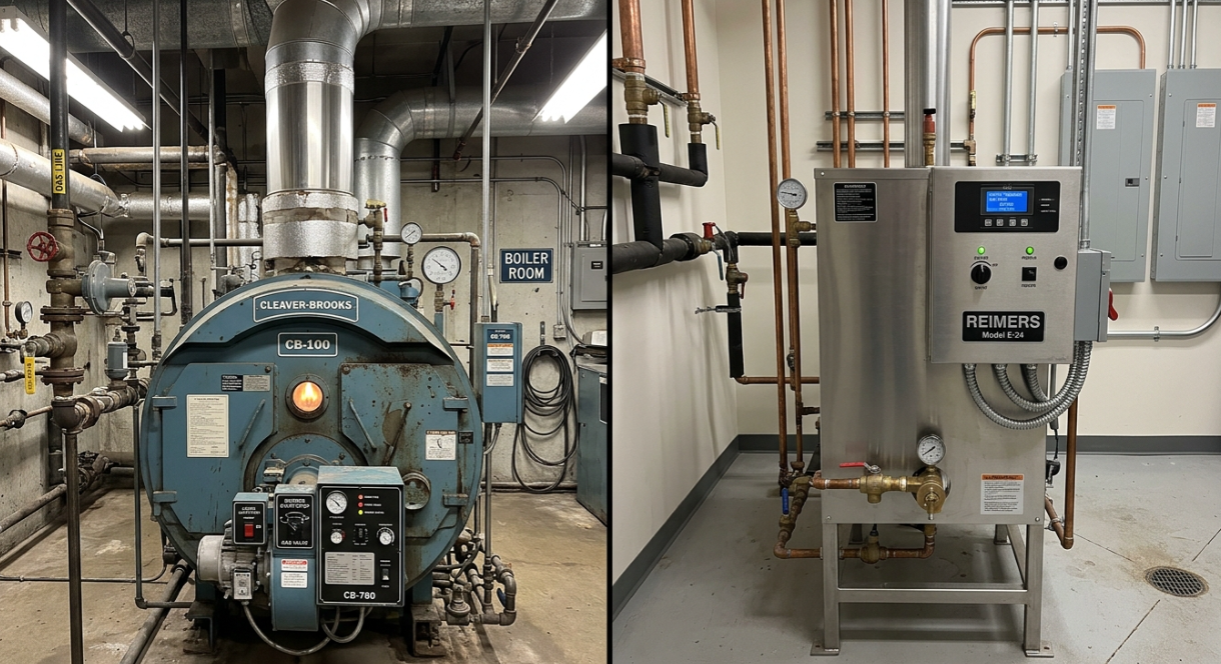
Almost all existing guidance on boiler performance logging assumes a gas-fired or oil-fired system. That’s because those systems dominate the large commercial and industrial boiler market. But the differences matter for small shop owners who run electric equipment.
Parameter | Gas-Fired Boiler | Electric Boiler |
|---|---|---|
Combustion air check | Yes | Not applicable |
Flue gas temperature | Yes | Not applicable |
O₂/CO emissions | Yes | Not applicable |
Fuel consumption | Gas or oil volume | kWh electrical |
Flame condition | Yes | Not applicable (no flame) |
Steam pressure | Yes | Yes |
Water level | Yes | Yes |
Blowdown | Yes | Yes |
Safety valve test | Yes | Yes |
Heating element check | Not applicable | Yes |
The takeaway: electric boiler performance logging is less complex, but it’s not less important. The parameters you do track, especially steam pressure, water level, and heat-up time, give you meaningful insight into equipment health. For a deeper comparison between electric and gas systems, see this electric vs. gas boiler guide.
Logging Requirements by Steam Boiler Application
Business Type | Typical Steam Pressure | Recommended Logging Frequency |
|---|---|---|
Jewelry shops | 80-100 PSI | Before each session |
Hat stores | 60-90 PSI | Before each session |
Garment businesses | 60-100 PSI | Daily |
Upholstery shops | 60-120 PSI | Daily |
Light manufacturing | 100+ PSI | Every shift |
Why Steam Boiler Performance Logging Matters
Preventing Unplanned Downtime and Reducing Costs
Regularly keeping a boiler log helps prevent unscheduled maintenance, reduce repair costs, and avoid emergency shutdowns. Studies adapted from the Cleaver-Brooks Boiler Room Guide have shown that, on average, 7% of boiler fuel costs (or energy costs, in the case of electric boilers) are a direct result of poor maintenance.
That 7% figure might seem modest, but for a shop running a boiler eight hours a day, five days a week, it adds up quickly over a year. More importantly, the cost of an emergency shutdown, including lost revenue, rush-ordered parts, and technician callouts, far exceeds the cost of catching a problem early through routine logging.
Practitioners on Reddit who operate commercial steam equipment consistently note that the units lasting decades are the ones that received regular attention. One user in r/jewelers reported using Hoffman steamers for over 30 years, with the first unit lasting 24 years. That kind of longevity doesn’t happen without consistent maintenance habits, and logging is the foundation of those habits.
Compliance and Legal Protection
Boiler operators are required to maintain records for safety compliance in many jurisdictions. Log books serve as a legal record and evidence that safety regulations are being followed.
State-level mandates are common. Massachusetts, for example, requires the commissioner to develop a log book including a checklist for proper daily steam boiler maintenance, to be completed daily by the operator of any steam boiler exceeding nine horsepower. New Jersey regulations specify that a boiler operator’s logbook shall be kept in a hardbound book, though electronic media recording devices are accepted if accessible for review or printing upon request.
Even in jurisdictions without strict logging mandates, a well-maintained log provides protection during insurance claims, inspections, and any liability situations. Paper log books have a long history of being accepted as legal evidence, and existing legal frameworks typically recognize their validity. If you need to pass a boiler inspection, a clean, consistent log is one of the strongest things you can present.
Trend Detection and Equipment Lifespan
Single readings tell you what’s happening right now. A log tells you what’s been happening over time, and that’s where the real value lives.
Trend charts showing parameter changes over time reveal gradual degradation that’s invisible in any individual reading. A boiler that took 12 minutes to reach operating pressure six months ago but now takes 18 minutes is telling you something. That signal only exists if you’ve been writing the numbers down.
Research published by Nikula et al. in Applied Energy (2016) established that monitoring of steam boiler operation can be based on the use of historical process data as a reference for real-time operation. The principle scales down perfectly: even a small shop can compare today’s heat-up time to last month’s and act on the difference.
Historical data also helps with budgeting and capital planning. Rather than replacing equipment on arbitrary timelines, you can track actual performance trends and make replacement decisions based on evidence. This is especially relevant for operators thinking about how long commercial boilers last.
How Often Should You Log Boiler Performance?
The National Board provides clear guidance on logging frequency:
Low-pressure heating boilers: Instrument readings should be taken daily.
High-pressure boilers: Readings should be taken at least once per eight-hour shift.
For small commercial electric boilers in shop environments, a practical approach is to log readings before each operating session. If you run your boiler five days a week, that’s five log entries per week. The process takes under two minutes once you’ve established a routine.
The key word is “consistent.” The National Board stresses that a boiler log must be kept in a consistent format for trends to be perceived and followed with preventive action. Skipping entries, changing formats, or recording inconsistently defeats the purpose.
Performance KPIs Worth Tracking
Beyond raw parameter readings, certain key performance indicators help you benchmark your boiler’s health over time. Boiler KPI frameworks typically cover efficiency, steam generation, water quality, safety, and maintenance. Ideal targets range from 85% to 95% efficiency depending on boiler type and application.
For small commercial electric steam boilers, the most useful KPIs are:
Steam pressure consistency: How stable is PSI during operation? Frequent fluctuations suggest control or element issues. Understanding PSI requirements for your application helps set the right baseline.
Heat-up time: Track minutes from cold start to operating pressure monthly. Increasing times point to scale buildup or failing elements.
Water consumption rate: Gallons used per operating hour. A spike might indicate a steam leak or excessive blowdown.
Electrical draw (kW): Monitor for consistency. Unexpected changes in power consumption can signal element problems.
Unplanned downtime: Count unscheduled shutdowns per month. Even one per month is worth investigating.
Scale/mineral buildup rate: Observed during descaling maintenance. If buildup accelerates, your water treatment approach needs adjustment.
You don’t need to track all of these from day one. Start with pressure, water level, and heat-up time, then add more as logging becomes habitual.
Steam Boiler Readings That Signal a Problem
Symptom | Possible Cause | Recommended Action |
|---|---|---|
Pressure falling | Steam leak | Inspect fittings |
Pressure fluctuating | Faulty pressure control | Check pressure switch |
Longer heat-up times | Scale buildup | Schedule descaling |
Rising electrical consumption | Heating element failure | Test elements |
Low water levels | Feed-water problems | Inspect water supply |
Frequent blowdowns | Poor water quality | Review water treatment |
A performance log isn’t just a historical record. It’s an early warning system. The purpose of logging is to identify changes before they become expensive failures.
Paper Logs vs. Digital Logs
Both formats work. The best one is the one you’ll actually use consistently.
Paper Logs
Paper log books are simple, inexpensive, and universally accepted. They require no software, no training, and no power. In jurisdictions that specify hardbound consecutively numbered logbooks, paper is the default. Paper logs also carry strong legal standing as evidence of compliance.
For a small shop with one or two boilers, a clipboard next to the equipment with a printed log sheet is perfectly adequate.
Digital Logs
Digital log sheets can be more convenient, reducing errors and allowing easier data analysis. Modern digital platforms offer features like trend analysis reports, export capability, streamlined shift handoffs, and acknowledgment workflows.
For small operations, a simple spreadsheet (Google Sheets or Excel) gives you the benefits of digital organization without the cost of specialized software. Save it to cloud storage for backup.
For larger industrial operations, dedicated boiler management platforms and building management systems (BMS) provide automated data collection and real-time monitoring. This level of sophistication is overkill for most small shop environments but worth considering as operations scale.
The bottom line: ASME Section VI and VII guidelines don’t mandate one format over the other. Choose what fits your workflow and stick with it.
How to Start a Simple Performance Log
Getting started takes about ten minutes. Here’s a five-column format that works for any small commercial electric steam boiler:
Date/Time | Steam Pressure (PSI) | Water Level | Heat-Up Time (min) | Notes |
|---|---|---|---|---|
03/15 8:00am | 72 | Normal | 14 | All elements on |
03/16 8:15am | 70 | Normal | 14 | Blowdown performed |
03/17 8:05am | 68 | Slightly low | 17 | Refilled, scheduled descaling |
Print a stack of these sheets, clip them next to your boiler, and fill in one row each time you start up. At the end of each month, file the completed sheets.
The National Board recommends that maintenance items be organized into daily, weekly, monthly, semiannual, and annual categories, with a checklist incorporated into the log. A separate log sheet for each period, filed in a loose-leaf binder, serves as a permanent maintenance record. In all cases, follow the equipment manufacturer’s recommendations.
For a more detailed maintenance framework, the commercial steam boiler maintenance guide provides a comprehensive checklist approach.
Steam Boiler Performance Log Template
Use this printable worksheet as a starting point.
Date | Time | PSI | Water Level | Heat-Up Time | Blowdown | Notes |
|---|---|---|---|---|---|---|
Weekly Boiler Maintenance Checklist
Task | Monday | Tuesday | Wednesday | Thursday | Friday |
|---|---|---|---|---|---|
Check pressure | |||||
Check water level | |||||
Verify element operation | |||||
Inspect safety valves | |||||
Perform blowdown |
ASME and Regulatory Context
ASME provides the standard framework for boiler operation and maintenance. ASME Section VII provides guidelines to assist those directly responsible for operating, maintaining, and inspecting power boilers. Section VI covers recommended guidelines for heating boilers.
Low-pressure boiler operator logs shall contain, at a minimum, the information outlined in ASME Section VI. For electric boilers classified as power boilers, ASME Section I applies. An electric boiler is defined under ASME standards as a power boiler or high-temperature water boiler in which the source of heat is electricity.
Understanding these standards matters because they establish the minimum expectations for what your log should contain. They also set the baseline that inspectors reference during compliance reviews. If your boiler carries ASME certification, maintaining proper logs aligns with the certification framework that makes your equipment insurable and inspectable.
Making Performance Logging Work in a Real Shop

Theory is one thing. Actually doing it every day in a busy hat shop or jewelry store is another.
Here are practical tips that make steam boiler performance logging stick:
Keep the log physically next to the boiler. If you have to walk across the shop, you’ll skip it.
Build it into your opening routine. Turn on the boiler, fill in the log while it heats up. The heat-up time entry gives you a natural reason to stand there and watch the gauges.
Review logs monthly. Set a calendar reminder. Flip through the month’s sheets and look for any numbers that changed. A five-minute review can catch a trend that prevents a five-day shutdown.
Don’t over-complicate it. Five columns are enough to start. You can always add parameters later. The goal is consistency, not comprehensiveness.
File everything. Even boring, perfectly normal log sheets have value. They prove the boiler was operating correctly on a given date. That documentation matters for insurance, inspections, and resale.
Ready to equip your shop with reliable commercial steam? Explore Hoffman’s complete product range from portable flash steamers to continuous-duty industrial boilers.
7 Common Boiler Performance Logging Mistakes
1. Recording pressure but ignoring heat-up time
Heat-up time is often the first indicator of scale accumulation.
2. Logging inconsistently
Missing entries make trend analysis impossible.
3. Using multiple log formats
Changing worksheets prevents meaningful comparisons.
4. Failing to record maintenance events
Blowdowns and descaling should always be documented.
5. Waiting until a problem appears
Logging should be preventive, not reactive.
6. Tracking too many variables
Start with the essentials and expand later.
7. Never reviewing historical data
A log that nobody reviews has limited value.
Frequently Asked Questions
What is steam boiler performance logging?
Steam boiler performance logging is the regular recording of a boiler’s operating conditions, including steam pressure, water level, temperature, and power consumption. These records create a historical baseline that helps operators detect problems early, maintain safety compliance, and extend equipment life.
What should I record in an electric boiler performance log?
For electric steam boilers, the essential entries are steam pressure (PSI), water level, heat-up time, heating element status, electrical draw (kW), and any notes about unusual conditions or maintenance performed. You can skip combustion-related parameters like flue gas temperature, O₂ levels, and flame condition since those only apply to gas-fired systems.
How often should I log my boiler’s performance?
The National Board recommends daily readings for low-pressure heating boilers and at least once per eight-hour shift for high-pressure boilers. For small shop operations, logging before each operating session is a practical and effective approach.
Is boiler performance logging legally required?
Requirements vary by state and jurisdiction. Some states, like Massachusetts, mandate daily logs for steam boilers above a certain size. Even where not strictly required by law, maintaining a performance log provides legal protection during inspections, insurance claims, and liability situations.
Should I use a paper log or a digital log?
Both are accepted by regulatory bodies. Paper logs are simple and carry strong legal standing. Digital logs (even a basic spreadsheet) make trend analysis easier. For small shops, a paper log clipped next to the boiler is the simplest solution. For operations wanting to track trends over time, a spreadsheet adds value without adding complexity.
What’s the difference between logging for electric boilers vs. gas-fired boilers?
Electric boiler logging is simpler because there’s no combustion to monitor. Gas-fired boiler logs require entries for combustion air, flue gas temperature, O₂/CO levels, flame condition, and fuel volume. Electric boiler logs focus on steam pressure, water level, element status, heat-up time, and kWh consumption.
How does performance logging relate to boiler maintenance?
Logging is the foundation of preventive maintenance. The data reveals trends (longer heat-up times, pressure inconsistency, rising power draw) that signal the need for descaling, element replacement, or other service before a breakdown occurs. Research suggests that 7% of boiler operating costs come directly from poor maintenance, and consistent logging is the primary tool for catching those issues early.
Can performance logging help my boiler last longer?
Yes. By catching early signs of scale buildup, element degradation, or water level issues, performance logs let you address small problems before they cause major damage. Operators who maintain consistent logs and follow manufacturer maintenance recommendations routinely get decades of service from quality commercial boilers.


