

TL;DR
Steam boiler tank size refers to the volume of the water reservoir, measured in gallons or liters, not the amount of steam the unit produces. A bigger tank means longer runtime between refills, but steam output rate depends on the wattage of the heating elements. For most small commercial applications, tank sizes range from 1 to 6 gallons. The fill system (manual vs. automatic) matters just as much as tank volume when calculating real-world productivity.
Quick Answer: What Steam Boiler Tank Size Do You Need?
The right steam boiler tank size depends on how much steam your business uses, how continuously you operate, and how much refill downtime you can tolerate. Small commercial steam boilers may have water capacities ranging from under 1 gallon to 6 gallons or more, but the correct size depends on the manufacturer’s usable water capacity and rated steam output.
– Intermittent use: A smaller tank may suit jewelry cleaning, occasional garment pressing, and other short steam sessions.
– Regular daily use: A mid-sized tank may work well for shops that need repeated steam sessions throughout the day.
– High-volume or continuous use: Consider a larger-capacity boiler or a properly sized automatic-fill system to reduce interruptions.
Do not choose a boiler by tank size alone. Compare usable water capacity, steam output, operating pressure, fill system, electrical requirements, and the manufacturer’s recommended application before purchasing.
Steam Boiler Tank Size Comparison
The following table is a general selection guide, not a specification chart. Actual usable water capacity, steam output, and available fill options vary by manufacturer and model.
Tank Size Category | Potential Best Fit | What to Evaluate |
|---|---|---|
Under 1 gallon | Light-duty or intermittent steaming | Usable water capacity, recovery time, and refill frequency |
Around 1 gallon | Small shops with occasional steam demand | Rated steam output and daily workload |
Around 2 gallons | Regular use with moderate demand | Runtime between refills and recovery time |
Around 6 gallons | Higher-volume operations | Electrical capacity, water consumption, and space requirements |
Larger or continuous-feed systems | Sustained or multi-station demand | Required steam output, automatic feed controls, and system sizing |
Important: These categories are starting points, not universal recommendations. Two boilers with the same tank volume may deliver different steam output and runtime because their heating elements, operating pressures, usable water capacities, and controls differ.
What Is Steam Boiler Tank Size?
Steam boiler tank size is the total internal volume of the water reservoir in a steam boiler. On spec sheets for small commercial electric boilers, you’ll see this listed as a number in gallons (1, 2, 6) or liters (1.6L, 3L, etc.).
Here’s what that number tells you: how much water the boiler can hold. That’s it.
It does not tell you how much steam the boiler produces per hour. It does not tell you what pressure the unit reaches. And it does not tell you whether the boiler is right for your application. Tank size is one variable among several, and treating it as the primary buying criterion is the most common mistake people make when shopping for commercial steam equipment.
The typical range for small commercial electric boilers breaks down like this:
Under 1.6 liters: Portable flash steamers, roughly 60 minutes of runtime
1 gallon: Entry-level shop boilers for intermittent use
2 gallons: Mid-range units for daily commercial applications
6 gallons: Large-capacity boilers for high-volume or sustained operations
These categories cover the vast majority of jewelry stores, hat shops, garment finishing operations, dental labs, and similar small businesses. If you’re looking at boiler horsepower (BHP) ratings of 50 or higher, or BTU figures in the hundreds of thousands, you’ve moved well beyond the small commercial segment into industrial territory that this guide doesn’t address.
Tank Size vs. Steam Output: The Distinction That Matters Most
Tank capacity and steam output measure two different things.
Tank capacity describes the amount of water the reservoir can hold. Steam output describes how much steam the boiler can generate over time under specified operating conditions. A boiler with a larger tank may operate longer between refills, while a boiler with a higher steam-generation rate can supply steam more quickly when demand increases.
For example, imagine two boilers with different tank capacities. The larger model may hold more water, but if its heating elements have a lower rated output, it may not generate steam as quickly as the smaller model. Conversely, a smaller boiler with a higher steam output may generate steam quickly but require more frequent refilling during sustained operation.
When comparing models, review these specifications separately:
Tank capacity: How much water the reservoir holds.
Rated steam output: How much steam the unit produces over time.
Operating pressure: The pressure range for which the boiler is designed and rated.
Heating power: The electrical power supplied to the heating elements.
Recovery time: How quickly the boiler returns to its required operating conditions after demand or a refill.
Boiler horsepower can also be useful when comparing commercial and industrial equipment, but do not assume a universal conversion applies to every operating condition. Any conversion between horsepower, heating input, and steam production should use the relevant rating basis and specified operating conditions.
Rated Capacity vs. Usable Capacity
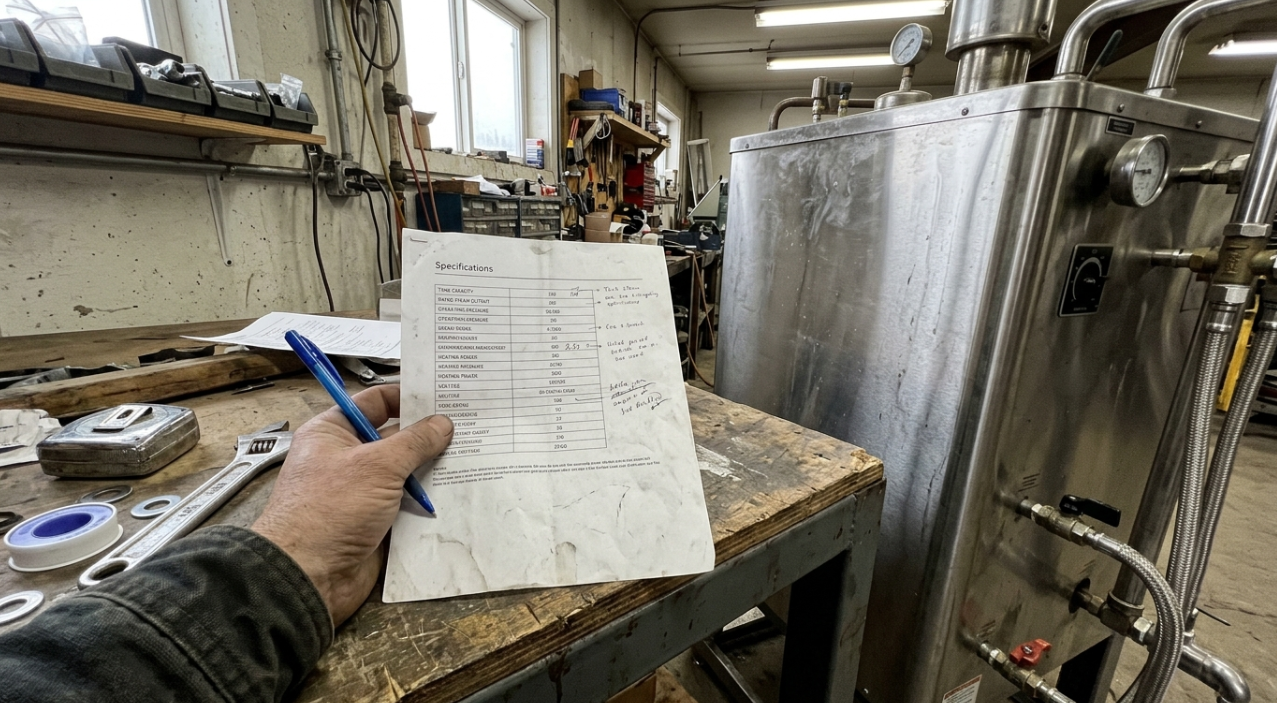
There’s another wrinkle that spec sheets rarely explain. The stated tank size includes steam headspace, the empty area above the waterline where steam collects before being discharged. So a boiler rated at 2 gallons might only hold 1.25 gallons of actual water. The rest is necessary space for steam to accumulate and pressurize.
This is not a defect or deceptive marketing. It’s how pressurized vessels work. But it means your actual water supply, and therefore your runtime, is always less than the headline tank size number suggests. When comparing models, ask about usable water capacity, not just rated tank volume.
For a deeper walkthrough of how these specs interact, the full boiler sizing guide covers wattage, pressure, and capacity relationships in detail.
How to Estimate Steam Boiler Runtime Between Refills
A boiler’s runtime between refills depends on usable water capacity and how quickly the system consumes water to generate steam. Tank size alone cannot provide an exact runtime estimate.
A simplified planning formula is:
Estimated runtime (hours) = usable water capacity (liters) ÷ average water consumption (liters per hour)
For example, if a boiler has 4 liters of usable water and its average water consumption during a particular workload is 2 liters per hour, the estimated runtime is 2 hours.
This is an illustrative calculation, not a performance claim for a specific boiler. Actual consumption varies with steam output, operating conditions, duty cycle, and how the equipment is used.
To estimate runtime for a real model:
Obtain the manufacturer’s usable water capacity.
Determine average water consumption under your expected operating conditions, using manufacturer data or measured usage.
Divide usable water capacity by average water consumption.
Allow for changes in workload, startup, recovery, and operating limits.
For manual-fill equipment, also account for the time required to follow the manufacturer’s safe shutdown, depressurization, cooling, refilling, and restart procedure. For automatic-fill equipment, confirm that the feed system and water supply can support the required operating demand.
If the manufacturer does not publish usable water capacity or consumption information, ask for these specifications before relying on a runtime estimate.
How the Fill System Changes Effective Tank Size
Tank capacity is only part of the equation. The fill system determines how water is replenished and how much operator attention is required during a workday.
Manual-Fill Steam Boilers
A manual-fill boiler requires an operator to replenish its water supply according to the manufacturer’s procedure. Depending on the design, refilling may require shutdown, depressurization, cooling, and a restart period before normal operation resumes.
Manual-fill systems can be suitable for businesses with intermittent steam demand. A jewelry store that cleans individual items throughout the day, for example, may be able to schedule refilling during natural breaks in its workflow.
The main limitation is downtime. If the boiler requires frequent refills during busy periods, the interruption can reduce productivity even when the tank itself is relatively large.
Automatic-Fill Steam Boilers
An automatic-fill boiler uses a feed system to replenish water when needed, subject to the equipment’s controls and operating limits. This can reduce manual intervention and help support longer work sessions.
However, automatic filling does not automatically guarantee continuous steam production. The boiler must still have sufficient heating capacity, an adequate water supply, compatible feed controls, and the ability to meet the application’s steam demand.
Which Fill System Should You Choose?
Factor | Manual Fill | Automatic Fill |
|---|---|---|
Operator involvement | More hands-on | Less routine manual refilling |
Refill interruptions | May be significant | Often reduced |
Best potential fit | Intermittent workloads | Frequent or sustained workloads |
Installation considerations | Model-specific | May require a suitable water supply and feed system |
Main sizing question | How often can you tolerate stopping? | Can the complete system meet your steam demand? |
For intermittent work, manual fill may be a practical and economical choice. For sustained production, compare automatic-fill models and confirm that their rated output matches your workload.
A smaller automatic-fill boiler may be more productive than a larger manual-fill model when refill interruptions are the main bottleneck. However, the smaller model must still have sufficient steam output to meet peak demand.
Read the manual-fill vs. automatic-fill steam boiler comparison before deciding which configuration fits your operation.
Tank Size by Application
The best steam boiler tank size depends on how frequently your business uses steam, how much steam each task requires, and whether the work occurs in short bursts or continuous sessions.
The following table provides a starting point for evaluating your needs. It is not a substitute for the manufacturer’s sizing recommendations or a calculation of your actual steam demand.
Application | Starting Point for Evaluation | Key Buying Considerations |
|---|---|---|
Jewelry cleaning | Small-capacity commercial boiler | Steam pressure, nozzle performance, intermittent demand, and water quality |
Hat shaping | Small or larger-capacity boiler, depending on throughput | Sustained steam output, work volume, and refill interruptions |
Garment finishing | Capacity matched to the number of stations | Steam iron demand, simultaneous usage, and recovery time |
Dry cleaning | Application-specific commercial system | Total connected load, peak demand, and simultaneous equipment use |
Upholstery cleaning | System sized for the cleaning equipment and workload | Continuous steam demand, usable capacity, and feed system |
Dental laboratory work | Equipment rated for the specific laboratory process | Required pressure, temperature, applicable regulations, and cleaning or sterilization requirements |
Before choosing a tank size, confirm the pressure, temperature, steam quality, and output requirements of the equipment or process the boiler will serve.
Steam Boiler Tank Size, Safety Certification, and Permits
Tank capacity is only one part of a boiler’s safety and compliance requirements. Before purchasing commercial steam equipment, confirm that the unit is suitable for its intended pressure, temperature, installation environment, and application.
What to Check Before Buying
Manufacturer’s pressure rating: Confirm the permitted operating pressure and the equipment’s specified safety controls.
Applicable construction standards: Determine which boiler or pressure-vessel codes apply to the particular model and installation.
Certification and documentation: Check the documentation required by your local authority and any applicable workplace or industry standards.
Installation and operating permits: Ask the relevant local authority whether the equipment requires a permit, inspection, registration, or licensed installation.
Electrical requirements: Verify the supply voltage, current, circuit protection, grounding, and installation requirements before connecting the boiler.
Do not assume that a smaller tank automatically qualifies for an exemption, or that every commercial boiler is subject to the same certification rules. Requirements vary by equipment classification and jurisdiction.
If a supplier advertises a boiler as suitable for commercial use, request the relevant documentation and confirm that the equipment meets the requirements for your location and intended application.
For more information, see the steam boiler permit requirements guide. Use the applicable local authority’s requirements when making a purchasing or installation decision.
How Tank Size Affects Steam Boiler Maintenance
Tank size can influence how a boiler is operated, but maintenance requirements depend on more than reservoir volume. Feedwater quality, total water consumption, operating conditions, boiler design, and the manufacturer’s maintenance schedule all affect scale buildup and equipment life.
Water Quality and Scale Buildup
Dissolved minerals in feedwater can form deposits when water is heated and steam is generated. These deposits may reduce heat-transfer efficiency and contribute to operational problems if they are not managed properly.
A boiler that consumes more water over time may process a greater total quantity of dissolved minerals. However, tank capacity alone does not determine how quickly scale accumulates.
Maintenance Practices to Evaluate
Water treatment: Follow the manufacturer’s feedwater specifications and use appropriate treatment when required.
Routine inspections: Check for leaks, unusual operating conditions, and signs of deterioration according to the manufacturer’s schedule.
Scale management: Use the approved inspection, cleaning, and descaling procedures for the specific model.
Safety controls: Have pressure controls, relief devices, and other safety components inspected or tested as required.
Maintenance records: Record inspections, service work, water treatment, and recurring problems.
Do not use a generic descaling interval as a substitute for the manufacturer’s instructions. Some boilers require more frequent attention because of their feedwater conditions and usage, while others may need different service procedures.
Before purchasing, ask about water-quality requirements, approved cleaning methods, replacement-part availability, and routine service costs. These factors can have a greater effect on long-term ownership costs than tank capacity alone.
See the commercial steam boiler maintenance checklist for additional maintenance guidance.
Common Steam Boiler Tank Sizing Mistakes
Choosing a Larger Tank Without Calculating Demand
A larger tank can reduce refill frequency, but it does not automatically improve efficiency or increase steam output. Buying a boiler with more capacity than your application needs can increase upfront costs and may create unnecessary installation or operating demands.
The correct approach is to size the boiler around your actual steam requirements, including peak demand and simultaneous equipment use. Avoid adding an arbitrary capacity margin without considering the manufacturer’s sizing method.
An oversized boiler may also operate inefficiently in some systems, particularly when its output and controls are poorly matched to the load. However, the effect depends on the equipment and application; tank size alone does not determine whether short cycling occurs.
Before purchasing, compare the expected workload with the boiler’s rated steam output, usable water capacity, operating pressure, and fill system.
Confusing Consumer Steamers With Commercial Boilers
Consumer garment steamers, portable steam cleaners, and commercial steam boilers are not directly interchangeable. Their operating pressure, steam output, reservoir design, and intended applications may differ substantially.
Compare equipment using its actual specifications and the requirements of the job. A tank-size number alone does not establish equivalent performance.
Ignoring Electrical Supply Requirements
Heating power affects how quickly a boiler can generate steam and what electrical supply it requires. Before choosing a model, verify its rated voltage, current, phase, circuit requirements, and installation instructions.
Do not assume a particular tank size always requires a particular voltage or phase. Requirements vary by model.
Ignoring Refill Downtime
A larger manual-fill tank may reduce the frequency of refills, but an automatic-fill system may reduce operator interruptions more effectively for some workloads.
Estimate both steam demand and the time spent refilling, restarting, and waiting for the boiler to return to operating conditions. Compare the complete workflow, not just the capacity printed on the specification sheet.
Choosing the Right Steam Boiler Tank Size
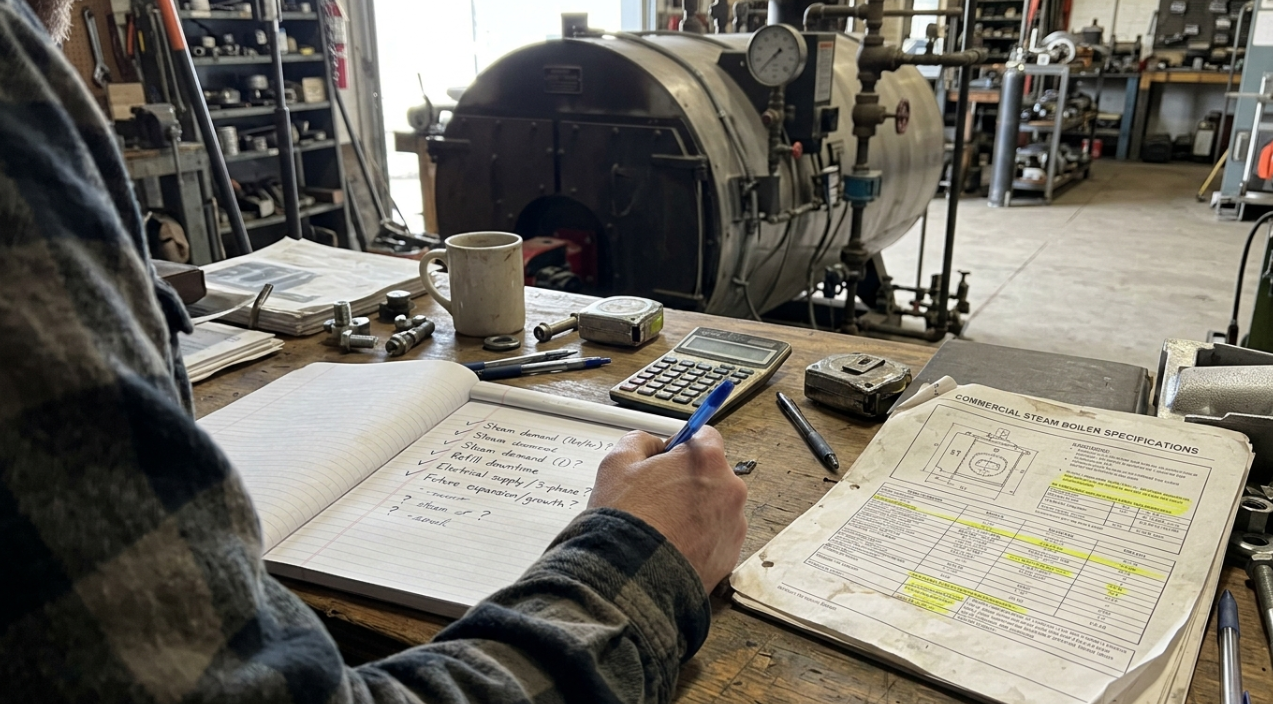
Picking the right tank size comes down to answering four questions:
How many items or hours of steam do you need per session? Intermittent use (a few items per hour) works with smaller tanks. Continuous use demands larger tanks or auto-fill systems.
Can you tolerate refill downtime? If yes, manual fill with a mid-range tank saves money. If no, invest in auto-fill or a larger tank.
What electrical service does your space provide? 110V limits you to smaller heating elements and, by extension, smaller practical tank sizes. 220V opens up the full range.
What’s your growth trajectory? If you expect to double volume in the next year, size slightly above current needs. But don’t buy three times what you need today.
For help matching these answers to specific models, compare commercial steamers across the full range of tank sizes and price points.
FAQ
What’s the best steam boiler tank size for a jewelry store?
Most jewelry stores do well with a 1 to 2 gallon boiler. You’re steaming individual pieces with brief bursts of high-pressure steam, not running continuous sessions. A 1-gallon unit at 40 PSI handles 15 or more items per day without issue. Only high-volume operations processing dozens of pieces per hour need to consider larger tanks.
How often do I need to refill a 2-gallon manual-fill boiler?
It depends on your usage pattern and the boiler’s steam output rate. For intermittent use (jewelry cleaning, occasional garment touch-ups), a 2-gallon tank can last several hours. For sustained use (hat shaping, continuous pressing), expect to refill every 1 to 3 hours. Each refill cycle on a manual system takes up to 20 minutes including cooldown and reheat.
Does a bigger tank mean more PSI?
No. Tank size and pressure are independent specifications. PSI is determined by the boiler’s pressure rating, safety valve settings, and heating element capacity. A 1-gallon boiler and a 6-gallon boiler can both operate at 40 PSI or 80 PSI depending on their design. Bigger tanks hold more water, not more pressure.
Can I upgrade my tank size later?
Generally, no. The tank is the boiler. Upgrading tank size means purchasing a new boiler. This is one reason it’s worth getting the sizing decision right upfront. That said, some businesses start with a smaller manual-fill unit and later add a larger auto-fill model as their volume grows, keeping the smaller unit as a backup.
What’s the difference between gallon capacity and steam output?
Gallon capacity is the volume of water the tank holds. Steam output is the rate at which the boiler converts that water into steam, measured in pounds per hour or sometimes gallons per hour. A 2-gallon tank with a 3 kW heating element produces steam faster than a 6-gallon tank with a 1.5 kW element. Both numbers matter, but they measure different things.
Is a 6-gallon boiler overkill for a small shop?
Often, yes. A small jewelry store, boutique, or single-operator hat shop rarely needs 6 gallons. Oversizing leads to wasted electricity through short cycling and higher upfront costs. The exception is businesses doing sustained, high-volume work with no tolerance for downtime, like busy western hat shops or multi-station garment operations.
Do I need ASME certification regardless of tank size?
If your boiler operates above 15 PSI (and virtually all commercial applications require 40 PSI or higher), ASME certification is effectively mandatory. This applies whether the tank is 1 gallon or 6 gallons. The certification is about safe pressure containment, not water volume.
How does water quality affect my tank size decision?
Hard water with high mineral content accelerates scale buildup in any boiler, but larger tanks process more water volume over time, concentrating more deposits. If your area has hard water, factor in more frequent descaling regardless of tank size, and consider whether a smaller tank with an auto-fill system (which can include inline filtration) might be easier to maintain than a large manual-fill tank.


