

TL;DR
Commercial mattress steam cleaning uses high-temperature, pressurized dry vapor steam to sanitize mattresses in hotels, hospitals, care homes, and rental properties. It kills 99.9% of bacteria, dust mites, and bed bugs without chemicals. The critical equipment specs are 212°F+ temperature, 75+ PSI pressure, and 5-6% moisture content (dry vapor). Memory foam mattresses should never be steam cleaned with conventional equipment. This glossary covers every technical term professionals need to choose the right equipment and process.
Commercial mattress steam cleaning sits at the intersection of sanitation science and business operations. Whether you manage a 200-room hotel, run a mobile cleaning service, or oversee infection control at a healthcare facility, the terminology in this space matters. Choosing equipment based on the wrong specs, confusing wet steam with dry vapor, or misunderstanding thermal kill thresholds can mean ruined mattresses, ineffective sanitization, or lost contracts.
This glossary breaks down every term you need, from the physics of steam generation to the certifications that matter in regulated environments. If you’re evaluating commercial steam equipment for soft surface cleaning, these definitions will ground your decision-making in actual science rather than marketing claims.
Direct Answer: What Is Commercial Mattress Steam Cleaning?
Commercial mattress steam cleaning is the process of sanitizing mattresses using high-temperature dry vapor steam in hotels, hospitals, care homes, and rental properties. Professional systems use boiler-generated steam at 212°F+ with low moisture output (5–6%) to kill bacteria, dust mites, allergens, and bed bugs without soaking the mattress.
Unlike consumer steam cleaners or hot water extraction machines, commercial dry vapor systems are designed to:
– sanitize with minimal moisture
– reduce drying times to 1–2 hours
– avoid mold growth risks
– meet hospitality and healthcare cleaning standards
– support chemical-free disinfection protocols
For commercial mattress work, the most important equipment specifications are:
Specification | Recommended Minimum |
|---|---|
Steam Temperature | 212°F+ at contact |
Boiler Temperature | 300°F+ |
Pressure | 75 PSI+ |
Moisture Content | 5–6% |
Dry Time | 1–2 hours |
What “Steam Cleaning Mattresses Commercial” Actually Means
At a technical level, commercial mattress steam cleaning is the application of pressurized, high-temperature steam, generated by an electric boiler-based system, to sanitize, deodorize, and restore mattresses in professional settings. The steam penetrates mattress fibers to kill microorganisms and break down organic stains using heat and pressure rather than excessive water and chemicals.
The word “commercial” is doing real work here. It separates professional-grade processes from household carpet steamers that lack the temperature and pressure to kill bed bugs, bacteria, or dust mites effectively. As one practitioner noted in a US Steam product review forum, “I’ve never had much success with homeowner machines found on Amazon. You really need to step up to commercial levels.” That gap between consumer and commercial equipment is not just about price. It’s about whether the process actually works.
Commercial Mattress Cleaning Methods Compared
Method | Moisture Level | Dry Time | Sanitization Strength | Safe for Mattresses? | Commercial Use |
|---|---|---|---|---|---|
Dry Vapor Steam | Very Low (5–6%) | 1–2 Hours | Excellent | Yes | Best Option |
Wet Steam | Moderate to High | 4–8 Hours | Moderate | Risky | Limited |
Hot Water Extraction | High | 5–8+ Hours | Good | Sometimes | Carpet/Upholstery |
Chemical Disinfection | Low | Varies | Good | Yes | Supplemental |
UV-C Sanitization | None | Immediate | Surface-Level | Yes | Supplemental |
Core Terms
Commercial Steam Cleaning
The professional application of pressurized steam for cleaning and sanitization purposes. Commercial steam cleaning systems use electric boilers to generate steam at temperatures typically ranging from 300°F to 356°F, delivered at 75 to 175 PSI. Unlike consumer handheld steamers (which often operate below 212°F with minimal pressure), commercial units produce enough sustained heat and force to penetrate soft surfaces like mattresses and eliminate pathogens on contact.
Minimum specs for effective mattress work: 212°F at the point of contact, 75 PSI pressure, and dry vapor output. Anything less risks incomplete sanitization or, worse, a waterlogged mattress.
Dry Vapor Steam
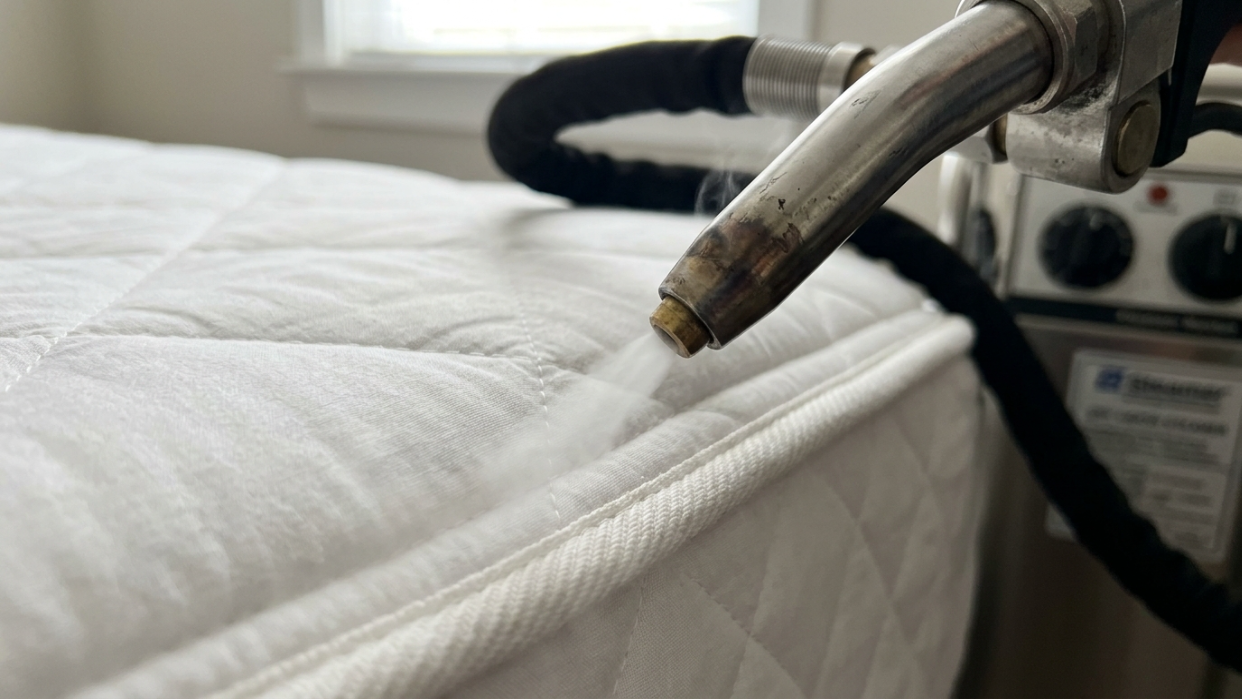
This is the single most important term for anyone involved in commercial mattress steam cleaning. Dry vapor steam refers to steam heated to 240-310°F with a moisture content of only 5-6%, meaning the output is roughly 94-95% dry.
Why it matters so much for mattresses: a conventional steam cleaner outputs around 25% water content. That level of moisture soaks a mattress through, creating conditions for mold growth and requiring lengthy drying times that may be impossible in a commercial setting. Dry vapor, by contrast, leaves surfaces nearly dry on contact. One German manufacturer (Medeco-Cleantec) puts it plainly: “It would simply not be possible to clean mattresses with a conventional steam cleaner.”
The thermal disinfection is automatic at these temperatures. Germs are inactivated and dust mites are killed because the outlet temperature exceeds 190°F, well above microbial survival thresholds.
Understanding the difference between dry vapor and wet output is essential when choosing between steamer types for any soft surface application.
Wet Steam
Steam with a moisture content above 10%, typically around 20-25%. Wet steam is effective for hard surface cleaning (tile, concrete, kitchen equipment) but is unsuitable for mattresses, upholstery, and most soft furnishings. The excess moisture gets trapped deep in foam and fabric layers, creating mold risk and extending drying times to unacceptable levels in commercial operations.
If a steamer spec sheet doesn’t explicitly state its moisture percentage, assume it produces wet steam. Only purpose-built dry vapor systems should be used on mattresses.
Hot Water Extraction (HWE)
A cleaning method commonly confused with steam cleaning, but technically distinct. Hot water extraction injects heated water (not steam) into a surface and then vacuums it back out along with dissolved soil and contaminants. Stanley Steemer, one of the largest cleaning franchises, explicitly differentiates: “Some people call it steam cleaning, but our process is a little different. It’s called hot water extraction.”
HWE is effective for carpets and some upholstered furniture, but it introduces significantly more moisture than dry vapor steam. Mattress drying times with HWE typically run 5-8 hours compared to 1-2 hours with dry vapor. For hotel operations where room turnover is measured in hours, that difference is the gap between a workable process and an impossible one.
PSI (Pounds Per Square Inch)
The unit measuring steam pressure output. In the context of steam cleaning mattresses commercially, PSI determines how deeply steam penetrates fibrous surfaces and how effectively it dislodges embedded soil and organisms.
Commercial benchmarks:
75-80 PSI: Entry-level commercial. Adequate for surface-level mattress sanitization.
90-117 PSI: Mid-range commercial. The sweet spot for most professional mattress cleaning operations.
150-175+ PSI: High-end commercial. Suited for heavy-duty or industrial cleaning tasks.
For context, understanding how much PSI matters helps operators avoid both underpowered equipment and overkill purchases.
Thermal Kill Threshold
The temperature at which specific organisms are eliminated. This is the scientific foundation of commercial mattress steam cleaning, and different organisms have different thresholds:
Organism | Kill Temperature | Notes |
|---|---|---|
Bed bugs and eggs | 122°F+ (contact) | Professional sources recommend 160°F+ for reliability |
Dust mites | 130°F+ | Killed on contact with steam |
E. coli, Salmonella, Staph | 212°F+ | Standard commercial sanitization range |
MRSA | 212°F+ | EPA-approved dry vapor steam method |
The key word is “at the point of contact.” Steam loses temperature as it travels from the boiler through the hose and nozzle to the mattress surface. A boiler generating 300°F+ steam might deliver only 200-220°F at the tip, which is still well above bacteria kill thresholds but explains why boiler temperatures need to be significantly higher than minimum kill requirements.
Dry Time / Turnaround Time
The period between steam application and when a mattress is ready for use. In commercial settings, this is often the deciding factor when choosing equipment and technique.
Dry vapor steam: 1-2 hours. Most surfaces dry almost instantly; the recommended wait is precautionary.
Conventional steam cleaning: 2-6 hours depending on moisture output.
Hot water extraction: 5-8 hours, and sometimes longer for thick mattresses.
For businesses, faster drying times translate directly to reduced downtime and improved operational efficiency. A hotel that can clean and return a mattress to service in 2 hours versus 8 hours is looking at fundamentally different scheduling capabilities.
How to Choose a Commercial Mattress Steam Cleaner
When evaluating commercial mattress steam cleaning equipment, focus on performance specifications rather than marketing claims.
Minimum Requirements for Professional Mattress Cleaning
Professional-grade mattress steamers should provide:
300°F+ boiler temperature
75–120 PSI pressure
5–6% moisture output
continuous-fill capability for high-volume work
ASME-certified boiler systems
UL-certified electrical components
Features That Matter Most
Feature | Why It Matters |
|---|---|
Dry Vapor Output | Prevents oversaturation |
Continuous Fill | Reduces downtime |
High PSI | Improves penetration |
Adjustable Steam Control | Protects delicate fabrics |
HEPA Filtration | Helps allergen removal |
Stainless Steel Boiler | Improves durability |
Equipment Terms
Steam Boiler
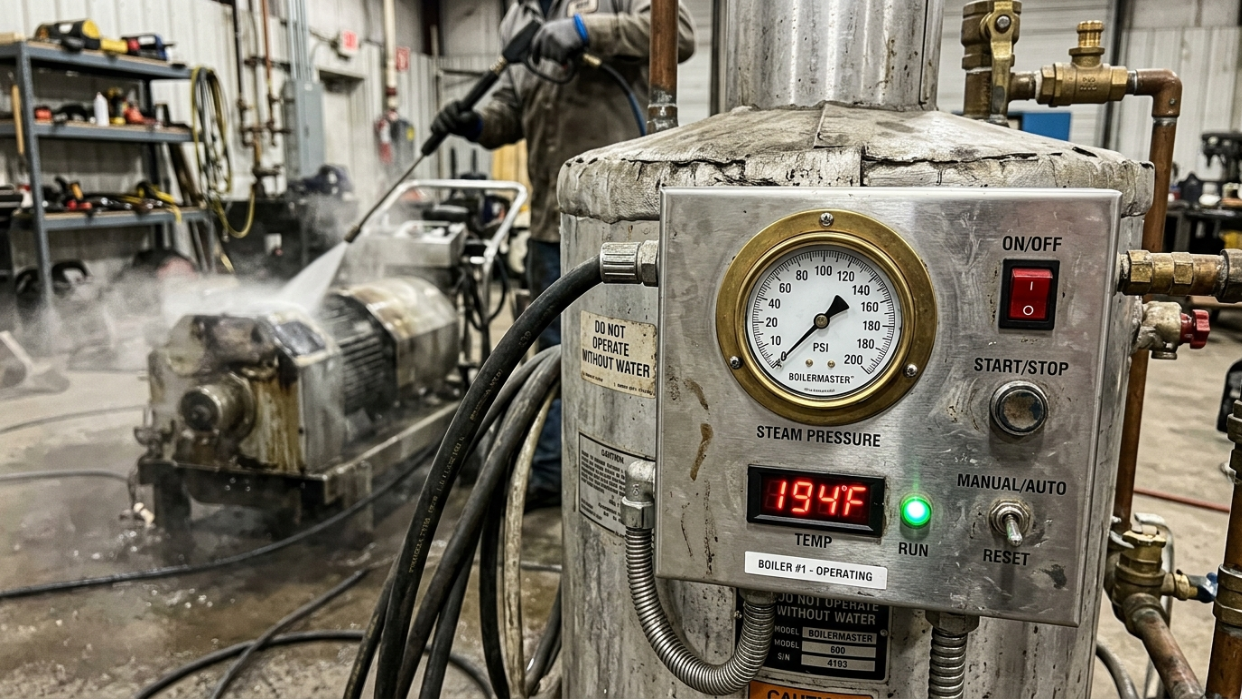
The core heat-generating unit in any commercial steam system. Electric steam boilers heat water in a sealed, pressurized tank to produce steam at controlled temperature and pressure. They come in various configurations:
Tank size: Ranges from 0.75 gallons (portable units) to 6+ gallons (continuous-duty industrial)
Power: 110V (1,500W) for smaller units, 220V single or three-phase for larger capacity
Pressure rating: 40 PSI for entry-level, up to 90 PSI for professional-grade models
Gas-fired boilers exist but are irrelevant to this context. Commercial mattress steam cleaning uses exclusively electric boiler systems for portability, indoor safety, and precise temperature control.
For a deeper understanding of how boiler specifications translate to real-world performance, commercial steamer specs explained covers power requirements, voltage considerations, and capacity planning.
ASME Certification
The American Society of Mechanical Engineers establishes safety standards for pressure vessels, including steam boilers. ASME certification means a boiler’s tank has been designed, manufactured, and tested according to rigorous engineering standards for safe operation under pressure.
Why it matters commercially: many municipal codes and insurance policies require ASME-certified equipment in business settings. Operating an uncertified pressurized boiler can create liability exposure, violate local ordinances, and void insurance coverage. For cleaning businesses serving hospitals, hotels, and institutional clients, ASME certification is non-negotiable.
UL Certification
Underwriters Laboratories (UL) certification covers the electrical safety of steam equipment. A UL listing confirms that the electrical components (heating elements, wiring, controls, switches) have been tested for fire and shock hazards. Like ASME certification, UL listing is often required by building codes and insurers for commercial equipment used in occupied spaces.
Continuous-Fill vs. Manual-Fill Boiler
Manual-fill boilers must be depressurized, opened, and refilled by hand when the water runs out. This creates downtime, typically 10-20 minutes per refill cycle.
Continuous-fill (auto-pump) boilers use an automatic pump to feed water into the pressurized tank from an external reservoir without interrupting operation.
For commercial mattress cleaning, the choice depends on scale. A mobile operator cleaning 5-10 mattresses per job can work efficiently with manual fill. A team cleaning 50+ hotel mattresses in a shift needs continuous fill to maintain productivity. Understanding manual fill vs. auto fill trade-offs prevents costly equipment mismatches.
Steam Vacuum / Steam Extraction
A combined unit that applies steam and simultaneously vacuums the loosened moisture, soil, and debris from the surface. These hybrid systems are specifically designed for soft surfaces like mattresses, upholstered furniture, and automotive interiors. They offer the sanitization benefits of steam with the moisture removal of extraction, reducing drying times further.
Not every commercial mattress cleaning operation requires a dedicated steam vacuum. Dry vapor systems with less than 5% moisture content often eliminate the need for simultaneous extraction, since there’s minimal liquid to remove.
Application Terms
Mattress Sanitization
The process of reducing or eliminating microorganisms from a mattress surface and interior. Sanitization is a specific, measurable outcome, not a synonym for “cleaning.” A mattress can look clean (stains removed, surface vacuumed) without being sanitized. True sanitization requires achieving thermal kill thresholds across the treated area.
Commercial dry vapor steam systems claim bacteria elimination rates of 99.9% to 99.999%, verified through EPA testing protocols. Over eight years of use, a mattress accumulates roughly 10 pounds of dead skin cells and millions of dust mites feeding on them. Sanitization addresses this invisible contamination that surface cleaning cannot reach.
Chemical-Free Cleaning
The use of water and heat alone, without detergents, disinfectants, or biocides, to achieve cleaning and sanitization. This approach is particularly valuable in regulated environments:
Hospitals and healthcare: Where chemical residue can trigger patient reactions or interact with medical treatments
Schools and childcare: Where chemical exposure regulations are strict
Food-adjacent environments: Where cleaning chemical residue is prohibited near food preparation
Steam cleaning mattresses commercially in these settings eliminates the compliance burden of chemical storage, handling documentation, and safety data sheet management. The cleaning power comes from physics, not chemistry.
Bed Bug Remediation (Steam)
The use of commercial steam as part of an Integrated Pest Management (IPM) protocol for bed bug elimination. Steam above 122°F kills bed bugs and their eggs on contact, making it a frontline tool for mattress treatment in infested rooms.
One significant advantage: bed bugs cannot develop resistance to heat, unlike chemical pesticides where resistance is an increasingly documented problem. As multiple pest management sources confirm, insects “can never develop a resistance to” thermal treatment.
Professional application requires slow, methodical passes across every mattress surface, seam, and crevice. The steam nozzle typically must maintain contact within 1-2 inches of the surface to deliver lethal temperatures. This is labor-intensive work, but the results are immediate and verifiable.
Memory Foam Exception
Memory foam mattresses should not be steam cleaned with conventional equipment. Steam introduces both heat and moisture, the two things most damaging to viscoelastic foam structure. The heat breaks down the foam’s adaptive properties, while trapped moisture promotes mold growth deep inside the mattress where air circulation cannot reach.
Using steam on memory foam makes it lumpy and uneven, destroying its supportive qualities. Most mattress manufacturers explicitly state in their warranty terms that steam cleaning voids coverage.
There is one nuance worth noting: some manufacturers of micro dry steam equipment (with moisture content below 5%) claim their systems can safely treat memory foam. This claim remains contested. The safe default for commercial operators is to treat memory foam as a no-steam surface and use alternative methods like UV-C light or cold extraction for these mattresses.
Allergen Removal
The elimination of dust mites, pet dander, pollen, and other allergens from mattress surfaces and interiors via high-temperature steam. Hot steam penetrates bedding, cushions, and carpeting where dust mites concentrate, killing them on contact and denaturing the protein compounds in their waste that trigger allergic reactions.
For hotels and care homes, allergen removal is both a health measure and a liability reduction strategy. Guest complaints about allergic reactions can generate negative reviews, comped stays, and in extreme cases, legal claims.
Business and Compliance Terms
IICRC Certification
The Institute of Inspection, Cleaning and Restoration Certification is the credentialing body for professional cleaning technicians. IICRC-certified technicians have completed training in cleaning science, equipment operation, and industry standards.
For cleaning businesses pursuing commercial mattress contracts, IICRC certification is often a prerequisite for hotel chains, healthcare systems, and property management companies. It signals competence to procurement departments and provides liability protection through documented training.
EPA Establishment Number
A registration number assigned by the Environmental Protection Agency to devices that make antimicrobial efficacy claims. If a steam cleaning device is marketed as “killing 99.99% of bacteria,” the EPA requires testing and registration to substantiate that claim.
The TANCS (Thermally Accelerated Nano Crystal Sanitation) system is one example of EPA-registered steam sanitation technology. Not all commercial steamers carry EPA establishment numbers, and the absence of one doesn’t mean the equipment is ineffective. It means the manufacturer hasn’t pursued (or doesn’t need) regulatory approval for disinfection marketing claims.
Hygiene Certificate
Documentation provided after professional mattress cleaning, certifying the date, method, and results of sanitization. Hygiene certificates are particularly common in European hospitality markets and are increasingly expected by institutional clients in the United States.
For cleaning businesses, offering a printed hygiene certificate after each service creates documented proof of compliance, supports the client’s health and safety records, and justifies premium pricing.
Commercial Applications of Steam Cleaning Mattresses
Hotels and Hospitality
Guest rooms require thorough cleaning between stays, and mattresses are the most contaminated surface in the room. Steam cleaning sanitizes mattresses while simultaneously removing dust mites, allergens, and odors that chemical sprays cannot fully address. Hotels, B&Bs, farm stays, hostels, and campsites welcome thousands of different guests each year, each with their own sensitivities.
The business case is compelling. A contract with a 100-room hotel for semi-annual mattress cleaning can generate $15,000 to $25,000 in predictable annual revenue. One hotel operator reviewing commercial steam equipment shared that they were “always suggesting it to our other hotels,” confirming the word-of-mouth referral pattern in this segment.
Hospitals and Healthcare Facilities
Hospitals are among the places where mattress sanitization is mandatory, not optional. The presence of pathogens, antibiotic-resistant bacteria like MRSA, and bodily fluids makes deep, regular mattress disinfection indispensable. Chemical-free steam cleaning is particularly valuable here because it eliminates residue concerns and avoids contributing to antimicrobial resistance.
Care Homes and Elderly Residences
Elderly residents are especially vulnerable to infections, allergies, and respiratory conditions. Proper mattress hygienization reduces the risk of pressure sore infections, respiratory disease, and pathogen transmission between residents. Care home operators increasingly specify steam sanitization in their cleaning contracts as a quality-of-care differentiator.
Short-Term Rentals and Property Management
Airbnb hosts, vacation rental managers, and property management companies represent a fast-growing market for commercial mattress cleaning services. High guest turnover, public reviews mentioning cleanliness, and the absence of dedicated housekeeping staff create recurring demand. Mobile operators serving this segment need portable equipment with fast dry times.
Equipment Selection for Commercial Mattress Work
Choosing the right equipment for steam cleaning mattresses commercially comes down to five factors:
Temperature and pressure minimums. Look for 300°F+ boiler temperature and at least 75 PSI. Below these thresholds, you risk incomplete sanitization. Most mid-range commercial steamers operate at approximately 90 PSI and 330°F.
Dry vapor output. The moisture content must stay at or below 5-6%. Any higher, and you’ll oversaturate mattresses. Always confirm the specific moisture percentage, not just a “dry steam” marketing label.
Tank capacity and refill type. Small jobs (residential, small rental portfolios) work fine with 1-2 gallon manual-fill tanks. High-volume commercial work (hotel floors, institutional facilities) demands 2+ gallon tanks with continuous-fill capability.
Portability. Mobile cleaning businesses need equipment that fits in a vehicle and can be moved through hallways, elevators, and narrow doorways. Weight, wheel configuration, and cord length all matter.
Safety certifications. ASME certification for the pressure vessel and UL certification for electrical components are the baseline for professional operation. These certifications protect you legally, satisfy client procurement requirements, and ensure equipment reliability under continuous use.
Professional-grade steam cleaning equipment typically costs between $1,500 and $4,000, representing the most significant capital investment for mattress cleaning operations. Total startup costs for a cleaning business focused on this service run $5,000 to $15,000 including equipment, supplies, insurance, and initial marketing.
If you’re exploring ASME-certified commercial boilers for upholstery and soft surface work, Hoffman’s commercial steam equipment line offers models ranging from portable flash steamers to continuous-duty industrial boilers, all manufactured in Pennsylvania with lifetime technical support.
Related Commercial Steam Cleaning Applications
Commercial dry vapor steam systems are also used for:
upholstery sanitization
hotel room disinfection
tile and grout cleaning
healthcare surface sanitation
automotive interior detailing
restaurant kitchen degreasing
allergy-sensitive cleaning environments
bed bug remediation services
Businesses evaluating mattress steam systems often compare them against:
upholstery steam cleaners
vapor steam cleaners
steam extraction systems
commercial boilers
soft surface sanitization equipment
Commercial Mattress Cleaning Industry Statistics
Statistic | Estimated Figure |
|---|---|
Mattress weight gained from debris over 8 years | Up to 10 pounds |
Dust mites in used mattresses | Millions |
Dry vapor steam moisture content | 5–6% |
Typical commercial steam temperature | 300–356°F |
Typical commercial PSI range | 75–175 PSI |
Average dry time with dry vapor | 1–2 hours |
Average hotel mattress replacement cost | $800–$2,500 |
Startup cost for mattress cleaning business | $5,000–$15,000 |
Key Takeaways
Dry vapor steam is the safest and most effective steam method for commercial mattresses.
Professional systems should deliver at least 212°F at the point of contact.
Moisture output above 10% increases mold and drying risks.
ASME and UL certifications are critical for commercial compliance.
Hotels, hospitals, and property managers increasingly use steam sanitization because it reduces chemical exposure while improving hygiene standards.
Fast drying times make dry vapor systems operationally superior for commercial environments.
Frequently Asked Questions
Can you steam clean a memory foam mattress?
No, not with conventional steam equipment. The combination of heat and moisture damages the viscoelastic structure of memory foam, causing it to lose its supportive properties and become lumpy. Most memory foam mattress warranties explicitly exclude steam cleaning. Some micro dry steam systems (below 5% moisture) claim compatibility, but the safe commercial practice is to use alternative sanitization methods for memory foam.
How often should commercial mattresses be steam cleaned?
Semi-annually at minimum. Hotels and short-term rentals with high turnover should target quarterly cleaning. Healthcare facilities and care homes often require monthly sanitization based on infection control protocols. The right frequency depends on occupancy rates, patient or guest population vulnerability, and local health regulations.
What temperature kills bed bugs in mattresses?
Bed bugs and their eggs die at 122°F on contact. However, professional pest management operators recommend 160°F+ at the point of surface contact to ensure reliable elimination, accounting for temperature loss through fabric layers. Commercial steamers generating 300°F+ at the boiler typically deliver 200°F+ at the nozzle tip, well above the kill threshold.
Is dry vapor or wet steam better for mattresses?
Dry vapor, always. Wet steam (20-25% moisture content) saturates mattresses, creates mold risk, and extends drying times to 6-8 hours or more. Dry vapor steam (5-6% moisture) sanitizes just as effectively while leaving surfaces nearly dry. Most mattresses treated with dry vapor are ready for use within 1-2 hours.
How long does a mattress take to dry after commercial steam cleaning?
With dry vapor steam: 1-2 hours. With conventional steam cleaning: 2-6 hours. With hot water extraction: 5-8 hours. In commercial settings where room turnover drives revenue, these differences make dry vapor the clear operational choice.
What certifications should commercial steam cleaning equipment have?
ASME certification (pressure vessel safety) and UL certification (electrical safety) are the two baseline standards. For the business operating the equipment, IICRC technician certification demonstrates competence to institutional clients. If your equipment makes specific antimicrobial kill-rate claims, an EPA Establishment Number validates those claims.
Is steam cleaning mattresses commercially a profitable business?
The numbers support it. A single 100-room hotel contract for semi-annual cleaning can generate $15,000 to $25,000 in annual revenue. Equipment costs of $1,500 to $4,000 and total startup costs of $5,000 to $15,000 mean the payback period is short. The service is recurring, the client base spans hospitality, healthcare, property management, and residential markets, and referrals tend to compound within industry networks.
Does steam cleaning replace the need for chemical disinfectants on mattresses?
For most applications, yes. Commercial dry vapor steam at 212°F+ kills 99.9% of bacteria, including E. coli, Salmonella, Staphylococcus, and MRSA. The EPA has approved dry vapor steam cleaning methods that use no chemicals at all. This is particularly valuable in healthcare settings, schools, and food-adjacent environments where chemical residue creates compliance challenges.
Understanding the terminology behind steam cleaning mattresses commercially is the foundation for making sound equipment decisions, winning institutional contracts, and delivering results that withstand scrutiny. The science is straightforward: sufficient heat, adequate pressure, minimal moisture, and proper technique. The business opportunity is real. The gap between consumer-grade tools and professional equipment is where results, and revenue, are made.
For businesses evaluating commercial steam boilers for upholstery, soft surface cleaning, and related applications, explore Hoffman Steam’s full product line to find ASME/UL-certified equipment backed by unlimited lifetime technical support and factory-direct pricing.


