

TL;DR
Steam for taxidermy safety refers to using commercial steam equipment for skull cleaning, hide work, and tool sterilization while reducing exposure to harmful chemicals and minimizing bone damage. Steam loosens tissue without the brittleness caused by boiling, eliminates the need for many hazardous chemicals, and plays a growing role in CWD prion decontamination. This guide covers the chemical hazards steam helps you avoid, the steam-specific risks you need to manage, and the PPE and equipment standards that keep a taxidermy shop safe.
Steam is one of the safest methods for cleaning taxidermy skulls when used with commercial-grade equipment and proper personal protective equipment (PPE). Compared to boiling, steam reduces bone damage, minimizes grease absorption, lowers chemical exposure, and offers greater control during tissue removal. However, steam introduces its own hazards—including burns, pressure, and moisture—that require heat-resistant gloves, eye protection, proper ventilation, and certified equipment.
For most taxidermists, steam provides the best balance between preservation quality and operator safety when compared with boiling or chemical-heavy cleaning methods.
Steam Safety at a Glance
Safety Factor | Steam | Boiling | Chemical Cleaning |
|---|---|---|---|
Bone Damage | Very Low | High | None |
Burn Risk | Moderate | High | Low |
Chemical Exposure | Low | Low | High |
Respiratory Hazard | Low | Low | High |
CWD Tool Decontamination | Partial | No | Chemical required |
Grease Retention | Low | High | Moderate |
Environmental Impact | Low | Low | High |
PPE Required | Heat PPE | Heat PPE | Chemical PPE |
Best For | Most skull cleaning | Rarely recommended | Specialized preservation |
What “Steam for Taxidermy Safety” Actually Means
The phrase covers two connected ideas. First, steam as a safer method for performing taxidermy tasks like euro mount cleaning, hide relaxation, and tool sterilization. Second, the safety precautions required when using steam equipment itself in a taxidermy shop.
Traditional taxidermy methods rely heavily on chemicals (formaldehyde, arsenic soap, pickling acids, degreasing solvents) and techniques like open-pot boiling that introduce real health risks over a career. Steam offers a middle path: effective tissue removal with less chemical exposure, less bone damage, and more operator control. But steam carries its own hazards, including burn risk, pressure management, and ventilation demands.
No single resource online brings both dimensions together. This guide does.
Explore taxidermy steamer bundles designed for skull cleaning and shop use.
Who Should Use Steam for Taxidermy?
Steam is especially beneficial for:
Commercial taxidermists
Euro mount businesses
Hunters cleaning their own trophies
Museums restoring natural history collections
Wildlife agencies processing specimens
Educational institutions
Veterinary schools
Biological research laboratories
It is less appropriate for preserving delicate skins or specimens that require specialized tanning or chemical preservation.
Why Steam Is Considered Safer Than Boiling and Chemical Methods
Steam vs. Boiling for Skull Cleaning
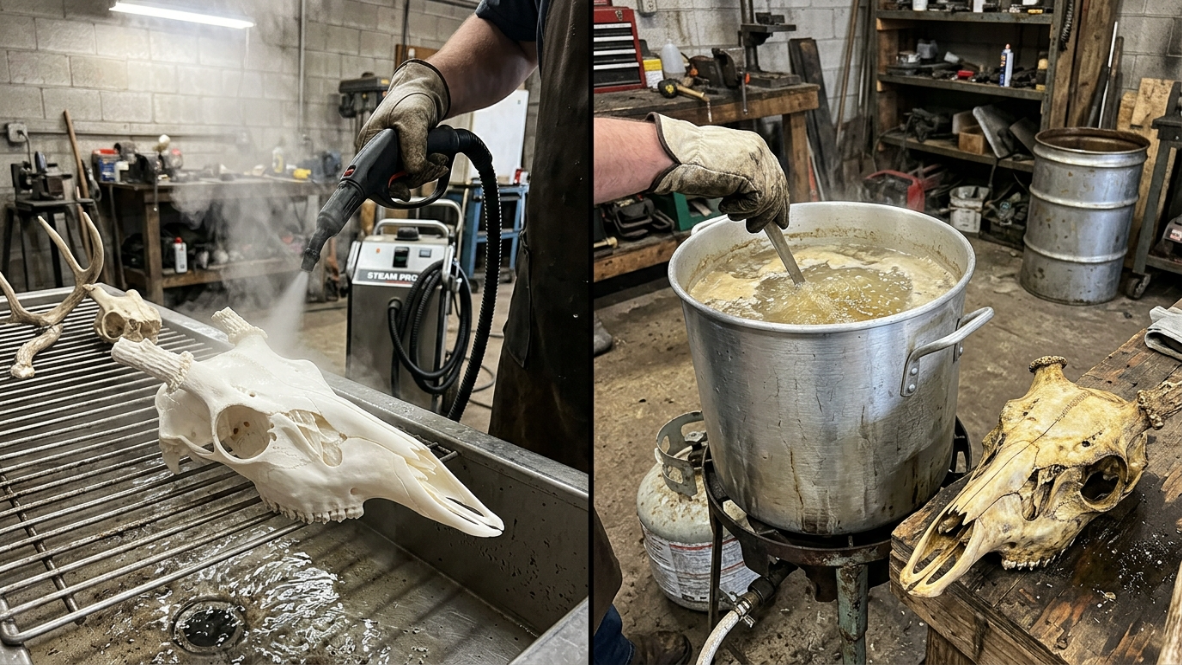
The word “boiling” gets thrown around loosely in taxidermy circles, but actual boiling is one of the worst things you can do to a skull. Boiling causes bone to become brittle and warp. Equally problematic, boiling locks animal fat and grease into the bone, which surfaces for years afterward, causing yellowing, tackiness, and dirt collection.
Steam sidesteps both problems. It loosens tissue without submerging bone in rolling water, preserving structural integrity while still breaking down soft tissue for removal. As one bone preparation specialist puts it plainly: “The steam will loosen tissue without damaging the bones. Despite what a lot of websites say, you shouldn’t boil bones.”
Practitioners on hunting forums confirm this in practice. One HuntTalk user writes: “I actually mainly use a steamer for the entire process. Works real slick, no boiling required and great for elk if you don’t have a means for a burner and big enough pot.” A Rokslide forum member described steaming a moose for 2 hours, pressure washing for 20 minutes, then doing two rounds of bleach to finish. For a full walkthrough of steam skull cleaning technique, the taxidermy steamer guide covers the process step by step.
Chemical Reduction
Steam methods can reduce or eliminate exposure to formaldehyde, pickling acids, and harsh degreasing agents. This matters because cumulative chemical exposure is a career-ending risk for taxidermists. Many taxidermists develop skin reactions and respiratory sensitivity after years of handling tanning chemicals. Your body can lose its resistance over time, and the damage compounds quietly.
By replacing chemical-heavy cleaning steps with steam, operators cut their daily exposure load without sacrificing results.
When Steam Is NOT the Safest Option
Although steam improves safety in many situations, it is not the correct solution for every taxidermy task.
Avoid using steam when:
Working on fragile bird skins
Preserving delicate fish specimens
Handling museum artifacts with unstable adhesives
Cleaning antlers with decorative finishes
Working near electronic display components
Treating chemically unstable preservation materials
In these situations, lower-temperature cleaning methods or traditional preservation techniques may produce better results while reducing damage.
Common Taxidermy Hazards That Steam Helps Address
Chemical Exposure in the Modern Shop
Taxidermy shops use a wide variety of chemicals with documented health effects. Common substances include borax, formic acid, acetic acid, oxalic acid, sulfuric acid, hydrochloric acid, degreasing agents, soda ash, formaldehyde, Eulan, and polyurethane foam.
Tanning poses the most danger to the user’s health due to dangerous fumes. Borax is a low lung irritant that may cause nasal and eye irritation. Pickling acids each carry their own risk profile, with formic acid producing dangerous fumes at high concentrations.
OSHA restricts formaldehyde exposure to 0.75 parts per million (ppm) over an 8-hour workday, with a short-term exposure limit of 2 ppm for any 15-minute period. NIOSH recommends an even lower threshold of 0.016 ppm over 8 hours. Every step in the workflow that replaces chemical processing with steam-based cleaning brings a shop closer to compliance without expensive fume extraction overhauls.
Arsenic and Legacy Toxins in Historical Specimens
If you handle, restore, or remount older taxidermy, chemical contamination is almost guaranteed. Arsenic was used in taxidermy as recently as the 1980s. Mercury, naphthalene, para-dichlorobenzene, asbestos, and DDT have all been found in taxidermy collections.
Steam doesn’t neutralize these substances, but understanding their presence is essential context for anyone working in taxidermy safety. Respiratory protection and skin barriers are non-negotiable when handling pre-1990s specimens, regardless of your cleaning method.
Biological Hazards and CWD
Chronic Wasting Disease has been detected in 36 U.S. states and four Canadian provinces. Caused by an infectious protein called a prion, CWD is always fatal in deer, elk, and moose, and the prion is extraordinarily resistant to environmental degradation and standard disinfection.
This is where steam for taxidermy safety intersects with emerging wildlife management concerns. Practitioners on Taxidermy.net note that tools used to remove heads and skull caps need to be washed in antibacterial soap, followed by steam autoclaving or by running a butane flame over the surface. All work surfaces should be covered with formica at minimum.
Steam autoclaving is recommended, but there are important limitations. It takes roughly 1,800°F to actually destroy a prion, which is far beyond what any commercial steamer produces. The practical solution is a two-step approach: steam autoclaving for general decontamination, combined with soaking tools in a 50/50 solution of household bleach and water for one hour. This bleach method is USDA-approved for inactivating CWD prions.
For a broader overview of steam safety principles in commercial settings, the commercial steam boiler safety guide covers pressure management and compliance requirements that apply directly to taxidermy shop setups.
Other Biological Risks Taxidermists Should Consider
Steam reduces some biological contamination but should never replace safe handling procedures.
Potential biological hazards include:
Salmonella
E. coli
Anthrax (rare but documented)
Tularemia
Rabies exposure during fresh specimen handling
Avian influenza in bird specimens
Parasites including ticks and mites
Mold spores from improperly stored specimens
Good hygiene, disposable gloves, disinfection, and ventilation remain essential regardless of the cleaning method.
Steam-Specific Safety Risks and Precautions
Steam is safer than many alternatives, but it introduces its own hazard category. Treating steam equipment casually is how injuries happen.
Burn Hazards
High-pressure steam is dangerous because of its temperature, the pressure it carries, and the energy stored in water vapor. A leak or rupture can cause severe burns, reduced visibility, and sudden equipment failures. The critical threshold to understand: exposure to water at 140°F for just five seconds can cause a third-degree burn. Systems should cool to 140°F or below before any direct skin contact.
Steam burns are particularly dangerous because vapor penetrates clothing and clings to skin longer than a splash of hot water. In a taxidermy shop where operators work close to the steam source for extended periods, this risk is constant.
Pressure Management
Pressurized steam boilers need to be built and certified to handle internal pressure over long operating cycles. This is where equipment quality directly becomes a safety issue. ASME (American Society of Mechanical Engineers) certification means a boiler has been tested for pressure integrity under defined conditions. UL (Underwriters Laboratories) listing confirms electrical safety and fire risk compliance.
In a taxidermy shop running multi-hour skull cleaning sessions, pressure integrity is not optional. Improvised steam rigs, however creative, lack these protections entirely.
The Problem with DIY Steam Rigs
Forum evidence shows hunters building steam setups from turkey fryers, extra propane tanks, braided steel hoses, and heavy-duty trash bags. One Rokslide user described their full rig: fill a turkey fryer halfway with water, fit a braided steel hose, put the skull in a heavy-duty trash bag with the hose inserted, tape it tight, and poke a small hole at the bottom for pressure relief once the bag fills with steam.
This works, in the sense that tissue loosens. But it also means running an uncertified pressure vessel with improvised seals, no automatic shutoff, no pressure gauge, and a propane flame beneath it. The burn and explosion risk is real. Purpose-built commercial equipment with ASME and UL certification exists specifically to eliminate these failure modes.
Browse ASME-certified commercial steamers built for continuous-duty applications like taxidermy.
Ventilation
Steam itself is just water vapor, but when you steam a skull or hide, you’re also volatilizing whatever is on or in the specimen: residual chemicals, biological material, fats, and potentially pathogenic particles. In an enclosed shop, this creates an air quality problem fast.
Fresh air circulation is not optional. Forced-draft ventilation or a portable fume extractor should run whenever steam equipment is operating. Taxidermy shops should target adequate air changes per hour, particularly when working with chemically treated or older specimens. A combination of open-air exhaust and filtered intake gives the best protection.
Shop Layout Tips for Steam Safety
Arrange your workspace so that:
Steam equipment stays away from electrical outlets.
Hoses do not cross walking paths.
Specimens move through a one-direction workflow.
Ventilation exhaust is positioned behind the steaming station.
Fresh-air intake is opposite the exhaust.
Chemical storage remains separated from steam equipment.
An organized shop reduces both accidents and cross-contamination.
Common Steam Safety Mistakes
Many injuries occur because experienced operators become comfortable with routine tasks.
Common mistakes include:
Opening the boiler before pressure is released
Using damaged steam hoses
Wearing thin nitrile gloves instead of insulated gloves
Operating indoors without ventilation
Using consumer garment steamers beyond their rated duty cycle
Allowing condensation to accumulate on floors
Filling boilers with hard water without descaling
Leaving pressurized equipment unattended
Avoiding these mistakes significantly reduces accidents.
PPE Requirements for Steam Use in a Taxidermy Shop
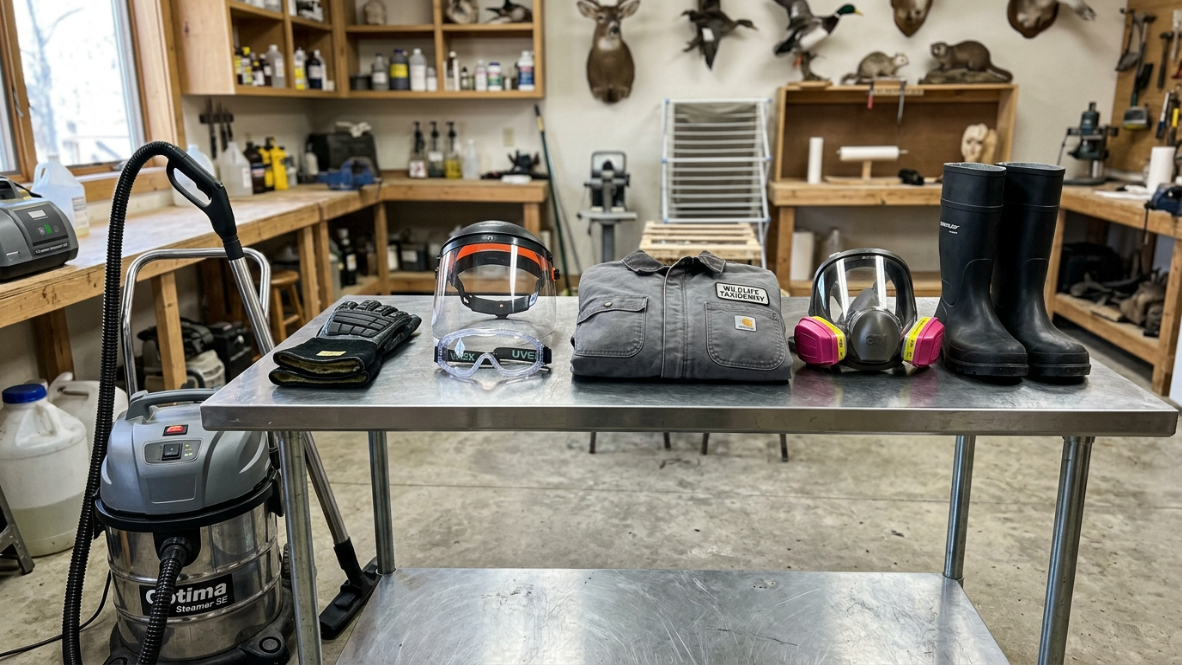
Personal protective equipment for steam work overlaps with general taxidermy PPE but has specific additions.
Baseline PPE for Steam Operations
Heat-resistant gloves: Standard nitrile or latex gloves offer zero burn protection. Insulated, heat-rated gloves are required when handling steam wands, hoses, or freshly steamed specimens.
Safety goggles or face shield: Steam condensation and splash from pressure washing after steaming create eye hazards. Goggles seal against vapor; a face shield adds protection during high-pressure applications.
Long-sleeved clothing: Exposed forearms are the most common burn site. Wrists and inner arms should be covered.
Closed-toe shoes with non-slip soles: Condensation on shop floors creates slip hazards. Rubber-soled, waterproof footwear is the minimum.
Respiratory protection: When steaming specimens that may contain residual chemicals (formaldehyde, arsenic, tanning agents), a half-face respirator with organic vapor cartridges is appropriate. For general steaming of fresh specimens, a well-ventilated space may suffice, but err toward protection.
Additional Considerations
For directed steam application, a steam wand keeps hands farther from the steam source and gives more precise control. This reduces both burn risk and wasted effort compared to free-flowing steam in a bag.
Many taxidermists develop chemical sensitivities after years of unprotected work. Protecting your skin and lungs now prevents serious problems later, whether those problems come from chemicals or from thermal exposure.
Recommended Shop Safety Equipment
Besides PPE, every taxidermy shop using steam should have:
Equipment | Purpose |
|---|---|
ABC Fire Extinguisher | Fire protection |
First Aid Kit | Burn treatment |
Eye Wash Station | Chemical or steam exposure |
Carbon Monoxide Detector | Gas-fired equipment |
Water Leak Detector | Prevent slipping hazards |
Ventilation Fan | Air quality |
Infrared Thermometer | Surface temperature checks |
Pressure Gauge | Monitor boiler pressure |
Equipment Certification: Why It Matters in a Taxidermy Shop
ASME Certification
ASME certification on a steam boiler means the pressure vessel has been designed, manufactured, and tested to meet the Boiler and Pressure Vessel Code. In practical terms, this means the tank can handle its rated pressure without rupture, the safety relief valve functions correctly, and the construction materials meet metallurgical standards. For a taxidermy shop running a boiler for hours during skull cleaning, ASME certification is the difference between engineered safety margins and hoping for the best.
Understanding what a boiler’s data plate tells you is useful context. The ASME data plate reading guide explains each specification and what it means for safe operation.
UL Listing
UL listing covers the electrical components: heating elements, wiring, controls, and switches. In a taxidermy shop where water, steam, and electricity all coexist in close quarters, electrical safety certification isn’t a luxury. It’s also often a requirement for commercial insurance coverage and local code compliance.
Commercial Equipment vs. Consumer Steamers
Consumer garment steamers and handheld units are not designed for the pressure, duty cycle, or output that taxidermy work demands. Running a consumer unit for a 2-hour skull steaming session will likely overheat the unit, void whatever warranty exists, and potentially cause a failure in an environment where burns are already a concern. The pressurized vs. non-pressurized steamer guide explains these differences in detail.
Consumer vs Commercial Steam Equipment
Feature | Consumer Steamer | Commercial Steamer |
|---|---|---|
Duty Cycle | Short | Continuous |
Boiler Size | Small | Large |
PSI Output | Low | High |
Recovery Time | Slow | Fast |
ASME Certified | Usually No | Often Yes |
UL Listed | Sometimes | Usually |
Suitable for Taxidermy | Limited | Yes |
Ventilation Best Practices for Taxidermy Shops Using Steam
Ventilation deserves its own section because it’s the single most neglected safety measure in small taxidermy shops. Breathing chemical vapors daily causes long-term respiratory damage, and adding steam to a poorly ventilated space concentrates airborne contaminants rather than dispersing them.
Practical Setup
Exhaust fan at the steam station. A wall-mounted exhaust fan directly behind or above the steaming area pulls contaminated vapor out of the breathing zone.
Makeup air intake. An exhaust fan without replacement air creates negative pressure that makes the fan work harder and may pull fumes from other parts of the shop. A filtered intake on the opposite wall balances the system.
Portable fume extractors. For shops where permanent ventilation modifications aren’t possible, a portable fume extractor with activated carbon filtration handles chemical vapor from previously treated specimens.
Humidity management. Continuous steaming raises shop humidity significantly. High humidity promotes mold growth on stored specimens and makes floors dangerously slippery. A commercial dehumidifier or additional ventilation addresses this.
Quick-Reference Safety Checklist for Steam Taxidermy Work
Before Starting
Inspect steam equipment for hose damage, loose fittings, or mineral buildup
Verify water level in the boiler
Confirm exhaust ventilation is running
Put on full PPE (heat gloves, goggles, long sleeves, closed-toe shoes, respirator if needed)
Clear the work area of flammable materials and unnecessary clutter
Check that the safety relief valve moves freely
During Operation
Never leave a pressurized steam unit unattended
Keep hands and exposed skin away from the steam outlet
Use a steam wand for directed application rather than free-flowing steam
Monitor pressure gauge readings and stay within rated limits
Keep the floor dry, wiping condensation as it accumulates
If working on a CWD-zone specimen, keep tools separated and follow bleach decontamination protocol
After Shutdown
Allow the unit to depressurize fully before opening fill caps or disconnecting hoses
Let steamed specimens cool below 140°F before handling
Clean and dry all equipment to prevent mineral scaling
Decontaminate tools if CWD exposure is possible (50/50 bleach soak for 1 hour)
Document any equipment issues for maintenance follow-up
Ventilate the shop for at least 15 minutes after shutting down steam equipment
Choosing the Right Equipment for Safe Taxidermy Steam Work
The choice between a portable flash steamer, a small shop boiler, and a continuous-duty industrial unit depends on workload. A taxidermist doing occasional euro mounts for personal use has different needs than a commercial shop processing dozens of skulls per season.
For smaller operations, an entry-level commercial steamer provides 40 PSI of steam from a standard 110V outlet, enough for individual skull cleaning sessions without the complexity of a larger system.
Commercial shops handling high volumes or running multi-hour sessions need higher-capacity boilers with automatic fill systems. The key specifications to evaluate are PSI output, tank capacity (which determines how long you can run before refilling), heating element wattage (which determines recovery time), and certification status.
For a deeper comparison of power requirements, the 110V vs. 220V steamer guide breaks down the tradeoffs relevant to shop electrical setups.
Steam Safety Maintenance Schedule
Task | Frequency |
|---|---|
Inspect hoses | Before every use |
Check relief valve | Weekly |
Descale boiler | Monthly (or as needed) |
Replace worn seals | Annually |
Inspect wiring | Every 6 months |
Test ventilation | Monthly |
Clean condensate tray | Weekly |
Professional inspection | Yearly |
Frequently Asked Questions
Is steam cleaning skulls safer than boiling them?
Yes. Steam loosens tissue without submerging bone in water at or near 212°F. Boiling causes bone to become brittle, warp, and trap grease inside the bone matrix. Steam gives more control over the cleaning process and reduces the risk of ruining a skull, while also lowering the splash and burn risk associated with handling large pots of boiling water.
What PPE do I need when using steam for taxidermy?
At minimum: heat-resistant gloves, safety goggles or a face shield, long-sleeved clothing, and closed-toe non-slip shoes. If you’re steaming specimens that were previously treated with chemicals (formaldehyde, arsenic, tanning agents), add a half-face respirator with organic vapor cartridges. For high-pressure applications, a full face shield is recommended over goggles alone.
Can steam kill CWD prions on taxidermy tools?
Steam autoclaving is recommended as part of a decontamination protocol, but steam alone does not destroy CWD prions. Prions require approximately 1,800°F for complete destruction, far beyond any commercial steamer’s output. The USDA-approved method for inactivating prions on hard surfaces is soaking tools in a 50/50 household bleach and water solution for one hour at room temperature. Use steam autoclaving as a first step, followed by the bleach soak.
Why does equipment certification matter for taxidermy steam safety?
ASME certification confirms that a steam boiler’s pressure vessel meets engineering standards for safe operation under sustained pressure. UL listing verifies electrical component safety. Together, they mean the equipment has been independently tested for the failure modes that cause injuries: rupture, overpressure, and electrical faults. Improvised steam rigs using turkey fryers and trash bags lack all of these protections.
How long can I safely steam a skull?
Practitioners commonly report steaming for 1 to 3 hours depending on specimen size. A moose skull may require 2 or more hours. The safety concern is not the duration itself but whether the equipment is rated for continuous duty at that runtime. Consumer-grade steamers are not designed for multi-hour sessions and may overheat. Commercial boilers with adequate tank capacity and proper pressure relief systems handle extended runs safely.
What ventilation do I need when steaming in my taxidermy shop?
A wall-mounted exhaust fan near the steaming station, combined with a makeup air intake on the opposite side of the shop, provides basic protection. When steaming chemically treated or older specimens, add a portable fume extractor with activated carbon filtration. Run ventilation during steaming and for at least 15 minutes after shutdown to clear residual vapor.
Is a consumer garment steamer good enough for taxidermy skull cleaning?
No. Consumer garment steamers lack the PSI output, tank capacity, and duty cycle rating needed for taxidermy work. They are not pressure-tested to commercial standards and will likely fail or overheat during a multi-hour skull cleaning session. For taxidermy applications, purpose-built commercial steam equipment is the baseline for both effectiveness and safety.
What temperature causes steam burns in a taxidermy shop?
Exposure to water or steam at 140°F for just five seconds can cause a third-degree burn. Commercial steam boilers produce output well above this threshold, often at 212°F or higher under pressure. This is why heat-resistant gloves, covered skin, and a steam wand for directed application are essential rather than optional.
Ready to move from improvised rigs to certified equipment? See taxidermy steamer bundles with everything needed to start safely, or explore more guides on the Hoffman Steam blog.


