

TL;DR
Steam and heat guns both shrink wrap film, but they work through fundamentally different physics. Steam transfers heat roughly 23 times more efficiently than air, operates at lower temperatures (180–200°F vs 350–500°F), and wraps products in uniform 360° heat that prevents wrinkles and fish eyes. Heat guns cost less upfront and work fine for low-volume, flat-product applications. For shrink sleeve labels, tamper bands, or anything over 100 units a day, steam is the clear winner on quality, speed, and per-unit cost.
If you’re choosing between steam and a heat gun for shrink wrapping, the right option depends on your production volume, film type, and quality requirements.
– Choose a heat gun if you package fewer than 50 products per day, use polyolefin or polyethylene film, and need the lowest upfront cost.
– Choose steam if you’re applying PETG shrink sleeves, tamper bands, curved containers, or producing more than 100 units daily.
– Steam produces fewer wrinkles, fish eyes, and distortions because it heats products evenly from every direction.
– Heat guns remain the best choice for oversized objects like pallets, boats, and furniture where steam tunnels are impractical.
For most commercial packaging lines, steam delivers better appearance, higher throughput, and lower long-term labor costs despite the higher equipment investment.
What Is a Heat Gun in Shrink Wrapping?
A heat gun is a handheld device that blows hot air through a nozzle to shrink plastic film around a product. Think of it as a more powerful version of a hair dryer, purpose-built for packaging. There are two main types:
Electric heat guns typically run at 1,200 watts on a standard 110-volt outlet. They’re used for lighter applications like polyolefin and PVC films, wrapping retail products such as books, toys, CDs, and food items.
Propane heat guns generate much higher heat output and are designed for heavy-duty work with polyethylene sheeting. Pallet wrapping, boat winterizing, and covering large irregular objects are their sweet spot.
The operator points the gun at the film and manually moves it around the product until the film contracts. It’s simple, affordable, and requires zero infrastructure beyond a power outlet or propane tank.
What Is Steam Shrink Wrapping?
Steam shrink wrapping uses generated steam as the heat transfer medium instead of blown hot air. In a typical setup, a steam boiler or generator produces live steam that flows into a tunnel or chamber. The product passes through (or sits inside) this steam environment, and the film shrinks uniformly from all directions simultaneously.
Steam tunnels operate at significantly lower temperatures than dry heat methods, typically between 180°F and 200°F. This gentler approach is becoming the label industry’s standard for shrinking sleeves onto filled product containers, particularly for beverages and cosmetics.
If you’re evaluating commercial steam equipment for packaging, understanding the differences between flash steamers and boilers is a good starting point.
The Physics: Why Steam Transfers Heat So Differently
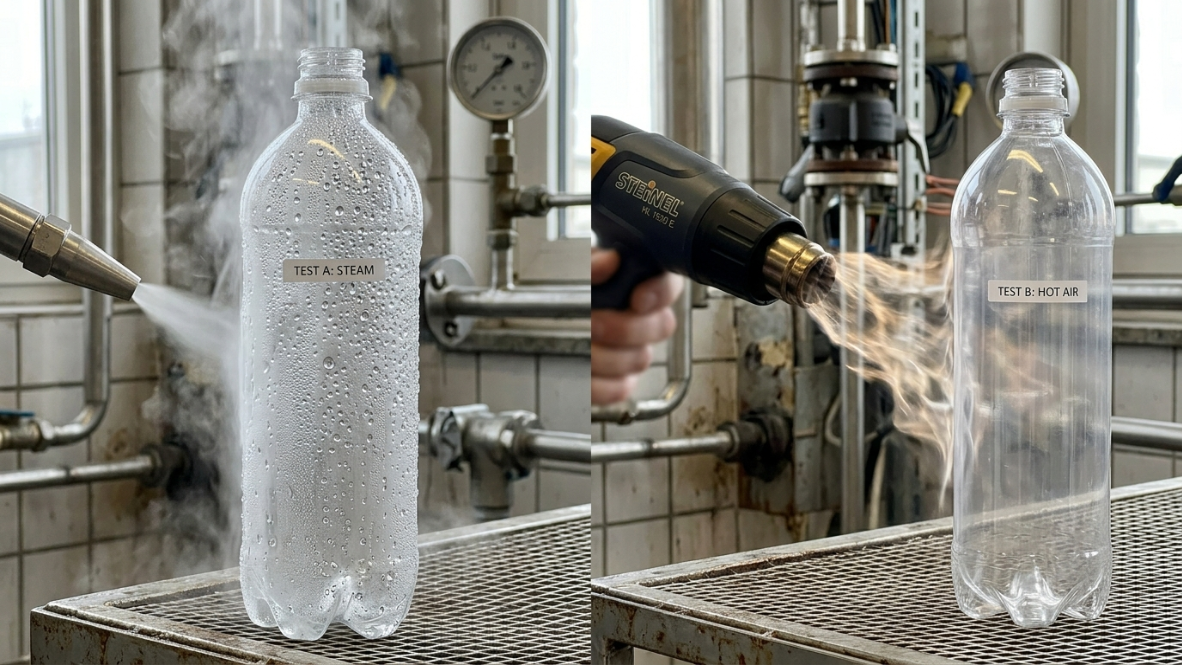
This is where the steam vs heat gun shrink wrap debate gets interesting, because it’s not just a matter of preference. It’s physics.
Water is 23.5 times more efficient at transferring heat than air. That alone should make you pause. But steam has an additional advantage that air simply cannot match: latent heat. When steam condenses on the surface of shrink film, it releases a massive burst of energy at a consistent temperature. According to engineering data from Campbell-Sevey, the mass flow rate of air needed to transfer the same amount of heat as steam would need to be roughly 34 times greater.
What does this mean practically? Steam delivers more heat, more evenly, at a lower temperature. A heat gun has to compensate for its inefficiency by running much hotter (350–500°F), which creates uneven exposure and increases the risk of melting or distorting both the film and the product inside it.
Steam vs Heat Gun at a Glance
Feature | Steam Shrink Wrapping | Heat Gun Shrink Wrapping |
|---|---|---|
Heat Source | Condensing steam | Hot air |
Typical Temperature | 180–200°F | 350–500°F |
Heat Distribution | 360° uniform | Directional |
Finish Quality | Excellent | Operator dependent |
Fish Eyes | Rare | Common |
Wrinkles | Minimal | Common |
Best Film | PETG, PVC | Polyolefin, PE |
Production Speed | High | Low |
Labor Required | Low | High |
Initial Cost | Higher | Very Low |
Operating Cost | Lower at scale | Higher at scale |
Best For | Shrink sleeves, tamper bands | Small batches, oversized items |
Finish Quality: Where the Difference Is Obvious
For many businesses evaluating steam vs heat gun shrink wrap methods, finish quality is the deciding factor. If your product sits on a retail shelf or ships directly to consumers, the appearance of your packaging matters.
Common Heat Gun Defects
Manual heat gun application creates several recurring problems because operators simply cannot deliver uniform heat from all angles at once:
Fish eyes are round or oval patterns in the film caused by insufficient heat in certain areas. They look sloppy and unprofessional, and they’re nearly impossible to eliminate consistently with a handheld gun.
Dog ears and crow’s feet are wrinkles that extend from package corners. They result from excess film bunching up where heat wasn’t applied evenly.
Uneven shrinkage happens when one side of the package gets more heat exposure than another. The film pulls tighter in some spots and stays loose in others.
These defects are well documented. As PDC International notes, hot air is not an efficient heat transfer medium, and temperatures must run higher to compensate, which can over-expose the leading edge of the container and produce a poor-quality finish.
Why Steam Prevents These Problems
Steam envelops the product from all 360 degrees. There are no hot spots, no cold spots, and no need for operator skill to achieve uniformity. The film shrinks at the same rate everywhere, which eliminates fish eyes, reduces wrinkles, and preserves printed graphics without distortion.
This matters especially for complex container shapes. Round bottles, hourglass figures, and containers with curves and contours all benefit from steam’s gentle, even heat distribution. If graphics appearance and distortion-free results are critical, steam is usually the better option.
Understanding how commercial steamers work helps clarify why the heat delivery is so fundamentally different from blown air.
Common Shrink Wrap Problems and Which Method Solves Them
Fish Eyes
Cause:
Uneven heat reaching portions of the film.
Best solution:
Steam.
Dog Ears
Cause:
Film bunching at corners.
Best solution:
Steam or properly adjusted heat tunnel.
Burn Marks
Cause:
Heat gun held too close or too long.
Best solution:
Increase distance or reduce temperature.
Loose Film
Cause:
Insufficient heat.
Best solution:
Increase exposure time or use steam for more consistent shrinkage.
Distorted Graphics
Cause:
Localized overheating.
Best solution:
Steam because it heats uniformly.
Speed and Throughput Comparison
The throughput gap between steam and heat guns is stark.
With a heat gun, wrapping a single product can take minutes depending on size and film type. The operator must work the gun around each surface, check for defects, and often re-apply heat to fix problem areas. For a small business doing a few dozen packages a day, this is manageable. Beyond that, it becomes a bottleneck.
Small manual steam units, by contrast, can process 600 to 900 units per hour according to Zap Labeler. That’s a roughly 10:1 throughput advantage over heat gun application for sleeve labeling. In the time it takes to wrap one tamper band with a heat gun, a steam-based system can handle ten shrink sleeve labels.
For businesses processing anything above 50 to 100 units daily, this speed difference translates directly into labor savings that can justify the higher equipment cost.
Cost and Equipment Requirements
Heat Gun: Low Barrier, Low Ceiling
A basic electric heat gun costs $30 to $200. Plug it into a wall outlet and you’re operational. No permits, no plumbing, no boiler maintenance. For a startup doing small-batch packaging or someone wrapping the occasional gift basket, the economics make perfect sense.
The catch is that a heat gun will work through a lesser volume of products each day. Labor costs per unit stay high, defect rates stay high, and there’s a hard ceiling on how much you can scale without fundamentally changing your process.
Steam: Higher Investment, Better Economics at Scale
Steam shrink wrapping requires a steam boiler or generator, which represents a meaningful upfront investment. You’ll need a reliable steam source, water supply, and a maintenance routine. Steam generators for packaging can cost as much as the tunnel itself, making the total system cost significantly higher than a handheld gun.
But operating costs tell a different story. Steam tunnels use less energy than other tunnel types and produce better results with easier configuration. The per-unit cost drops quickly as volume increases, and the reduction in defects means less wasted film and fewer rejected products.
For businesses ready to move beyond heat guns, Hoffman Steam manufactures commercial electric steam boilers in the U.S. specifically designed for applications like shrink packaging.
Return on Investment (ROI): When Does Steam Pay for Itself?
Example table:
Daily Production | Recommended Method | Typical Payback |
|---|---|---|
Under 25 units | Heat Gun | Steam rarely justified |
25–50 units | Heat Gun | Depends on labor |
50–100 units | Either | Evaluate labor costs |
100–300 units | Steam | Often within 12–24 months |
300+ units | Steam | Usually fastest ROI |
Film Type Compatibility Guide
Different shrink films require different temperature ranges, and this directly affects which heat method works best.
Film Type | Temperature Range | Best Heat Method | Notes |
|---|---|---|---|
PETG | 150–200°F (65–93°C) | Steam | Commonly used for beverage and cosmetics sleeves. Often requires steam to shrink evenly. |
PVC | 176°F+ (80°C minimum) | Steam or heat gun | Works with both methods, but steam gives more uniform results on curved surfaces. |
Polyolefin | 250–375°F (121–190°C) | Heat gun or hot air tunnel | Higher temps needed. Standard for retail flat-pack shrink wrapping. |
PE (Polyethylene) | 284–356°F (140–180°C) | Propane heat gun or hot air tunnel | Used for pallets, large items, heavy-duty applications. |
The key takeaway: PETG shrink sleeves, which dominate the beverage and personal care markets, are best served by steam. Polyolefin and PE films, commonly used for flat retail packaging and pallet wrapping, tolerate the higher temperatures of heat guns and hot air tunnels.
Practitioners on packaging forums frequently report that attempting PETG sleeves with a heat gun leads to bubbling and uneven shrinkage. Zap Labeler states directly that methods other than steam for shrink sleeves “may result in bubbles, wrinkles or melted sections.”
Which Industries Use Steam vs Heat Guns?
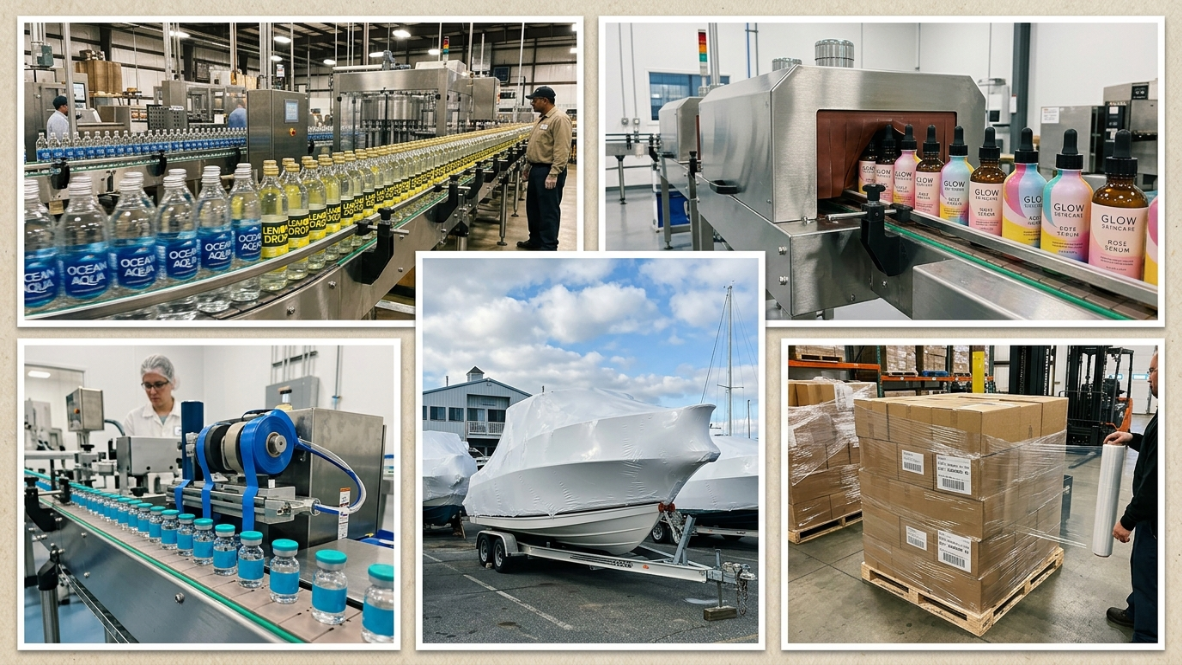
Food Packaging
Preferred method:
Steam
Reason:
Uniform shrink on bottles and jars.
Beverage Industry
Preferred:
Steam
Reason:
PETG sleeves dominate.
Cosmetics
Preferred:
Steam
Reason:
Protects printed graphics.
Pharmaceutical Packaging
Preferred:
Steam
Reason:
Tamper bands require consistency.
Warehouse Shipping
Preferred:
Propane heat gun
Reason:
Large polyethylene covers.
Marine and Boat Storage
Preferred:
Propane heat gun
Reason:
Oversized objects cannot fit steam tunnels.
When to Use a Heat Gun
Heat guns earn their place in specific scenarios:
Low volume operations processing fewer than 50 packages per day won’t see enough throughput benefit to justify a steam system.
Tight budgets under $200 make a heat gun the only realistic option. It works. It just works slowly.
Large or irregular items like boats, outdoor furniture, or pallet loads need propane heat guns that can cover large surface areas with PE film. No steam tunnel accommodates a 24-foot boat.
Simple flat packages where 360-degree uniformity isn’t critical. Shrink wrapping a flat box or book with polyolefin doesn’t demand the precision that a contoured bottle does.
Moisture-sensitive products may also favor dry heat. Powdered products, empty containers awaiting filling, and items that can’t tolerate any condensation are better candidates for hot air or a heat gun.
If you’re new to commercial steam equipment and wondering whether your situation warrants the upgrade, comparing equipment specifications and power requirements can help frame the decision.
When to Use Steam
Steam wins the steam vs heat gun shrink wrap comparison in these situations:
Shrink sleeve labels, particularly PETG, almost always require steam for acceptable results. The lower operating temperature and uniform heat distribution are not optional for this application.
Tamper-evident bands on bottles and jars benefit from steam’s 360-degree coverage. A heat gun can apply tamper bands, but the inconsistency leads to higher reject rates.
Curved, contoured, or non-straight-sided containers such as hourglass bottles, tapered jars, and containers with embossing or ridges. Steam’s gentle and even shrinkage follows complex geometries without creating hot spots or distortion.
Daily production exceeding 100 units. The throughput advantage and lower defect rate make steam economically superior at moderate volumes.
Premium shelf-ready products where packaging quality reflects brand quality. Retailers and consumers notice fish eyes and wrinkles. Steam virtually eliminates them.
Filled products, especially beverages. Steam tunnels operating at 170–180°F are safe for filled containers. Dry heat tunnels running at 350°F or higher can compromise product integrity.
Steam vs Heat Gun by Production Volume
Products Per Day | Best Choice |
|---|---|
Under 20 | Heat Gun |
20–50 | Heat Gun |
50–100 | Depends on quality needs |
100–300 | Steam |
300–1,000 | Steam |
1,000+ | Steam Tunnel |
Steam Generator vs Steam Boiler for Shrink Wrapping
Steam Generator
Faster startup
Smaller footprint
Lower water capacity
Best for light commercial use
Steam Boiler
Continuous operation
Higher steam output
Better for production lines
Lower operating cost at high volume
Steam Boiler Sizing for Shrink Packaging
Choosing the right boiler depends on your production volume, the size of your tunnel or chamber, and whether you need continuous operation or batch processing.
Small operations doing a few hundred units per day can often work with a compact boiler in the 1 to 2 gallon range. Larger lines producing thousands of units need continuous-duty boilers with automatic pump-fill systems to avoid downtime for manual refilling.
Key specifications to evaluate include PSI output (which affects steam velocity and temperature), tank capacity (which determines run time between fills), and voltage requirements. If you’re comparing 110V versus 220V options, the distinction matters for both power output and facility compatibility.
Hoffman Steam offers boilers ranging from the EVD-1 (1-gallon, 40 PSI, $1,199) up through the RHPG series of industrial continuous-duty boilers. All are manufactured in Pennsylvania and carry ASME/UL certification on Pro and industrial models.
Explore Hoffman Steam’s commercial boiler lineup for shrink packaging applications.
Making the Decision: A Simple Framework
Here’s a practical way to think about the steam vs heat gun shrink wrap choice:
Choose a heat gun if your daily volume is under 50 units, your products are flat or oversized, you’re wrapping with polyolefin or PE film, and your total equipment budget is under $200.
Choose steam if you’re applying shrink sleeves or tamper bands, working with PETG film, packaging curved or contoured containers, producing more than 100 units daily, or selling products where packaging appearance directly impacts perceived quality.
The gray zone falls between 50 and 100 units per day with straightforward product shapes. At that volume, either method can work, but most businesses that start with heat guns at this level switch to steam within a year as defect frustration and labor costs accumulate.
The real question isn’t which method is “better” in the abstract. It’s which method matches your products, your volume, and your quality standards. For the majority of businesses packaging consumer goods with shrink sleeves or tamper bands, steam is the more professional and economical choice over time.
Hoffman Steam provides lifetime remote technical support and virtual demos for businesses evaluating steam equipment for shrink wrap packaging.
Frequently Asked Questions
Can I use a hair dryer instead of a heat gun for shrink wrap?
A hair dryer typically maxes out around 140°F, which is below the minimum shrink temperature for most films. PVC requires at least 176°F, and polyolefin needs 250°F or more. A hair dryer might partially shrink very thin PVC film, but the results will be poor and inconsistent. A proper heat gun or steam source is necessary for reliable shrinkage.
Does steam leave moisture on my products?
Some condensation can occur, particularly on cold products. Most steam tunnels include an air-dry section or blow-off zone at the exit to remove residual moisture. For products that absolutely cannot tolerate any moisture (powders, dry electronics, unsealed containers), a hot air tunnel or heat gun may be preferable.
What size steam boiler do I need for shrink packaging?
It depends on your tunnel size and throughput. A small manual steam shrink setup for a few hundred units per day might work with a 1 to 2 gallon boiler. High-volume production lines require continuous-duty boilers with automatic fill systems. Start by calculating your peak steam demand in pounds per hour and matching that to boiler output capacity.
Is steam shrink wrap safe for food packaging?
Yes. Steam tunnels are widely used in food and beverage packaging. The lower operating temperatures (170–200°F) are safe for filled containers, and the steam itself is simply water vapor. FDA-compliant shrink films are available for direct food contact, regardless of the heat method used.
How much faster is steam than a heat gun for shrink wrapping?
For shrink sleeve applications, steam offers roughly a 10:1 speed advantage. A manual steam unit can process 600 to 900 units per hour, while a heat gun requires minutes per product. The gap narrows somewhat for simple flat-wrap applications but remains significant at any meaningful volume.
Why does my shrink wrap have fish eyes?
Fish eyes, those round or oval blemishes in the film, are caused by insufficient or uneven heat. They’re one of the most common defects when using a heat gun because the directional airflow can’t reach all surfaces equally. Switching to steam or a heat tunnel with proper 360-degree coverage eliminates this problem in almost every case.
Can I use a heat gun with PETG shrink sleeves?
Technically yes, but the results are usually unacceptable. PETG sleeves are sensitive to uneven heat and will bubble, wrinkle, or distort when heated directionally. Industry consensus and packaging equipment manufacturers consistently recommend steam for PETG applications.
What’s the total cost difference between a heat gun and a steam setup?
A heat gun costs $30 to $200 with no additional infrastructure. A basic steam boiler suitable for shrink packaging starts around $1,000 to $1,200, and a complete steam tunnel system (boiler plus tunnel) can run several thousand dollars. However, the per-unit cost of steam shrink wrapping drops well below heat gun costs once you exceed a few hundred units per day, thanks to labor savings and reduced waste from defects.


