

TL;DR
A taxidermy steamer case study documents how a commercial steamer performs in a real taxidermy shop, measuring time savings, bone integrity, and workflow efficiency compared to traditional methods like boiling, maceration, or dermestid beetles. Directed commercial steam loosens tissue without trapping grease in bone, a problem that plagues simmering methods. For solo taxidermists processing 100+ skulls per season, even modest per-specimen time savings can recover 50 or more hours of high-value production time.
A “taxidermy steamer case study” is not an academic paper. It is proof. Proof that a piece of equipment works in the specific, messy, time-pressured reality of a taxidermy shop. If you are searching for this term, you have probably already heard that steam can be used for skull cleaning, hide relaxing, or form fitting. Now you want to see the evidence before committing money and changing your workflow.
This article breaks down what a taxidermy steamer case study actually measures, compares steam against the traditional methods your shop likely uses, and gives you the practitioner-sourced evidence that most equipment guides leave out.
Explore Hoffman’s taxidermy steamer bundles to see specifications and pricing for shop-ready setups.
A taxidermy steamer case study measures whether commercial steam equipment improves skull cleaning quality, reduces preparation time, lowers degreasing effort, and increases shop productivity compared with simmering, maceration, or dermestid beetles.
In most professional shops, the largest measurable benefits include:
Metric | Typical Improvement |
|---|---|
Tissue removal time | 20–60% faster |
Grease contamination | Lower than simmering |
Bone damage risk | Reduced on delicate structures |
Multi-purpose shop use | High |
ROI | Often recovered within one busy hunting season for high-volume shops |
The biggest advantage is not simply faster skull cleaning. It is recovering skilled labor hours that can be redirected toward higher-value mounting work.
What Is a Taxidermy Steamer Case Study?
In the context of a taxidermy shop, a case study is a documented evaluation of how a specific tool (in this case, a commercial steamer) performed under real working conditions. It is an equipment evaluation term, not a scientific one.
A useful taxidermy steamer case study answers three questions:
What problem did the shop have before? (Slow turnaround, bone damage, grease issues, workflow bottlenecks)
What changed when steam was introduced? (Process steps, time per specimen, quality of output)
What were the measurable results? (Skulls processed per week, reduction in degreasing time, bone integrity, customer satisfaction)
The reason people search for this specific phrase is that generic product descriptions are not convincing. A solo taxidermist earning $50,000 to $100,000 a year needs to see that a $2,000+ investment pays for itself during the busy season, not just that the machine produces steam.
What Makes a Good Taxidermy Steamer Case Study?
Not every equipment review qualifies as a true case study.
A useful case study should include:
Number of skulls processed
Species cleaned
Cleaning method before steam
Commercial steamer model
PSI used
Average prep time
Degreasing duration
Bone damage observations
Labor hours saved
Operator experience level
Total ROI
Without these measurements, most online “case studies” are simply product reviews rather than documented workflow evaluations.
At-a-Glance Results
Question | Short Answer |
|---|---|
Does steam replace beetles? | No |
Is steam faster than simmering? | Usually yes for tissue loosening |
Does steam reduce grease problems? | Yes compared with immersion boiling |
Is steam safer for bone? | Generally yes |
Is ROI measurable? | Yes |
Best for | Professional taxidermy shops |
Why Steam in Taxidermy? The Problem It Solves
The Four Traditional Skull Cleaning Methods
Before understanding what steam adds, you need to know what it competes with.
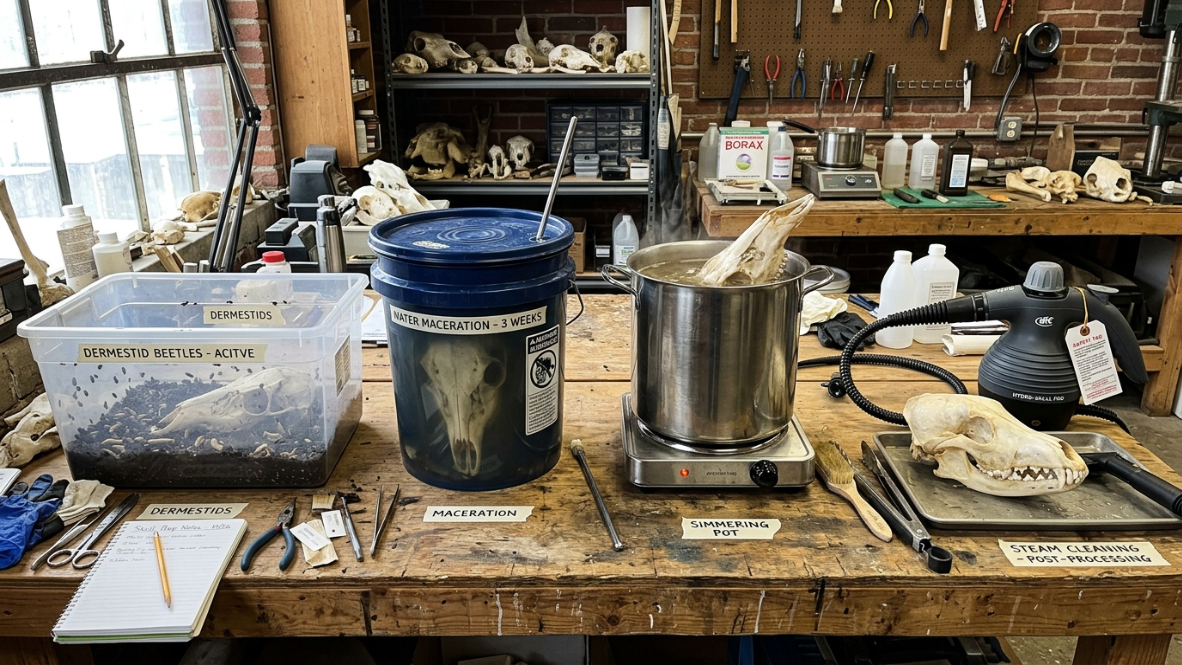
Dermestid beetles remain the gold standard in professional taxidermy. Beetle colonies clean bone completely while preserving delicate nasal structures that heat or water would destroy. The drawback is speed (5 to 21 days per skull) and the ongoing maintenance a colony requires, including temperature control, feeding schedules, and housing.
Maceration involves soaking skulls in warm water (around 95°F) and letting bacteria do the work. It is effective and cheap but extremely slow, often taking weeks. All cartilage dissolves during the process, which limits its usefulness for certain mounts.
Simmering is what most people mean when they say “boiling,” though true boiling is almost universally discouraged. Maintaining water just below boiling point loosens tissue quickly, but it comes with a serious cost.
Commercial steam is the newer option. Directed steam from a nozzle loosens connective tissue for manual removal without submerging the specimen in liquid.
For a deeper look at how steam applies across the full range of taxidermy tasks, the steam skull cleaning glossary covers terminology and techniques in detail.
The Boiling Problem That Steam Addresses
This is where most taxidermists’ frustrations begin. Simmering a skull in water may be fast, but it creates a cascading quality problem.
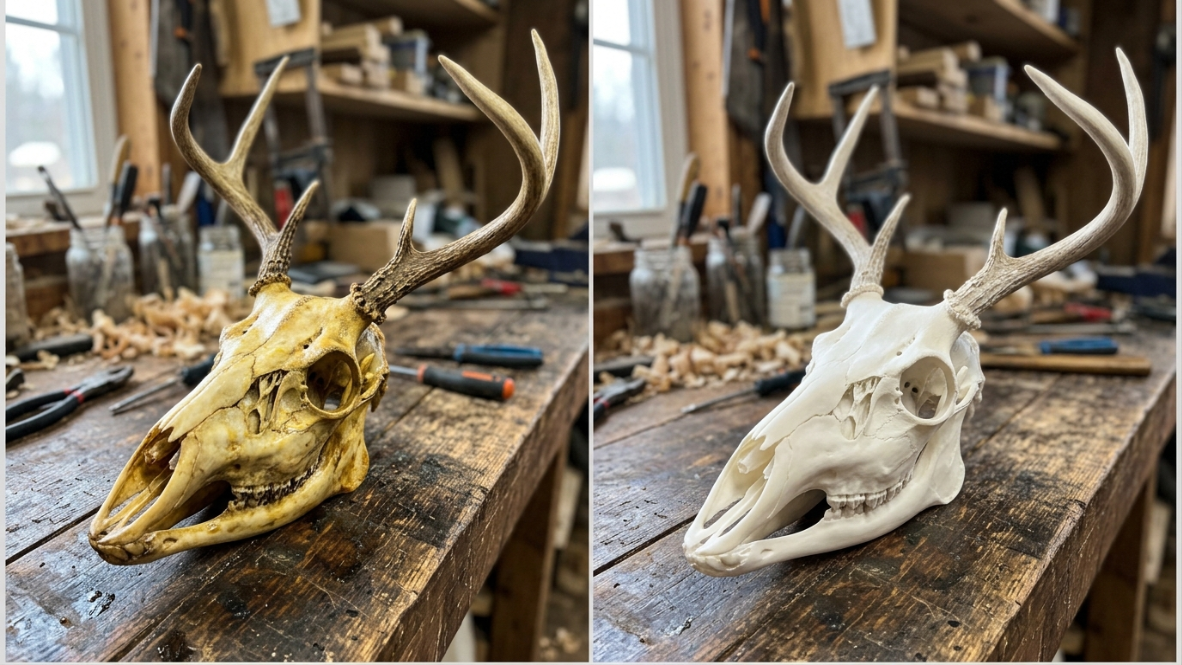
Boiling locks animal fat and grease into the bone. That trapped grease continues to surface for years, causing yellowing, a tacky feel, and dirt collection on what should be a clean European mount. Beyond aesthetics, boiling can cause bone brittleness and warping, particularly in thin structures like nasal bones and turbinates.
A practitioner blog dedicated to bone cleaning puts it bluntly: simmering or steaming can loosen tissue for scraping, but you should never boil bones. The distinction matters. Submerging bone in a pot of rolling water forces grease deep into porous bone material. Directed steam from a commercial nozzle works differently: it applies heat and moisture to a targeted area, loosening tissue on contact without the immersion that drives grease into pores.
Beyond Skulls: Multiple Uses in a Taxidermy Shop
A commercial steamer is not a single-purpose skull tool. Shops that invest in steam equipment report using it for:
Hide relaxing to rehydrate dried or frozen hides before mounting
Form fitting by steaming hide over polyurethane forms for a tighter, more natural appearance
Antler and horn sheath removal where controlled heat loosens sheaths from cores
Supplemental degreasing to address surface grease on bone
Tool sterilization for scalpels, pliers, and other prep equipment
This multi-purpose utility is a critical factor in any case study’s ROI calculation. A steamer that only cleaned skulls would be harder to justify. One that serves five or six functions across your workflow changes the math entirely.
What a Taxidermy Steamer Case Study Measures
If you are evaluating steam equipment for your shop, or reading someone else’s case study, these are the metrics that matter.
Time Per Specimen
This is the headline number. How many minutes does it take to loosen tissue from a skull using directed steam versus simmering, maceration, or waiting for beetles? For a shop processing deer, elk, and bear skulls, even a 20 to 30 minute reduction per skull compounds quickly.
Consider the math: a deer shoulder mount generates roughly $900 to $1,200 over 6 to 8 hours of work. If you can generate that kind of revenue per hour of mounting time, spending those hours on low-value tasks like manual scraping represents a poor trade. A steamer that cuts skull prep time frees you to do more of the work that actually pays.
Bone Integrity
A case study should document whether nasal bones, turbinates, and other fragile structures survived the cleaning process intact. Steam’s advantage here is that it applies controlled, directional heat rather than submerging the entire skull in liquid. Practitioners on UK hunting forums have confirmed that a steam cleaner works well for skull cleaning “straight from the boiler,” though they also note the importance of controlling the steam jet’s direction.
Degreasing Reduction
One of the most time-consuming steps in European mount preparation is degreasing. If steam loosens tissue more effectively upfront, less grease remains trapped in the bone, which reduces the time and chemicals needed for the degreasing stage. A good case study tracks total degreasing hours before and after introducing steam.
Peak Season Throughput
September through February is the universal busy season for taxidermists. Turnaround times of 3 to 6 months are standard, and shops that fall behind during this window struggle to catch up. Any case study worth reading should show how steam equipment performed under peak-season volume, not just on a single test skull in July.
Setup Cost vs. Per-Unit Savings
Hoffman’s taxidermy bundles range from $2,107 to $6,952 and include the accessories needed to start immediately. A meaningful case study calculates break-even: how many specimens does the shop need to process before the time savings cover the equipment cost?
See current taxidermy bundle options with included accessories and pricing.
Steam vs. Other Skull Cleaning Methods: Comparison
Method | Speed | Bone Safety | Grease Risk | Startup Cost | Best For |
|---|---|---|---|---|---|
Dermestid beetles | Slow (5–21 days) | Excellent | None | Moderate (colony upkeep) | High-volume pro shops with space and climate control |
Maceration | Very slow (weeks) | Good | Low | Low | Patient hobbyists, large specimens |
Simmering | Fast (1–3 hours) | Moderate risk of damage | High (grease locks into bone) | Low | Quick DIY turnaround when quality is secondary |
Commercial steam | Fast (minutes per skull for tissue loosening) | Excellent (directed, no immersion) | Low | Higher upfront, lower ongoing | Shops needing speed and quality across multiple tasks |
A few things to note about this table. Dermestid beetles remain unmatched for total, hands-off skull cleaning that preserves every delicate bone structure. Steam does not replace beetles for shops that already have a healthy, well-maintained colony. What steam does is serve shops that cannot maintain a colony (due to space, climate, or logistics), and it works as a pre-cleaning tool that reduces the time beetles need to finish a skull.
To understand how flash steamers differ from boilers, which matters when choosing between a portable unit and a shop-mounted system, that comparison breaks down the key distinctions.
Example ROI Calculation
The following example illustrates how many professional taxidermists evaluate equipment purchases.
Variable | Example |
|---|---|
Skulls per year | 150 |
Time saved each | 25 minutes |
Total hours saved | 62.5 |
Labor value | $150/hour |
Annual labor value recovered | $9,375 |
Commercial steamer cost | $3,000 |
Estimated first-year ROI | Approximately 212% |
Actual savings vary depending on specimen size, workflow, and production volume.
What Practitioners Actually Say
The taxidermy community is honest, sometimes brutally so, about what works and what doesn’t. Here is what real users report.
Steam Works, But Technique Matters
Practitioners on The Stalking Directory forum confirm that steam is effective for skull cleaning. One user noted it works “straight from the boiler on with the steam jet.” Another suggested that even borrowing a steam cleaner from a local garage would handle the job.
But there is a candid warning worth repeating: using a steam jet on a skull can result in “a faceful of boiled brain.” This is not a reason to avoid steam. It is a reason to use proper personal protective equipment, a face shield or safety glasses at minimum, and to work in a ventilated area. The foot-pedal control available on commercial steamers (Hoffman units include this feature) gives you hands-free on/off control, which means you can direct the nozzle precisely and cut steam instantly when needed.
The Grease Objection
Some taxidermists hesitate to use any heat-based method because fat can absorb into bone, creating long-term odor and yellowing. This concern is legitimate when it comes to simmering, where the skull sits in a pot of hot water and grease has nowhere to go but into porous bone.
Directed nozzle steam is fundamentally different. You are applying a focused jet to a specific spot on the skull, loosening tissue for manual scraping. There is no pot of greasy water surrounding the bone. The tissue loosens, you scrape it away, and the grease goes with the tissue rather than being forced into the bone’s interior. Understanding the distinction between immersion heat and directed steam is the single most important concept in any taxidermy steamer case study.
Material Costs Are Rising
One taxidermy shop reported that material costs have doubled to nearly quadrupled in recent years, forcing shops to raise prices just to break even. In that environment, equipment ROI matters more than ever. A commercial steamer that serves multiple functions (skull cleaning, hide relaxing, form fitting, sterilization) spreads its cost across more of your workflow than a single-purpose tool.
For context on how PSI requirements vary across different commercial tasks, higher pressure typically means faster tissue loosening but also demands more operator control.
Building a Case Study for Your Own Shop
You do not need to wait for someone else to publish a taxidermy steamer case study. You can build one yourself with straightforward documentation.
Step 1: Establish Your Baseline
Before introducing steam, record your current metrics for 10 to 20 skulls:
Total prep time per skull (from raw to ready for whitening)
Degreasing time and chemical costs
Bone damage rate (cracked nasal bones, warped structures)
Your hourly production value during peak season
Step 2: Introduce Steam and Track the Same Metrics
Process the next 10 to 20 skulls using directed steam for tissue loosening. Keep everything else constant: same species, same whitening process, same finishing standards. Record time, quality, and any issues.
Step 3: Compare and Calculate
The comparison will show you time saved per specimen, quality differences, and whether the degreasing stage shortened. Multiply time saved by your effective hourly rate during busy season. If you are generating $150+ per hour on mounting work, every hour recovered from skull prep is worth exactly that.
This kind of documented, before-and-after comparison is what makes a taxidermy steamer case study credible, both for your own decision-making and for sharing with others in the trade.
Sample Data Collection Sheet
Keeping consistent records makes it much easier to determine whether a commercial steamer improves your workflow.
Skull | Species | Cleaning Method | Prep Time | Degreasing Days | Bone Damage | Notes |
|---|---|---|---|---|---|---|
1 | Deer | Steam | ||||
2 | Deer | Steam | ||||
3 | Elk | Steam | ||||
4 | Bear | Steam |
This also encourages user engagement and adds practical value.
Choosing the Right Steamer for a Taxidermy Shop
Not every steamer fits a taxidermy workflow. Here is what to look for.
PSI Output
Higher PSI means the steam jet has more force to loosen stubborn connective tissue. For skull work and hide relaxing, you want a unit capable of consistent pressure. Hoffman’s Pro line models produce up to 70 to 90 PSI, which is significantly more force than any consumer garment steamer.
Nozzle Control
Precision matters. You need a nozzle that directs steam exactly where you want it, particularly around delicate nasal bones and orbital sockets. Foot-pedal activation is a major advantage because it keeps both hands free to hold the skull and scraping tools.
Boiler Capacity
A one-person shop processing skulls intermittently can work with a 1 to 2 gallon manual-fill unit. High-volume operations during peak season may need a larger boiler that can produce steam continuously without waiting for reheat cycles. If you are unsure about the difference, the guide on manual fill vs. auto fill boilers explains when each type makes sense.
Certification
ASME and UL certification matters for pressurized equipment. It is not just a regulatory checkbox. Certified equipment has been tested for safe operation under pressure, which protects you and your shop. Hoffman’s Pro line carries both certifications.
Power Requirements
Most one-person shops run on standard 110V circuits. Some larger Hoffman models offer 220V upgrades for shops with the electrical infrastructure. If your shop is in a garage or outbuilding, verify your available power before ordering. The comparison of 110V vs. 220V steamers covers what each voltage option means for daily use.
View the full range of Hoffman taxidermy steamers to find the right fit for your shop’s volume and budget.
The Industry Context: Why This Matters Now
The taxidermy industry is not shrinking. There are approximately 3,877 taxidermy businesses in the United States as of 2024, a 3.2% increase from 2023, with average annual growth of 4.4% over the past five years. The industry was valued at roughly $1.1 billion in 2023.
More shops mean more competition for customer turnaround expectations. Hunters increasingly expect faster delivery on European mounts and full-body mounts. The shops that win that race are the ones with the most efficient workflows, not necessarily the ones who work the most hours.
It is worth noting that major taxidermy supply companies like Van Dyke’s and McKenzie sell chemicals, beetle colonies, and hand tools, but none of them sell steam equipment. This gap means taxidermists looking for steam solutions need to look outside their usual supply chain, which is precisely why documented case studies and clear comparisons are so valuable.
Related Glossary Terms
European mount: A skull mount displaying the cleaned, whitened skull and antlers without any hide or tissue. The most common application for steam in a taxidermy context.
Dermestid beetles: Flesh-eating beetle colonies used to clean skulls and skeletons. The profession’s gold standard for bone-safe cleaning, though colonies require space, temperature control, and ongoing maintenance.
Maceration: A cold or warm-water soaking method that uses bacterial action to dissolve tissue. Effective but very slow.
Degreasing: The process of removing fat from cleaned bone, typically using solvents or extended soaking. Steam can reduce the degreasing stage by preventing grease from being driven into bone in the first place.
Hide relaxing: Rehydrating dried or frozen animal hides using moisture and heat so they become pliable enough for mounting. Steam provides controlled moisture without oversaturating the hide.
ASME certification: Certification from the American Society of Mechanical Engineers confirming that a pressure vessel (like a steam boiler) meets safety standards for operation under pressure. Relevant for any pressurized steamer used in a commercial shop. For more on what this means in practice, the ASME data plate guide walks through how to read the markings on a certified boiler.
Key Takeaways
Commercial steam reduces tissue removal time without immersing bone in hot water.
Steam does not eliminate the need for degreasing but may shorten it.
Dermestid beetles remain the gold standard for complete skull cleaning.
Steam provides additional value through hide preparation, form fitting, and tool sterilization.
ROI depends more on annual production volume than equipment price.
Frequently Asked Questions
Can a steamer fully replace dermestid beetles for skull cleaning?
No. Dermestid beetles remain the best option for complete, hands-off skull cleaning that preserves every fine bone structure. Steam is most effective as a pre-cleaning tool that loosens the bulk of tissue before beetles finish the job, or as a standalone option for shops that cannot maintain a beetle colony.
Does steam push grease into bone the same way boiling does?
This is the most common concern, and the answer is no, with an important distinction. Simmering submerges the entire skull in hot water, which forces grease into porous bone. Directed steam from a commercial nozzle applies heat to a specific area without immersion. The tissue loosens and is scraped away, carrying the grease with it rather than driving it inward.
How long does it take to loosen tissue from a deer skull with a commercial steamer?
It varies depending on how much tissue remains, but practitioners report that directed steam can loosen connective tissue in minutes per area, significantly faster than waiting days for beetles or weeks for maceration. Total time depends on the size of the skull and how thoroughly you need to clean it before the next stage.
What safety precautions are needed when steaming skulls?
At minimum: safety glasses or a face shield, heat-resistant gloves, and adequate ventilation. Forum users have noted that steam can cause tissue and fluid to splatter. A foot-pedal-controlled steamer allows you to cut steam instantly while keeping both hands on the work.
Is a taxidermy steamer only useful for skulls?
Not at all. Shops use commercial steamers for hide relaxing, form fitting, antler and horn sheath removal, surface degreasing, and tool sterilization. The multi-purpose utility is a significant factor in the ROI calculation.
What PSI is needed for taxidermy work?
Higher PSI provides more force for loosening stubborn tissue. Units in the 40 to 90 PSI range cover most taxidermy applications. The right PSI depends on whether you are primarily doing light hide work (lower PSI is fine) or heavy skull tissue removal (higher PSI is better).
How do I justify the cost of a commercial steamer to my taxidermy business?
Calculate your effective hourly rate during peak season. If mounting a deer generates $900 to $1,200 over 6 to 8 hours, your time is worth $112 to $200 per hour. A steamer that saves 30 minutes per skull across 100 skulls recovers 50 hours, worth $5,600 to $10,000 in production time. That math makes a $2,000 to $7,000 steamer investment pay for itself within a single busy season.
What is the busy season for taxidermists, and why does it matter for steam equipment?
September through February is peak season for most taxidermy shops, driven by hunting seasons across North America. Turnaround times stretch to 3 to 6 months during this period. Any equipment that reduces per-specimen processing time during these months has an outsized impact on shop throughput and customer satisfaction.


