

TL;DR
Upholstery steam cleaner setup involves understanding boiler types, steam quality, PSI ranges, fabric cleaning codes, water quality, and safety certifications before you ever touch a piece of furniture. Fabric code is the gatekeeper: never steam S or X coded upholstery. Dry vapor steam (under 10% moisture) is non-negotiable for upholstery work. This glossary covers every term trade professionals and serious users need to configure their equipment correctly and avoid costly mistakes.
Setting up a steam cleaner for upholstery is not the same as plugging in a household appliance. The equipment, the fabric, the water, the pressure, and the certification requirements all interact, and getting any one of them wrong can ruin a $3,000 sofa or void your commercial insurance.
This glossary exists for upholstery shops, auto detailers, commercial cleaning businesses, and advanced DIYers who want to understand the terminology behind every setup decision. It is organized by category rather than alphabetically, so you can read it straight through or jump to the section that matters most.
For a broader walkthrough of commercial upholstery steam equipment, see the full commercial upholstery steam cleaner guide.
Browse Hoffman’s upholstery shop bundles and pricing
Direct Answer: Upholstery Steam Cleaner Setup Essentials
To properly set up an upholstery steam cleaner in 2026, you need five things:
1. Dry vapor steam output (under 10% moisture)
2. Correct fabric compatibility (only W and WS codes)
3. Proper PSI range for the material
4. Distilled water to prevent scale buildup
5. ASME and UL certified equipment for commercial use
The safest upholstery setup uses continuous-fill boilers, dry vapor steam at 45–90 PSI, distilled water, and proper airflow during drying. Never steam clean S-coded or X-coded fabrics.
Quick Setup Checklist
Setup Factor | Recommended Standard |
|---|---|
Steam Type | Dry vapor steam |
Moisture Content | Under 10% |
Safe Fabric Codes | W and WS |
Unsafe Fabric Codes | S and X |
Water Type | Distilled water |
Commercial PSI Range | 45–90 PSI |
Delicate Fabric PSI | 20–45 PSI |
Ideal Boiler Type | Continuous fill |
Required Certifications | ASME + UL |
How to Choose the Right Upholstery Steam Cleaner Setup
The best upholstery steam cleaner setup depends on your workload, fabric types, operating environment, and drying requirements.
Best Setup for DIY Homeowners
Home users typically benefit from:
Smaller boiler systems
Lower PSI output
Compact continuous-fill models
Lightweight upholstery attachments
Faster heat-up times
These systems work well for occasional sofa, chair, mattress, and vehicle interior cleaning.
Best Setup for Upholstery Shops
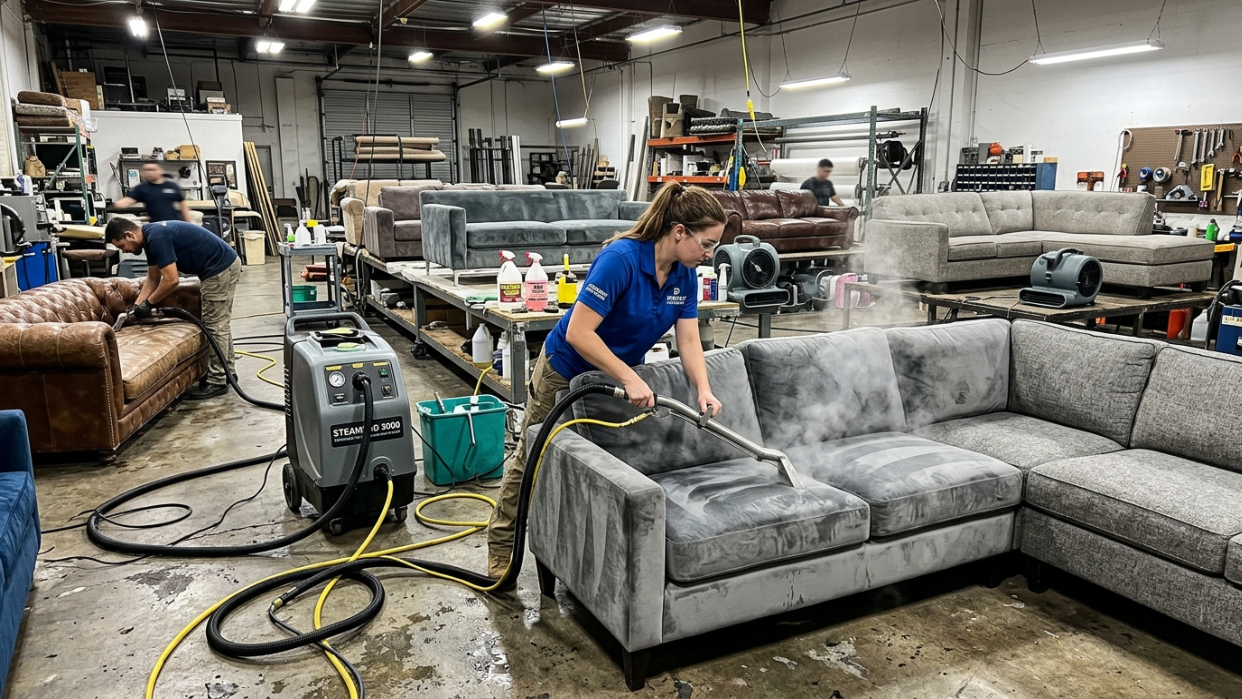
Commercial upholstery businesses need:
Continuous-duty operation
ASME-certified boilers
Dry vapor output
Long hose reach
Commercial-grade attachments
High-capacity water reservoirs
Downtime from refill cycles becomes expensive in production environments, making continuous-fill systems the preferred setup.
Best Setup for Auto Detailers
Automotive interior cleaning requires:
Lower moisture output
Precision nozzles
Fast drying capability
Compact maneuverability
Flexible hose systems
Vehicle interiors contain adhesives, electronics, and tight seams that respond best to controlled dry vapor steam.
Equipment Terms
These are the core components you will encounter during any upholstery steam cleaner setup. Understanding what each part does, and how it affects performance, prevents both equipment damage and fabric damage.
Boiler
The boiler is the heart of a steam cleaner. It heats water to the point of vaporization, creating pressurized steam that travels through hoses and nozzles. Commercial boilers are typically made of stainless steel because they must withstand extreme heat and pressure over thousands of hours of use.
The boiler’s capacity (measured in gallons or liters) determines how long you can work before refilling. For upholstery shops processing multiple pieces daily, boiler size is a direct productivity factor.
Single Boiler (Direct Fill)
A single boiler system uses one pressurized tank that you fill with water, seal, and heat. Once the water runs out, you must power down the unit, wait for it to depressurize and cool, then refill and reheat.
This creates real downtime. Some single boiler systems require up to 20 minutes of cooling and reheating for every 45 minutes of work. For hobbyists cleaning one couch, that’s manageable. For a shop doing five pieces a day, it’s a bottleneck.
Continuous Fill / Continuous Refill System
A continuous fill steamer separates the water supply from the pressurized boiler. Water goes into a non-pressurized reservoir, and a pump feeds it into the boiler in small increments. This means you can add water on the fly without shutting down or depressurizing.
Practitioners on auto detailing forums consistently highlight this distinction. As one professional on the Mike Phillips Forum put it: with an unpressurized option, you can add water on the fly, but with a pressurized version, you have to turn the unit off and let it cool before adding more water. For trade use, continuous fill is the clear winner.
For a deeper comparison, read about manual fill vs. auto fill steam boilers.
Flash Steamer
A flash steamer heats water almost instantly by passing it over a superheated element, producing steam on demand rather than storing pressurized water in a boiler. Flash steamers are portable, quiet, and typically do not require boiler permits, which makes them suitable for retail environments like malls.
The trade-off is lower sustained pressure compared to boiler systems. Flash steamers work well for light upholstery touch-ups and spot treatment, but they are not built for continuous heavy-duty upholstery cleaning. Learn more about the differences in this flash steamer vs. boiler comparison.
Pump-Fill System
Found on larger commercial and industrial boilers, a pump-fill system automates water delivery to the boiler using an electric pump. Unlike manual fill, where the operator pours water in by hand, pump-fill systems monitor water levels and refill automatically. This enables true continuous-duty operation for high-volume upholstery shops.
Heating Element (Internal vs. External)
The heating element converts electrical energy into heat inside the boiler. Internal elements sit submerged in the water, while external elements heat the boiler shell from outside. Internal elements are more common in commercial steam cleaners and transfer heat more efficiently, but they are also more susceptible to mineral buildup from hard water.
Pressure Gauge (PSI / Bar)
A pressure gauge displays the operating pressure inside the boiler. Machines show this in PSI (pounds per square inch), Bar (metric pressure unit), or both. During upholstery steam cleaner setup, the pressure gauge tells you whether the machine has reached operating temperature and whether it is functioning normally.
You cannot adjust the temperature directly on most steam cleaners. You control the pressure, and temperature follows. A working pressure gauge is not optional, it is your primary diagnostic tool.
Steam Wand / Nozzle
The steam wand or nozzle directs steam from the hose onto the work surface. For upholstery, specialized nozzle heads distribute steam evenly across fabric. The quality of the nozzle matters more than most buyers realize. One user on Detailing World reported that a cheap nozzle snapped within about 3 minutes, and they found it nearly impossible to keep a microfiber cloth over the end without burning their hand.
Upholstery Attachment / Upholstery Tool
This is a broader head designed specifically for flat fabric surfaces. It typically includes a cloth or pad holder to absorb loosened dirt while steaming. During setup, confirm the attachment locks securely to the wand and that you have replacement pads available.
Spray Gun / Electronic Spray Gun
Some commercial setups include a spray gun that delivers a focused stream of steam for targeted cleaning. Electronic spray guns offer variable control, letting you pulse steam in short bursts for precision work on stains or seams.
Foot Pedal Control
A foot pedal lets the operator control steam flow hands-free, which is essential when both hands are managing the nozzle position and the furniture piece. Foot pedal control is standard on most commercial upholstery steam cleaner setups and is worth confirming before purchase.
Steam Hose (Standard vs. Extended)
The hose connects the boiler to the nozzle. Standard hoses are typically 6 to 8 feet. Extended hoses (10 to 15 feet) give you more reach, which matters when the boiler is on a cart and the furniture piece is across the room. Longer hoses can cause slight pressure drop at the tip, so factor that into your PSI expectations.
Steam Type Terms
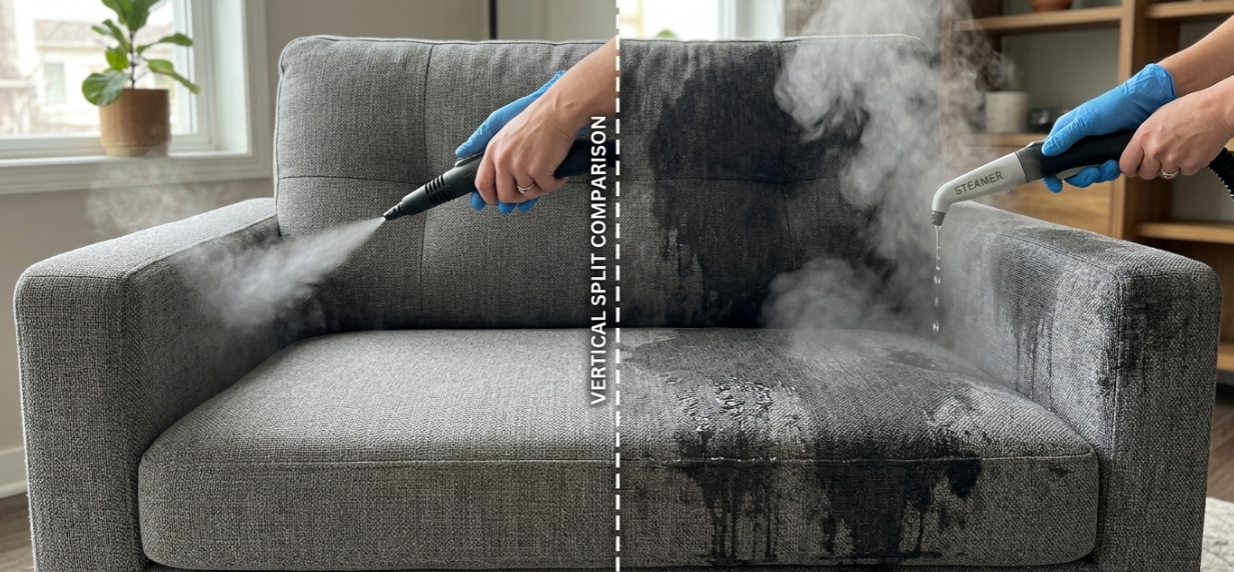
Not all steam is equal. The type of steam your machine produces determines whether it is safe for upholstery or whether it will soak the foam core and invite mildew.
Dry Vapor Steam
Dry vapor steam contains less than 5 to 10% water content, meaning 90 to 95% of what exits the nozzle is vapor rather than liquid. This is the only acceptable steam type for upholstery work. Dry vapor cleans and sanitizes without saturating fabric or the foam padding underneath.
Multiple industry sources confirm this. Dry steam is described as the hero for delicate surfaces and quick turnaround cleaning, especially anywhere dampness is a problem.
Wet Steam
Wet steam has a moisture content above 10%, meaning a significant fraction of the output is liquid water droplets. Using wet steam on upholstery is a recipe for over-saturation. Water soaks into foam cores, and if drying conditions are poor, mildew follows within 24 to 48 hours.
Steam Quality / Dryness Fraction
Steam quality is expressed as a percentage of dryness. Anything below 90% dryness is considered wet steam. For upholstery steam cleaner setup, look for machines that produce steam at 90 to 95% dryness. This specification is sometimes listed on the machine’s data plate or in the product manual.
Boiler Temperature vs. Nozzle-Tip Temperature
Most commercial-grade steamers reach temperatures above 300°F inside the boiler. But the steam cools as it travels through the hose and exits the nozzle. The tip temperature is always lower than the boiler temperature. This matters because when manufacturers advertise “300°F steam,” they mean at the boiler, not at the fabric surface. Understand this distinction to set realistic expectations during setup.
Upholstery Steam Cleaner Setup Mistakes to Avoid
Most upholstery steam cleaning problems happen during setup, not during cleaning itself.
Using Wet Steam Instead of Dry Vapor
Wet steam saturates cushions and foam padding, dramatically increasing mildew risk and drying time.
Ignoring Fabric Cleaning Codes
Steaming S-coded or X-coded fabrics can permanently damage upholstery through shrinkage, browning, or water staining.
Using Tap Water
Minerals inside tap water create scale buildup that reduces steam performance and shortens boiler lifespan.
Holding the Nozzle Too Close
Excessive proximity causes over-saturation and uneven cleaning patterns.
Skipping the Spot Test
Always test steam on a hidden section before cleaning visible surfaces.
Poor Ventilation During Drying
Without airflow, upholstery may stay damp for 8+ hours and develop odors or mildew.
Fabric and Material Terms
Fabric type is the single most important variable in any upholstery steam cleaner setup. Get this wrong and you will destroy the piece. Get it right and steam becomes one of the most effective, chemical-free cleaning methods available.
Upholstery Cleaning Codes: W, S, WS, X
Every piece of upholstered furniture should have a cleaning code tag, usually found under the cushions or on the frame. These codes dictate what cleaning methods are safe:
Code W (Water-based cleaner): Safe for steam cleaning. These fabrics tolerate water-based methods including steam. This is not the same as machine washable, but it means steam is compatible.
Code S (Solvent only): Never apply water or steam. S-coded fabrics must be cleaned with solvent-based, dry-cleaning products only. Using steam on S-coded upholstery can cause browning, water rings, and permanent shrinkage. This is the most expensive mistake in upholstery steam cleaning.
Code WS (Water or Solvent): Safe for steam. You can use either water-based or solvent-based methods, giving you flexibility.
Code X (Vacuum only): No steam, no water, no solvents. These fabrics can only be vacuumed or lightly brushed. Steam will damage them.
No glossary on the topic currently connects these codes to a clear steam decision matrix. Here it is: if the code is W or WS, proceed with steam. If it is S or X, stop. No exceptions.
For techniques on handling sensitive materials, see this guide to steaming delicate fabrics.
Colorfastness Test / Spot Test
Before steaming any upholstery, test a hidden area. Hold the nozzle about 6 inches from the fabric, release a small burst of steam, and wait for the area to dry completely. Check for discoloration, texture change, or water marks. Skip this step and you risk visible damage on the most prominent surface of the piece.
Over-Saturation
Over-saturation occurs when too much moisture penetrates the fabric and reaches the foam padding beneath. Upholstery foam absorbs water readily. Once saturated, it takes far longer to dry and becomes a breeding ground for mold and mildew. The primary defenses against over-saturation are using dry vapor steam, keeping the nozzle in constant motion, and maintaining proper working distance.
Drying Time
Most upholstered furniture takes 4 to 8 hours to dry after steam cleaning, depending on fabric thickness, cushion density, humidity, and air circulation. Proper ventilation cuts drying time roughly in half and prevents musty odors from developing. Position fans to create airflow across the cleaned surface, and avoid stacking cushions until fully dry.
Pressure and Performance Terms
PSI is the most misunderstood specification in upholstery steam cleaning. Knowing what the numbers mean, and what they don’t, prevents both fabric damage and wasted equipment purchases.
PSI (Pounds per Square Inch)
PSI measures the pressure of steam inside the boiler. Higher PSI means more force behind the steam. But here is the critical distinction that almost no competitor content explains: the PSI listed on a machine is boiler pressure. The actual pressure at the nozzle tip is always lower due to friction losses in the hose and fittings.
When a machine says 90 PSI, the steam hitting the fabric is significantly less forceful. This is actually a good thing for upholstery, where excessive pressure can damage fibers.
Bar (Metric Pressure Unit)
Bar is the metric equivalent of PSI. One bar equals approximately 14.5 PSI. European-made machines often display pressure in bar. If your gauge shows 6 bar, that is roughly 87 PSI.
PSI Ranges for Upholstery
This is where sources disagree, but the ranges cluster around two tiers:
Delicate upholstery (silk, velvet, linen): 20 to 45 PSI at the boiler. This provides gentle steam that cleans without stressing fibers.
Standard commercial upholstery (polyester, nylon, heavy cotton): 45 to 90 PSI at the boiler. This handles deep stain removal and sanitization on durable fabrics.
Most commercial-grade steamers operate at around 90 PSI with boiler temperatures above 300°F, which covers the full range of upholstery work. You regulate output by adjusting nozzle distance and dwell time rather than by changing boiler pressure.
For a detailed breakdown of pressure selection, read about PSI settings for commercial steamers.
Boiler Capacity (Gallons / Liters)
Boiler capacity determines how much steam you can produce before refilling. A 1-gallon boiler suits light-duty work. A 2-gallon boiler handles a full day in a small upholstery shop. Larger 6-gallon systems serve high-volume operations where continuous duty is required.
Heat-Up Time
Heat-up time is the period from powering on the machine to reaching full operating pressure. Most commercial steamers need 8 to 10 minutes. Flash steamers heat up faster, often under 2 minutes, but at lower sustained pressure. During upholstery steam cleaner setup, use the heat-up period to vacuum the piece and check fabric codes.
Continuous Duty
A continuous-duty steamer can run indefinitely without scheduled cooldown periods. This requires a continuous fill or pump-fill water system and robust heating elements. For upholstery shops handling multiple jobs per day, continuous duty eliminates the stop-start cycle that kills productivity.
Compare Hoffman’s steamer models by capacity
Recommended PSI by Upholstery Material
Upholstery Material | Recommended Boiler PSI | Risk Level |
|---|---|---|
Silk | 20–30 PSI | High |
Velvet | 20–40 PSI | High |
Linen | 25–45 PSI | Moderate |
Cotton | 40–60 PSI | Moderate |
Polyester | 45–90 PSI | Low |
Nylon | 45–90 PSI | Low |
Microfiber | 35–60 PSI | Moderate |
Leather (limited steam use) | Under 30 PSI | High |
Water Quality and Maintenance Terms
Water quality is a setup decision, not a maintenance afterthought. What you put in the boiler on day one determines how long the machine lasts and how well it performs.
Distilled Water
Distilled water is strongly recommended for all steam cleaners. Tap water contains calcium, magnesium, and other dissolved minerals that accumulate inside the boiler, internal lines, and heating elements. This buildup, called scale or limescale, reduces steam pressure, causes sputtering, and eventually kills heating elements and seals.
One practitioner on the Auto Geek Online forum shared their approach: running the steamer for half an hour with vinegar then draining, filling with distilled water and running for 15 minutes, and never using tap water. Their machine was four years old without any issues. That is not coincidence.
Mineral Buildup / Scale / Limescale
Scale is the white, chalky deposit that forms inside boilers when minerals in water are heated and precipitate out of solution. Even small amounts of scale act as insulation between the heating element and the water, forcing the element to work harder and shortening its life. In severe cases, scale can block internal lines entirely.
Descaling
Descaling is the process of removing mineral deposits from the boiler interior. Commercial descaling solutions dissolve calcium and magnesium buildup. For light use, descaling every one to two months is usually sufficient. For heavier use or hard water areas, monthly descaling is recommended. Some manufacturers include descaling solution in their consumables packages.
Softened Water (and Why to Avoid It)
This catches many people off guard. Water softeners use an ion exchange process that replaces calcium and magnesium with sodium. Sodium in a steam cleaner system can significantly shorten the lifespan of the boiler. If your shop has a water softener system, find a different water source for your steamer. Use distilled water instead.
Flush Cycle
A flush cycle runs clean water through the boiler and internal lines to clear out residual minerals and descaling solution. After every descaling session, run at least one full flush cycle with distilled water before resuming normal operation.
Consumables
Consumables are the parts and supplies that wear out or get used up during normal operation: gaskets, seals, microfiber pads, descaling solution, and replacement nozzle covers. A good upholstery steam cleaner setup accounts for consumable costs and replacement schedules from the start.
For a deeper look at ongoing maintenance, see this steam boiler maintenance guide.
Upholstery Steam Cleaner Maintenance Schedule
Maintenance Task | Recommended Frequency |
|---|---|
Flush boiler | Weekly |
Descale boiler | Monthly |
Replace microfiber pads | As worn |
Inspect hose seals | Monthly |
Test pressure gauge | Monthly |
Clean attachments | After every job |
Check relief valve | Quarterly |
Full professional inspection | Annually |
Safety and Certification Terms
Certification is not just a sticker on the nameplate. In commercial settings, it determines whether you can legally operate the equipment, whether your insurance covers you, and whether your clients trust your operation.
ASME (American Society of Mechanical Engineers)
ASME publishes the Boiler and Pressure Vessel Code (BPVC), the international standard for boiler design and construction. Compliance with this code is required by law in nearly every U.S. state. When a boiler is built according to these rules, it earns an official ASME stamp on its nameplate. There are over 6,800 ASME Certificate Holders globally, and not every steam cleaner manufacturer holds one.
For upholstery shops operating commercially, an ASME-certified boiler is often required for insurance coverage and local permitting. The full details are covered in this commercial steam boiler safety requirements guide.
UL (Underwriters Laboratories)
UL tests and certifies electrical products for safety. A UL listing on a steam cleaner means the electrical components (wiring, heating elements, controls) have been evaluated for fire and shock hazards. UL certification is separate from ASME certification. Both matter for commercial operations.
ASME Stamp / National Board Registration
The ASME stamp on a boiler’s nameplate confirms the vessel was designed, fabricated, and inspected according to BPVC standards. National Board registration means the boiler has been logged with the National Board of Boiler and Pressure Vessel Inspectors, creating a traceable compliance record. This is important during safety inspections and insurance audits.
Maximum Allowable Working Pressure (MAWP)
MAWP is the highest pressure at which a boiler is rated to operate safely under normal conditions. It is stamped on the data plate. Operating above MAWP is dangerous and illegal. During upholstery steam cleaner setup, confirm that the machine’s MAWP exceeds your intended working pressure by a comfortable margin.
Safety Relief Valve
The safety relief valve automatically releases steam if boiler pressure exceeds the MAWP. It is a mandatory safety component on all pressurized steam boilers. During setup, verify the relief valve is unobstructed and functioning. Never tamper with or disable it.
ETL / CE Certification
ETL is a North American safety certification from Intertek that is functionally equivalent to UL listing. CE marking indicates compliance with European safety standards. If you are purchasing imported equipment, check whether it carries ETL or UL marks for the U.S. market, not just CE.
Setup Process Terms
With the glossary of components, steam types, and certifications covered, here are the procedural terms that describe the actual steps of upholstery steam cleaner setup and operation.
Pre-Cleaning / Vacuuming
Always vacuum upholstery before steaming. Embedded dirt, crumbs, and pet hair will spread if you steam over them. Vacuuming first removes loose debris and allows steam to penetrate fabric fibers directly. Skipping this step is one of the most common mistakes in upholstery steam cleaning.
Spot Test / Patch Test
Test steam on a hidden area of the fabric before cleaning the visible surfaces. Apply a short burst, let it dry fully, and inspect for any discoloration, texture change, or water marking. This takes 5 minutes and can save thousands in damage claims.
Fill Procedure (Manual Fill vs. Auto-Fill)
Manual fill requires you to open the boiler cap, pour in water, and seal it before pressurizing. Auto-fill systems draw water from a separate reservoir through a pump. During setup, confirm which type your machine uses so you know whether you can refill during operation or need to shut down.
Heat-Up / Pressurization
After filling, power on the machine and wait for it to reach operating temperature and pressure. Watch the pressure gauge. Most commercial units reach working pressure in 8 to 10 minutes. Do not begin steaming until the gauge reads within the manufacturer’s specified range.
Working Distance (Nozzle-to-Surface)
Hold the nozzle approximately 6 inches (15 cm) from the upholstery surface. Too close and you risk over-saturating the fabric or creating water spots. Too far and steam dissipates before reaching the fibers, reducing cleaning effectiveness. A 45-degree angle is generally recommended for even steam distribution.
Overlapping Passes
Move the nozzle in slow, overlapping passes across the fabric surface. Each pass should overlap the previous one by about one-third. This ensures consistent coverage without missing strips. Never hold the nozzle in one spot; constant motion prevents water spots and soggy patches.
Post-Cleaning Blotting / Extraction
After steaming, blot the surface with clean microfiber towels to absorb loosened dirt and residual moisture. For heavier cleaning jobs, a low-moisture extraction tool can pull additional water from the fabric. This step accelerates drying and prevents soil from resettling into fibers.
Ventilation / Airflow for Drying
Position fans or open windows to create airflow across the cleaned upholstery. Good ventilation cuts drying time roughly in half. Without it, fabric can take 8 or more hours to dry and may develop musty odors. In commercial settings, many shops position box fans directly at the cleaned piece and use dehumidifiers during humid months.
Commercial vs. Hobbyist: Why It Matters for Upholstery Setup
The professional cleaning industry is valued at approximately $4.5 billion in the U.S., and upholstery cleaning is a growing segment within it. The equipment gap between hobbyist and commercial steamers is significant.
Hobbyist steamers typically offer lower PSI, smaller boiler capacity, single-boiler designs, and no ASME or UL certification. They work fine for occasional home use. But for an upholstery shop or detailing business that needs to clean multiple pieces daily, meet insurance requirements, and deliver consistent results, commercial equipment is the baseline.
A proper commercial upholstery steam cleaner setup includes ASME/UL certified boilers, continuous fill systems for uninterrupted work, dry vapor output to protect fabrics, commercial-grade attachments that do not break after three minutes of use, and transparent maintenance programs.
Explore Hoffman’s support and warranty options
Upholstery Steam Cleaner Setup Decision Matrix
Situation | Recommended Setup |
|---|---|
Delicate fabrics | 20–45 PSI + dry vapor |
Commercial upholstery | 45–90 PSI |
Mobile detailing | Compact continuous-fill unit |
High-volume shop | Pump-fill boiler system |
Sensitive interiors | Low moisture dry steam |
Fast turnaround jobs | High airflow + dry vapor |
Heavy daily use | ASME-certified continuous-duty steamer |
Occasional residential cleaning | Small continuous-fill machine |
Signs Your Upholstery Steam Cleaner Is Set Up Incorrectly
Common symptoms of poor setup include:
Excessive water dripping from the nozzle
Long drying times
Uneven steam output
Sputtering steam
Water spotting on fabric
Low pressure readings
Burnt or musty odors
Visible scale buildup
Weak stain removal performance
These symptoms usually indicate improper water quality, insufficient heat-up time, clogged lines, or incorrect steam quality.
Frequently Asked Questions
What PSI should I use to steam clean upholstery?
For delicate fabrics like silk or velvet, keep boiler pressure between 20 and 45 PSI. Standard commercial upholstery (polyester, nylon, heavy cotton) handles 45 to 90 PSI. Remember that boiler PSI is always higher than what reaches the fabric at the nozzle tip.
Can I use tap water in my upholstery steam cleaner?
Distilled water is strongly recommended. Tap water contains minerals that build up inside the boiler as scale, reducing pressure and shortening equipment life. Never use softened water either, as the sodium it contains can damage boiler components.
What is the difference between dry vapor steam and wet steam?
Dry vapor steam contains less than 5 to 10% moisture, making it safe for upholstery because it cleans without soaking foam padding. Wet steam (above 10% moisture) saturates fabric and can cause mildew. For upholstery work, dry vapor is the only appropriate option.
How do I know if my upholstery is safe to steam clean?
Check the cleaning code tag on the furniture. Code W and Code WS fabrics are safe for steam. Code S (solvent only) and Code X (vacuum only) must never be steamed. Always perform a spot test on a hidden area before cleaning visible surfaces.
What does ASME certification mean for a steam cleaner?
ASME certification means the boiler was built according to the Boiler and Pressure Vessel Code, which is required by law in most U.S. states for commercial operation. It ensures the pressure vessel meets strict safety standards for design, fabrication, and inspection.
How long does upholstery take to dry after steam cleaning?
Most upholstered furniture dries in 4 to 8 hours. Using proper ventilation (fans, open windows, dehumidifiers) can cut that time roughly in half. Avoid using the furniture until it is completely dry to prevent mildew and odor issues.
What is the difference between a single boiler and continuous fill steamer?
A single boiler must be depressurized, cooled, refilled, and reheated when the water runs out, creating up to 20 minutes of downtime. A continuous fill system uses a separate reservoir and pump to feed water into the boiler during operation, allowing uninterrupted cleaning.
How often should I descale my steam cleaner?
For light use with distilled water, every one to two months. For heavy commercial use or hard water areas, monthly descaling is recommended. Always run a flush cycle with distilled water after descaling to clear residual solution from the lines.
Can steam cleaning remove odors from upholstery?
Dry vapor steam can help remove odors caused by bacteria, light mildew, food residue, and pet contamination by sanitizing fabric surfaces without chemical cleaners.
Is steam cleaning safe for couches?
Steam cleaning is safe for couches labeled W or WS, provided dry vapor steam is used and the fabric passes a spot test.
How hot is upholstery steam cleaner steam?
Most commercial upholstery steamers generate internal boiler temperatures above 300°F, though nozzle-tip temperatures are significantly lower.
What happens if upholstery gets too wet?
Over-saturated upholstery may develop mildew, odors, water stains, adhesive failure, or foam deterioration.


