

TL;DR
Upholstery steam equipment maintenance is about keeping your commercial steamer or boiler running safely and efficiently, not about cleaning couches. Water quality is the single biggest factor in equipment longevity, with scale deposits as thin as 1/16 inch reducing heat transfer efficiency by 12%. This glossary covers 30+ terms every upholstery shop owner should know, from blowdown procedures and ASME certification to fabric cleaning codes and preventive maintenance schedules.
Commercial upholstery shops depend on consistent, reliable steam. When your equipment goes down, the work stops. Customer furniture sits unfinished. Revenue stalls.
Yet most online resources about upholstery steam equipment maintenance focus on the wrong audience. They teach homeowners how to clean their sofa cushions, or they address massive facility boilers that have nothing to do with a two-gallon shop steamer. The gap between those two worlds is where upholstery professionals actually operate.
This glossary exists to fill that gap. It defines the terms you’ll encounter when maintaining, inspecting, troubleshooting, and extending the life of your commercial steam equipment. Terms are grouped by category for quick scanning. If you’re still choosing equipment, our commercial upholstery steam cleaner guide covers the buying side.
Explore Hoffman’s upholstery shop bundle to see what’s included with the JEL3.
What Is Upholstery Steam Equipment Maintenance?
Commercial upholstery steam equipment maintenance is the process of keeping steam cleaners, boilers, hoses, heating elements, and safety systems operating safely and efficiently through regular inspection, descaling, water treatment, and preventive servicing.
The most important maintenance tasks include:
– Using distilled or softened water
– Performing regular boiler blowdown
– Descaling mineral buildup
– Testing safety valves and low water cutoffs
– Inspecting hoses and fittings for leaks
– Following a daily, weekly, monthly, and annual maintenance schedule
Proper maintenance reduces downtime, extends boiler lifespan, improves steam quality, lowers energy costs, and helps prevent safety failures caused by scale buildup or low-water conditions.
Water and Chemistry Terms
Water quality is the number one factor determining how long your steam equipment lasts and how well it performs. Every maintenance conversation starts here.
Blowdown
The process of periodically draining water from a steam boiler to remove accumulated dissolved solids and sludge. As a boiler converts water into steam, minerals and impurities stay behind in the remaining water, concentrating over time. Sludge collects at the bottom of the boiler, while the highest concentration of dissolved solids sits just below the water line. Skipping blowdown leads to scale, corrosion, and increased energy consumption. Commercial boilers typically need both bottom blowdown (to remove sludge) and skimmer blowdown (to control dissolved solid concentration).
Descaling / Deliming
The removal of mineral deposits (scale) from internal boiler surfaces, heating elements, and steam pathways. Many upholstery shop owners use white vinegar for routine descaling of smaller steamers, while larger boilers may require commercial descaling solutions. Practitioners on Auto Geek forums report running their steamer with vinegar for 30 minutes, draining it, then flushing with distilled water for 15 minutes before draining again. The key is regularity, not waiting until buildup is visible.
Dissolved Solids
Minerals, salts, and organic matter dissolved in water that remain behind when water turns to steam. The higher the dissolved solid content of your feed water, the faster scale and sludge accumulate inside your boiler. Municipal tap water varies enormously by region, which is why testing your water source matters.
Distilled Water
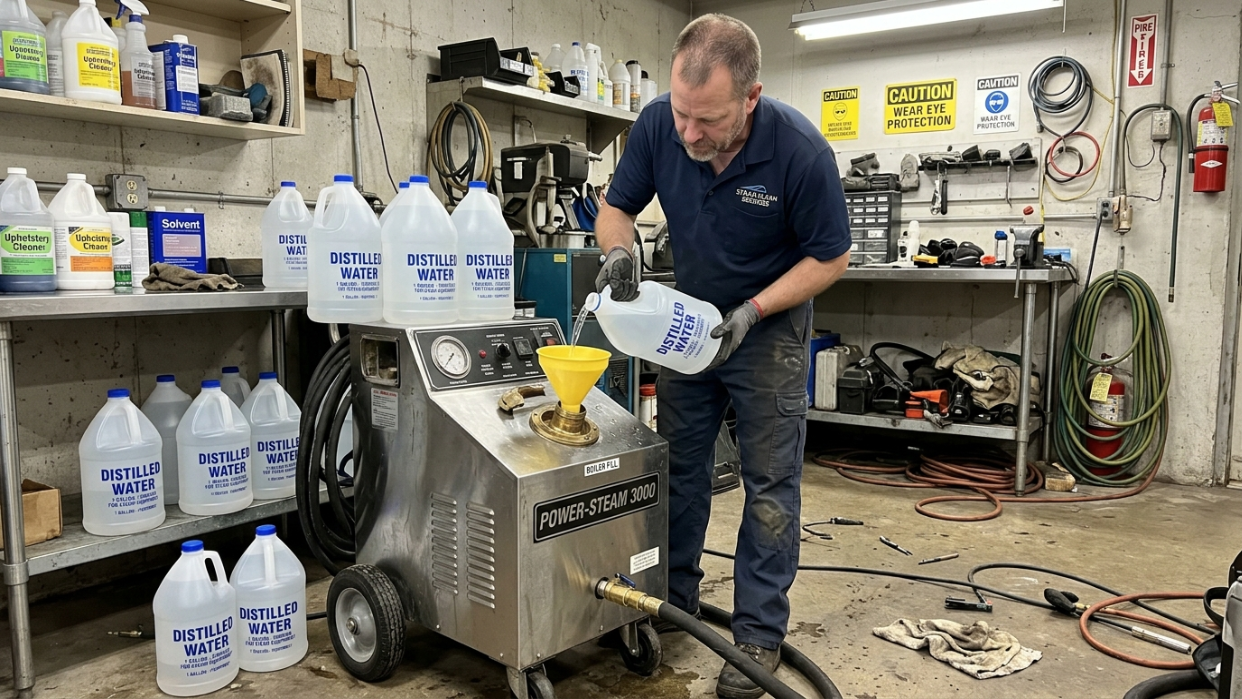
Water that has been boiled into vapor and condensed back into liquid, removing virtually all minerals and impurities. Many upholstery shop operators use distilled water exclusively in their steamers to prevent mineral buildup. One forum user on Auto Geek Online shared that they never use tap water and always drain their steamer after each session. Four years in, no issues. Another user who bought a used steamer noted visible mineral deposits inside the tank from a previous owner who apparently used tap water. The takeaway: distilled water is cheap insurance.
Hard Water
Water containing high concentrations of calcium and magnesium. Hard water is the primary cause of scale formation inside steam equipment. If your shop is in an area with hard water (most of the U.S. Midwest and Southwest), you either need to use distilled water, install a water softener, or commit to aggressive descaling schedules.
Scale Buildup
The hard, chalky mineral deposits that form on internal boiler surfaces when dissolved minerals in water are heated and precipitate out. Scale acts as an insulator. A deposit just 1/16 of an inch thick reduces heat transfer efficiency by up to 12%. Left unchecked, scale can block steam pathways entirely. Untreated water causing corrosion and scale is responsible for roughly 25% of all boiler tube failures.
Water Softener
An external pre-treatment device that removes calcium and magnesium from incoming water before it enters the boiler. For shops with very hard municipal water that cannot practically use distilled water for all steam operations, a water softener is the most cost-effective preventive measure.
Water Treatment Program
A systematic approach to managing the chemistry of boiler feed water, typically involving some combination of softening, chemical treatment, regular testing, and blowdown schedules. Large facilities hire water treatment consultants. For smaller upholstery shop boilers, a water treatment program might simply mean “distilled water only, monthly descaling, drain after every session.” The point is having a plan rather than reacting to problems.
Wet Steam
Steam that carries water droplets because the boiler has not fully vaporized the water. If you see water dripping from connections or the steam feels heavy and damp on fabric, the boiler is producing wet steam. This happens when the boiler is overfilled, firing too fast, or generating steam faster than it can separate water droplets. Wet steam is bad for upholstery work because it over-saturates fabric, and it is bad for efficiency because the burner has to run longer to achieve the same cleaning result.
Water Types and Their Impact on Steam Equipment
Water Type | Mineral Content | Scale Risk | Maintenance Frequency | Best Use Case |
|---|---|---|---|---|
Distilled Water | Very low | Minimal | Lowest | Best overall for commercial steamers |
Softened Water | Moderate-low | Reduced | Moderate | High-volume shops |
Filtered Tap Water | Moderate | Medium | Moderate-high | Temporary solution |
Hard Tap Water | High | Severe | Very high | Not recommended |
Using distilled water consistently is one of the easiest ways to extend the life of commercial upholstery steam equipment and reduce descaling frequency.
Common Causes of Upholstery Steamer Failure
Most commercial upholstery steam equipment failures are preventable. The most common causes include:
Scale Buildup From Hard Water
Mineral deposits reduce heat transfer, clog steam pathways, and overwork heating elements.
Running the Boiler Low on Water
Low-water conditions can damage heating elements and create dangerous overheating situations.
Ignoring Preventive Maintenance
Skipping inspections, blowdown procedures, and descaling increases long-term repair costs.
Steam Hose Deterioration
Steam hoses weaken over time due to heat cycling and pressure stress. Small leaks often become major failures.
Overworking Undersized Equipment
Using a low-capacity steamer for high-volume upholstery production causes excessive wear and inconsistent steam quality.
Equipment Components
Understanding the parts of your steamer or boiler makes upholstery steam equipment maintenance far less intimidating. When something fails, knowing what to call it (and what it does) speeds up troubleshooting and parts ordering.
Heating Element
The component that converts electrical energy into heat to boil water. Commercial steamers use either internal immersion elements (submerged directly in water) or external elements (heating the vessel from outside). Electric steamers in the upholstery trade typically range from 1.5kW on smaller units to 3kW or more on higher-capacity boilers. Heating elements are consumable parts that degrade over time, especially in hard water environments. For a deeper look at power options, see our commercial steamer specs guide.
Low Water Cutoff (LWCO)
A safety device that automatically shuts off the heating element or fuel supply when water drops below a safe minimum level. Running a boiler without enough water can cause catastrophic overheating and vessel failure. The National Board of Boiler and Pressure Vessel Inspectors has found that defective low water cutoffs are among the leading culprits behind boiler incidents. Weekly testing of the LWCO is non-negotiable. One boiler room inspector noted finding facilities where the cutoff had not been tested in six months simply because it was not on a formal schedule.
Pressure Gauge
An instrument displaying the current steam pressure inside the boiler, measured in PSI. For upholstery applications, normal operating pressure typically falls between 40 and 90 PSI. Lower pressures (40 to 45 PSI) suit delicate fabrics, while higher pressures handle heavier commercial furniture. Regularly verify your gauge against a known-accurate reference gauge. A faulty pressure gauge can mask dangerous overpressure conditions.
PSI (Pounds per Square Inch)
The standard unit of measurement for steam pressure. In upholstery steam work, PSI determines how much force the steam delivers to the fabric and how effectively it penetrates fibers for cleaning and sanitization. Most commercial steam cleaners operate at 75 to 100+ PSI for general use. For upholstery specifically, 45 to 90 PSI suits delicate fabrics, while 150 to 250 PSI handles heavy-duty commercial furniture for deep stain removal. Choosing the right PSI for the fabric at hand is itself a maintenance consideration, because running excessive pressure wastes energy and accelerates wear on hoses and nozzles.
Safety Relief Valve / Pressure Relief Valve
A spring-loaded valve designed to open automatically when internal pressure exceeds a preset threshold. This is the last line of defense against overpressure. Relief valves should be tested on a regular schedule (typically monthly for commercial equipment) and replaced if they show signs of corrosion, mineral deposits, or failure to reseat properly after opening. Never block, plug, or remove a safety relief valve.
Sight Glass
A transparent tube or window mounted on the boiler that shows the current water level inside. Operators should check the sight glass before every use to confirm adequate water level. Over time, mineral deposits can cloud the glass, making it unreliable. Clean or replace the sight glass whenever visibility decreases. A sight glass that reads full when the boiler is actually low can lead to a low-water condition, the very scenario the LWCO is designed to prevent.
Steam Nozzle / Wand
The handheld attachment at the end of the steam hose that directs steam onto the work surface. Nozzles can become partially blocked by mineral deposits, reducing steam flow and creating uneven output. Periodic soaking in a descaling solution and clearing the orifice with a fine needle keeps flow consistent. For upholstery, a controlled, focused nozzle prevents over-saturation.
Steam Hose
The flexible line carrying pressurized steam from the boiler to the nozzle or wand. Hoses endure heat, pressure, and physical flexing with every use. Inspect hoses routinely for cracks, soft spots, bulges, or leaks at connection fittings. Most manufacturers recommend replacement at the first sign of degradation rather than waiting for failure, because a burst steam hose in an occupied shop is a serious safety hazard.
Safety and Compliance Terms
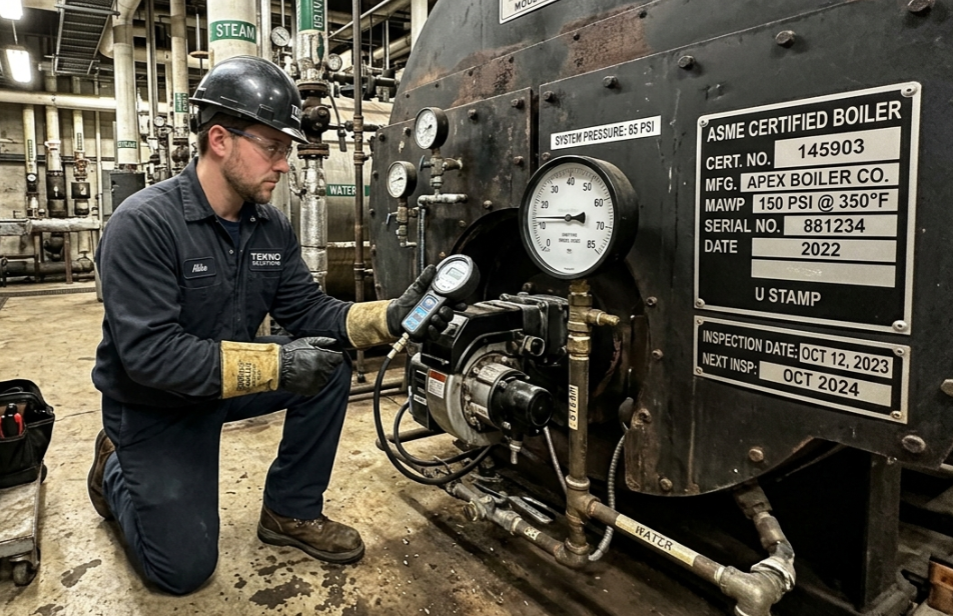
Upholstery steam equipment maintenance is not just about performance. It’s about operating legally and safely. These terms come up during inspections, insurance reviews, and permit applications.
ASME Certification
Certification from the American Society of Mechanical Engineers confirming that a pressure vessel was designed, fabricated, and inspected according to the Boiler and Pressure Vessel Code (BPVC). ASME-stamped equipment carries an “S” (Power) or “H” (Heating) stamp. For upholstery shops, ASME certification matters because many jurisdictions require it for any pressurized boiler. ASME and the National Board record hundreds of pressure vessel incidents annually, with improper maintenance as the root cause in over 60% of cases. Our commercial steam boiler safety guide covers the full compliance picture.
See Hoffman’s ASME/UL certified ELG4 boiler for entry-level compliant equipment.
Certificate of Inspection
A legal document issued after a qualified inspector examines a boiler and confirms it meets safety standards. In most U.S. states, boilers cannot be operated without a valid Certificate of Inspection. Inspection frequency is typically annual or biennial depending on equipment type and jurisdiction. Maintaining consistent logs of water levels, pressure, and temperature helps demonstrate “safe operation” to inspectors.
Lockout/Tagout (LOTO)
A safety procedure requiring that equipment be de-energized, cooled, drained, and physically locked out before any maintenance work begins. LOTO prevents accidental startup while someone is working inside or on the boiler. Before an internal inspection, the unit must be cooled, drained, and locked out with tags indicating that it is not to be operated. This is an OSHA requirement, not a suggestion.
National Board (NB) Registration
Registration with the National Board of Boiler and Pressure Vessel Inspectors, which tracks the manufacturing, installation, and inspection history of pressure vessels throughout their service life. An NB registration number on your boiler’s data plate confirms it was manufactured and inspected under a recognized quality program. This number is what inspectors look for alongside the ASME stamp.
UL Listing
Certification from Underwriters Laboratories that the electrical components of a product meet safety standards. For electric steam boilers, UL listing covers the heating elements, wiring, controls, and overall electrical design. Some insurance carriers and local codes require UL-listed equipment.
Maintenance Practices and Programs
Knowing the terms is half the battle. The other half is building a system around them. This section covers the practices and programs that keep upholstery steam equipment maintenance on track.
Consumables
Parts that wear out through normal use and require periodic replacement. For commercial steamers, common consumables include gaskets, seals, heating elements, sight glass tubes, and hose fittings. Tracking consumable replacement dates in a simple log prevents unexpected failures. Some service programs ship consumables automatically so you never run out.
Daily / Weekly / Monthly / Annual Maintenance Intervals
Commercial steam equipment requires attention at four levels. Daily checks include verifying water level via the sight glass, checking for leaks, and draining the boiler after the last use. Weekly tasks include testing the low water cutoff and inspecting the safety relief valve. Monthly maintenance covers descaling (depending on water quality), hose inspection, and cleaning the steam nozzle. Annual maintenance should include a comprehensive inspection of all components, replacement of worn consumables, and (where required) a professional boiler inspection for certification renewal.
Factory Reconditioning
A process where the manufacturer disassembles, inspects, cleans, repairs, and reassembles a piece of equipment to restore it to original operating specifications. Factory reconditioning goes well beyond basic cleaning. It typically includes replacing all worn consumables, testing every safety device, and recertifying the unit. Hoffman Steam offers factory reconditioning as part of its Workhorse Essential protection plan, including a 47-point inspection and ASME/UL recertification.
47-Point Inspection
A comprehensive reconditioning scope that systematically checks every critical component of a commercial steamer or boiler. This includes testing safety valves, verifying pressure gauge accuracy, inspecting heating elements, examining internal vessel surfaces for corrosion or scale, checking all electrical connections, and more. A 47-point inspection is the kind of thorough evaluation that catches problems before they cause downtime.
Browse refurbished Hoffman steamers that include protection plan coverage.
Preventive Maintenance Schedule
A written plan specifying what maintenance tasks need to happen and when. For a small upholstery shop, this does not need to be complicated. A single-page checklist posted near the steamer, covering daily, weekly, monthly, and annual tasks, is enough. The critical point is consistency. Shops that follow a preventive schedule avoid the vast majority of emergency breakdowns.
Protection Plan / Service Agreement
A contract with the equipment manufacturer or a third party that covers ongoing maintenance, parts, and sometimes loaner equipment. Hoffman Steam’s Workhorse plans, for example, include automatic consumable shipments, compliance documentation, discounted parts, and (on the Essential tier) factory reconditioning every 24 months with a hot-swap loaner machine so your shop never goes without steam.
Hot-Swap Loaner
A replacement machine shipped to your shop while your primary unit is away for reconditioning or repair. The “hot-swap” concept means you receive the loaner before (or at the same time as) shipping your machine out, minimizing downtime to near zero. This is a critical service for upholstery shops that cannot afford to pause production.
Total Cost of Ownership
The full expense of operating a piece of equipment over its lifetime, including purchase price, consumables, maintenance, downtime, repairs, and eventual replacement. A cheaper steamer that breaks down frequently or requires expensive proprietary parts can cost more over five years than a higher-quality unit with strong support. When budgeting, factor in consumables, water treatment, and service plans alongside the sticker price. One Reddit user in r/jewelers reported using two Hoffman steamers over 30 years, with the first lasting 24 years, a testament to how build quality and proper maintenance affect total cost.
Upholstery-Specific Terms
These terms sit at the intersection of steam equipment and the upholstery trade. Understanding them protects both your equipment and your customers’ furniture.
Dry Vapor Steam
Steam with very low moisture content (typically 5% or less liquid water). Dry vapor steam cleaners are ideal for upholstery work because they deliver high heat for sanitization and cleaning without saturating fabric. This matters enormously for delicate textiles, leather, and any surface where excess moisture causes damage, warping, or mildew. If your equipment is producing wet, dripping steam rather than dry vapor, that is a maintenance issue (often caused by scale buildup or overfilling). More detail on handling sensitive textiles is available in our guide to steaming delicate fabrics.
Fabric Cleaning Codes (W, S, WS, X)
A standardized labeling system that tells you what cleaning methods are safe for a particular fabric. W means water-based cleaners are safe, and steam is generally appropriate. S means solvent-only cleaning, and you should never apply water or steam to S-coded fabric. WS means either water-based or solvent cleaners work. X means vacuum only, with no water, no solvent, and no steam allowed. For upholstery professionals, checking the fabric code before applying steam is a form of equipment “maintenance” in the broadest sense, because steaming the wrong fabric leads to damaged customer furniture, costly callbacks, and wasted resources.
Flash Steamer
A non-pressurized steam generator that heats water to produce steam at atmospheric pressure, with no internal vessel pressure. Flash steamers do not require boiler permits in most jurisdictions, making them suitable for retail environments, malls, and small shops where permitting would be impractical. The tradeoff is lower pressure output compared to pressurized boilers. For light upholstery touch-ups and refresh work, a portable flash steamer is often sufficient. For deeper cleaning on heavy commercial furniture, a pressurized boiler is the better tool.
Pressurized Boiler
A sealed vessel that heats water under pressure to generate high-PSI steam. Pressurized boilers deliver stronger, more consistent steam output than flash steamers and are the standard for professional upholstery cleaning. Because they operate under pressure, they may require ASME certification, boiler permits, and regular inspections depending on your state and local codes. Understanding whether your jurisdiction requires permits is essential before purchasing. Our flash steamer vs. boiler comparison breaks down the differences in detail.
Continuous-Fill vs. Manual-Fill Systems
Manual-fill boilers require you to stop, depressurize, and add water when the tank runs low. Continuous-fill (pump-feed) boilers have an automatic water supply that replenishes the tank during operation, allowing uninterrupted steam production. For high-volume upholstery shops processing multiple pieces per day, a continuous-fill system avoids repeated cooldown and refill cycles that eat into production time. The maintenance implications differ too: continuous-fill systems require periodic pump maintenance and check valve inspection, while manual-fill systems demand closer attention to water level monitoring.
Over-Saturation
Applying too much moisture to fabric during steam cleaning, resulting in soaking, extended drying times, potential mildew, and fabric damage. Over-saturation is the number one risk when steaming upholstery. It happens when operators use excessive pressure for the fabric type, hold the nozzle too close for too long, or when the equipment is producing wet steam due to a maintenance issue. Proper equipment calibration, correct PSI settings for the fabric code, and dry vapor output all prevent over-saturation. This is where upholstery steam equipment maintenance and technique overlap directly.
Boiler Permit Requirements
Regulations governing the installation and operation of pressurized steam boilers, varying by state and municipality. Some jurisdictions exempt boilers below certain thresholds (often based on PSI, BTU input, or water volume). Non-pressurized flash steamers are generally exempt. Before installing a pressurized boiler in your upholstery shop, confirm local requirements with your building inspector or state boiler board. Operating without the required permits can result in fines, insurance claim denials, and forced shutdown.
Building Your Upholstery Steam Equipment Maintenance Routine
A glossary is a reference. A routine is what keeps your equipment running. Here is a condensed framework:
Daily: Check the sight glass water level. Inspect hoses and connections for visible leaks. Drain the boiler after the last use of the day (especially if using tap water). Wipe down the nozzle.
Weekly: Test the low water cutoff. Test the safety relief valve by lifting the lever briefly. Inspect the steam hose for soft spots, cracks, or bulging.
Monthly: Descale the boiler (frequency depends on water hardness and usage). Clean or replace the sight glass if clouded. Check electrical connections and cords for damage.
Annually: Schedule a comprehensive inspection (professional if required by your jurisdiction). Replace worn consumables including gaskets, seals, and heating elements as needed. Review your water treatment approach. Update your maintenance log.
Consistent record-keeping is the thread that ties everything together. Inspectors view a well-maintained log as proof of safe operation. And if you ever need to file a warranty or insurance claim, that log is your evidence.
Recommended Upholstery Steam Equipment Maintenance Schedule
Interval | Maintenance Tasks |
|---|---|
Daily | Check water level, inspect hoses, drain boiler, wipe nozzle |
Weekly | Test LWCO, inspect relief valve, check hose condition |
Monthly | Descale boiler, inspect electrical components, clean sight glass |
Quarterly | Inspect fittings, evaluate steam pressure consistency |
Annually | Full inspection, replace worn consumables, verify certifications |
Flash Steamer vs. Pressurized Boiler for Upholstery Shops
Feature | Flash Steamer | Pressurized Boiler |
|---|---|---|
Steam Pressure | Lower | Higher |
Permit Requirements | Usually none | Often required |
Continuous Operation | Limited | Better for high volume |
Best For | Retail touch-ups | Deep commercial cleaning |
Maintenance Complexity | Lower | Higher |
Steam Consistency | Moderate | Excellent |
For upholstery shops handling daily commercial workloads, pressurized boilers generally provide better long-term productivity and more consistent dry vapor output.
Key Takeaways
Water quality is the biggest factor in steam equipment lifespan
Scale buildup reduces efficiency and increases repair risk
Preventive maintenance is cheaper than emergency repairs
Dry vapor steam is ideal for upholstery applications
Distilled water dramatically reduces maintenance needs
Safety devices like LWCOs and relief valves must be tested regularly
Commercial shops benefit from written maintenance schedules and inspection logs
Frequently Asked Questions
How often should I descale my upholstery steamer?
It depends on your water quality and usage volume. Shops using distilled water exclusively may only need to descale every two to three months. Shops using tap water in hard water areas should descale monthly or even more frequently. The moment you notice reduced steam output or visible mineral deposits, descale immediately.
Can I use tap water in my commercial steamer?
You can, but you probably should not. Tap water contains dissolved minerals that cause scale buildup, reducing efficiency and shortening equipment life. Many experienced operators use distilled water exclusively and report years of trouble-free operation. If distilled water is impractical for your volume, install a water softener and increase your descaling frequency.
What is the difference between a flash steamer and a pressurized boiler for upholstery work?
A flash steamer operates at atmospheric pressure (no vessel pressure), produces steam on demand, and typically does not require a boiler permit. A pressurized boiler generates higher-PSI steam for deeper cleaning and sustained output, but may require ASME certification and state permits. Light upholstery refresh work can be handled by a flash steamer. Heavy cleaning on commercial furniture generally requires a pressurized boiler.
Why does my steamer produce wet, dripping steam?
Wet steam usually indicates the boiler is overfilled, that scale is interfering with heat transfer, or that the unit is being pushed beyond its capacity. Check your water level, descale the boiler, and verify that you are operating within the manufacturer’s specifications. Wet steam is less effective and can damage upholstery fabric through over-saturation.
Do I need a boiler permit for my upholstery shop steamer?
It depends on your state and local regulations, as well as the type of equipment. Non-pressurized flash steamers are generally exempt. Pressurized boilers above certain PSI or volume thresholds typically require permits and annual or biennial inspections. Check with your local boiler board before purchasing or installing pressurized equipment.
What does ASME certification mean for my steam equipment?
ASME certification means the pressure vessel was designed, built, and inspected according to the Boiler and Pressure Vessel Code. It is a widely recognized safety standard and is legally required for commercial boilers in most U.S. jurisdictions. Equipment bearing an ASME stamp and National Board registration number has been independently verified for safe operation.
How long should a commercial upholstery steamer last?
With proper upholstery steam equipment maintenance, a well-built commercial steamer can last decades. Build quality, water treatment practices, and adherence to a preventive maintenance schedule are the biggest factors. Some Hoffman users have reported 20 to 30 years of service life from a single unit.
What PSI is best for upholstery steam cleaning?
Most upholstery applications work best between 40 and 90 PSI, depending on the fabric type and moisture sensitivity.
Can scale buildup damage a steam boiler permanently?
Yes. Severe scale buildup can overheat heating elements, reduce efficiency, block steam flow, and eventually damage the boiler vessel itself.
How do I know if my steam hose needs replacement?
Replace steam hoses immediately if you notice cracking, bulging, soft spots, leaking fittings, or reduced steam delivery.
Is distilled water worth the cost for commercial steamers?
In most cases, yes. Distilled water significantly reduces scale buildup and lowers long-term maintenance costs.
Maintaining your steam equipment is not glamorous work, but it is the work that keeps your upholstery shop productive. Every term in this glossary connects to a real decision you will make, whether it is choosing distilled water, testing your LWCO, or scheduling your next descaling session. The shops that treat maintenance as routine rather than reactive are the ones that avoid costly downtime.
Have questions about maintaining your Hoffman steamer, or ready to explore equipment options? Contact Hoffman’s team directly for lifetime technical support.


